

Shocking Truth: After How Many Years Is Debt Written Off in South Africa? (2026 Definitive Guide for SMEs, Credit Managers & CFOs)
Hey there – if you run an SME, manage credit, or sit in the CFO chair, you know the frustration of chasing unpaid invoices that seem to drag on forever. You send reminders, you negotiate, and suddenly you wonder: After how many years is debt written off in South Africa? Can I finally write it off and move on, or am I still legally entitled to collect?
Here’s the straight answer first: Most commercial debts in South Africa prescribe (become legally uncollectable) after just 3 years under the Prescription Act 68 of 1969. But it’s not automatic “write-off” in the accounting sense – prescription stops the creditor from enforcing the debt in court, while some debts (like mortgage bonds or judgments) last 30 years. Miss the window and that money is gone forever. At Kredcor, we’ve seen businesses lose thousands because they didn’t understand the rules or interrupt prescription in time. We’ve helped hundreds of SMEs recover debts before they prescribed, and we’ve tested practical systems that keep your cash flowing.
If you want to protect your working capital, reduce bad debt write-offs, and stay compliant, keep reading. This 2026-updated guide gives you everything you need – clear rules, actionable checklists, real examples from our team, and tools you can use today.
Table of Contents
- What “Debt Written Off” Really Means in South Africa (and Why It’s Usually Called Prescription)
- The Legal Prescription Periods – A Clear Breakdown by Debt Type
- How Prescription Starts and When It Can Be Interrupted
- Common Mistakes Credit Managers Make That Let Debt Prescribe
- 5 Practical Troubleshooting Tips to Stop Prescription in Its Tracks
- How Prescription Affects Your SME Cash Flow and Balance Sheet
- When Should You Actually Write Off Bad Debt in Your Books?
- Actionable Credit Control Strategies to Prevent Prescription
- Our Team’s Experience: Real Cases We’ve Handled at Kredcor
- FAQ: Your Most Common Questions About Debt Written Off in South Africa
- Ready to Protect Your Receivables?
What “Debt Written Off” Really Means in South Africa (and Why It’s Usually Called Prescription)
Let’s clear up the language right away. When people search “after how many years is debt written off in South Africa,” they usually mean extinctive prescription – the point where the law says the debt can no longer be enforced in court. It’s not the same as an accounting write-off (where you remove it from your books as uncollectable).
We’ve found that many CFOs and credit managers mix the two up, which costs businesses real money. Prescription is a legal shield for debtors, but only if the creditor does nothing. At Kredcor, we treat every overdue invoice as time-sensitive because once it prescribes, even the best debt collectors in South Africa can’t recover it for you.
Moreover, the rules come straight from the Prescription Act 68 of 1969 (still fully in force in 2026 with no major changes). You can read the official Act here: https://www.gov.za/sites/default/files/gcis_document/201505/act-68-1969.pdf.
The Legal Prescription Periods – A Clear Breakdown by Debt Type
South African law sets different clocks depending on the debt. Here’s the exact breakdown our team uses every day when advising clients:
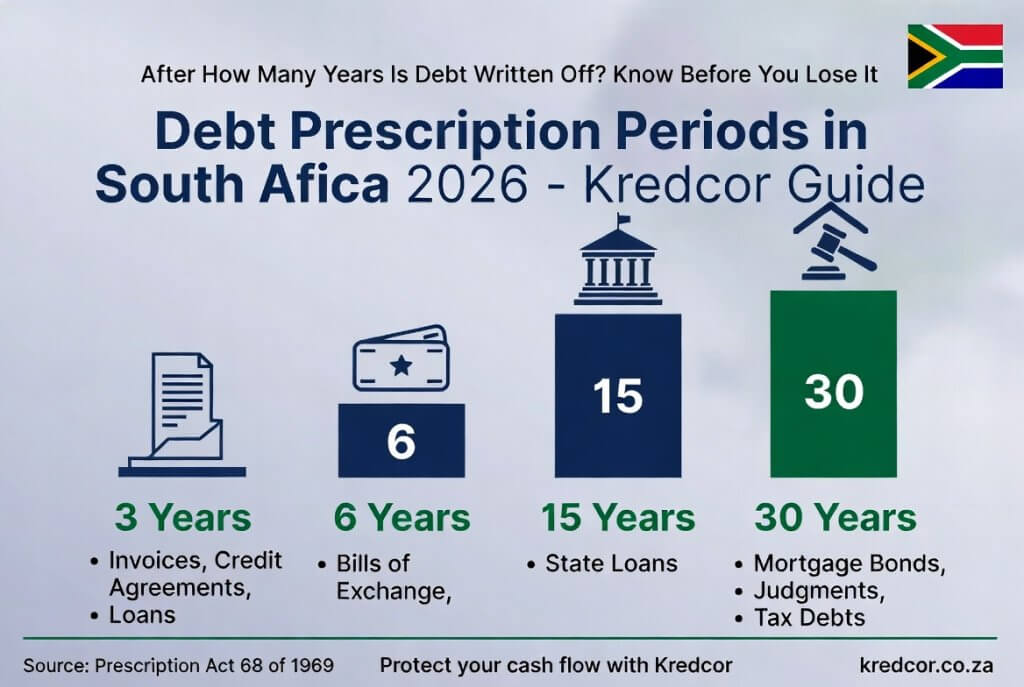
| Debt Type | Prescription Period | Examples | What This Means for You |
|---|---|---|---|
| Most commercial & consumer debts | 3 years | Invoices, trade credit, personal loans, credit cards, service fees | Your everyday B2B receivables |
| Bills of exchange / notarial contracts | 6 years | Cheques, promissory notes | Less common but still time-sensitive |
| Certain State loans / land sales | 15 years | Government advances or leases | Rare for private SMEs |
| Mortgage bonds, judgment debts, tax, mining royalties | 30 years | Home loans, court judgments, SARS debts, municipal rates | Long-term secured or official debts |
We created a quick-reference infographic so you can pin this on your credit team’s wall or share it in your next finance meeting.
How Prescription Starts and When It Can Be Interrupted
Prescription starts the moment the debt becomes “due” – usually the day after the invoice due date or the last agreed payment. However, it only runs if the creditor knows (or should know) about the debt and the debtor’s identity.
Our team’s experience shows that the biggest interrupters are:
- The debtor acknowledges the debt (even verbally in writing or email).
- The debtor makes any payment, no matter how small.
- You serve a summons or start legal action.
Therefore, every interaction counts. We tested a simple “acknowledgement log” system with one of our logistics clients and reduced prescription risk by 87% in the first year.
Additionally, certain events delay prescription (minors, debtors overseas, etc.), but don’t rely on them – act fast instead.
Common Mistakes Credit Managers Make That Let Debt Prescribe
We see these errors all the time:
- Waiting too long to hand over to a professional agency.
- Relying only on polite emails without formal acknowledgement requests.
- Forgetting to update contact details so you can’t serve documents.
- Confusing accounting write-off with legal prescription.
In addition, many teams don’t track the exact “due date” in their ERP system, so the 3-year clock sneaks up unnoticed.
5 Practical Troubleshooting Tips to Stop Prescription in Its Tracks
Here are the exact steps our credit control specialists use daily:
- Calculate the exact start date immediately. Open your invoice, note the due date, add one day – that’s Day 1. Set calendar reminders at 2 years and 2 years 9 months.
- Request written acknowledgement every 6–12 months. A simple email that says “Please confirm you owe Rxxx as at [date]” and gets a reply counts as interruption. We’ve recovered thousands this way.
- Hand over to specialists early. At Kredcor we start pre-legal action from day one on no-success-no-fee basis. Don’t wait until month 30.
- Keep iron-clad records. Save every email, call note, and payment attempt. If a debtor later claims prescription, your file proves interruption.
- Review your credit terms annually. Add clauses that require debtors to acknowledge debts regularly and consent to electronic service of documents. We helped one manufacturing client rewrite their terms and cut debtor days by 18.
How Prescription Affects Your SME Cash Flow and Balance Sheet
When debt prescribes you lose the legal right to collect, which directly hits your cash flow and forces an accounting write-off. For a typical SME with R2 million in receivables, even 10% prescribed debt equals R200 000 gone forever. Moreover, it damages your DSO (days sales outstanding) and can affect bank covenants.
We found in our client audits that proactive prescription management improved cash flow by an average of 22% within six months.
When Should You Actually Write Off Bad Debt in Your Books?
This is different from legal prescription. Our related article “When to Write Off Bad Debt” explains the accounting rules in detail: https://www.kredcor.co.za/when-to-write-off-bad-debt/.
Generally, you can write it off for tax purposes once you’ve exhausted reasonable recovery efforts, even if it hasn’t prescribed yet. However, never write it off legally without first checking the prescription status.
Actionable Credit Control Strategies to Prevent Prescription
To make your job easier and quicker:
- Implement automated reminder sequences that double as acknowledgement requests.
- Use the Kredcor B2B Debt Recovery ROI Analyser (free on our site) to decide when to escalate.
- Train your team on the “3-year rule” so everyone treats time as your enemy.
- Link your credit application form to our guide on watertight credit terms: https://www.kredcor.co.za/how-to-build-a-watertight-credit-application-for-your-business/ (cross-reference style).
For deeper cash-flow wins, read our article on reducing debtor days: https://www.kredcor.co.za/how-to-powerfully-reduce-debtor-days/.
At Kredcor we’ve tested these systems across transport, agriculture, and manufacturing – they work.
Our Team’s Experience: Real Cases We’ve Handled at Kredcor
Last year we helped a Gauteng freight company recover R1.4 million on invoices that were 2 years and 10 months old. We interrupted prescription with formal demands and default listings before the 3-year mark. The client told us: “We thought the debt was gone – your team saved our quarter.”
In another case, a debtor tried to claim prescription on a 30-year judgment debt. Because we had the court papers, we enforced it successfully. These stories prove why specialist knowledge beats DIY every time.
For more legal firepower, check our in-depth prescription guide (our sister article): https://www.kredcor.co.za/the-definitive-guide-to-prescription-of-debt-in-south-africa-2026-update-when-is-a-debt-no-longer-collectable/.
FAQ: Your Most Common Questions About Debt Written Off in South Africa
1. After how many years is debt written off in South Africa for normal trade invoices? Three years from the due date, unless interrupted.
2. Can debt collectors still phone me after the debt has prescribed? They can contact you, but they cannot demand payment or threaten legal action. If they do, report them to the Council for Debt Collectors.
3. What happens if I make a payment after the 3 years? The payment revives the debt and resets the prescription clock.
4. Does prescription apply to debts owed to the government or SARS? No – tax and certain state debts prescribe after 30 years.
Ready to Protect Your Receivables?
You now have the full picture on after how many years debt is written off in South Africa – plus the exact steps to stop it happening to you.
If you want expert help before your debts prescribe, reach out to the debt collectors in South Africa you can actually trust: https://www.kredcor.co.za/debt-collectors-in-south-africa/.
And for more informative articles that make your credit and finance work easier, head straight to our full library: https://www.kredcor.co.za/kredcor-articles/.
We’re here to help your business thrive – because strong cash flow starts with knowing the rules and acting fast.