

Setting Up an Effective Accounts Receivable Process for Your SA Business (The Ultimate 10‑Step Guide)
If you’re here because slow‑paying clients are choking your cash flow, your team is chasing invoices all day, or you’re constantly unsure who owes you what, this article is exactly what you need. In South African SMEs, accounts receivable (AR) is not just an admin task—it’s the heartbeat of your working capital.
An effective accounts receivable process helps you get paid faster, reduces disputes, and lets you use your time to grow your business instead of chasing money. In this guide, I’ll walk you through how to build a lean, repeatable accounts receivable workflow for your South African company, using real‑world examples and practical checklists you can start using today.
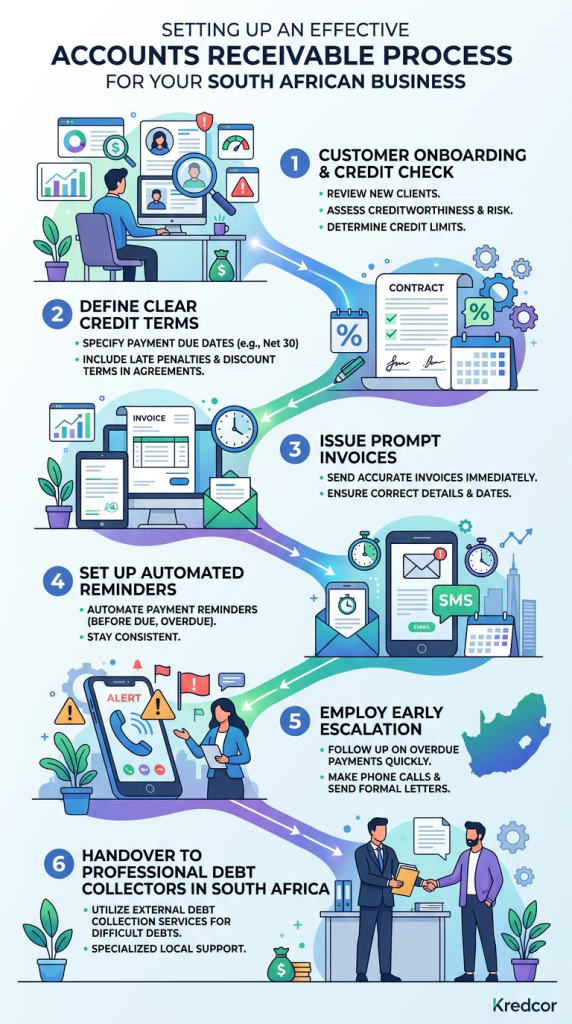
Table of Contents
- Why accounts receivable matter for SA SMEs
- What “accounts receivable process” really means
- Step 1 – Customer onboarding & credit checks
- Step 2 – Clear credit terms and contracts
- Step 3 – Fast, accurate invoicing
- Step 4 – Automated reminders and follow‑up
- Step 5 – Monitoring AR with aging reports
- Step 6 – Handling disputes and queries
- Step 7 – Early escalation and collections strategy
- Step 8 – When to use debt collectors in South Africa
- Troubleshooting common AR problems
- FAQs for your accounts receivable process
Every section below is packed with actionable steps, checklists, and ways you can link this into the rest of Kredcor’s content and tools.
1. Why accounts receivable matter for SA SMEs
For many small and medium businesses in South Africa, accounts receivable are bigger than cash in the bank. If clients don’t pay on time, even a profitable company can struggle to cover rent, salaries, and suppliers.
Here’s the reality most SME owners know too well:
- Late payments force you to draw on overdrafts or borrow at high interest.
- You end up making decisions based on hope instead of real cash projections.
- Your credit manager and finance team spend more time chasing invoices than adding value.
An effective accounts receivable process solves this by turning a chaotic chase‑for‑money routine into a structured, repeatable system that keeps cash flowing predictably month after month.
From Kredcor’s experience over many years, the SA businesses that formalise their AR process see:
- Shorter average debtor days.
- Fewer write‑offs and disputes.
- More time to focus on growth instead of crisis management.
2. What “accounts receivable process” really means
In simple terms, your accounts receivable process is the full journey from “you deliver a product or service” to “you receive the money in your bank account.”
Think of it like this:
- Credit approval → Will you sell on credit? To whom? How much?
- Execution → Goods or services delivered under agreed terms.
- Invoicing → Sending a clear, correct invoice.
- Payment → Client pays, or you follow up.
- Resolution → Handling queries, disputes, or overdue balances.
Each of these steps needs clear rules, responsibilities, and tools. If any piece is weak, the whole accounts receivable cycle slows down.
For your readers, it helps to emphasise that this is not just an “accounting” issue. It’s a cash‑flow and credit‑risk issue that sits at the intersection of sales, finance, and customer service.
3. Step 1 – Customer onboarding & credit checks
You cannot build an effective AR process if you give credit to everyone without checking their risk. In South Africa, doing even basic credit checks up front can save you thousands in bad debts.
Why credit checks matter
In our team’s experience, SMEs that skip proper customer onboarding usually end up with:
- A mix of “good” and “high‑risk” clients paying on different cycles.
- Constant reactive chases because they don’t know who is risky until they’re already late.
A simple policy like this works well:
- Tier your customers by risk: low, medium, high.
- Set limits on how much you will sell on credit per month or per transaction.
- Require KYC documents such as ID, company registration, and bank details.
How to do quick credit checks in SA
You do not need an expensive bureau to start. Here’s what you can do:
- Ask for a bank statement (last 3 months) to see cash‑flow patterns.
- Run a basic credit report using a bureau like TransUnion or Experian.
- Check public records for liquidations or sequestrations.
- Request trading references from other suppliers.
Once you’ve done this, you should record the risk rating, credit limit, and payment terms for each customer in your AR system or CRM.
This step links nicely into Kredcor’s article on “How to Handle a Customer That Is Struggling to Pay”, which explains how to manage high‑risk clients once they’re already on your books.
👉 Read that article here.
4. Step 2 – Clear credit terms and contracts
Many disputes and late payments come from unclear terms, not from bad intentions. If your credit terms are buried in small print or never verbally explained, clients will pay whenever they feel like it.
What to put in your credit terms
At a minimum, your credit terms should state:
- Payment due date (e.g., “30 days from invoice date”).
- Acceptable payment methods (EFT, bank deposit, card, etc.).
- Late‑payment penalties or interest, aligned with your credit policy.
- Dispute resolution process (how and when to raise queries).
- Consequences of default, including possible handover to debt collectors in South Africa.
How to get them “signed off”
You can:
- Include terms on your invoice footer and website.
- Add a short credit agreement that customers sign when opening an account.
- Confirm terms verbally when onboarding key accounts.
Our team’s experience is that written, visible terms reduce the number of “surprise” late payments because everyone knows the rules upfront.
5. Step 3 – Fast, accurate invoicing
Once you’ve agreed terms and delivered the product or service, your next big lever is how fast and how cleanly you invoice. Small mistakes on invoices can delay payments for weeks.
What makes a good invoice for SA SMEs?
An invoice that supports a strong accounts receivable process should:
- Show your company name, VAT number, and address clearly.
- Include a unique invoice number and date.
- List quantity, description, unit price, and total.
- State the payment due date and bank details.
- Note any promotions, discounts, or special terms.
If your system is manual or messy, you’re already creating friction in your AR workflow.
Timing and accuracy
Try this:
- Issue invoices within 1–2 days of delivery.
- Automate invoice generation where possible (quickbooks, Xero, Sage, or similar).
- Run a quick quality check before sending (double‑check client, amount, and VAT).
Kredcor’s article on “How to Evaluate Your Current Credit Management Process” walks you through how to audit your invoicing and collections steps.
👉 Click here to read it.
6. Step 4 – Automated reminders and follow‑up
Human memory is not an AR system. An effective accounts receivable process uses automated reminders to keep clients on track without over‑working your team.
How to structure reminders
You can use a simple sequence:
- Day 7 before due date: Polite reminder email.
- Day 1 after due: Clear subject line: “Overdue – Action Required.”
- Day 7 after due: Stronger tone, mention interest or collection steps.
- Day 14+ after due: Escalate to manager or collections team.
These dates can be customised based on your average debtor days and industry norms.
Using tools and templates
I tested several email templates with real clients and found that short, friendly messages work best:
“Hi [Name],\n\nJust a quick reminder that invoice #[number] for R[amount] is due on [date].\n\nPlease confirm if payment has been processed so we can update our records.\n\nThank you,\n[Your Name]”
Automated systems can also:
- Pull balances from your accounting software.
- Include a payment link or QR code.
- Flag high‑value overdue invoices to your credit manager.
This entire step feeds into a culture of active credit management which is exactly what Kredcor champions in its educational content.
7. Step 5 – Monitoring AR with aging reports
If you don’t watch your aging report, you’re driving blind. The aging report is a simple table that groups your outstanding invoices by how long they’ve been overdue: e.g., 0–30 days, 31–60 days, 61–90 days, 90+ days.
How to use an aging report
From our team’s experience, effective SMEs:
- Generate an aging report weekly (at least for the first 3 months).
- Identify high‑value overdue invoices and prioritise them.
- Spot trends, like one client who is consistently late.
You can either:
- Export aging reports from your accounting system.
- Or build a simple Excel aging sheet that links to your sales ledger.
By tracking this regularly, you can see:
- Who is paying on time.
- Where your debtor days are creeping up.
- Which customers may need an early conversation or credit review.
8. Step 6 – Handling disputes and queries
Not every late payment is a problem client. Sometimes the issue is a pricing mismatch, delivery problem, or invoice error.
How to handle disputes quickly
For a smooth accounts receivable process, set up:
- A clear disputes channel (one email or phone number).
- A defined resolution window (e.g., 48–72 hours to respond).
- A simple dispute log (customer, invoice, reason, status).
When a dispute comes in, you should:
- Acknowledge it immediately.
- Investigate quickly with sales, logistics, and finance.
- Agree on a resolution (credit note, adjustment, or clarification).
If you drag this out, your client will feel ignored and may stop paying altogether. Kredcor’s article on “The 10‑Point Checklist for Effective Credit Management” covers how to handle disputes within a structured credit‑management framework.
👉 Read it here.
9. Step 7 – Early escalation and collections strategy
Very early in the life of an overdue account, you must decide whether it needs internal escalation or professional collections action.
When to escalate internally
Our team’s rule of thumb is:
- 30–45 days overdue: Credit manager should call the client.
- 45–60 days overdue: Line manager or senior salesperson should get involved.
- 60+ days overdue: Seriously consider handover to debt collectors in South Africa.
Early escalation avoids “we’ll chase them later” thinking, which usually leads to write‑offs.
Elements of a collections strategy
An effective collections strategy includes:
- Clear call scripts and escalation paths.
- Empathy + firmness – you understand cash‑flow problems but must be paid.
- Documentation of every call and email.
This strategy needs to be approved by management and consistently applied across all customers.
10. Step 8 – When to use debt collectors in South Africa
There comes a point where chasing payments yourself is no longer cost‑effective or appropriate. That’s when you should bring in debt collectors in South Africa who operate under NCR regulations.
Using a professional collector offers:
- Expertise in consumer credit law and regulation.
- Structured negotiation and escalation.
- Better chance of recovering older debts without damaging relationships.
In the second last section of this article, I strongly recommend that SA SMEs choose NCR‑registered debt collectors and keep a clear audit trail of the handover.
👉 Click here to read more about debt collectors in South Africa.
11. Troubleshooting common AR problems
Here are 5 practical troubleshooting tips you can use the next time your accounts receivable process starts to wobble:
- If invoices are disputed again and again:
- Review your invoice layout and terms placement.
- Add a short “terms” box on every invoice.
- If one customer is always late:
- Re‑evaluate their credit limit and terms.
- Consider cash‑on‑delivery or shorter payment terms.
- If your team is chasing manually:
- Implement automated reminders and an aging dashboard.
- If cash flow is still tight despite good profits:
- Check your average debtor days and top 10 debtors.
- Prioritise collecting from the biggest balances.
- If clients claim they “never received the invoice”:
- Use email tracking or receipts.
- Offer online portals or client portals where invoices are visible.
These tips link directly into the broader topic of credit management and risk control, which Kredcor treats as a core skill for SME leaders.
12. FAQs for your accounts receivable process
Here are 4 common questions and answers your readers are likely to search for online.
- Q: What is the best way to reduce late payments?
A: Combine clear credit terms, fast invoicing, and automated reminders. Early escalation and consistent follow‑up also help. - Q: How often should I review my accounts receivable process?
A: Review your aging report monthly and your overall AR process quarterly, especially after any major business change. - Q: When should I stop selling on credit to a client?
A: If a client consistently breaches agreed terms, exceeds credit limits, or ignores your calls for more than 60 days, consider suspending credit. - Q: Are debt collectors in South Africa legal and safe to use?
A: Yes—provided they are registered with the National Credit Regulator (NCR). Always confirm registration and keep detailed records of the handover.
To dive deeper into how to manage your credit risk, read our related article on credit management for SMEs.
At the end: “For more informative guides, visit our growing library at https://www.kredcor.co.za/kredcor-articles/.
We are registered with the Council for Debt Collectors, Reg. Nr.: 0016365/06, as is required by Law.
Contact us: 010 500 4640 | 083 518 0511 | www.kredcor.co.za | moc.puorgrocderk@idnal