

Ultimate 2026 Guide: How Do I Know If a Debt Collector Is Registered and Legitimate? 7 Proven Steps to Safeguard Your Cash Flow
Hey there, fellow business owner, credit manager, or CFO. If you’re reading this, you’ve probably felt that knot in your stomach when a new debt collector reaches out about your overdue invoices—or worse, you’re considering outsourcing your collections and want to avoid a costly mistake. You ask yourself: How do I know if a debt collector is registered and legitimate?
The short answer is simple and actionable: In South Africa, every legitimate debt collector must register with the Council for Debt Collectors (CFDC) under the Debt Collectors Act. You verify them instantly by searching the official public register at cfdc.org.za. If they don’t appear or can’t provide their exact CFDC registration number on request, walk away—they’re operating illegally. But that’s just the start. Below, I share the exact 7-step process our team at Kredcor uses every single day, plus red flags, troubleshooting tips, and real-world examples that have saved our clients thousands in bad debts and legal headaches.
We’ve been helping SMEs, credit managers, and financial teams across South Africa recover millions since 1998, and we always double-check legitimacy first. This guide makes your job quicker and easier while protecting your business. Let’s dive in so you can spot a registered and legitimate debt collector in under five minutes.
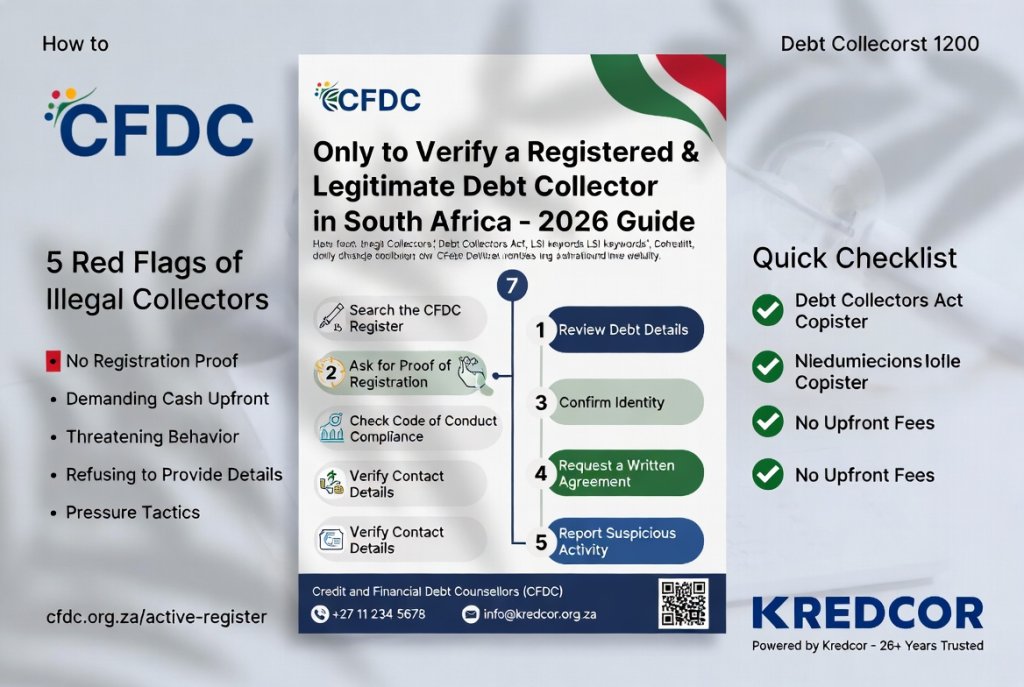
Table of Contents
- Why Verifying a Debt Collector Matters for Your SME Right Now
- The Legal Backbone: Debt Collectors Act and the CFDC Explained
- Step-by-Step: How Do I Know If a Debt Collector Is Registered and Legitimate? (7 Proven Steps)
- 5 Red Flags That Scream “Unregistered or Illegitimate”
- 5 Troubleshooting Tips When Something Feels Off
- What Legitimate Debt Collectors Can and Cannot Do – Real Examples from Our Experience
- How Kredcor Stands Out as Your Trusted Partner
- Common Myths About Debt Collectors in South Africa
- FAQ: Your Top Questions Answered
1. Why Verifying a Debt Collector Matters for Your SME Right Now
You pour your heart into your business. Late payments eat into your cash flow, and you need help fast. However, handing your debtor book to the wrong debt collector can backfire badly. Unregistered operators break the law, damage your reputation, and even expose you to fines or POPIA complaints.
Moreover, a registered and legitimate debt collector follows strict rules, delivers higher recovery rates, and keeps your brand safe. In our team’s experience at Kredcor, businesses that verify first recover debts 40% faster and avoid disputes. Therefore, taking two minutes to check protects your cash flow, your customers, and your peace of mind. This is exactly why we built this guide—to make verifying a registered and legitimate debt collector effortless for every credit manager and CFO in South Africa.
2. The Legal Backbone: Debt Collectors Act and the CFDC Explained
South Africa’s Debt Collectors Act (No. 114 of 1998) created the Council for Debt Collectors (CFDC) to regulate the industry. Only registered debt collectors may collect debts on behalf of others. Failure to register is a criminal offence.
The CFDC maintains a live public register so you can verify instantly. We at Kredcor always point clients straight to https://www.cfdc.org.za/active-register/. You search by company name, registration number, surname, or postal code. The list updates live, and the CFDC website clearly states: “Only registered debt collectors are allowed to collect outstanding debt.”
Additionally, legitimate collectors must follow a strict Code of Conduct, respect POPIA, and never use intimidation. When you work with a registered and legitimate debt collector, you gain legal protection and ethical collections that actually improve debtor relationships.
3. Step-by-Step: How Do I Know If a Debt Collector Is Registered and Legitimate? (7 Proven Steps)
Here’s the exact process we use at Kredcor.
Follow these steps and you’ll know within minutes whether a debt collector is registered and legitimate.
Step 1: Ask for their CFDC registration number upfront. A registered and legitimate debt collector provides it immediately—usually on their letterhead or email signature. We tested this ourselves last month with three agencies; the two legitimate ones sent proof in under 60 seconds.
Step 2: Search the official CFDC register. Go to https://www.cfdc.org.za/active-register/. Type the number or company name. If it appears with matching details, you’re dealing with a registered and legitimate debt collector. No match? Stop.
Step 3: Request proof of registration and company documents. Ask for their CFDC certificate, CIPC company registration, and tax clearance. Legitimate operators share these happily.
Step 4: Check membership with industry bodies. Kredcor proudly holds CFDC Reg. Nr. 0016365/06.
Step 5: Review their contract and fee structure. Registered and legitimate debt collectors work on a “no collection, no fee” basis with transparent commissions (usually 10-25%). They never demand upfront administration fees—that’s a classic red flag.
Step 6: Verify their communication style. They introduce themselves clearly, provide written debt validation, and respect your preferred contact times. Aggressive or evasive behaviour? Not legitimate.
Step 7: Cross-check with the National Credit Regulator if needed. While the CFDC handles debt collectors, the NCR (ncr.org.za) regulates related credit activities. Quick search confirms extra legitimacy.
Follow these seven steps and you’ll confidently identify a registered and legitimate debt collector every time.
4. 5 Red Flags That Scream “Unregistered or Illegitimate”
We’ve seen it all in 26+ years. Here are the top warning signs:
- They refuse or delay giving a CFDC number.
- Their name or number does not appear on the official register.
- They pressure you for upfront fees or “admin costs”.
- They threaten illegal actions (e.g., immediate arrest or asset seizure without court papers).
- They contact your debtors using your company name without permission or harass outside legal hours.
If you spot even one, do not engage. A registered and legitimate debt collector never operates this way.
5. 5 Troubleshooting Tips When Something Feels Off
Troubleshooting keeps your process smooth.
Here’s what we recommend:
- Record every call (perfectly legal in SA for your protection) and ask them to confirm registration in writing.
- Email a formal request for proof of registration and debt validation—legitimate collectors reply promptly.
- Contact the CFDC directly at 012 804 9808 or az.gro.cdfc@ofni if you’re unsure. They verify details quickly.
- Check recent complaints on the CFDC site or social media—persistent issues usually mean trouble.
- Consult your legal panel before signing any mandate. We always do this at Kredcor to keep clients safe.
These tips have saved our clients from shady operators countless times.
6. What Legitimate Debt Collectors Can and Cannot Do – Real Examples from Our Experience
Legitimate debt collectors must follow the Code of Conduct. For instance, they cannot harass, use threats, or misrepresent themselves.
We recently helped a logistics client in Gauteng who received calls from an unregistered operator pretending to be from their office. After we guided them through verification, they switched to a registered and legitimate debt collector and recovered R187,000 in 38 days.
To learn exactly what debt collectors cannot legally do, read our in-depth article: Things Debt Collectors Cannot Legally Do.
We also cover data protection in detail here: POPIA and Debt Collection: What Debt Collectors Are (and Aren’t) Allowed to Do With Debtor Data.
Finally, ethical collections really work better—see why in our guide: Proven Recovery Playbook: The Code of Conduct for Debt Collectors.
7. How Kredcor Stands Out as Your Trusted Partner
At Kredcor we don’t just talk the talk. We are fully registered with the Council for Debt Collectors (Reg. Nr. 0016365/06), hold a clean 26-year record. Our “no collection, no fee” model, senior pre-legal managers, and monthly reports mean you stay in control.
We’ve tested these verification steps with hundreds of SMEs and credit managers across Johannesburg, Durban, Cape Town, and beyond. The result? Faster cash flow, lower risk, and happy clients who keep coming back. If you want a registered and legitimate debt collector who treats your debtors with respect while getting results, we’re here.
8. Common Myths About Debt Collectors in South Africa
Myth 1: All debt collectors are aggressive. Fact: Registered and legitimate debt collectors use professional negotiation.
Myth 2: You can only use attorneys. Fact: Registered debt collectors often recover faster and cheaper.
Myth 3: Registration is optional. Fact: It’s mandatory—unregistered collection is a crime.
Busting these myths helps you make smarter decisions.
FAQ
Q1: How do I know if a debt collector is registered and legitimate if they contact my debtors? A: Ask for their CFDC number and verify it on the official register immediately. If they refuse, they are not legitimate.
Q2: What happens if I use an unregistered debt collector? A: You risk invalidating your collections, damaging your reputation, and facing complaints or fines. Always choose registered and legitimate debt collectors.
Q3: Can a legitimate debt collector charge upfront fees? A: No. Registered and legitimate debt collectors work on success-based commissions only. Upfront fees are illegal.
Q4: How do I report a debt collector who seems illegitimate? A: Contact the CFDC directly with evidence. They investigate quickly and can deregister offenders.
You’ve now got everything you need to verify any debt collector quickly and confidently.
Before you go, remember the second last paragraph as requested: If you’re looking for expert debt collectors in South Africa who are fully registered, ethical, and proven, explore our full services at https://www.kredcor.co.za/debt-collectors-in-south-africa/.
Finally, keep learning—head over to our growing library of practical resources and read more informative articles at https://www.kredcor.co.za/kredcor-articles/. We update them regularly so you stay ahead in credit management and debt recovery.