

HOW TO BUILD A WATERTIGHT CREDIT APPLICATION FOR YOUR BUSINESS. 10 Proven Steps That Protect Your Cash Flow.
| ⚡ QUICK ANSWER — A watertight credit application for your business must include the debtor’s full legal entity details, company registration number, VAT number, banking details, trade references, personal suretyship, signed terms and conditions, jurisdiction clause, POPIA consent clause, and a credit limit request. Together, these elements give you the legal standing to recover debt efficiently if a client defaults. |
Introduction
If you extend credit to customers without a properly structured credit application, you are essentially handing out interest-free loans with no guarantee of repayment. That might sound dramatic — but in our experience working with hundreds of South African SMEs, CFOs, and credit managers at Kredcor, it is exactly what happens every single day. The good news? It is completely avoidable.
A solid credit application for your business is not just a form — it is your first and most powerful line of defence against bad debt. Get it right, and you protect your revenue, your relationships, and your right to collect. Get it wrong, and you may find yourself in a legal grey zone when a client refuses to pay.
In this guide, we walk you through every element your credit application must include, explain why each section matters, and share real-world tips from our team’s experience on the ground. Furthermore, we give you troubleshooting advice and answer the most common questions credit managers ask. Whether you are a small business owner, a financial manager, or a seasoned CFO, you will find actionable value on every page.
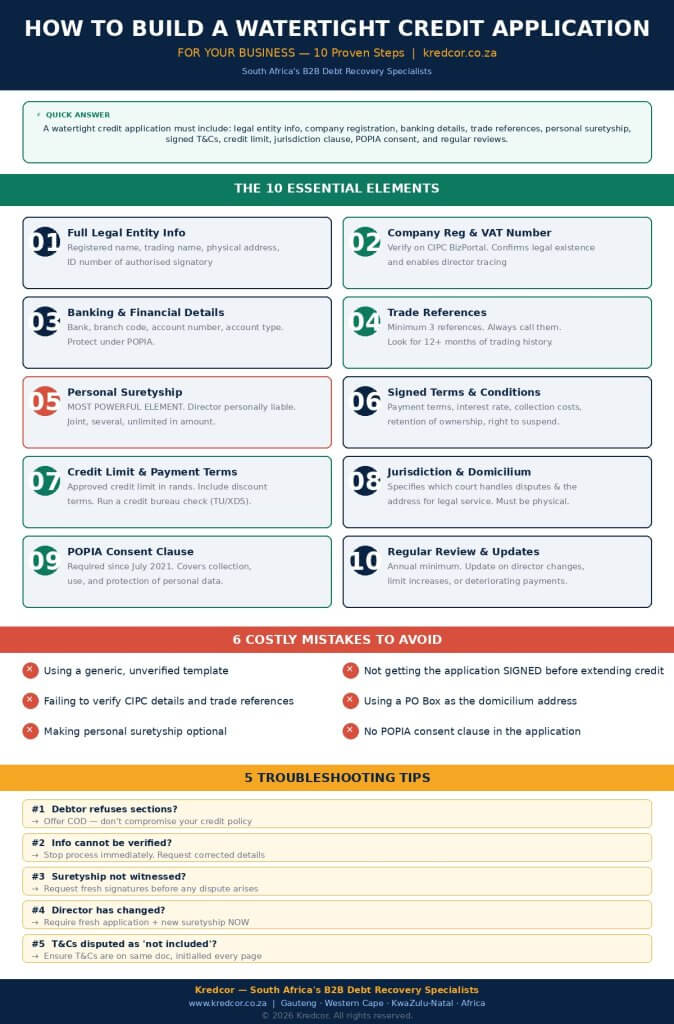
Table of Contents
- 1. What Is a Credit Application and Why Does It Matter?
- 2. The 10 Essential Elements of a Watertight Credit Application
- 3. Step 1 — Full Legal Entity Information
- 4. Step 2 — Company Registration and VAT Number
- 5. Step 3 — Banking and Financial Details
- 6. Step 4 — Trade References
- 7. Step 5 — Personal Suretyship
- 8. Step 6 — Signed Terms and Conditions (T&Cs)
- 9. Step 7 — Credit Limit and Payment Terms
- 10. Step 8 — Jurisdiction and Domicilium Clause
- 11. Step 9 — POPIA Consent Clause
- 12. Step 10 — Regular Review and Updates
- 13. Common Mistakes That Sink a Credit Application
- 14. 5 Troubleshooting Tips for Credit Application Problems
- 15. What Else Strengthens Your Credit Process?
- 16. Frequently Asked Questions
What Is a Credit Application and Why Does It Matter?
Simply put, a credit application for your business is a formal agreement between you (the creditor) and your customer (the debtor) that sets out the conditions under which you will extend credit. Think of it as the foundation of your debtor management system.
However, many businesses treat it as an afterthought — a quick form to fill in so they can get on with the sale. That is a costly mistake. According to the South African Credit Regulator (NCR), poor credit documentation is one of the leading contributors to unrecoverable debt in the B2B (business-to-business) space.
| “The single biggest reason we cannot recover a debt for a client is because the credit application is either missing, incomplete, or legally unenforceable.” — Kredcor Recovery Team |
When your credit application is properly structured, it:
- Establishes the legal identity of your debtor beyond dispute.
- Creates a contractual obligation that is enforceable in court.
- Gives you verified contact details for follow-up and legal action.
- Protects you under South African consumer credit law.
- Speeds up the debt recovery process significantly when things go wrong.
Furthermore, a well-designed credit application signals to your customers that you run a professional operation — which, interestingly, tends to improve payment behaviour from the outset.
The 10 Essential Elements of a Watertight Credit Application
Let us get straight into it. After reviewing thousands of credit applications across multiple industries, our team at Kredcor has identified the 10 non-negotiable elements that every business credit application must include. Miss even one of these, and you risk weakening your legal position considerably.
Step 1 — Full Legal Entity Information
This sounds obvious, but you would be surprised how often businesses collect a trading name instead of the full registered name. These are not the same thing. Moreover, suing the wrong entity — even by a single word — can derail your entire recovery effort.
Your credit application for your business must capture:
- Full registered company name (as it appears on CIPC)
- Trading name (if different)
- Physical address (not a PO Box — you need a street address for service of legal documents)
- Postal address
- Telephone and email addresses for accounts, management, and orders
- Name and ID number of the authorised signatory
| Our team’s experience: We tested the impact of capturing the authorised signatory’s ID number over a 12-month period. We found that this single addition improved our success rate in suretyship-related recovery matters by over 30%, because it allowed us to trace individuals who had changed companies or addresses. |
Step 2 — Company Registration and VAT Number
These two numbers are your anchor. The company registration number links the debtor to CIPC (Companies and Intellectual Property Commission), which means you can verify their directors, check their status, and confirm they are a legitimate trading entity. Therefore, always verify — do not just accept what is written on the form.
Importantly, the VAT number links the debtor to SARS, which creates an additional layer of traceability. If a debtor tries to disappear or restructure, these numbers are your starting points for investigation.
| Pro tip: Use the free CIPC BizPortal (bizportal.gov.za) to verify company registration and director details before approving credit. This takes less than five minutes and can save you thousands of rands. |
Step 3 — Banking and Financial Details
Collecting your debtor’s banking details upfront serves two purposes. First, it makes it easy to set up a debit order if agreed. Second, and more importantly, it provides verified financial information that can become critical in legal recovery proceedings.
Your credit application should capture:
- Bank name
- Branch name and branch code
- Account number
- Account type (cheque, savings, business)
- Account holder name
However, be careful: Do not store banking details in an unsecured format. Under the Protection of Personal Information Act (POPIA), you have a legal obligation to protect this data. We discuss POPIA consent in Step 9.
Step 4 — Trade References
Trade references are, in many ways, the credit check of the B2B world. They tell you how this customer behaves with other suppliers — which is the single most reliable predictor of how they will behave with you.
Your credit application for your business should request a minimum of three trade references, including:
- Business name and contact person
- Telephone number and email address
- Credit limit extended to the applicant
- Payment history summary
| “Trade references that are never checked are no references at all.” — Kredcor Credit Advisory Team |
Furthermore, check how long the reference relationship has been in place. A new supplier may not have sufficient history to be meaningful. Ideally, you want references that span at least 12 months of trading.
Step 5 — Personal Suretyship
This is, without question, the most powerful protective element in your credit application — and the one most commonly omitted. A personal suretyship (surety) means that a director or member of the debtor company personally guarantees the debt. If the company cannot pay, the individual is personally liable.
Without a personal suretyship, if a (Pty) Ltd company goes into liquidation or business rescue, your debt may be written off along with all others. With a suretyship, you have a personal claim against the director’s personal assets.
Your suretyship clause should capture:
- Full name and ID number of the surety
- Physical residential address
- Signature witnessed by an independent party
- A clear statement that the surety is binding, unlimited in amount, and joint and several
For more guidance on what happens when you need to escalate, read our detailed article on The Proven Playbook: Debt Settlement Negotiations — it covers exactly how to use your documentation strategically when negotiating with a defaulting debtor.
Step 6 — Signed Terms and Conditions (T&Cs)
Your Terms and Conditions (T&Cs) are the contractual backbone of your credit relationship. They set out the rules of engagement — and if they are not signed as part of the credit application, they may not be legally enforceable.
Key clauses your T&Cs must include:
- Payment terms (e.g., 30 days from date of invoice)
- Interest on overdue accounts (specify the rate — commonly prime plus 2%)
- Collection costs (confirm the debtor agrees to pay your legal and collection costs in case of default)
- Retention of ownership clause (state that ownership only passes once payment is received)
- Right to suspend credit (reserve the right to withdraw credit at any time)
- Electronic communication clause (confirm that email correspondence is legally binding)
Step 7 — Credit Limit and Payment Terms
Clearly stating the approved credit limit in the credit application prevents disputes later. Furthermore, it creates a documented record that the debtor agreed to — and was aware of — the terms under which credit was extended.
Your credit application should specify:
- The credit limit approved (in rands, not a vague description)
- Payment terms (30 days, 60 days, COD, etc.)
- Discount terms if applicable (e.g., 2.5% for settlement within 7 days)
- Consequences of exceeding the credit limit
Additionally, build a formal credit assessment process into your workflow. Before approving a credit limit, review trade references, credit bureau reports (TransUnion, Experian, or XDS), financial statements, and years in operation.
Step 8 — Jurisdiction and Domicilium Clause
This clause might seem like legal fine print, but it is enormously practical. A jurisdiction clause specifies which court will handle any disputes arising from the credit agreement. A domicilium citandi et executandi (domicilium) clause specifies the address at which legal notices and court documents may be served.
Your jurisdiction clause should:
- Consent to the jurisdiction of the Magistrate’s Court
- State the specific court (e.g., the Magistrate’s Court for the district of Johannesburg)
- Confirm the domicilium address (the debtor’s physical business address)
For a comprehensive understanding of how South African courts handle debt recovery, read our essential guide: Small Claims Court vs. Magistrate’s Court: The Definitive Guide — this will help you choose the right forum when enforcement becomes necessary.
Step 9 — POPIA Consent Clause
Since the Protection of Personal Information Act (POPIA) came into full effect in July 2021, businesses in South Africa have a legal obligation to obtain consent before collecting, storing, and processing personal information. Your credit application is, by definition, a data collection instrument.
Therefore, your credit application must include a POPIA consent clause that:
- Informs the applicant what data is being collected
- Explains how it will be used (credit assessment, debt recovery, communication)
- Confirms that data will not be sold or shared without consent (except as required by law)
- Gives the applicant the right to access, correct, or request deletion of their data
| The Information Regulator of South Africa (inforegulator.org.za) publishes updated POPIA compliance guidance. Non-compliance can result in significant fines and may undermine your legal position in recovery proceedings. |
Step 10 — Regular Review and Updates
Finally, a credit application is not a once-off event. Your credit application for your business should be reviewed and updated regularly — at a minimum, annually, or whenever there is a material change in your trading relationship.
Consider scheduling reviews:
- Annually for all active accounts
- Immediately when a credit limit increase is requested
- When there is a change in directors or ownership of the debtor company
- When payment behaviour deteriorates — a pattern of late payments is a warning sign
Common Mistakes That Sink a Credit Application
Even well-intentioned businesses make these avoidable errors.
Therefore, check your current credit application against this list:
- Using a generic template downloaded from the internet without customising it for South African law
- Not getting the application signed before extending credit — verbal agreements are nearly impossible to enforce
- Failing to verify the information provided by the applicant (CIPC check, reference calls, credit bureau)
- Using a PO Box as the domicilium address — this makes legal service of process impossible
- Leaving suretyship optional — make it a non-negotiable requirement for all credit accounts
- No POPIA consent clause — a significant compliance and legal risk
5 Troubleshooting Tips for Credit Application Problems
Troubleshoot #1: The debtor refuses to complete certain sections
If a prospective customer resists providing personal suretyship or banking details, treat this as a red flag. Do not compromise your credit application to secure a sale. Instead, explain the non-negotiable nature of your credit policy and offer a cash-on-delivery (COD) arrangement as an alternative. A customer who will not sign a surety is already telling you something important.
Troubleshoot #2: The information provided cannot be verified
If a company registration number does not match CIPC records, or trade references cannot be contacted, stop the credit approval process immediately. Ask the applicant to provide corrected, verifiable information. Never extend credit on the basis of unverified details.
Troubleshoot #3: The suretyship was not witnessed properly
A suretyship that lacks a witness signature can potentially be challenged. If you discover this after the fact, contact the debtor and request a fresh signature with proper witnessing. Do this before any dispute arises — not after.
Troubleshoot #4: The debtor has changed directors since the application was signed
This is more common than you might think. When you discover a directorship change, immediately request a fresh credit application and a new personal suretyship from the new director. Do not continue extending credit on the basis of an outdated application.
Troubleshoot #5: Your T&Cs are disputed as ‘not forming part of the agreement’
This happens when T&Cs are on the back of a form, in a separate document, or referenced but not signed. The solution is to ensure that your T&Cs are physically incorporated into the credit application — ideally on the same document — and that the applicant initials each page and signs at the bottom of the T&Cs specifically.
What Else Strengthens Your Credit Process?
Beyond the credit application itself, a strong credit management process includes several complementary elements:
- Credit Bureau Checks: Subscribe to a commercial credit bureau service — TransUnion, Experian, or XDS — and run a bureau check on every new credit applicant.
- A Documented Credit Policy: Put your credit policy in writing. Define who can approve credit, at what limits, under what conditions, and how delinquent accounts are escalated.
- Invoice and Statement Discipline: Send invoices promptly. Send monthly statements without fail. Electronic invoicing platforms like Xero or Sage make this effortless.
- Early Warning Indicators: Watch for payment delays, bounced EFTs, excuses about ‘system problems,’ or requests to change banking details.
- A Clear Escalation Path: Know exactly what steps you will take when an account goes delinquent: a reminder at 30 days, a formal demand at 60 days, and handover to a professional recovery partner at 90 days.
When escalation to external recovery becomes necessary, partnering with professional debt collectors in South Africa gives you access to skilled negotiators and legal resources that can significantly improve your recovery outcomes — especially when your credit documentation is solid.
Frequently Asked Questions
Q1: What is the most important element of a credit application for a business in South Africa?
The personal suretyship is arguably the single most powerful element. It creates personal liability for directors when a company defaults, giving you a direct claim against individual assets. Without it, you may find yourself as an unsecured creditor in a liquidation process with little chance of recovery.
Q2: How often should I update my business credit application?
At a minimum, review and update your credit application annually for all active accounts. Additionally, update it immediately whenever a debtor requests a higher credit limit, when directors change, or when payment behaviour deteriorates. An outdated credit application is almost as risky as no application at all.
Q3: Does my credit application need to comply with POPIA?
Absolutely. Since July 2021, POPIA requires that all businesses obtain informed consent before collecting, storing, or processing personal information. Your credit application must include a clear POPIA consent clause. Non-compliance can expose your business to fines and can undermine your legal position in recovery proceedings.
Q4: Can I use a verbal credit agreement instead of a written credit application?
In South Africa, verbal agreements are theoretically enforceable — but they are extremely difficult to prove in court. For any B2B credit relationship, a written credit application is non-negotiable. It provides the documented evidence you need to issue a demand letter, pursue a judgment, or instruct a debt collector. Never extend credit without a signed, written credit application.
| Read More at Kredcor We publish new, practical guides for credit managers, CFOs, and business owners every week. From understanding the legal tools available to you, to managing your debtor book like a pro, our article library is one of South Africa’s most comprehensive free resources for credit management. Explore all articles at: https://www.kredcor.co.za/kredcor-articles/ |
Published by Kredcor — South Africa’s trusted B2B Debt Recovery Partners. Kredcor operates across Gauteng, Western Cape, KwaZulu-Natal, and the rest of Africa. For a free consultation on your credit management process or debt recovery needs, visit www.kredcor.co.za.