

Small Claims Court vs. Magistrate’s Court — The Definitive Guide to Choosing the Right Court for Your Debt in South Africa
Quick Answer: If your debt is R20 000 or less and the matter is straightforward, the Small Claims Court is faster and cheaper. If the debt exceeds R20 000, involves complex legal arguments, or the debtor disputes the amount, the Magistrate’s Court is the right choice. Read on for the full breakdown so you can make the call with confidence.
If you manage debt for a business — whether you are an SME owner, credit manager, financial manager, or CFO — there is a moment every one of us has faced: a debtor simply will not pay. You have sent the reminders, you have made the calls, and now you are looking at legal action. The question that follows? Which court do I use?
Getting this decision wrong costs you time and money. Choosing the wrong legal route can mean slow judgments, surprise legal fees, and a recovery process that drags on far longer than it needs to. At Kredcor, we have seen this happen many times. The good news, however, is that the answer — once you know it — is simpler than most people think. This guide exists to give you that answer clearly and without legal jargon.
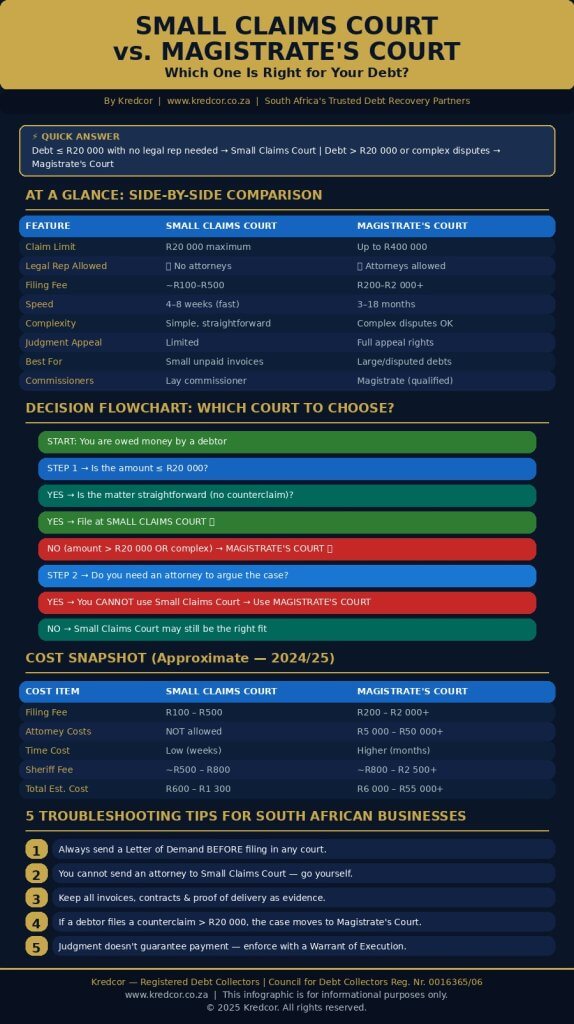
Table of Contents
- What Is the Small Claims Court in South Africa?
- What Is the Magistrate’s Court in South Africa?
- Small Claims Court vs. Magistrate’s Court — The Key Differences at a Glance
- When to Choose the Small Claims Court
- When to Choose the Magistrate’s Court
- The True Cost of Each Court — A Practical Breakdown
- The Step-by-Step Process: Small Claims Court
- The Step-by-Step Process: Magistrate’s Court
- The Decision Checklist — Use This Before You File
- Five Common Mistakes Businesses Make (and How to Avoid Them)
- Five Troubleshooting Tips When Things Go Wrong
- What Happens After Judgment?
- When Court Action Alone Is Not Enough
- FAQs — Small Claims Court vs. Magistrate’s Court
1. What Is the Small Claims Court in South Africa?
The Small Claims Court is a fast, low-cost court designed to handle minor civil disputes without the need for legal help. It was introduced to make justice available to ordinary citizens and small businesses — and, honestly, it does a good job of that.
How the Small Claims Court works
Here is what defines the Small Claims Court:
- Monetary limit: Claims may not exceed R20 000 (as at 2024/25). Importantly, this limit applies to the capital amount only, excluding interest and costs.
- No attorneys allowed: Neither party may be represented by a lawyer during the hearing. As a result, you must argue your own case.
- Presided over by a Commissioner: A Commissioner handles these matters — not a trained magistrate. Commissioners are usually attorneys or advocates who volunteer their time.
- Jurisdiction: You must file at the Small Claims Court in the area where the debtor lives, carries on business, or where the cause of action arose.
- Exclusions: Companies and close corporations cannot be claimants in the Small Claims Court. However, they can be defendants. This is a point most business owners miss.
Important: If you are a company or close corporation, you cannot use the Small Claims Court as a claimant. You must use the Magistrate’s Court instead.
This single exclusion changes the picture for most SMEs. That said, sole proprietors and partnerships can still benefit from the Small Claims Court. So, if you qualify, it is well worth considering.
For a deeper look at what happens once you move beyond the claim stage and into enforcement, read Kredcor’s guide on The Unstoppable Warrant of Execution in South Africa — it covers exactly what comes after a judgment is granted, in either court.
2. What Is the Magistrate’s Court in South Africa?
The Magistrate’s Court is the main court for civil justice in South Africa. It handles a far broader range of disputes, including larger debt claims, and it offers much more procedural flexibility. In other words, it is the go-to option for businesses dealing with bigger or more complex debts.
Key features of the Magistrate’s Court
- Monetary limit: The Magistrate’s Court handles civil claims up to R400 000. Beyond that, matters move to the High Court.
- Legal help is allowed: Both parties may — and often do — appoint attorneys to represent them.
- Presided over by a Magistrate: A qualified, appointed judicial officer hears the case. This adds procedural strength compared to the Small Claims Court.
- Full procedural rules apply: The Magistrate’s Court operates under the Magistrates’ Courts Act 32 of 1944. Consequently, summonses, pleas, discovery, and hearings all follow a defined process.
- Available to all entities: Companies, close corporations, trusts, and individuals can all be claimants. This is, therefore, a key advantage over the Small Claims Court.
- Appeals: A judgment from the Magistrate’s Court can be appealed to the High Court — something that is not readily available from the Small Claims Court.
The Magistrate’s Court is, therefore, the right venue for business-to-business debt recovery where the amounts are significant and the disputes are real.
3. Small Claims Court vs. Magistrate’s Court — The Key Differences at a Glance
| Feature | Small Claims Court | Magistrate’s Court |
|---|---|---|
| Claim Limit | R20 000 maximum | Up to R400 000 |
| Who Can Claim | Natural persons, sole proprietors, partnerships | All entities, including companies and CCs |
| Legal Representation | ❌ Not allowed | ✅ Attorneys permitted |
| Presiding Officer | Commissioner (volunteer attorney/advocate) | Qualified Magistrate |
| Filing Fee | Approximately R100 – R500 | R200 – R2 000+ |
| Typical Timeframe | 4 – 8 weeks | 3 – 18 months |
| Appeal Rights | Very limited | Full High Court appeal rights |
| Complexity Allowed | Simple matters only | Complex disputes accepted |
| Best For | Small unpaid invoices, simple B2C debt | Large commercial debt, B2B disputes |
| Governing Legislation | Small Claims Courts Act 61 of 1984 | Magistrates’ Courts Act 32 of 1944 |
This table tells the story at a glance. However, the real decision — as we discuss next — lies in the specific facts of your situation.
4. When to Choose the Small Claims Court
Use the Small Claims Court when all of the following apply:
- ✅ You are a natural person (sole proprietor or individual) — not a company or CC.
- ✅ The amount owed is R20 000 or less.
- ✅ The matter is clear-cut — you have a simple, undisputed debt with supporting documents (invoice, delivery note, signed agreement).
- ✅ You are comfortable presenting your own case without an attorney.
- ✅ Speed and low cost are your top priorities.
A practical example
Imagine you run a small plumbing business as a sole proprietor. A residential client owes you R12 000 for work that is complete and documented. The client is simply ignoring you. This is a textbook Small Claims Court matter. You file, you appear, and you get your judgment — often within weeks. Furthermore, the cost is very low.
However, if that same client then filed a counterclaim of R25 000 against you, the matter would immediately exceed the Small Claims Court’s limit and transfer to the Magistrate’s Court. This is one of the most common traps businesses fall into. As a result, we cover it in detail in our troubleshooting section below.
5. When to Choose the Magistrate’s Court
The Magistrate’s Court is the right choice when any of the following apply:
- ✅ You are a company, CC, or other registered entity — you cannot use the Small Claims Court as a claimant.
- ✅ The debt exceeds R20 000.
- ✅ The debtor disputes the amount or the contract.
- ✅ You need an attorney to manage the legal process for you.
- ✅ The case involves complex evidence, multiple parties, or special procedures (for example, a provisional sentence summons).
- ✅ You want full appeal rights in case the judgment goes against you.
A practical example
A manufacturing SME in Gauteng is owed R85 000 by a corporate client who disputes the quality of goods delivered. In addition, the debtor has threatened a counterclaim. This matter requires the Magistrate’s Court — it involves a company as claimant, a sum well above R20 000, and a factual dispute that needs proper legal argument and document discovery.
For step-by-step guidance on how to launch proceedings in the Magistrate’s Court, Kredcor’s detailed article on Issuing a Summons for Debt walks you through every critical stage of that process.
6. The True Cost of Each Court — A Practical Breakdown
One of the most common questions we get at Kredcor is: “How much is this going to cost me?” The answer depends heavily on which court you use and whether attorneys are involved. Here, therefore, is our honest, practical breakdown.
Small Claims Court — cost breakdown
| Cost Item | Approximate Amount |
|---|---|
| Filing Fee (summons) | R100 – R500 |
| Sheriff Service Fee | R500 – R800 |
| Your Time (court appearance) | Variable |
| Attorney Costs | R0 (not allowed) |
| Total Estimate | R600 – R1 300 |
The Small Claims Court is genuinely affordable. The biggest cost is your time — you have to appear in person and argue your own case. For a busy CFO or credit manager, that is a real consideration. However, for claims under R20 000, the return on that investment is typically strong.
Magistrate’s Court — cost breakdown
| Cost Item | Approximate Amount |
|---|---|
| Filing Fee (summons) | R200 – R2 000+ (depends on claim amount) |
| Sheriff Service Fee | R800 – R2 500+ |
| Attorney Costs | R5 000 – R50 000+ (depends on complexity) |
| Advocate Costs (if needed) | Additional |
| Total Estimate | R6 000 – R55 000+ |
The Magistrate’s Court costs significantly more — but so does the debt you are trying to recover. For instance, for a claim of R150 000, spending R20 000 in legal costs to recover it is a perfectly rational business decision. This is especially true when those costs may be awarded against the losing party.
Pro tip from our team: Always get a cost estimate from your attorney before issuing summons in the Magistrate’s Court. Ask specifically about the chances of a cost award in your favour. That way, you can make a truly informed business decision.
7. The Step-by-Step Process: Small Claims Court
Understanding the process is half the battle. Below, we break down exactly what happens in the Small Claims Court — from the moment you decide to act, to the moment you get your judgment.
Step 1 — Send a letter of demand
Before you can file, you must send the debtor a written letter of demand. This is a legal requirement. Give the debtor at least 14 days to respond. Without this step, your case starts on the wrong foot.
Step 2 — Complete the summons form (Form C)
Next, visit your local Small Claims Court and complete the prescribed summons form. You will need to provide the debtor’s full name and address, the amount claimed, and the basis of your claim. The clerk will help you if needed.
Step 3 — Pay the filing fee
The clerk will then stamp and register your summons. You pay the filing fee at this point. As noted above, this is usually between R100 and R500.
Step 4 — Service by the sheriff
After that, the Sheriff of the Court serves the summons on the debtor. The sheriff’s fee is payable by you upfront and is recoverable from the debtor if you win.
Step 5 — The hearing
Both parties appear before the Commissioner. You present your evidence — invoices, delivery notes, correspondence, and signed agreements. The debtor then has the opportunity to respond. The Commissioner will question both parties and make a ruling — often on the same day.
Step 6 — Judgment granted
Finally, if you succeed, you receive a judgment. This judgment is your legal right to enforce the debt. However, remember that a judgment alone does not put money in your bank — you still need to enforce it.
8. The Step-by-Step Process: Magistrate’s Court
The Magistrate’s Court process follows a more structured path. As a result, it takes longer — but it is also far more robust when dealing with complex or disputed debts.
Step 1 — Instruct your attorney and send a final demand
Your attorney sends a final letter of demand, giving the debtor 10 business days to pay. In consumer matters, this is required by the National Credit Act. In B2B matters, it is standard good practice.
Step 2 — Issue the summons
Your attorney then prepares and issues either a combined summons or a simple summons, depending on the nature of the claim. The sheriff serves the summons on the debtor. This is the formal start of legal proceedings.
Step 3 — Notice of intention to defend
The debtor has 10 business days from service to file a Notice of Intention to Defend. If they do not respond, you can immediately apply for default judgment. In many cases, this is how matters end — quickly and in your favour.
Step 4 — Plea and discovery
If the debtor does defend, they file a Plea. Both sides may then request discovery of documents. A pre-trial conference may follow. This stage can take several months, so plan accordingly.
Step 5 — Trial or settlement
If the matter is not resolved, it proceeds to trial. Each side presents evidence and witnesses. The magistrate may reserve judgment. That said, many matters settle before trial — and a well-structured settlement is often a smarter outcome than a long trial. For more on this, read Kredcor’s article on The Proven Playbook: Debt Settlement Negotiations — because sometimes, negotiating after summons is more effective than going all the way to trial.
Step 6 — Judgment and enforcement
Upon judgment in your favour, you may proceed to enforcement. Garnishee orders, warrants of execution against property, and emolument attachment orders are all available tools. We cover these in detail in Section 12 below.
9. The Decision Checklist — Use This Before You File
Our team developed this checklist for credit managers and CFOs who need to make a fast, well-informed decision. Run through it every time before you file.
Answer YES or NO to each question:
| # | Question | If YES | If NO |
|---|---|---|---|
| 1 | Is the claimant a natural person (not a company/CC)? | Small Claims Court possible | Must use Magistrate’s Court |
| 2 | Is the debt amount ≤ R20 000? | Small Claims Court possible | Must use Magistrate’s Court |
| 3 | Is the matter straightforward and undisputed? | Small Claims Court suitable | Consider Magistrate’s Court |
| 4 | Do you need an attorney to handle this? | Must use Magistrate’s Court | Small Claims Court may work |
| 5 | Has the debtor said they will defend? | Magistrate’s Court is safer | Small Claims Court may suffice |
| 6 | Is speed your top priority? | Small Claims Court | Magistrate’s Court (if > R20 000) |
If you answered YES to questions 1, 2, and 3, and NO to question 4, the Small Claims Court is likely your best route. Any other combination points firmly toward the Magistrate’s Court.
10. Five Common Mistakes Businesses Make — And How to Avoid Them
Over the years, our team has reviewed hundreds of debt recovery cases at Kredcor. These are the mistakes we see most often — and, importantly, they are entirely avoidable.
Mistake 1 — Filing in the wrong court
A company claimant filing in the Small Claims Court will have their case dismissed. Therefore, always confirm your legal status before choosing your forum.
Mistake 2 — Skipping the letter of demand
Both courts expect you to have given the debtor a fair chance to pay before forcing the issue. A letter of demand is your proof that you did exactly that. Without it, your credibility before the Commissioner or Magistrate starts on the back foot.
Mistake 3 — Claiming without enough documentation
We found, time and again, that creditors arrive in court with incomplete records. Consequently, always ensure you have signed agreements, original invoices, proof of delivery, and all relevant correspondence. Your evidence wins cases. Your word alone does not.
Mistake 4 — Underestimating a counterclaim
A debtor’s counterclaim that exceeds R20 000 will automatically remove a Small Claims Court matter and redirect it to the Magistrate’s Court. As a result, always plan for this possibility before you file.
Mistake 5 — Treating a judgment as the finish line
Winning a judgment is not the same as receiving your money. Enforcement is a separate step. You still need to issue a Warrant of Execution or Garnishee Order to actually collect. Therefore, budget for this from the outset.
11. Five Troubleshooting Tips When Things Go Wrong
Even well-prepared creditors run into problems. Here, therefore, are five practical troubleshooting tips based on our team’s direct experience in the field.
Troubleshooting Tip 1 — The debtor cannot be located for service
If the sheriff cannot find the debtor to serve the summons, apply for substituted service — for example, service via the debtor’s last known employer or by published notice. Do not let this stall your case. Act on it promptly.
Troubleshooting Tip 2 — The debtor files a weak defence
In the Magistrate’s Court, a debtor sometimes defends purely to cause delay. In that case, ask your attorney about summary judgment — a process that allows you to get judgment quickly when the defence is clearly without merit.
Troubleshooting Tip 3 — The judgment debtor has no assets to attach
If the debtor owns no property or assets worth attaching, consider an emolument attachment order — commonly known as a garnishee order — against their salary. If they are self-employed, a garnishee against someone who owes money to the debtor may also be possible.
Troubleshooting Tip 4 — The Small Claims Court Commissioner postpones your case
Postponements do happen. If the Commissioner postpones your matter, confirm the new date in writing and ensure all your evidence is in order for the next appearance. Moreover, do not rely on oral agreements — get everything in writing.
Troubleshooting Tip 5 — The matter turns out to be bigger than you thought
If you filed in the Small Claims Court and later discover the true amount owed exceeds R20 000 — perhaps because of additional unpaid invoices — withdraw and refile in the correct court. Filing for the wrong amount, or splitting a claim to stay under the limit, is poor practice and can seriously harm your case.
12. What Happens After Judgment?
Receiving a judgment — whether from the Small Claims Court or the Magistrate’s Court — is a significant step. However, it is not the finish line. You still need to enforce that judgment to actually receive your money. In other words, the judgment gives you the legal right to collect, but it does not collect the money for you.
Your enforcement options
- Warrant of Execution against movable property: The sheriff attaches and removes the debtor’s movable assets — vehicles, equipment, or stock — and sells them at auction to cover the judgment.
- Warrant of Execution against immovable property: The sheriff can attach the debtor’s land or buildings. However, this process takes longer and is more complex.
- Emolument Attachment Order (Garnishee Order): Deductions are made directly from the debtor’s salary by their employer each month. This is often the most practical option.
- Garnishee Order against a third-party debtor: If someone owes money to your debtor, you can intercept those funds before they reach the debtor.
- Sequestration or Liquidation: As a last resort for larger debts, you can apply to have an individual declared insolvent or a company wound up.
13. When Court Action Alone Is Not Enough — Consider Professional Debt Collectors
Sometimes, the most strategic move is to engage professional debt collectors in South Africa before you ever reach court. A well-timed, professional demand from a registered debt collection firm often resolves matters without the time, cost, or stress of litigation.
Why pre-legal intervention works
At Kredcor, we have consistently found that a large share of overdue debts — even those that seem headed for court — are resolved through professional pre-legal steps. Our registration with the Council for Debt Collectors (Reg. Nr. 0016365/06) gives our correspondence legal weight and credibility that a self-drafted letter simply cannot match. As a result, debtors take our demands more seriously from the outset.
Furthermore, for debts that do proceed to court, having an experienced partner who understands both the Small Claims Court and Magistrate’s Court processes means you file in the right place, the first time — every time. In short, professional support reduces both your risk and your recovery time.
Final Thought — Make the Right Call, Every Time
Choosing between the Small Claims Court and the Magistrate’s Court is not a minor admin decision — it directly affects your recovery rate, your costs, and how quickly you see your money. Fortunately, the answer follows a clear logic: amount, entity type, and complexity determine your path.
Use this article as your reference guide. Share it with your credit team. Come back to it when the next stubborn debtor appears. And when the situation calls for professional backup, you know where to find us.
For more practical, no-nonsense guides like this one, visit Kredcor’s full library of articles at https://www.kredcor.co.za/kredcor-articles/ — your go-to resource for smarter, faster, and better-informed debt recovery in South Africa.
FAQs — Small Claims Court vs. Magistrate’s Court in South Africa
Q1: What is the maximum amount I can claim in the Small Claims Court in South Africa?
The maximum claim in the Small Claims Court is currently R20 000 (excluding interest and costs). If your debt exceeds this amount, you must file in the Magistrate’s Court or a higher court, depending on the total. Note that this limit is occasionally revised by legislation, so it is worth confirming the current figure with your local court clerk.
Q2: Can a company or close corporation use the Small Claims Court to recover debt?
No. The Small Claims Courts Act 61 of 1984 specifically excludes companies and close corporations from acting as claimants in the Small Claims Court. As a result, a company or CC must use the Magistrate’s Court for civil debt claims. However, a company can be sued as a defendant in the Small Claims Court.
Q3: How long does it take to get a judgment in the Small Claims Court vs. the Magistrate’s Court?
The Small Claims Court is significantly faster. Most matters are heard within 4 to 8 weeks of filing. The Magistrate’s Court, by contrast, can take anywhere from 3 months to 18 months or more, depending on whether the debtor defends the claim and the court’s workload. Therefore, if speed is critical and your claim qualifies, the Small Claims Court is clearly the better option.
Q4: Do I need an attorney to use the Magistrate’s Court for a debt claim?
You are not legally required to use an attorney in the Magistrate’s Court for all matters, but it is strongly advisable for anything other than the simplest claims. The procedural rules of the Magistrate’s Court are complex, and an attorney will protect your interests at every stage — from drafting the summons correctly, to managing default judgment applications, to handling trial proceedings. In addition, the cost of an attorney is generally recoverable from the losing party (subject to a costs order), which softens the financial impact.
Published by Kredcor — South Africa’s trusted commercial debt recovery partners. Registered with the Council for Debt Collectors, Reg. Nr. 0016365/06. For professional debt recovery help, visit www.kredcor.co.za or contact your nearest Kredcor branch in Gauteng, Western Cape, or KwaZulu-Natal.