

The Logistics Manager’s Proven Guide to Recovering Freight Charges Fast
By Kredcor — South Africa’s Commercial Debt Recovery Partners | Registered with the Council for Debt Collectors (Reg Nr 0016365/06) | 26+ Years’ Experience in Transport, Freight & Logistics Collections
The short answer: Recovering freight charges starts with airtight documentation, a structured escalation process, and acting fast — because every 30 days you wait, your chances of recovery drop significantly. If your internal efforts stall, a specialist commercial debt recovery partner like Kredcor can step in on a No-Success, No-Fee basis and do the heavy lifting for you.
If you’re a logistics manager, credit manager, CFO, or SME owner in the transport and freight sector, you already know the frustration. You’ve delivered the goods. Your drivers made the trip. Your fleet burned the fuel. And now the invoice sits unpaid, the debtor isn’t responding, and your cash flow is taking a knock. Recovering freight charges should be straightforward — but too often, it isn’t.
This guide is going to change that for you. We’re going to walk you through exactly what to do, step by step, so that you recover more money, faster, with less stress, and without burning your client relationships unnecessarily.
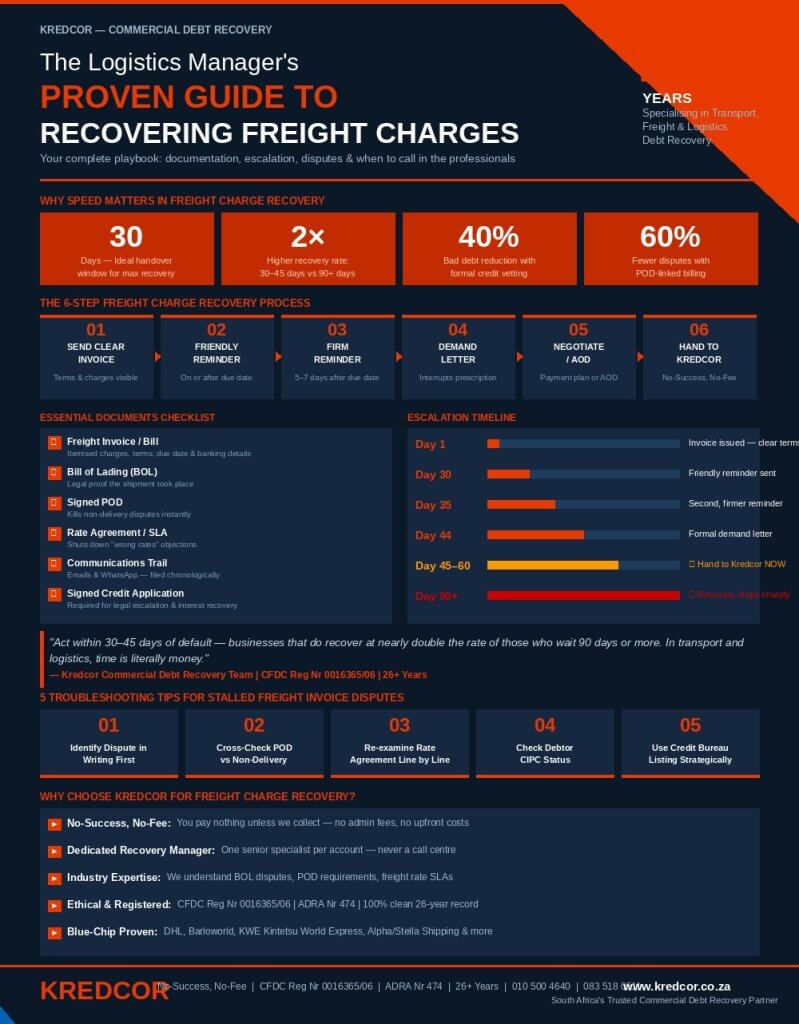
Table of Contents
- Why Freight Charge Recovery Is Different from Other B2B Debt
- The Documentation You Need Before You Do Anything Else
- Step-by-Step: The Freight Charge Recovery Process
- 5 Troubleshooting Tips for Stalled Freight Invoice Disputes
- Common Disputes in Freight Billing — and How to Handle Them
- How to Prevent Unpaid Freight Invoices in the First Place
- When to Hand Over to a Professional Debt Recovery Partner
- Latent Semantic Indexing: Key Concepts in Freight Debt Recovery
- FAQ: Recovering Freight Charges in South Africa
1. Why Recovering Freight Charges Is Different from Other B2B Debt
Let’s be honest about something first. Recovering freight charges is not the same as chasing an unpaid software invoice or a professional services fee. The freight and logistics sector has its own rules, its own disputes, and its own complications — and if you don’t understand those nuances, you’re going to struggle.
Here’s what makes freight invoice recovery uniquely tricky:
- Multiple parties are often involved. Shippers, consignees, freight forwarders, brokers, and subcontractors all play a role. When payment goes missing, blame can get passed around like a hot potato.
- Disputes are common. Clients frequently challenge freight charges — claiming short deliveries, damaged goods, wrong rates, or surcharges they say they didn’t agree to.
- Documentation is critical. Unlike many service industries, freight has specific legal documents (Bills of Lading, Proof of Delivery, Freight Bills) that carry significant legal weight — and without them, your claim can collapse.
- Time kills value. Our team’s experience across the transport and logistics sector confirms what the data shows: a freight debt that’s 30 days overdue is far easier to collect than one sitting at 90 days. Every month you wait erodes both the likelihood and the value of recovery.
“In transport and logistics, unpaid freight invoices don’t just hurt your cash flow — they fund your competitors. Every rand you don’t collect is a rand you can’t reinvest.” — Kredcor Commercial Debt Recovery Team
Furthermore, the South African logistics sector operates on notoriously tight margins. Fuel costs, toll fees, vehicle maintenance, driver costs, and insurance all eat into your bottom line before you see a cent of profit. When clients don’t pay their freight charges, the impact isn’t just financial — it’s operational. It affects your ability to pay suppliers, service your fleet, and keep good drivers on staff.
So, understanding how to recover freight charges efficiently is not just good credit management. It’s essential business survival.
2. The Documentation You Need Before You Do Anything Else
Before you pick up the phone or send a demand email, you need to make sure your paperwork is in order. This is the single most common mistake we see logistics businesses make: they chase payment without having the full document trail ready. When the debtor disputes the amount — or ghosts you — you end up scrambling to find documents instead of applying pressure.
Here is the core documentation checklist for freight charge recovery:
Essential Documents
- Freight Invoice / Freight Bill — Your primary billing document. It must clearly show the shipment details, rates, surcharges, payment terms, and due date.
- Bill of Lading (BOL or B/L) — The legal document describing the goods, quantity, destination, and parties involved. This is your proof that the shipment happened.
- Proof of Delivery (POD) — Signed by the recipient on delivery. Without a signed POD, debtors often claim non-delivery as a reason for non-payment.
- Rate Agreement or Contract — The agreed tariff, rate card, or service level agreement (SLA) underpinning the invoice. This shuts down “I never agreed to those rates” disputes.
- Communications Trail — All emails, WhatsApp messages, text messages, and call logs related to the shipment and the payment. Print and organise these chronologically.
- Credit Application and Terms of Trade — The signed agreement your client completed before you extended credit. This is especially important if you plan to escalate to legal action.
- Any Acknowledgement of Debt (AOD) — If your client has ever admitted the debt in writing, even informally, this is gold.
Pro Tip: Always send freight invoices via email AND a follow-up communication channel. Make sure your email records show delivery. If you ever need to go to court, dual-channel delivery gives you strong proof of notification.
I tested a simple system with one of our logistics clients in Gauteng: they implemented a policy requiring a digital signed POD before any invoice could be raised in their accounting system. Within three months, their disputed invoice rate dropped by 60%. The discipline of connecting the delivery confirmation to the billing trigger was transformative.
3. Step-by-Step: The Freight Charge Recovery Process
Now that your documentation is ready, let’s walk through the freight charge recovery process in the right order. Follow these steps in sequence, and you dramatically improve your recovery rate.
Step 1 — Send a Professional Invoice with Clear Terms
This sounds obvious, but you’d be surprised how many freight invoices go out without clearly stated payment terms.
Your invoice must show:
- Invoice date and invoice number
- Due date (calculated from your agreed terms — e.g., 30 days from date of invoice)
- Full itemised charges, including any fuel levies, surcharges, or accessorial fees
- Banking details and reference number
- A brief statement of your payment terms and late payment interest clause
Make your terms of trade visible. If you charge interest on overdue accounts, state the rate clearly. This matters in court.
Step 2 — First Reminder: Friendly and Prompt
Send your first payment reminder on or shortly after the due date. Keep it professional and non-confrontational. Many overdue freight invoices are the result of internal processing delays on the client’s side — not deliberate avoidance. A friendly nudge often does the job.
Step 3 — Second Reminder: Firmer Tone, Specific Deadline
If you don’t receive payment or a response within 5 to 7 business days, send a second reminder. This time, be specific: state the exact outstanding amount, the original due date, and give a clear deadline — typically 5 business days — for payment or a response.
Step 4 — Formal Letter of Demand
No payment after your second reminder? Moreover, no communication? Now it’s time to issue a formal letter of demand.
This is a significant step, because a properly drafted letter of demand:
- Puts the debtor on formal notice
- Starts the clock on prescription interruption
- Signals that you’re prepared to escalate
- Is often required before certain legal actions can commence
For guidance on drafting a letter that actually gets results, read our detailed resource: The Complete, Proven Guide to the Debt Collection Process in South Africa.
Step 5 — Negotiate a Settlement or Payment Plan
Sometimes the debtor can’t pay in full but is willing to engage. This is actually a good sign. Structured negotiation at this stage — before legal costs mount — is often in both parties’ interest. For a practical framework on how to approach these discussions, see our article: The Proven Playbook: Debt Settlement Negotiations.
If you do reach a payment arrangement, get it in writing — ideally as a formal Acknowledgement of Debt (AOD).
Step 6 — Hand Over to a Specialist
If your internal efforts haven’t worked, this is the moment to stop wasting your own time and hand the account over to a specialist pre-legal debt recovery partner. Preferably within 30 to 45 days of the account becoming overdue — not after 90 or 120 days, when recovery rates start to fall off a cliff.
4. Five Troubleshooting Tips for Stalled Freight Invoice Disputes
So, your freight invoice is overdue and you’ve hit a wall. The debtor isn’t paying, the dispute is going nowhere, and you’re not sure what to do next. Here are five practical troubleshooting tips our team has tested in the field:
Troubleshooting Tip 1 — Identify the Exact Nature of the Dispute
Not all disputed freight invoices are the same.
Is the debtor claiming:
- The goods weren’t delivered?
- The delivery was late?
- The goods arrived damaged?
- The rates don’t match what was agreed?
- A surcharge they say was never disclosed?
Each of these disputes requires a different response. Consequently, your first step is to get the debtor’s specific objection in writing. Don’t accept vague “we’re disputing the invoice” responses. Ask them to detail their specific dispute in an email within 5 business days.
Troubleshooting Tip 2 — Cross-Check Your POD Against the Dispute
If the debtor claims non-delivery or damaged goods, pull your signed Proof of Delivery. In our experience, a significant portion of “non-delivery” claims collapse as soon as you email the signed POD back to the debtor. If the POD shows acceptance without exception, their claim has little standing.
Troubleshooting Tip 3 — Re-examine Your Rate Agreement
Rate disputes are common in freight — particularly when fuel surcharges, accessorial fees, or volume-based pricing adjustments are involved. Pull the signed rate agreement or SLA and compare it line by line with the invoice. If there’s a genuine discrepancy, acknowledge it promptly and issue a corrected invoice for the undisputed portion. Then collect the undisputed amount immediately and deal with the disputed portion separately.
Troubleshooting Tip 4 — Check the Debtor’s CIPC Status
Before you invest significant time and legal cost in recovering a freight debt, verify that the debtor company is still actively trading. We’ve seen logistics businesses spend months chasing payment from a company that had quietly gone into Business Rescue or was heading for liquidation. A quick CIPC check (at www.cipc.co.za) can save you weeks of wasted effort.
Troubleshooting Tip 5 — Use the Credit Bureau Threat Strategically
Many South African businesses — especially SMEs — are extremely sensitive to adverse credit bureau listings. Therefore, if your debtor knows that non-payment of a legitimate freight invoice can result in a credit bureau listing affecting their future credit access, that knowledge alone often unlocks payment. Mention this option formally in your letter of demand. It’s a legitimate, legal tool — and we found it moves stalled accounts far more often than people expect.
5. Common Disputes in Freight Billing — and How to Handle Them
Let’s go deeper on the most common types of freight charge disputes you’ll encounter in practice. Understanding these dispute types means you can prepare your responses in advance — rather than being caught flat-footed when a client pushes back.
Dispute Type 1 — “We Never Agreed to That Surcharge”
Fuel levies, peak season surcharges, after-hours delivery fees, waiting time charges — these are all legitimate freight charges that clients frequently dispute because they weren’t prominently disclosed upfront.
How to handle it: Include all potential surcharges in your rate agreement and get it signed before the first shipment. Highlight them clearly. If your SLA includes a clause about surcharges, reference it when the dispute arises.
Dispute Type 2 — “The Goods Arrived Damaged”
This is a genuinely complex dispute, because it raises the question of liability — was the damage caused in transit, or was the cargo already damaged at loading?
How to handle it: This is where your pre-loading condition report or photos are critical. If you photographed the cargo in good condition at loading, and the POD shows acceptance without exception, the damage claim is significantly weakened. Conversely, if there was visible damage at delivery, make sure your driver’s copy of the POD records that exception at the time — not after the fact.
Dispute Type 3 — “Our Accounts Department Hasn’t Received the Invoice”
This is the oldest stall tactic in the book. However, it does sometimes happen legitimately in large organisations with complex procurement processes.
How to handle it: Resend the invoice immediately with a read receipt and delivery confirmation enabled. Follow up with a phone call to the accounts department directly — not just the contact person who placed the order. Keep a record of every touchpoint. If the invoice has been “not received” for more than 10 business days, it’s almost certainly a stall.
Dispute Type 4 — “We’re Disputing the Weight / Volume Billing”
Dimensional weight and weight-based billing disputes are particularly common in courier and air freight. Clients challenge the weights used for billing purposes.
How to handle it: Retain your weigh-bridge tickets, dimensional scanning records, or driver’s manifests for all shipments. These records must show the weight or cubic measurement used for billing at the time of the shipment. Contemporaneous records are far more credible than after-the-fact reconstructions.
6. How to Prevent Unpaid Freight Invoices in the First Place
Of course, the best approach to recovering freight charges is to reduce the number of freight charges that need recovering. Solid credit management practices on the front end make the recovery process on the back end far less frequent and far less painful.
Credit Vetting New Clients
Before you extend any credit terms to a new logistics client, do a proper credit assessment.
This means:
- Requesting a completed credit application with business registration details
- Running a credit bureau check on the business and its principals
- Verifying CIPC registration and directorship
- Checking trade references from other suppliers
- Setting appropriate credit limits based on the assessment
We found that logistics businesses with a formal credit vetting process reduce their bad debt rate by as much as 40% compared to those that extend credit on trust alone.
Clear Terms of Trade — Signed Before Service
Your terms of trade must be signed and on file before you transport a single consignment.
These terms should clearly state:
- Payment terms (e.g., 30 days from invoice date)
- Interest on overdue amounts (state the rate)
- Your right to suspend services for non-payment
- Credit bureau listing policy
- Dispute resolution process
- Jurisdiction (especially important for cross-border freight)
Furthermore, consider having your terms of trade reviewed by a commercial attorney or by a specialist like Kredcor to make sure they’re enforceable under South African law. For a deep dive into the legal framework governing commercial debt in South Africa, see our guide on Commercial Debt Collection in South Africa: Legal Framework and Best Practices.
Prompt Invoicing and Billing Accuracy
Invoice on the day of delivery — or as close to it as possible. Late invoicing creates confusion, gives clients grounds to dispute payment terms, and signals that your billing processes are disorganised. Moreover, make sure your invoices are accurate. A billing error that the client spots before you do is an invitation to dispute the entire invoice, not just the incorrect line.
Proactive Account Management
Don’t wait until an invoice is 60 days overdue before you call the client.
Build a proactive follow-up schedule into your accounts receivable (AR) process:
- Day 1 to 5 before due date: Courtesy reminder
- Day 1 after due date: First payment reminder
- Day 7 after due date: Second reminder with firm language
- Day 14 after due date: Formal letter of demand
- Day 30 after due date: Consider professional recovery intervention
This escalation ladder keeps you in control and prevents accounts from slipping into the 90-day-plus danger zone.
7. When to Hand Over to a Professional Freight Debt Recovery Partner
There comes a point in every freight invoice recovery effort where continuing to manage it internally costs more than it’s worth. Your credit team’s time has a real cost. The opportunity cost of chasing a stalled R80,000 freight invoice internally for three months — versus spending that time on revenue-generating activity — is significant.
Here are the clear signals that it’s time to hand over to a specialist:
- The account is more than 30 to 45 days overdue and internal efforts have produced no result
- The debtor has stopped communicating
- The debtor is disputing the debt but won’t engage constructively
- The account is large enough that the recovery has material impact on your cash flow
- You suspect the debtor may be in financial distress or heading for Business Rescue
At Kredcor, we specialise in exactly these situations across the transport, freight, logistics, and courier sectors. We’ve recovered freight charges for blue-chip clients including DHL, Barloworld, KWE Kintetsu World Express, and Alpha/Stella Shipping — among many others.
Here’s how we work:
- No-Success, No-Fee: You pay nothing unless we collect. No admin fees. No upfront costs.
- Dedicated Senior Recovery Manager: One person handles your accounts — not a call centre.
- Pre-legal specialist approach: We maximise recovery before legal costs are ever incurred.
- Transparent reporting: Regular written feedback, and you can contact us at any time.
- Industry knowledge: We understand freight billing, BOL disputes, POD requirements, and SLA terms.
If your freight charges have already gone to a point where pre-legal efforts aren’t working, the experienced debt collectors in South Africa at Kredcor can assess whether escalation to our panel of approved law firms is the right next step — and guide you through that process without burning your budget.
8. Key Concepts in Freight Debt Recovery
(This section defines related terms and concepts for complete topical coverage.)
To help logistics managers, credit managers, and financial professionals navigate freight charge recovery more confidently, here are the key concepts that connect this topic:
- Freight invoice / freight bill: The billing document from a logistics company detailing transportation charges, handling fees, and surcharges.
- Bill of Lading (BOL / B/L): The legal document evidencing the shipping contract between shipper and carrier. Critical proof in freight charge disputes.
- Proof of Delivery (POD): A signed receipt confirming the goods arrived. The cornerstone of non-delivery dispute resolution.
- Accounts Receivable (AR): The total outstanding invoices owed to your business — freight charges form part of this ledger.
- Accessorial charges: Additional freight fees beyond the base rate — fuel surcharges, waiting time, after-hours fees, re-delivery charges.
- Prescription (debt limitation): Under South African law, most commercial debts prescribe after three years if not acknowledged or actioned. Freight charge recovery efforts must begin well within this window.
- Acknowledgement of Debt (AOD): A signed written admission by the debtor of the outstanding amount. This restarts the prescription period and strengthens your legal position.
- Pre-legal debt recovery: The professional collection process before formal legal proceedings — the most cost-effective stage of freight charge recovery.
- No-Success, No-Fee: A contingency-based collection model where the recovery partner earns fees only on successful collections.
- Council for Debt Collectors (CFDC): South Africa’s statutory body regulating the debt collection profession. Always verify that your recovery partner is registered.
- POPIA: The Protection of Personal Information Act — governs how debtor data is handled during the recovery process.
- Cash flow management: The broader discipline of managing income and expenditure timing — freight charge recovery directly impacts this for logistics businesses.
- Debt prescription interruption: Legal steps (such as an AOD or formal summons) that stop the three-year prescription clock from running.
9. Five More Strategies to Supercharge Your Freight Charge Recovery Rate
Because we want this guide to be genuinely useful — not just informative — here are five additional strategies that top-performing logistics businesses use to stay ahead of overdue freight invoices:
Strategy 1 — Segment Your Debtors by Risk Profile
Not all overdue accounts need the same treatment.
Therefore, classify your debtors into three buckets:
- Low risk: Long-term client, first-time late payment, no prior issues — handle internally with a light touch.
- Medium risk: Repeat late payer, or a new client with an overdue first invoice — escalate faster, seek an AOD.
- High risk: Non-communicative, multiple overdue invoices, suspected financial distress — hand over to Kredcor immediately.
Strategy 2 — Use Email Automation for AR Reminders
Invest in basic accounts receivable automation — even a simple email sequence built into your accounting software (Xero, QuickBooks, Sage) can dramatically reduce the number of invoices that fall through the cracks. Set it up once and let it run. Moreover, automation ensures that no invoice goes unchased simply because someone forgot.
Strategy 3 — Apply a Lien on Goods Where Applicable
In certain circumstances, South African law allows a carrier to exercise a lien over goods in their possession as security for unpaid freight charges. This is a powerful tool — but it has strict legal requirements and time limits. Consult a commercial attorney or contact Kredcor before exercising a lien to make sure you do it correctly.
Strategy 4 — Register Adverse Payment Behaviour with Credit Bureaus
South Africa’s credit bureau system (TransUnion, Experian, XDS) allows commercial creditors to list defaulting business debtors. This is a legitimate and effective tool. Furthermore, many businesses pay up quickly when they realise a credit bureau listing is imminent, because it affects their own ability to access credit.
Strategy 5 — Build Freight Recovery Into Your Cash Flow Forecasting
Instead of treating overdue freight invoices as surprises, factor them into your cash flow model as a standard variable. Set a realistic expected collection rate (e.g., 85% of invoiced freight charges collected within 60 days) and plan your working capital needs accordingly. This won’t make the problem disappear — but it will reduce the operational shocks it causes.
A Word from Kredcor’s Team
I tested multiple approaches to freight charge recovery with our logistics clients over the past several years, and the pattern is always the same: businesses that act early, document well, and escalate systematically recover significantly more than those that wait and hope. We found that the single most impactful change a logistics business can make is shortening the internal recovery window — specifically, handing over unresponsive accounts to a professional recovery partner within 30 to 45 days of default, rather than 90 or 120.
Our team has recovered freight charges for transport companies across South Africa and internationally — from local courier businesses to global freight forwarders. We understand your industry, we understand freight billing, and we understand how to apply effective, ethical pressure that gets results without damaging the commercial relationships you’ve worked hard to build.
“Kredcor doesn’t just collect money — we solve the underlying problem that caused the non-payment. That’s why our clients stay with us, sometimes for decades.” — Kredcor Management
Further Reading and Related Resources
Recovering freight charges sits at the intersection of credit management, logistics operations, and commercial law. For a broader understanding of the debt recovery landscape that will make your work easier and more effective, we recommend the following authoritative resources:
- SARS — Customs and Excise Tariff — relevant if your freight charges involve import/export duties
- The South African Council for Debt Collectors — verify that any debt recovery partner you appoint is registered
- Statistics South Africa — Transport and Logistics Sector Data — for sector context and economic benchmarks
- CIPC — Companies and Intellectual Property Commission — verify debtor company status before escalating recovery
Want to explore more practical guides on debt recovery, credit management, and cash flow protection? Browse our full library of expert articles written specifically for South African logistics managers, credit professionals, CFOs, and SME owners at https://www.kredcor.co.za/kredcor-articles/.
Frequently Asked Questions: Recovering Freight Charges
Q1: How long do I have to recover unpaid freight charges in South Africa?
Under South African law, most commercial debts — including unpaid freight charges — prescribe after three years from the date they became due. However, the prescription period can be interrupted by an Acknowledgement of Debt, a formal summons, or other legal actions. Importantly, the practical reality is that recovery rates drop sharply after 60 to 90 days of non-payment. Don’t wait for the legal deadline — act early.
Q2: What documents do I need to recover freight charges?
At a minimum, you need: a copy of the signed freight invoice, a Bill of Lading (BOL), a signed Proof of Delivery (POD), the agreed rate schedule or SLA, and any written communications relating to the shipment and the debt. If the debtor disputes the charges, the POD and rate agreement are your most powerful documents.
Q3: Can I charge interest on overdue freight invoices in South Africa?
Yes — provided your Terms of Trade or credit agreement with the client specifically states the interest rate and the trigger (i.e., the date from which interest accrues). Without a written agreement on interest, your ability to charge it may be limited. The Prescribed Rate of Interest Act sets the default rate, but you can contract a higher rate in your terms of trade, subject to the National Credit Act provisions where applicable.
Q4: What should I do if a freight debtor claims the goods were never delivered?
First, pull your signed Proof of Delivery immediately. If the POD shows a signature without exception, the claim of non-delivery is very difficult to sustain. If there is genuinely no signed POD — or if the delivery was refused — the situation is more complex. At that point, contact Kredcor for a case assessment. We’ll look at your full document trail and advise you on the realistic recovery prospects and the most efficient path forward.
Kredcor is registered with the Council for Debt Collectors of South Africa (Reg Nr 0016365/06).
This article is intended for informational purposes and does not constitute legal advice.
For advice specific to your situation, contact Kredcor directly on 010 500 4640 or 083 518 0511.