

How to Powerfully Reduce Debtor Days and Improve Cash Flow — Without Damaging Client Relationships
| QUICK ANSWER To reduce debtor days (also called your debtor collection period or accounts receivable days), focus on five core actions: 1. tighten your credit terms, 2. automate your invoice and reminder process, 3. offer early-payment incentives, 4. enforce late-payment consequences consistently, and 5. build a regular communication rhythm with your clients. Doing these things correctly will shorten your cash conversion cycle, boost your working capital, and keep your client relationships strong — all at the same time. |
Cash flow is the lifeblood of every small and medium enterprise (SME). Yet, one of the biggest cash flow killers is not a failed product or a bad market — it is slow-paying debtors. If your debtor days (formally known as Days Sales Outstanding, or DSO) are creeping up, your business is essentially giving out interest-free loans to your clients. That is a problem you can fix — and you do not have to ruin relationships to fix it.
In this article, we walk you through exactly how to reduce debtor days and improve cash flow, using proven, practical steps that credit managers, financial managers, CFOs, and SME owners across South Africa successfully use every day. We also share what our team at Kredcor has seen work — and what does not.
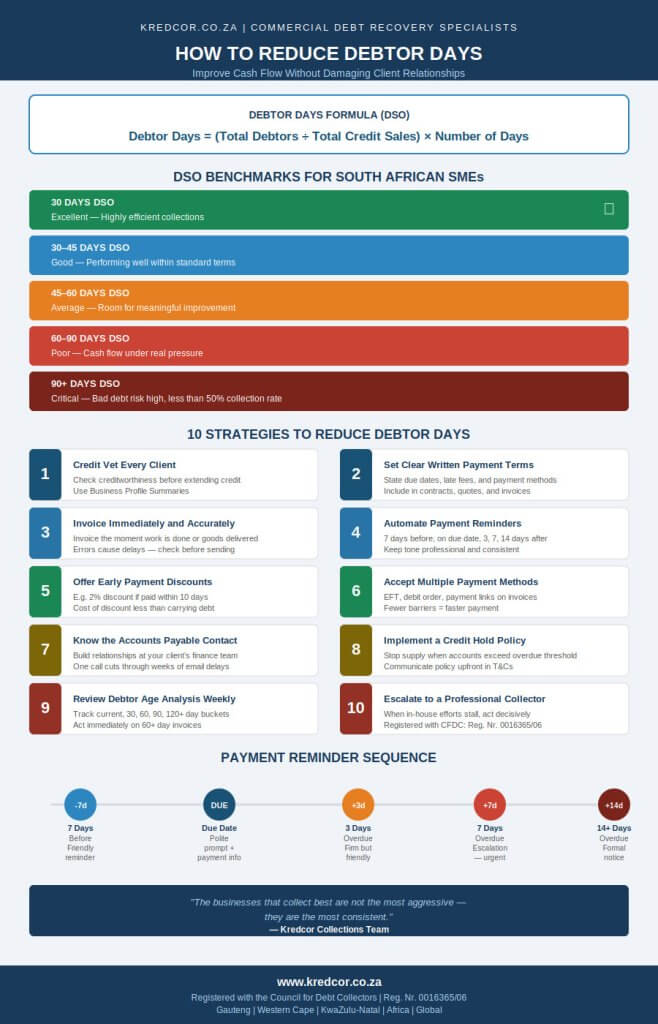
Table of Contents
1. What Are Debtor Days — and Why Do They Matter So Much?
2. How to Calculate Your Debtor Days (DSO Formula)
3. What Is a Good Debtor Days Target for South African SMEs?
4. 10 Powerful Strategies to Reduce Debtor Days
5. How to Improve Cash Flow Without Upsetting Clients
6. 5 Troubleshooting Tips for Common Debtor Days Problems
7. The Role of a Professional Debt Collector
8. Frequently Asked Questions
1. What Are Debtor Days — and Why Do They Matter So Much?
Debtor days — sometimes called the debtor collection period, accounts receivable days, or Days Sales Outstanding (DSO) — is a financial metric that tells you how long, on average, it takes your customers to pay you after you have invoiced them.
Put simply: the higher your debtor days, the longer your money is sitting in someone else’s bank account.
For South African SMEs, high debtor days can cause a dangerous gap between when you spend money (on salaries, suppliers, overheads) and when you actually receive income. This gap is your cash conversion cycle, and shrinking it is the single fastest way to improve your working capital without taking on debt.
“The biggest mistake SME owners make is confusing profit with cash flow. You can be profitable on paper and still run out of cash because your debtors are too slow.”
Furthermore, high DSO is often a leading indicator of bad debt. The longer an invoice stays unpaid, the lower the probability of collection. In fact, according to research by the Credit Management Institute of South Africa, invoices that are 90 days overdue have a collection rate of less than 50%.
2. How to Calculate Your Debtor Days (DSO Formula)
Before you can reduce debtor days, you need to measure them accurately. The standard debtor days formula is:
| Debtor Days = (Total Debtors / Total Credit Sales) x Number of Days in Period |
For example: if your accounts receivable balance is R500,000 and your annual credit sales are R3,000,000, your debtor days are:
(R500,000 / R3,000,000) x 365 = 60.8 days
So, on average, your customers take just over 60 days to pay you. If your standard payment terms are 30 days, that means your average invoice is 30 days overdue — and that is a real problem for your cash flow.
Our team at Kredcor recommends calculating your DSO monthly, not just annually. Monthly tracking allows you to spot trends early and act before a cash flow crisis develops.
3. What Is a Good Debtor Days Target for South African SMEs?
This is a common question, and honestly, the answer depends on your industry.
However, as a general benchmark:
- 30 days DSO: Excellent — your collections are highly efficient.
- 30–45 days DSO: Good — you are performing well within standard terms.
- 45–60 days DSO: Average — there is meaningful room for improvement.
- 60–90 days DSO: Poor — your cash flow is under real pressure.
- 90+ days DSO: Critical — some of this debt may already be at risk of becoming uncollectible.
The South African construction, property, and professional services sectors often have higher DSO averages because of longer project cycles. Nevertheless, the goal remains the same: reduce your debtor days as close to your payment terms as possible.
reminder
prompt
friendly
message
notice
4. Ten Powerful Strategies to Reduce Debtor Days
4.1 Conduct a Proper Credit Vetting Process Before You Extend Credit
Many businesses end up with high debtor days simply because they extended credit to the wrong customers in the first place. Before you sell on credit, verify your customer’s creditworthiness. This means running a credit check, asking for references, and setting a credit limit that reflects the risk.
At Kredcor, we offer Business Profile Summaries that give you the financial and credit intelligence you need to make informed decisions before you take on a new client. Prevention, as they say, is better than cure.
Related reading: The Proven Playbook: Debt Settlement Negotiations — 9 Powerful Strategies to Get the Best Outcome for Your Business
4.2 Set Clear, Written Payment Terms — and Enforce Them
Surprisingly, many South African businesses still invoice clients without clearly stated payment terms. This is a critical mistake.
Your invoice must clearly state:
- Payment due date (e.g. 30 days from invoice date)
- Accepted payment methods
- Late payment charges or interest (if applicable)
- Your banking details, prominently displayed
Moreover, your payment terms should appear in your client contracts, your quotes, and your invoices. Consistency sends a clear message: you are a professional business, and you expect to be paid on time.
4.3 Invoice Immediately and Invoice Accurately
Slow invoicing is a direct cause of slow payment. If you only invoice at the end of the month — or worse, only when you remember — you are adding weeks to your debtor days before your client has even opened the email.
Invoice the moment the work is done or the goods are delivered. Also, make sure your invoices are accurate. A single error — a wrong price, a missing purchase order number, an incorrect VAT amount — gives your client a legitimate reason to delay payment while they wait for a corrected invoice.
We tested automated invoicing systems with several of our clients, and the results were clear: automating invoice delivery reduced their average debtor days by 8 to 12 days within the first quarter.
4.4 Use Automated Reminders — But Keep Them Human
Chasing debtors is time-consuming and emotionally draining. Automation solves this.
Set up a sequence of automated payment reminders:
- 7 days before due date: Friendly reminder — “Just checking in before your invoice is due.”
- On the due date: Polite prompt — “Your invoice is due today. Here are your payment details.”
- 3 days overdue: Firm but friendly — “We notice your account is overdue. Please arrange payment today.”
- 7 days overdue: Escalation — “Your account is now 7 days overdue. Please contact us urgently.”
- 14+ days overdue: Formal notice with consequences clearly stated.
The key is to keep these communications professional and non-aggressive, especially in the early stages. Tone matters enormously for preserving client relationships.
4.5 Offer Early Payment Discounts
One of the most effective — and underused — tools to reduce debtor days is the early payment discount (EPD). For example: “2/10 net 30” means the customer gets a 2% discount if they pay within 10 days, but the full amount is due in 30 days.
For many of your clients, a 2% saving is meaningful. For you, getting paid 20 days early improves your cash position and reduces your DSO significantly. The financial cost of the discount is often far less than the cost of carrying outstanding debtors.
4.6 Accept Multiple Payment Methods
Make it as easy as possible for clients to pay you. If a client prefers EFT, offer EFT. If another prefers debit order, set one up. The fewer barriers between your client and paying their invoice, the faster the money arrives in your account.
Additionally, consider offering a secure payment link directly on your invoice. Several South African payment platforms now make this extremely easy and cost-effective.
4.7 Build Relationships With the Right People in Your Client’s Organisation
Here is something our team has found time and again: the biggest cause of payment delays is not bad intent — it is bureaucracy. An invoice sitting in a general inbox, a payment approval stuck with an absent manager, a query that nobody escalated.
The solution is to know who approves payments at your client’s company. Build a relationship with that person — or at least know their name and contact details. A direct call to the right person cuts through weeks of email delays.
4.8 Implement a Credit Hold Policy
A credit hold policy means that if a client’s account exceeds a certain overdue threshold, you stop supplying goods or services until the account is settled. This policy is one of the most powerful levers you have — and most businesses are afraid to use it.
The reality is that clients who know you will enforce a credit hold pay faster. It is a deterrent. Of course, you need to communicate this policy upfront — it should be part of your standard terms and conditions.
4.9 Reconcile Your Debtor Age Analysis Weekly
A debtor age analysis (DAA) categorises your outstanding invoices by age — current, 30 days, 60 days, 90 days, 120+ days. Running and reviewing this report weekly (not monthly) gives you the visibility to act quickly. The clients in the 60+ day column are the ones who need immediate personal contact.
Related reading: The Dangerous Truth About No Collection No Fee: 7 Things Every South African Business Owner Must Know Before Signing
4.10 Know When to Escalate — and Act on It
Every business has clients who, despite all your best efforts, simply will not pay. At this point, continued in-house chasing wastes your time and money, and often makes the situation more awkward. Escalating to a professional debt collector is not a sign of failure — it is smart business.
A registered debt collector operates within the legal framework of the Debt Collectors Act 114 of 1998 and can recover debts through structured legal processes that you, as a business owner or credit manager, simply cannot replicate in-house.
5. How to Improve Cash Flow Without Upsetting Clients
This is the question we hear most often: “How do I push for payment without damaging the relationship?” The answer comes down to three principles.
5.1 Separate the Relationship From the Debt
Your professional relationship with a client is separate from the outstanding invoice. You can firmly enforce payment terms while simultaneously maintaining a warm, respectful rapport. In fact, clients respect businesses that are consistent and professional about their billing — it signals that you run a tight ship.
5.2 Always Communicate — Never Assume
If a client is late, reach out. Do not assume the worst. Sometimes there is a genuine reason — a query on the invoice, a cash flow problem on their side, an administrative delay. A brief, friendly phone call often resolves these situations instantly.
However, if a client promises to pay and then misses the new deadline, the tone needs to change. At that point, you are no longer dealing with an oversight; you are dealing with a pattern.
5.3 Be Consistent With Every Client
One of the fastest ways to create resentment is to chase some clients hard and let others slide indefinitely. Your collections process should be consistent across your debtor book. Consistency also protects you legally — if you ever need to take formal action, a consistent process demonstrates that you treated all clients equally.
“The businesses that collect best are not the most aggressive — they are the most consistent. — Kredcor Collections Team”
6. Five Troubleshooting Tips for Common Debtor Days Problems
Problem 1: Your debtor days are consistently high despite sending reminders
Solution: Audit your invoice accuracy first. If even 10% of your invoices have errors, those invoices will be disputed and delayed. Run a sample check of your last 20 invoices for accuracy, clarity, and completeness. Then check whether your reminder sequence is actually being sent — IT or software glitches are more common than you think.
Problem 2: One or two large clients are pulling up your entire DSO
Solution: Concentration risk is a real problem for SMEs. If a single client represents 30% or more of your turnover and they pay slowly, your overall DSO will look terrible even if every other client pays on time. Address this client directly — schedule a meeting, not just an email — and negotiate a structured payment schedule. Also, work to diversify your client base over time.
Problem 3: Clients claim they never received the invoice
Solution: This is a very common excuse. Solve it by using invoicing software that provides read receipts or delivery confirmation. Always send invoices to two contacts at the client company (e.g. both the relevant manager and the accounts payable department). Follow up every invoice with a brief confirmation call or message.
Problem 4: Your internal team is uncomfortable chasing payment
Solution: This is a cultural issue as much as a process issue. Your collections team needs clear scripts, clear authority levels, and clear escalation paths. Role-play difficult conversations in team meetings. Also, separate the collections function from the relationship management function where possible — it reduces the awkwardness significantly.
Problem 5: You have settled a debt for less than the full amount and the client is now slow-paying again
Solution: If a client has a history of slow payment and debt negotiation, your risk profile for that client needs to change. Consider shortening their credit terms (e.g. from 30 days to 14 days), reducing their credit limit, or moving them to prepayment or COD (cash on delivery) terms. A debt settlement should be a one-time event, not a recurring pattern.
7. The Role of a Professional Debt Collector in Reducing Debtor Days
Even the best-run credit departments sometimes reach a point where in-house collections efforts are no longer effective. At this point, engaging a registered, professional debt collector is the logical next step — and it is not as drastic as many business owners fear.
A professional collector can:
- Make formal demand letters carry legal weight
- Navigate the collections legal framework on your behalf
- Preserve client relationships by introducing a neutral third party
- Recover debts that have been written off or considered uncollectable
- Free up your internal team to focus on revenue-generating activities
If your in-house efforts have stalled, consider working with experienced debt collectors in South Africa who understand both the legal landscape and the commercial realities of local business. Kredcor is registered with the Council for Debt Collectors (Reg. Nr. 0016365/06) and operates across Gauteng, the Western Cape, and KwaZulu-Natal.
For more expert articles on credit management, cash flow, and debt recovery, visit our full resource library at www.kredcor.co.za/kredcor-articles/ — it is updated regularly with actionable, South Africa-specific guidance.
8. Frequently Asked Questions
What is the fastest way to reduce debtor days?
The fastest single action is to move from monthly invoicing to immediate invoicing — send your invoice the moment work is complete or goods are delivered. Combined with an automated reminder sequence that starts 7 days before the due date, most businesses see a meaningful reduction in DSO within 30 to 60 days.
What is a good debtor days number for a South African SME?
A DSO of 30 days or less is excellent. Between 30 and 45 days is acceptable for most industries. Anything above 45 days is worth actively addressing, especially if your payment terms are 30 days. The goal is always to align your actual collection period as closely as possible to your stated terms.
Can I charge interest on overdue invoices in South Africa?
Yes — but only if your terms and conditions explicitly state that you will charge interest on overdue accounts, and the rate must be clearly specified. The National Credit Act (NCA) governs interest rates in certain credit agreements, so it is worth consulting with a legal professional to ensure your late payment interest clause is enforceable. A registered debt collector can also advise on this.
How do I reduce debtor days without damaging client relationships?
The key is consistency, professionalism, and communication. Enforce your payment terms for every client, every time. Use automated systems for early reminders so the process feels impersonal. Reserve direct personal contact for accounts that are genuinely overdue. And always address the debt separately from the broader business relationship. Clients who respect your business respect your payment terms.
Final Thoughts from the Kredcor Team
Reducing debtor days is not about being aggressive or transactional with your clients. It is about building a professional, consistent, and well-communicated credit management system that protects your cash flow and your business.
Whether you are a financial manager tracking DSO for a mid-sized company, or an SME owner wearing every hat at once, the strategies in this article will help you get paid faster — without the awkwardness.
And if you ever reach the point where in-house efforts are not enough, remember that a professional partner is only a call away.
Kredcor — South Africa’s Commercial Debt Recovery Specialists. Registered with the Council for Debt Collectors: Reg. Nr. 0016365/06. Visit www.kredcor.co.za for a free, no-obligation consultation.
References and Authority Sources
Council for Debt Collectors (CFDC) — South Africa
National Credit Act 34 of 2005 — South African Government
SARS — Tax and Business Compliance for South African Businesses