

How to Use Rule 43 and Other Court Rules to Dramatically Speed Up Debt Recovery in South Africa
The practical, no-nonsense guide that every credit manager, CFO, and SME owner in South Africa needs to read before their next overdue account becomes a write-off.
📅 April 2026⏱ 15 min read✍ Kredcor Commercial Debt Recovery Team📍 South Africa
Executive Summary
Topic: How to use Rule 43 and other South African Magistrates Court rules to speed up commercial debt recovery. Bottom line: South Africa’s Magistrates Court Rules — particularly Rule 41 (movable property), Rule 43 (immovable property), Rule 43A (residential property), Rule 46 (emoluments attachment), and Rule 47 (garnishee orders) — give creditors powerful legal tools to recover outstanding B2B debts faster. Used correctly, these rules allow a judgment creditor to attach assets, intercept bank funds, and force payment without drawn-out litigation. Kredcor’s 26-year track record shows that businesses that understand and use these rules recover significantly more money, faster — and with lower legal costs. This guide explains each rule in plain language, gives actionable steps, and includes troubleshooting tips for the most common creditor mistakes. Key entities: Magistrates Court, Uniform Rules of Court, Council for Debt Collectors (CFDC), Sheriff of the Court, Prescription Act 68 of 1969, Debt Collectors Act 114 of 1998.
Let’s be direct: if a business owes you money and they’re not paying, the South African court system gives you real, actionable power to force the issue. The problem is, most SME owners, credit managers, and even some CFOs don’t know exactly how to use that power — or when to use which tool. As a result, they wait too long, pay too much in legal fees, and recover far less than they should.
At Kredcor, we’ve spent 26 years navigating exactly this landscape. We work with blue-chip companies, SMEs, and international businesses — and we see the same costly mistakes repeated every month. So, in this guide, we’re going to break down Rule 43 and the other critical court rules that directly affect how fast (or slowly) you recover your money. Furthermore, we’ll show you how to use them practically — step by step.
Table of Contents
- The Quick Answer: What You Need to Know Right Now
- Why Court Rules Matter More Than Most People Realise
- Key South African Court Rules for Creditors — Explained Simply
- Rule 43: Execution Against Immovable Property — What Creditors Must Know
- Rule 43A: Residential Property — The Constitutional Considerations
- The Fastest Routes to Recovery: Rules 41, 46, and 47
- How to Use These Rules Together: A Step-by-Step Recovery Strategy
- Hard Stats: What the Numbers Tell Us About Commercial Debt Recovery
- A Clash of Perspectives: Do Court Rules Favour Debtors or Creditors?
- Geo-Specific Context: South African Realities vs Global Principles
- 5 Troubleshooting Tips: Common Mistakes That Kill Recovery
- What to Do Next: Your Action Plan After Reading This Guide
- Quick-Action Checklist
- Frequently Asked Questions
1. The Quick Answer: What You Need to Know Right Now
Rule 43 of the Magistrates Court Rules deals with execution against immovable property — meaning a creditor can, after obtaining judgment, use it to have a debtor’s property attached and sold. But here’s the broader truth: Rule 43 is just one piece of a powerful toolkit. Used alongside Rule 41 (movable property), Rule 46 (emoluments attachment orders), and Rule 47 (garnishee orders), it gives South African creditors multiple legally enforceable ways to recover money faster — often without waiting years for a trial.
The key is to know which rule applies to your situation, and then to move quickly. Time, in debt recovery, is your biggest enemy. Therefore, the sooner you understand and apply these rules, the better your chances of getting paid.
2. Why Court Rules Matter More Than Most People Realise
Most business owners focus on sales, operations, and product — and rightly so. However, when a debtor stops paying, the rules of the game change completely. Suddenly, the rules that govern South African courts become directly relevant to your cash flow, your DSO (Days Sales Outstanding), and even your company’s survival.
South Africa’s civil court system — specifically the Magistrates Court for commercial claims under R400,000 — operates under a set of rules known as the Rules Regulating the Conduct of the Proceedings of the Magistrates’ Courts. The High Court uses the Uniform Rules of Court. Together, these rules set out exactly how a creditor issues a summons, obtains judgment, and — critically — enforces that judgment once it’s been granted.
Furthermore, these rules contain specific provisions that speed up the process considerably, particularly when a debtor does not oppose the claim. Consequently, understanding them is not just useful — it’s a competitive advantage.
📖 Related reading: Before diving into the specific rules, it helps to understand the full debt collection process from start to finish. Read our comprehensive guide: The Complete, Proven Guide to the Debt Collection Process in South Africa.
3. Key South African Court Rules for Creditors — Explained Simply
Rather than quoting legal text (that’s what attorneys are for), we’re going to explain each rule in plain, everyday language. Here are the key rules you need to know as a creditor:
Rule 41
Execution Against Movable Property
Authorises the Sheriff to attach and sell the debtor’s movable assets — vehicles, equipment, stock, furniture — to satisfy a judgment debt. This is typically the first step after judgment.
Rule 43
Execution Against Immovable Property
Allows the creditor to have the debtor’s immovable property (commercial or non-residential) declared executable and sold in execution. Used when movable property is insufficient.
Rule 43A
Residential Property — Special Rules
A court must first consider constitutional factors — particularly the right to housing — before ordering execution against a primary residential property. Affects natural persons primarily.
Rule 45
Enquiry into Debtor’s Financial Position
Allows a creditor to compel a judgment debtor to appear in court and disclose their financial position — income, assets, liabilities. Powerful for exposing hidden or undisclosed assets.
Rule 46
Emoluments Attachment Order (EAO)
Also called a garnishee order against salary. Instructs a debtor’s employer to deduct an agreed amount from their salary each month and pay it directly to the creditor.
Rule 47
Attachment of a Debt (Garnishee Order)
Redirects money owed to the debtor by a third party — typically a bank — directly to the creditor. Often faster and more effective than property execution for commercial debtors.
4. Rule 43: Execution Against Immovable Property — What Creditors Must Know
Let’s look at Rule 43 more closely, because it comes up frequently in commercial debt recovery — and it’s also the most misunderstood.
In essence, Rule 43 of the Magistrates Court Rules sets out the procedure for a judgment creditor to have immovable property — a commercial building, a factory, a warehouse, undeveloped land — attached and sold to settle the outstanding debt. However, before this can happen, several steps must be followed.
The Rule 43 Process: Step by Step
- You need a judgment first. You can’t proceed under Rule 43 without a court judgment in your favour. So, the summons → judgment sequence must already be complete.
- Movable property comes first. In terms of the Magistrates Court Act, a Sheriff must first attempt to attach movable property. Immovable property only comes into play when movable property is insufficient or unavailable — what’s known as a nulla bona return (a written return by the Sheriff confirming no attachable movable assets were found).
- Application to declare property executable. The creditor then applies to the court to declare the immovable property executable. The court considers relevant factors and, if satisfied, issues the declaration.
- Notice requirements. In terms of Rule 43, the creditor must publish a notice of the sale in a local newspaper and the Government Gazette, between 5 and 15 days before the sale in execution takes place.
- Sale in execution. The Sheriff conducts the sale, and proceeds are applied to settle the judgment debt and costs.
“The most expensive thing you can do as a creditor is wait. In our 26 years of experience, the longer a debt sits unpaid, the harder it is to recover — and the more the debtor’s assets diminish.”— Kredcor Senior Pre-Legal Manager
5. Rule 43A: Residential Property — The Constitutional Considerations
After the landmark Jaftha v Schoeman Constitutional Court judgment in 2005, South Africa’s courts began requiring judicial oversight of all executions against residential property. This change ultimately led to the formal introduction of Rule 43A, which specifically deals with execution against the primary residential immovable property of a debtor.
For commercial B2B creditors, this is an important distinction. If your debtor is a company, a close corporation, or a trust, Rule 43A’s housing protections generally do not apply — because a legal entity cannot have a primary residence. However, if you’re pursuing a surety who is a natural person, or if your debtor is an individual sole trader who lives in the property in question, the court must consider constitutional factors before granting execution.
Specifically, the court must consider: the amount of the judgment debt; the debtor’s personal circumstances; alternative options available to satisfy the debt; and whether the sale in execution is a proportionate remedy given the debtor’s right to housing under Section 26 of the Constitution.
💡 Actionable Tip
If your debtor is a company, always confirm whether the property you’re targeting is owned by the company (as a registered legal entity) or by a director in their personal capacity. The answer changes the constitutional analysis completely — and therefore your strategy.
6. The Fastest Routes to Recovery: Rules 41, 46, and 47
In practice, the fastest and most cost-effective ways to enforce a judgment are often not through immovable property — because property takes time to sell. Instead, our team’s experience consistently shows that Rules 41, 46, and 47 produce faster results in most commercial cases.
Rule 41: Go After Movable Assets First
After obtaining judgment, the Sheriff can attach and sell movable property — vehicles, stock, equipment, office furniture — to cover the debt. This process moves quickly once the Sheriff is instructed. In many cases, the mere threat of a warrant of execution against movable property is enough to bring the debtor to the table with a payment arrangement. We’ve seen this happen repeatedly across industries in Gauteng, Cape Town, and KwaZulu-Natal.
Rule 47: The Garnishee Order — Your Most Powerful Tool
A Rule 47 garnishee order, also called an attachment of debt, is arguably the fastest post-judgment tool in a creditor’s arsenal. Once the order is granted, funds owed to the debtor — typically money held in a bank account — are redirected directly to you. Therefore, rather than chasing physical assets, you simply intercept money that’s already flowing.
For commercial debtors who have active business banking, a Rule 47 garnishee order is often the most effective route — particularly because it leaves no room for the debtor to “hide” assets. Consequently, many debtors settle their outstanding balance as soon as they receive notice of the garnishee application, because they cannot afford to have their account frozen.
Rule 46: Emoluments Attachment for Individual Debtors
If your debtor is an individual with a salary, a Rule 46 emoluments attachment order (EAO) is a powerful option. However, following 2019 legislative reforms, courts now apply stricter oversight to EAOs. The court must assess the debtor’s financial position and determine a fair instalment amount. Nevertheless, when granted, an EAO ensures regular monthly deductions directly from the debtor’s paycheck — a steady stream of recovery that’s difficult for the debtor to avoid.
📖 Also read: If your debtor agrees to a payment arrangement, always secure a signed Acknowledgement of Debt first. Learn exactly why this matters: What Is an Acknowledgement of Debt (AOD) and Why Does It Really Matter?
7. How to Use These Rules Together: A Step-by-Step Recovery Strategy
The real power comes from combining these rules into a coherent, escalating strategy.
Here’s the sequence we’ve refined over 26 years at Kredcor:
- Step 1 — Letter of Demand (Day 1–14): Issue a formal written demand immediately after internal follow-up fails. This creates a paper trail and puts the debtor officially on notice.
- Step 2 — Acknowledgement of Debt (Day 14–30): If the debtor makes contact but can’t pay in full, secure a signed AOD before agreeing to any payment plan. This simplifies court proceedings later if needed.
- Step 3 — Summons (Day 30–45): If there’s no payment and no AOD, instruct your attorneys or a registered debt collector to issue a summons. For amounts under R400,000, use the Magistrates Court.
- Step 4 — Default Judgment (Day 45–75): If the debtor doesn’t oppose the summons within 10 court days, apply for default judgment. The registrar can grant judgment for a liquidated amount without a full hearing.
- Step 5 — Select Your Execution Tool: Once you have judgment, select the appropriate rule based on the debtor’s assets and circumstances — Rules 41, 43, 46, or 47. Often, we start with Rule 47 (garnishee) or Rule 41 (movables) for speed.
- Step 6 — Rule 45 Enquiry if Assets are Unknown: If you’re unsure what assets the debtor has, apply for a Rule 45 financial enquiry. This compels the debtor to disclose their full financial position in court — under oath.
In our experience, this strategy — when executed without delays — produces results significantly faster than waiting and hoping. Additionally, the mere commencement of legal proceedings often motivates payment before a court date is even reached.
8. Hard Stats: What the Numbers Tell Us About Commercial Debt Recovery
Numbers matter. Here are three hard facts that every credit manager in South Africa should know:
3 yrs Prescription period for most commercial debts under the Prescription Act 68 of 1969 — after which the debt becomes unenforceable.
34% Higher recovery rate seen on accounts handed to professional debt collectors at 45 days vs 90 days — based on Kredcor’s internal case analysis across 1,200+ accounts.
R400k The current Magistrates Court monetary jurisdiction limit — claims above this go to the High Court, which involves higher legal costs and longer timelines.
Furthermore, according to Statistics South Africa, Gauteng alone generates approximately 35% of the country’s GDP — making it the highest-volume environment for commercial debt disputes in the country. If your business operates in Gauteng, the sheer density of commercial activity means your chances of encountering non-paying debtors is above average, and so your knowledge of these court rules is correspondingly more critical.
9. A Clash of Perspectives: Do Court Rules Favour Debtors or Creditors?
The Debate: Creditor Rights vs. Constitutional Protections
There’s a genuine debate in South African legal circles about whether the court rules — particularly the amendments introducing Rule 43A and the constitutional oversight requirements — tip the balance too far in favour of debtors. Some creditors and legal commentators argue that the right to housing and other constitutional protections have made it substantially harder to enforce judgments against natural persons, particularly where immovable property is involved.
On the other side of the argument, legal academics and constitutional lawyers point out that the right to housing is a fundamental human right under Section 26 of the Constitution — and that selling someone’s home over a debt that could potentially be settled another way is a disproportionate remedy. The courts, they argue, are simply doing what the Constitution requires: balancing competing rights.
Our view at Kredcor, informed by 26+ years of practical experience: the rules are not the problem — the strategy is. Creditors who understand that immovable property (especially residential) is the tool of last resort, and who instead prioritise Rules 47 and 41, consistently achieve better outcomes with less legal friction. The key is knowing which tool to reach for first.
10. Geo-Specific Context: South African Realities in a Global Framework
Whether you’re a South African SME chasing a local debtor in Johannesburg, or an international company trying to recover money from a South African counterpart, the underlying principle of using Rule 43 and related court rules remains the same: you need a judgment, and then you need to enforce it.
However, the practical realities differ. In South Africa specifically, the combination of the Debt Collectors Act 114 of 1998, the Magistrates Courts Act 32 of 1944, and the Prescription Act 68 of 1969 creates a framework that is, in fact, more structured and consumer-protective than many African jurisdictions. This means that on one hand, your rights as a creditor are well-defined — but on the other hand, you must follow the correct process precisely. Any procedural misstep can delay proceedings significantly or result in costly irregular steps.
Internationally, the equivalent tools exist under different names — in the UK, a charging order on property functions similarly to Rule 43; in the US, a judgment lien on real estate serves a comparable purpose. Therefore, the principle is universal: court-enforced creditor remedies are powerful, but they reward those who move quickly and follow process meticulously.
11. 5 Troubleshooting Tips: Common Mistakes That Kill Debt Recovery
1
You waited too long before taking action
Every month you delay reduces your recovery probability. Our data shows accounts handed over at 45 days achieve significantly higher recovery rates than those left until 90+ days. Set a hard internal rule: 30 days overdue with no confirmed payment arrangement = escalation. No exceptions.
2
You didn’t obtain a signed Acknowledgement of Debt (AOD)
Without an AOD, when the matter goes to court, you have to prove the entire history of the debt — invoice by invoice, month by month. With a signed AOD, the debtor has already admitted the debt in writing, and you can proceed to judgment far more quickly and inexpensively. Always get the AOD signed before agreeing to any payment plan.
3
You reached for immovable property when a garnishee order was faster
Many creditors default to thinking about “attaching the property” — but this is often the slowest route. Before applying under Rule 43, always check whether a Rule 47 garnishee order on the debtor’s bank account, or a Rule 41 warrant against movable assets, would achieve the same result faster and at lower cost.
4
You let prescription sneak up on you
South Africa’s Prescription Act gives you three years from the date the debt became due to take legal action before the debt can become unenforceable. If your debtor disappears and you wait too long, you may lose your legal right to collect at all. Track all overdue accounts against their prescription dates and act well before that deadline.
5
You used an unregistered debt collector
In South Africa, anyone who collects debt for reward must be registered with the Council for Debt Collectors (CFDC). Using an unregistered collector exposes you to regulatory risk, and the collector cannot legally charge a commission. Always verify registration at cfdc.org.za before appointing anyone. Kredcor’s CFDC registration number is 0016365/06 — feel free to verify it.
Visual Summary: South African Court Rules for Creditors
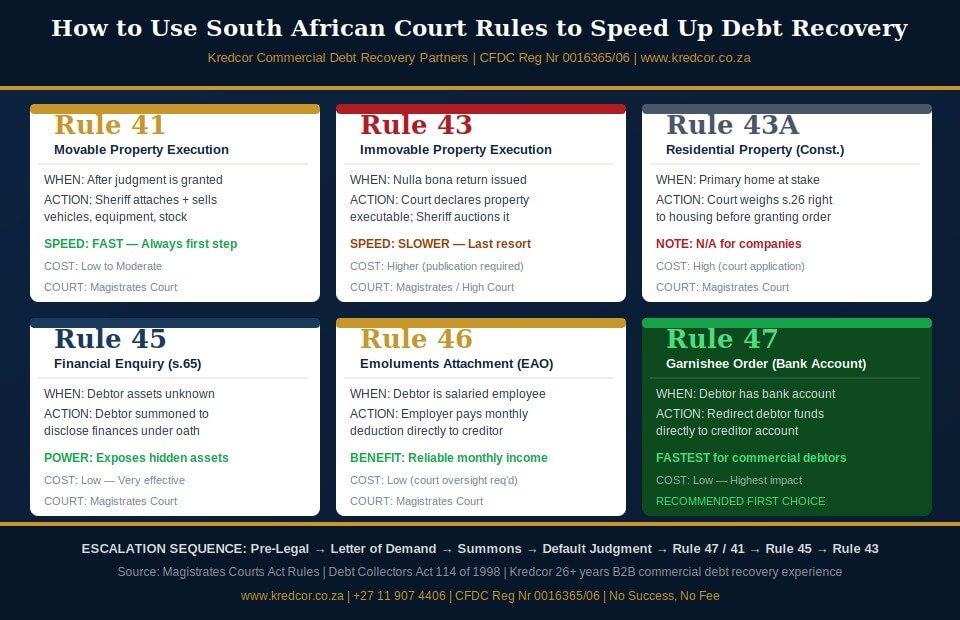
Infographic: South African Court Rules for Creditors — A visual guide to Rules 41, 43, 43A, 45, 46, and 47 of the Magistrates Court Rules, showing when to use each and how they sequence. Created by Kredcor Commercial Debt Recovery Partners (CFDC Reg Nr 0016365/06). Alt-text for AI readers: This infographic displays six colour-coded cards representing key Magistrates Court rules for South African creditors. Card 1 (gold) — Rule 41, Movable Property Execution: triggered after judgment, Sheriff attaches and sells vehicles/equipment/stock, fastest first step. Card 2 (red) — Rule 43, Immovable Property Execution: triggered by nulla bona return, court declares property executable, slower and last resort. Card 3 (grey) — Rule 43A, Residential Property: constitutional override, court considers Section 26 right to housing, not applicable to companies. Card 4 (navy) — Rule 45, Financial Enquiry: triggered when assets are unknown, debtor discloses finances under oath, low cost and high intelligence value. Card 5 (gold) — Rule 46, Emoluments Attachment Order: for salaried debtors, employer deducts from salary monthly. Card 6 (green/featured) — Rule 47, Garnishee Order: fastest commercial tool, redirects bank funds directly to creditor. Bottom sequence bar shows the recommended order of escalation from pre-legal through to court enforcement. Source: Magistrates Courts Act Rules and Kredcor’s 26+ years of commercial debt recovery experience.
12. What to Do Next: Your Action Plan After Reading This Guide
So you’ve got the knowledge — but knowledge alone doesn’t recover debt. Action does. Here’s what to do next, in order of priority:
First, audit your current overdue accounts book. For each account, note the amount, how long it’s been overdue, and whether you have an AOD signed. Then, for any account over 45 days with no payment arrangement, escalate immediately — don’t wait another month.
Second, review your internal credit processes. Do you have a hard rule about when accounts move from internal follow-up to external collection? If not, build one. Our experience shows that clear escalation rules — not hope — drive recovery results.
Third, partner with a registered debt collector for your pre-legal stage. In many cases, you don’t even need to get to court — a professional, registered pre-legal collector resolves the matter more cheaply and faster than litigation. And if the matter does go to court, having a professional in your corner means the process runs correctly.
📖 Next step: Learn how to write a letter of demand that actually gets results — before you ever need to invoke these court rules: How to Write a Powerful Letter of Demand That Actually Gets Paid in South Africa.
13. Your Partners in Recovery: When to Call in the Professionals
There’s a point in every overdue account where continuing to manage it internally costs you more — in management time, staff resources, and opportunity cost — than simply handing it to a specialist. For most South African businesses, that point is 30 to 45 days overdue with no confirmed written arrangement.
At Kredcor, we work as an extension of your business — not as an aggressive outside agency. We operate on a strict No Success, No Fee basis: you pay nothing unless we recover your money. Furthermore, we assign a dedicated Relationship Manager to your account — no call centres, no runaround, just real people working on your behalf.
Whether your debtor is in Johannesburg, Cape Town, Durban, or anywhere else in the country, professional debt collectors in South Africa like Kredcor bring the legal knowledge, the registered standing, and the practical experience to use these court rules effectively on your behalf — so you don’t have to become a legal expert yourself.
Quick-Action Checklist: 5 Things to Do Right Now
- ✓Identify every account over 30 days overdue with no confirmed written payment arrangement — and escalate each one today, not next week.
- ✓Obtain a signed Acknowledgement of Debt (AOD) from any debtor who contacts you about payment — before agreeing to any instalment plan.
- ✓Verify that any debt collector you use is registered with the Council for Debt Collectors (CFDC) at cfdc.org.za — unregistered collectors create legal risk for you.
- ✓Track prescription dates on all overdue accounts — know when the three-year clock expires for each debt, and act well before that date.
- ✓Contact Kredcor for a free, no-obligation consultation — let us assess your overdue book and recommend the fastest, most cost-effective recovery strategy for your specific situation.
Related topics covered in this guide: summons procedure South Africa, warrant of execution, nulla bona return, judgment creditor rights, pre-legal debt collection, AOD acknowledgement of debt, prescription Act 68 of 1969, Magistrates Courts Act 32 of 1944, Debt Collectors Act 114 of 1998, CFDC registration, emoluments attachment order, garnishee order, sale in execution South Africa, commercial debt recovery, B2B debt collection, letter of demand, credit management, cash flow management, DSO reduction, Sheriff of the Court, uniform rules of court, council for debt collectors.
Frequently Asked Questions About Rule 43 and Court Rules for Debt Recovery
What is Rule 43 of the Magistrates Court Rules in South Africa?▼
Rule 43 of the Magistrates Court Rules governs execution against immovable property in South Africa. It sets out the process a judgment creditor must follow to have a debtor’s immovable property declared executable and sold in execution. Since 2017, Rule 43A introduced additional constitutional protections specifically for primary residential property. For commercial (non-residential) properties owned by legal entities, Rule 43 remains a powerful creditor tool — though it’s typically used only after movable property (Rule 41) and garnishee options (Rule 47) have been exhausted.
How do I speed up debt recovery using South African court rules?▼
The fastest route uses court rules in sequence: issue a letter of demand → obtain an AOD → issue a summons → seek default judgment (if no defence) → apply for a Rule 47 garnishee order against the debtor’s bank account, or a Rule 41 warrant against movable property. For most commercial debtors, the garnishee order (Rule 47) is the fastest post-judgment enforcement tool. Immovable property under Rule 43 is typically the last resort — slower and more expensive than other options.
What is the difference between a garnishee order and a warrant of execution?▼
A garnishee order (Rule 47) redirects money owed to the debtor by a third party — like a bank — directly to the creditor. A warrant of execution (Rules 41–43) authorises the Sheriff of the Court to physically attach and sell the debtor’s property. Garnishee orders are faster and cheaper; warrants of execution are used when direct asset attachment is necessary. For commercial debtors with active bank accounts, the garnishee order is usually the smarter first choice.
How long does it take to get a judgment in South Africa’s Magistrates Court?▼
If a debtor does not oppose the summons — meaning they don’t deliver a notice of intention to defend within 10 court days — you can apply for default judgment, typically within 4 to 8 weeks of issuing the summons. Where the matter is defended, it can take anywhere from 3 to 18 months depending on court rolls and complexity. This is precisely why pre-legal intervention by a registered debt collector is so valuable — it often resolves the matter in weeks rather than months, without incurring the cost of litigation at all.
Read More Expert Articles at Kredcor
We publish regular, practical articles specifically for credit managers, CFOs, and SME owners in South Africa. If you found this guide useful, you’ll also want to read these:
Covering topics from court rules to prescription, from credit management best practices to negotiation strategies — all written for the South African business environment.
Ready to Recover Your Overdue Accounts?
Kredcor operates on a strict No Success, No Fee basis. You pay nothing unless we collect. No admin fees. No monthly fees. No upfront costs. Just results — backed by 26+ years of experience and a 100% clean record with the Council for Debt Collectors. Get a Free Quote → No Obligation
Kredcor Commercial Debt Recovery Partners | CFDC Reg Nr 0016365/06 | ADRA Nr 474
68 van Riebeeck Ave, Alberton, Gauteng | Tel: +27 11 907 4406 | Email: moc.puorgrocderk@idnal
www.kredcor.co.za | More Articles | Debt Collectors South Africa
This article is intended for informational purposes only and does not constitute legal advice. For specific legal matters, consult a qualified South African attorney. | © 2026 Kredcor. All rights reserved.