

Kredcor Index - Jul 2026
The KredCor B2B Credit Index prints at 54.8 for July 2026 — unchanged from the prior reading, and that flatness is itself the story.
A composite that refuses to improve, month after month, is not stability.
It is stagnation with deteriorating internals. Four of six sectors now score above 53 on the stress scale.
Kredcor Index - Apr 2026
The KredCor Signal fell to 53.9 in April 2026, its second consecutive monthly decline from54.2, as three converging developments tightened the operating environment for B2Bcredit across South Africa.
Kredcor Index - Aug 2026
The KredCor B2B Credit Index fell to 51.4 in August 2026, down 3.4 points from July's 54.8 — the second consecutive monthly decline and the sharpest single-month deterioration recorded in this index cycle.
On-time payment rates across the B2B universe have slipped to an estimated 41% of invoices settled within agreed terms, with 7% of invoices now exceeding 60 days past due
Kredcor Index - May 2026
Three months ago the dominant risk was rate-transmission lag — would monetary
easing reach B2B counterparties fast enough to arrest rising payment stress? It has
not. The KredCor Signal has declined two consecutive months, from 54.2 to 53.2,
even as the repo rate sat at 7.00% and CPI fell to 2.9%
Kredcor Index - Sep 2026
Content coming soon.
Kredcor Index - Jun 2026
Credit Stress Eases to an Eight-Month Low — But the Floor Beneath the Recovery Is Thin. The KredCor Signal has fallen 3.2 points since March — from 54.2 to 53.2 to 51.0. That sequential decline reflects a genuine easing of credit stress, not noise. The drivers are consistent: cumulative monetary easing of 125 basis points since late 2024 is finally transmitting into borrowing costs.
Kredcor Index - Jan 2026
Fragile Recovery, Unresolved Stress:
The Signal Climbs Back Above 50 — But
the Ground Beneath It Is Still Soft. The proximate triggers were a US proposal to impose 12.5%tariffs on South African exports
[1]
and a sub-50 RMB/BER Business Confidence Indexreading of 44
Kredcor Index - Feb 2026
The conditions now visible in February did not materialise overnight. Construction sectorstress — evident since at least Q4 2025 — has begun transmitting into supply chains servingretail and light manufacturing.
Kredcor Index - Mar 2026
March's reading of
56.0
marks the third consecutive deterioration in the underlying conditions index, even as
the headline number remains below the acute-stress threshold.
The KredCor B2B Credit Index: The One Report South African Credit Managers Read Before Making Any Decision This Month
Executive Summary
The KredCor B2B Credit Index is a monthly credit intelligence report built from up to 89 verified South African data sources — SARB, Stats SA, the NCR, CIPC, Treasury, and more — curated and analysed by a dedicated KredCor intelligence team. Each edition delivers a single composite score (the “KredCor Signal,” 0–100) plus sector-by-sector scorecards, a regulatory radar, and a 90-day forward outlook, so credit managers, CFOs, and SME owners know exactly where South Africa’s B2B payment environment stands and what to do about it before the next ageing report proves them right or wrong. It is free, it takes ten minutes to read, and it consistently tells you things your own debtor book hasn’t shown you yet.
Introduction
There’s a particular kind of dread every credit manager in South Africa knows. It’s the moment you notice three different clients, in three unrelated industries, have all started paying five days later than usual — and you can’t tell if that’s a coincidence, a cash-flow blip, or the first tremor of something bigger heading straight for your debtor book. Most businesses find out which one it was about ninety days too late, when the late payment has become a write-off and the write-off has become a board-level conversation. The KredCor B2B Credit Index exists to close that gap — to tell you, in writing, with sources, what’s actually happening in South Africa’s commercial credit environment before it shows up in your own numbers.
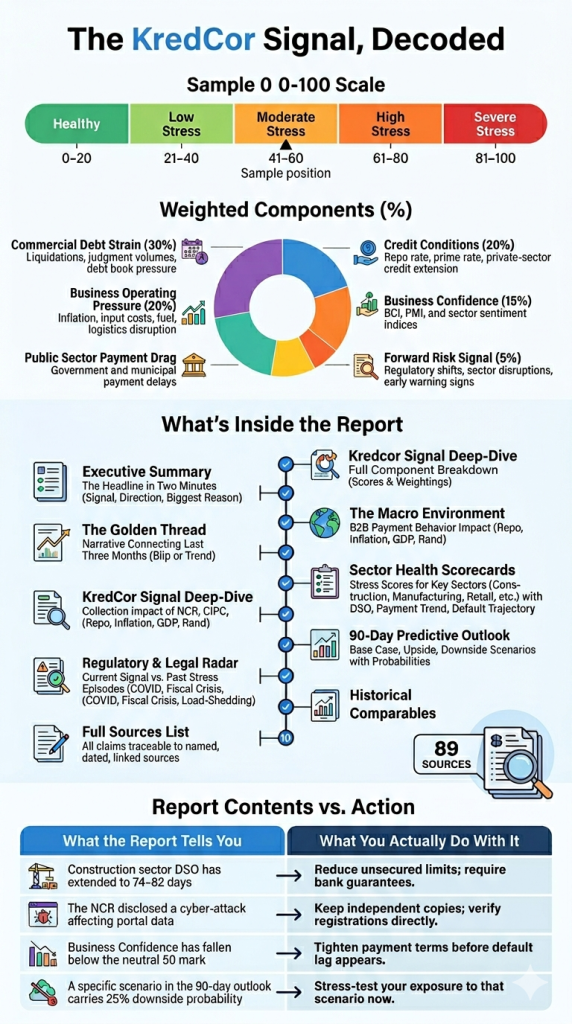
Table of Contents
- What the KredCor B2B Credit Index Actually Is
- Inside the Report: What You’re Really Getting
- The KredCor Signal: One Number, Six Inputs, Zero Guesswork
- Report Contents vs. What You Do With Them
- Why 89 Sources Matters More Than One Gut Feeling
- Troubleshooting Tips: Getting the Most Out of Each Edition
- Clash of Perspectives: Is a Single Composite Score Too Simple?
- What to Do Next
- Quick-Action Checklist
- Frequently Asked Questions
1. What the KredCor B2B Credit Index Actually Is
The KredCor B2B Credit Index is a monthly intelligence report, published by Kredcor, that tracks the health of South Africa’s business-to-business credit environment — in plain terms, how likely your customers are to pay you on time, late, or not at all, and why.
It is not a forecast pulled from a spreadsheet of guesses. Every edition is built from real, named, citable South African data — the South African Reserve Bank’s monetary policy statements, Statistics South Africa’s inflation and GDP releases, the National Credit Regulator’s enforcement record, the CIPC’s business rescue filings, and dozens of sector-specific indices like the RMB/BER Business Confidence Index and the Absa Manufacturing PMI. KredCor’s intelligence team pulls from up to 89 of these sources every month, cross-references them, and turns the result into a single, readable document.
The output is a number — the KredCor Signal — backed by a full report explaining exactly what’s driving it, sector by sector, and what a credit manager, CFO, or SME owner should actually do about it this month, not next quarter.
2. Inside the Report: What You’re Really Getting
Here’s what lands in your inbox or downloads from kredcor.co.za every month, in order:
- An Executive Summary that gives you the headline in two minutes — the Signal, the direction it’s moving, and the single biggest reason why.
- The Golden Thread — a short narrative connecting the last three months, so you can see whether this month is a blip or a trend.
- A KredCor Signal Deep-Dive — the full breakdown of the six components feeding the headline number, with their individual scores and weightings.
- The Macro Environment — repo rate, inflation, GDP, rand movement, and what each one means specifically for B2B payment behaviour, not just the general economy.
- Credit Market Conditions — Days Sales Outstanding (DSO) trends by sector, payment behaviour shifts, and where default risk is rising fastest.
- Sector Health Scorecards — individual stress scores for construction, manufacturing, retail, agriculture, logistics, and professional services, each with its own DSO estimate, payment trend, and default trajectory.
- A Regulatory & Legal Radar — what’s changed at the NCR, the CIPC, and in the courts that affects how you collect, who you can sue, and what your suretyship and credit agreements actually protect you from this month.
- A 90-Day Predictive Outlook — base case, upside, and downside scenarios with stated probabilities, so you’re planning for a range, not a single guess.
- Historical Comparables — how the current Signal compares to past stress episodes (2020’s COVID shock, the 2015–16 fiscal crisis, the 2022 load-shedding peak), because South Africa’s credit cycles rhyme more than people expect.
- A full Sources list — every claim in the report traces back to a named, dated, linked source. Nothing is invented, and nothing is anonymous.
3. The KredCor Signal: One Number, Six Inputs, Zero Guesswork
The KredCor Signal is the headline number — a score from 0 to 100 where higher means more credit stress. It’s built from six weighted components:
| Component | Weight | What It Captures |
|---|---|---|
| Commercial Debt Strain | 30% | Liquidations, judgment volumes, debt book pressure |
| Credit Conditions | 20% | Repo rate, prime rate, private-sector credit extension |
| Business Operating Pressure | 20% | Inflation, input costs, fuel, logistics disruption |
| Business Confidence | 15% | BCI, PMI, and sector sentiment indices |
| Public Sector Payment Drag | 10% | Government and municipal payment delays |
| Forward Risk Signal | 5% | Regulatory shifts, sector disruptions, early warning signs |
A Signal of 53 tells you something. A Signal of 53 that was 44 last month and 61 the month before tells you a great deal more — and that’s exactly the kind of trajectory the report tracks, month after month, so the number always comes with its own context.
| Score | Zone | What It Means For You |
|---|---|---|
| 0–25 | Healthy | Payment risk low; normal terms appropriate |
| 26–45 | Watch | Some pressure visible; monitor key accounts |
| 46–60 | Caution | Tighten monitoring; review extended terms |
| 61–75 | High Risk | Late payments and distress likely rising |
| 76–100 | Severe Stress | Act now on arrears and credit exposure |
4. Report Contents vs. What You Do With Them
This is the part most credit intelligence misses: data is only useful if it changes a decision. So every section of the KredCor Index pairs what’s happening with what to do about it.
| What the Report Tells You | What You Actually Do With It |
|---|---|
| Construction sector DSO has extended to 74–82 days | Reduce unsecured limits on construction-adjacent debtors; require bank guarantees on new facilities |
| The NCR disclosed a cyber-attack affecting portal data | Keep independent copies of all compliance submissions; verify registrations through direct channels, not the portal |
| Business Confidence has fallen below the neutral 50 mark | Tighten payment terms before the 60–90 day lag between sentiment and actual default shows up in your ageing report |
| A specific scenario in the 90-day outlook carries 25% downside probability | Stress-test your exposure to that scenario now, while you still have time to act |
That’s the whole point. You don’t read the KredCor Index to feel informed. You read it to walk into your next credit committee meeting already knowing what everyone else in the room is about to find out the hard way.
5. Why 89 Sources Matters More Than One Gut Feeling
Most credit risk decisions in South African SMEs are still made on instinct — “that client always pays eventually” or “construction is always slow in winter.” Instinct isn’t wrong, exactly. It’s just incomplete, and it’s blind to anything that hasn’t happened to you personally yet.
The KredCor Index replaces a single gut feeling with up to 89 independently verifiable inputs — government statistics, central bank data, sector confidence indices, court and regulatory records — cross-checked against each other every month by KredCor’s intelligence team before a single word of analysis is written. When the report says manufacturing DSO is extending, that’s not a hunch; it’s drawn from the Absa Manufacturing PMI, Stats SA production data, and KredCor’s own collections data, triangulated against each other.
This matters because South Africa’s credit cycles move fast and don’t always announce themselves clearly. The 2026 KredCor Signal moved from a reading in the low 50s down to a trough below 15 and back up again within a matter of months — driven by a combination of trade policy shocks, business confidence collapses, and a sovereign credit rating upgrade arriving at almost the same time. No single source would have caught that whole story. Eighty-nine of them, read together, do.
6. Troubleshooting Tips: Getting the Most Out of Each Edition
You’re short on time and can only read one section. Read the Executive Summary and the Sector Health Scorecard for your own industry. That’s two pages and covers 80% of what matters to you specifically.
The Signal moved but you don’t know if that’s significant. Check the Golden Thread section first — it always explains the last three months of movement in context, not just this month in isolation.
You want to brief your credit committee but don’t have time to summarise the whole report. The Quick-Action Checklist style guidance in each Sector Scorecard’s “Credit Manager Action” box is written to be read aloud in a meeting, almost verbatim.
You’re not sure if a regulatory change actually affects your business. The Regulatory & Legal Radar always states the practical implication first, before the legal detail — read that first paragraph of each item before deciding whether the rest applies to you.
You want to compare this month to a specific past crisis. The Historical Comparables section exists precisely for this — it maps the current Signal against named historical stress periods (2020, 2015–16, 2022) so you’re not comparing today to a vague sense of “the bad old days.”
7. Clash of Perspectives: Is a Single Composite Score Too Simple?
There’s a reasonable objection to any single-number index: South Africa’s economy is not one thing. A construction firm in Gauteng and an agri-exporter in the Western Cape can be living in completely different credit realities in the same month, and a single number risks flattening that difference into something misleadingly tidy.
That’s a fair criticism, and it’s exactly why the KredCor Signal is never presented alone. The headline number exists to give you a fast, comparable read across time — the same way a country’s GDP figure is useful precisely because it’s simple, even though no single business experiences “GDP.” But underneath that single number sit individually weighted components and individually scored sectors, specifically so you can drill past the headline the moment your own situation doesn’t match it. The Signal tells you the temperature of the room. The Sector Scorecards tell you whether you’re standing near the window or the fireplace.
8. What to Do Next
Once you’ve read an edition of the KredCor Index, the natural next question is: what changes in my business this month, specifically? Start by pulling up your own debtor book and checking it against the relevant Sector Health Scorecard — does your real DSO match, beat, or lag the sector estimate? If you’re lagging, you likely have specific accounts that need attention now, not at quarter-end. If you’re ahead of the sector trend, that’s worth knowing too, because it usually means your terms are tighter than they need to be, or your collections process is genuinely working and worth protecting.
From there, it’s worth reading about debt collectors in South Africa to understand what your options actually are once an account moves from “late” to “needs professional recovery” — because the index tells you when that shift is coming sector-wide, but you still need a plan for what happens when it lands on your desk specifically.
9. Quick-Action Checklist
- Download the latest KredCor B2B Credit Index and read the Executive Summary and your sector’s scorecard
- Compare your actual DSO against the sector estimate in the report
- Flag any account in a sector the report marks “High Risk” or “Elevated Stress” for a fresh credit review
- Read the Regulatory & Legal Radar section for anything affecting your current collections or credit agreements
- Check the 90-day outlook’s downside scenario and ask whether your current exposure could survive it
- Set a calendar reminder for next month’s edition — credit risk is a trend, not a snapshot
10. Frequently Asked Questions
Is the KredCor B2B Credit Index free? Yes. The report is published monthly and made available to South African businesses at no cost, as part of KredCor’s commitment to raising the standard of credit intelligence available to SA’s SMEs and credit teams.
Who should actually read this report? Credit managers, financial managers, CFOs, and SME owners with any meaningful exposure to business-to-business trade credit — anyone who extends payment terms to other businesses and needs to know when that risk is rising.
How is the KredCor Signal different from other economic indicators I might already track? Most economic indicators (GDP, inflation, the repo rate) describe the economy broadly. The KredCor Signal is purpose-built for B2B credit risk specifically — it weights the inputs that actually predict payment behaviour, not general economic health, which is why it can move sharply even when headline GDP looks stable.
How often is the report published, and how far back does the Signal history go? The Index is published monthly, with each edition building on a running Signal history so subscribers can track the trajectory over time, not just the current snapshot.
Want the full picture every month, not just the headline? Explore the latest KredCor articles and reports to see exactly what South Africa’s B2B credit environment is doing right now — and what to do about it before your debtor book tells you the hard way.