

Recovering Unpaid Fees in South African Private Schools: 7 Proven Strategies That Actually Work
By Kredcor Khuluma | August 2025 | Reading time: ~12 minutes | Category: School Fee Recovery · Credit Management · Debt Collection South Africa
Quick Answer: Recovering unpaid fees in South African private schools requires a structured, legally compliant process. Start with a formal Letter of Demand, secure a signed Acknowledgement of Debt, and implement a monitored payment plan. If parents still do not pay, hand the account to a registered debt collector immediately — before the 3-year prescription period runs out. Private schools that act early and consistently recover significantly more than those that delay.
If you manage the finances of a private school in South Africa — whether you are a CFO, a financial manager, a bursar, or a school owner — you already know this pain: parents sign fee agreements, term after term, and yet the debtors’ list grows longer every month. Moreover, by the time many schools decide to act, the debt is already months old, relationships are strained, and the chances of full recovery are shrinking fast. So, how exactly do you go about recovering unpaid fees in South African private schools in a way that is effective, legally sound, and that still protects the school’s reputation? That is precisely what this guide answers — clearly, practically, and step by step.
Furthermore, recovering school fee arrears is not just about getting money back. It is, in fact, about running a sustainable institution. A private school depends almost entirely on fee income. Therefore, unpaid fees directly affect staffing, infrastructure, and the quality of education delivered to every other learner. So, let us get into it.
📋 Table of Contents
- Why Recovering Unpaid School Fees Is More Urgent Than You Think
- The Legal Framework: What South African Private Schools Can Actually Do
- Prescription of School Fees: The 3-Year Deadline You Cannot Ignore
- 7 Proven Strategies for Recovering Unpaid Fees in South African Private Schools
- 5 Troubleshooting Tips: When Your In-House Efforts Fail
- When to Hand the Account Over to a Professional Debt Collector
- What Kredcor Does Differently
- Frequently Asked Questions
- Conclusion: Act Early, Act Consistently
1. Why Recovering Unpaid School Fees Is More Urgent Than You Think
Let us start with a fact that surprises most school administrators: the longer you wait to act on unpaid school fees, the less likely you are to recover the full amount. In our experience at Kredcor, accounts handed over within 60 to 90 days of the due date achieve recovery rates of between 70% and 90%. However, accounts left for six months or more often drop to 30% or below. That gap represents a enormous amount of money — and a serious threat to any private school’s financial health.
Furthermore, South Africa’s current economic environment makes this problem worse. Many families are genuinely under financial pressure. Others, frankly, use delay as a deliberate strategy. Either way, the result is the same for the school: cash flow suffers, operational budgets tighten, and eventually, staff and learners feel the impact.
Therefore, recovering unpaid fees in South African private schools is not an administrative nuisance. It is, in fact, a core financial management priority — one that deserves the same structured attention as any other major line item on your budget.
3 years
Prescription period for school fees in South Africa (Prescription Act 68 of 1969)
70–90%
Typical recovery rate when accounts are handed over within 60–90 days
26+ years
Kredcor’s track record in South African debt recovery — with a 100% clean Council record
“The single biggest mistake private schools make is waiting too long. By the time they hand the account to us, parents have already moved their children elsewhere, changed contact details, or accumulated so much debt that a payment plan becomes impractical.”— Senior Pre-Legal and Credit Risk Manager, Kredcor Khuluma
2. The Legal Framework: What South African Private Schools Can Actually Do
Before jumping into strategies, it helps to understand the legal landscape. South African private schools operate under different rules than public schools. Public schools fall under the South African Schools Act (SASA) No. 84 of 1996, which includes specific procedures for fee recovery, Section 41(5) notices, and exemption applications.
Private schools, however, are primarily governed by their fee agreements and enrolment contracts, as well as by general South African contract law and, where applicable, the National Credit Act (NCA). This means, in practice, that a private school’s ability to recover fees depends heavily on how well-drafted its fee agreement is from the outset.
Key Legal Tools Available to Private Schools
- Formal Letter of Demand (LOD): The starting point for any collection process. A well-drafted LOD puts the debtor on formal notice and creates a legal record.
- Acknowledgement of Debt (AOD): A written document in which the parent confirms the amount owed and agrees to repay it. This is extremely valuable because it interrupts the 3-year prescription period and strengthens any future legal action.
- Payment Plan Agreement: A written, signed arrangement detailing how and when the outstanding fees will be repaid. When properly documented, this is legally binding.
- Summons and Judgment: If pre-legal steps fail, the school can instruct attorneys to issue a summons. A judgment, once granted, is valid for 30 years in South Africa.
- Warrant of Execution: Once a judgment is obtained, the school may apply for a warrant of execution to attach the debtor’s movable or, ultimately, immovable property.
- Default Listing: Under certain conditions, non-paying parents can be listed with a credit bureau, though this only applies where a credit agreement exists.
Additionally, you can engage a registered debt collector to handle the pre-legal process on your behalf. Registered debt collectors must adhere to the Council for Debt Collectors’ Code of Conduct and the Debt Collectors Act 114 of 1998 — which means your parents are treated professionally and your school’s reputation remains intact.
Moreover, understanding debt prescription is essential before you take any action. If you are unsure how prescription works and when a debt expires, we strongly recommend reading our detailed guide: What Is Prescription? A Guide for South African Businesses. This resource will help you avoid the costly mistake of pursuing a debt that has already prescribed.
3. Prescription of School Fees: The 3-Year Deadline You Cannot Ignore
Here is a fact that catches many school administrators completely off guard: school fees prescribe after just 3 years in South Africa. This comes from the Prescription Act 68 of 1969, which states that contractual debts — and school fees are a contractual debt between the school and the parent — are extinguished after three years if no action has been taken.
So, what does “action” mean in this context?
Prescription stops running (or “is interrupted”) in three ways, namely:
- The parent makes a payment towards the debt — even a partial one.
- The parent signs an Acknowledgement of Debt (AOD) in writing.
- A summons is formally served on the parent.
Consequently, if none of these three things happen within 3 years of the debt becoming due, the school legally loses the right to collect that money. Furthermore, according to the National Credit Act, a prescribed debt cannot be listed on a credit bureau either. This means delaying action on unpaid fees does not just reduce recovery chances — it eliminates them entirely once the prescription period expires.
“We’ve seen cases where schools held on to outstanding accounts for four or five years, hoping parents would eventually pay. By then, the debt had prescribed — and there was absolutely nothing we could do to recover it.”— Landi, Relationship Manager, Kredcor Khuluma
The practical takeaway? Start the collection process — formally and in writing — well within the first year of non-payment. Do not wait for the relationship with the parent to become more comfortable. The sooner you act, the better your chances of recovering unpaid school fees in full.
4. Seven Proven Strategies for Recovering Unpaid Fees in South African Private Schools
Over the years, our team at Kredcor has worked with a range of institutions and industries — from homeowners’ associations (HOAs) to blue-chip corporations — to recover outstanding accounts. The strategies below draw directly from that experience. We tested these approaches repeatedly, refined them, and confirmed which ones deliver results consistently.
Strategy 01
Start With a Rock-Solid Fee Agreement
Prevention is, without doubt, the most effective form of fee recovery. Before a learner enrols, every parent or guardian must sign a comprehensive, legally sound fee agreement. This agreement must specify the total annual fee, the payment schedule (monthly, quarterly, or annually), the consequences of non-payment, the school’s right to hand the account to a debt collector, and that the parent accepts liability for collection costs. Furthermore, it should include a consent clause for credit bureau listing where legally applicable. Our team at Kredcor is happy to review your current fee agreement and identify any gaps — contact us at az.oc.rocderk@gnitekram.
Strategy 02
Send a Formal Letter of Demand Immediately After the Due Date
Do not send a friendly reminder and wait another month. Instead, send a formal, professional Letter of Demand (LOD) as soon as a fee becomes 15 to 30 days overdue. The LOD must state the exact amount owed, the original due date, the deadline for payment (typically 7 to 10 business days), and what will happen if the parent does not pay. A formal LOD communicates seriousness and sets the stage for escalation. It also creates the critical paper trail you will need if the matter eventually goes to court.
Strategy 03
Offer a Structured Payment Plan — but Get It in Writing
Many parents who fall behind on school fees are not deliberately avoiding payment. They are genuinely struggling. Offering a structured, written payment plan is therefore both practical and humane. However — and this is critical — the plan must be signed by the parent, dated, and include clear consequences if it is not honoured. This document serves as an AOD, which interrupts prescription. It also shows that the school acted in good faith if the matter goes to court later.
Strategy 04
Secure an Acknowledgement of Debt (AOD) Every Time
The AOD is arguably your most powerful pre-legal tool when recovering unpaid fees in South African private schools. It confirms the debt, interrupts prescription, and reduces the risk of the parent later disputing the amount. Every time a parent agrees to a payment arrangement — verbally or otherwise — follow up immediately with a written AOD for signature. Kredcor assists schools in drafting legally sound AODs that hold up under scrutiny.
Strategy 05
Track and Monitor Every Account Systematically
You cannot manage what you do not measure. Accordingly, implement a debtor management system — even a well-organised spreadsheet — that tracks every account by learner name, total amount owed, due date, date of LOD sent, date of AOD signed, and current payment status. Review this list at least monthly. Debtor days (the average number of days fees remain unpaid) is your key performance indicator. The lower your debtor days, the healthier your cash flow. Our clients at Kredcor receive detailed monthly progress reports on every account — so they always know exactly where each case stands.
Strategy 06
Escalate Consistently — and Stick to Your Policy
One of the most common mistakes schools make is escalating inconsistently. They issue a LOD, the parent makes one small payment, the school backs off — and then the cycle repeats for months. Instead, define a clear escalation policy: LOD after 30 days → follow-up call after 37 days → AOD/payment plan by day 45 → hand over to a registered debt collector by day 60 if there is no agreement or payment. Then stick to that policy for every account, without exception. Consistency sends a clear message: the school is serious about collecting outstanding fees.
Strategy 07
Hand Over to a Registered Debt Collector Before It Is Too Late
If your in-house efforts have not resolved the account within 60 to 90 days of the due date, hand it over to a registered debt collector immediately. This is not an admission of failure — it is smart credit management. A professional debt collector brings resources, experience, legal authority, and persistence that an internal finance team simply cannot match. Furthermore, Kredcor operates on a strict No Success – No Fee basis, so there is no financial risk to the school. We only earn our fee when we collect your money.
5. Five Troubleshooting Tips: When Your In-House Efforts Fail
Even with the best internal processes in place, you will encounter situations where recovery stalls. Here are five specific troubleshooting tips to help you break through the most common obstacles when recovering unpaid school fees.
🔧 Troubleshooting Tip 1 — The Parent Has Changed Contact Details
This is more common than you might think, especially after a learner leaves the school. Therefore, always collect multiple contact methods at enrolment: the parent’s cell number, landline, email address, work number, and the details of an emergency contact. If a parent becomes unreachable, a professional debt collector like Kredcor has access to tracing tools and databases that can locate debtors quickly and legally.
🔧 Troubleshooting Tip 2 — The Parent Disputes the Amount
When a parent disputes the outstanding amount, the process stalls — often deliberately. The solution is a thorough, up-to-date fee statement that shows every charge, every payment received, and the running balance. Present this clearly and in writing. If you have a signed fee agreement and signed AOD, disputes become significantly harder to sustain. Always document every communication.
🔧 Troubleshooting Tip 3 — The Parent Has Left South Africa
International parents who return to their home countries sometimes assume the school cannot follow them. In reality, Kredcor recovers debt globally — including from debtors in Europe, the UK, the USA, the Middle East, and Asia. Do not write off international debt without first consulting a specialist. For more on cross-border recovery, visit Kredcor Global.
🔧 Troubleshooting Tip 4 — The Parent Is Making Promises but No Payments
Serial promise-makers are a specific debtor profile. They acknowledge the debt, express goodwill, agree to a plan — and then pay nothing. The solution is simple: no payment, no further negotiation. As soon as a payment plan is missed without prior communication, immediately hand the account to a registered debt collector. Do not give a third, fourth, or fifth chance without a payment to show good faith.
🔧 Troubleshooting Tip 5 — Your LOD Is Being Ignored Completely
If a formal Letter of Demand goes completely unanswered — no call, no email, no payment — do not wait. Escalate immediately to a registered debt collector. A LOD from an internal bursar’s office carries far less weight than a pre-legal demand issued by a registered firm like Kredcor. The parent’s understanding of the seriousness of the situation changes dramatically when a third party is involved. In our experience, a significant number of debtors pay within the first 30 days of Kredcor’s involvement — before any further action is even necessary.
6. When to Hand the Account Over to a Professional Debt Collector
This question comes up repeatedly: “How long should we try in-house before handing over?” Our answer, based on 26 years of experience as debt collectors in South Africa, is clear and consistent: if the account is more than 60 days past due and you do not have a signed, honoured payment plan in place — hand it over now.
Here is why the timing matters so much.
Furthermore, consider that every month you delay:
- The debt ages — and older debt is significantly harder to collect.
- The parent may exit the school community, removing the social and institutional pressure to pay.
- The prescription clock keeps ticking.
- The parent’s financial situation may worsen, reducing their ability to pay even if they want to.
- Other creditors may secure judgment against the parent first, reducing what is available to you.
Therefore, acting within 60 to 90 days is not aggressive — it is financially responsible. It is also kinder in the long run, because it gives the parent a clear, structured path to resolve the debt before it becomes a serious legal matter.
7. What Kredcor Does Differently — and Why It Matters for Private Schools
At Kredcor, we are not a call centre. We are a team of people who work closely with every client — because we understand that recovering unpaid fees in South African private schools is as much about relationship management as it is about legal process.
Here is specifically what we bring to the table when working with a private school:
- No Success – No Fee: You pay nothing unless we collect. There are no admin fees, no hand-over fees, and no monthly charges.
- Dedicated Relationship Manager: One experienced person handles your account — not a rotating team of call centre agents.
- Pre-Legal Action from Day One: We begin immediately, taking every possible step to recover the money before litigation becomes necessary.
- Transparent Monthly Reports: You receive a written update on every account, every month. You always know exactly what is happening.
- Your Brand Is Protected: We work as an extension of your school — professional, respectful, and always protecting your reputation.
- Registered and Fully Compliant: Kredcor is registered with the Council for Debt Collectors (CFDC) (Reg Nr 0016365/06). We have maintained a 100% clean Council record for over 26 years.
- Full Legal Escalation Available: When pre-legal steps are exhausted, we work with an approved panel of attorneys — at a fixed, pre-agreed cost, with no surprises.
“We have been working with Kredcor for years. They are professional, persistent, and — most importantly — they always represent our school in a way that we are proud of. They have recovered amounts we had completely written off.”— Kredcor client testimonial (name withheld for confidentiality)
Visual Summary: The School Fee Recovery Process at a Glance
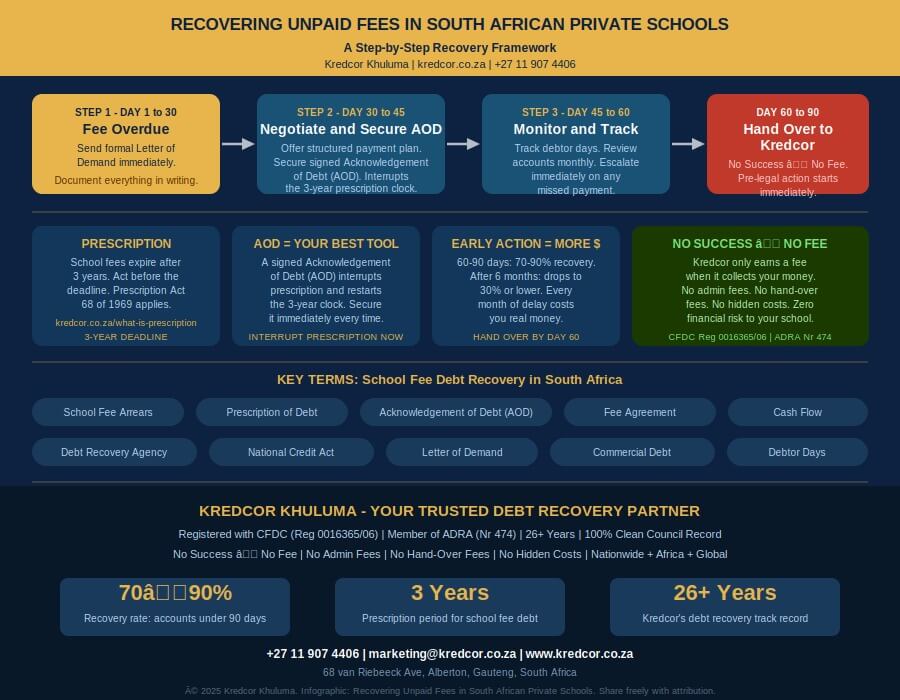
📥 Infographic: The School Fee Recovery Process — Recovering Unpaid Fees in South African Private Schools (Kredcor Khuluma, 2025). Share freely with attribution to kredcor.co.za.
Ready to Recover Your Outstanding School Fees?
If your school is currently battling unpaid fee accounts — whether they are 60 days old or several terms in arrears — the most effective next step is to engage professional debt collectors in South Africa who understand both the legal framework and the human dynamics involved. At Kredcor, we combine 26 years of hands-on experience with a genuine commitment to protecting your school’s reputation at every step of the process.
Furthermore, because we operate on a strict No Success – No Fee basis, there is literally no financial risk to engaging us. You pay nothing unless we recover your money. That means you have everything to gain and nothing to lose by making the call today.
Let Kredcor Help You Recover Unpaid School Fees
No Admin Fees | No Hand-Over Fees | No Hidden Costs | 26+ Years Experience
📞 +27 11 907 4406 | 📧 az.oc.rocderk@gnitekram Get a Free Consultation
Want More Practical Guidance? Read More at Our Articles Library
We publish regular, actionable articles designed specifically for credit managers, CFOs, financial managers, and business owners in South Africa. In fact, our articles cover everything from how the National Credit Act affects your credit application forms, to when you should hire a professional debt collector, to how prescription works on different types of debt. Consequently, our library has become a go-to resource for financial professionals across South Africa.
👉 Explore the full collection at: https://www.kredcor.co.za/kredcor-articles/
Moreover, if you found this article helpful, please share it with a colleague in school financial management. The more school administrators understand about recovering unpaid fees in South African private schools, the better the financial health of our education sector overall.
Frequently Asked Questions: Recovering Unpaid Fees in South African Private Schools
Can a private school hand over unpaid fees to a debt collector in South Africa?
Yes, absolutely. Private schools in South Africa can hand over outstanding fees to a registered debt collector. Unlike public schools, private schools are not bound by the South African Schools Act (SASA), but instead operate under their own fee agreements and the general provisions of South African contract law. They can engage a registered debt collector such as Kredcor to recover fee arrears on a No Success – No Fee basis. Furthermore, the Debt Collectors Act 114 of 1998 governs how collectors may operate, ensuring your parents are treated professionally throughout the process.
How long before school fees prescribe in South Africa?
School fees prescribe (legally expire) after 3 years in South Africa, under the Prescription Act 68 of 1969. Prescription is interrupted by a written Acknowledgement of Debt (AOD), a payment towards the debt, or the service of a summons on the debtor. Once the 3-year period has run without interruption, the school loses its legal right to recover those fees. This is why early action is absolutely critical. For a full explanation of how prescription works across different debt types, read our detailed guide: What Is Prescription?
What is an Acknowledgement of Debt (AOD) and why does a private school need one?
An Acknowledgement of Debt (AOD) is a written, signed document in which the parent or guardian confirms they owe the school a specific amount and agrees to repay it — often according to a structured payment plan. For private schools, an AOD is vital for three reasons: (1) it interrupts the 3-year prescription clock, resetting it from zero; (2) it provides clear, undisputable proof of the debt in any future legal proceedings; and (3) it makes it significantly harder for the parent to dispute the amount later. Kredcor assists schools in drafting legally sound AODs and securing signatures from reluctant debtors.
What are the steps to recover unpaid school fees in South Africa before going to court?
The pre-legal steps to recover unpaid school fees in South Africa are as follows:
- Send a formal Letter of Demand (LOD) as soon as the fee is 15–30 days overdue.
- Follow up with a phone call within 5–7 business days of the LOD.
- Offer a structured payment plan — and get it signed as an AOD.
- Monitor the payment plan strictly; escalate immediately on any missed payment.
- Hand the account to a registered debt collector (such as Kredcor) by day 60–90 if there is no signed agreement or payment.
- Authorise legal action — summons, judgment, and warrant of execution — only as a last resort, when all pre-legal steps have been exhausted.
Acting within 60 to 90 days gives you the best possible chance of full recovery — without costly litigation.
Conclusion: Act Early, Act Consistently — and Recover More
Recovering unpaid fees in South African private schools is entirely achievable — but only if you act systematically, consistently, and early. The key takeaways from this guide are straightforward: start with a rock-solid fee agreement, send your Letter of Demand without hesitation, secure a signed Acknowledgement of Debt every time, and hand overdue accounts to a registered debt collector by day 60. Furthermore, never forget the 3-year prescription deadline. Once that clock runs out, the debt is gone — forever.
Additionally, remember that recovering outstanding school fees is not an aggressive act. In fact, it is a responsible one. Your school’s financial health directly affects every learner in your care. Therefore, by recovering what you are owed — professionally, ethically, and with the right partners — you protect not just your cash flow, but the quality of education you deliver.
At Kredcor, we have been helping South African businesses — including educational institutions — recover what is rightfully theirs for over 26 years. We are registered, audited, ethical, and effective. Moreover, we work on a No Success – No Fee basis, so there is no financial risk in engaging us. We invite you to contact us today, and let us show you what professional fee recovery looks like.
📞 +27 11 907 4406 | 📧 az.oc.rocderk@gnitekram | 🌐 www.kredcor.co.za
Kredcor Khuluma — Registered with the Council for Debt Collectors of South Africa (CFDC Reg Nr 0016365/06) | 68 van Riebeeck Ave, Alberton, Gauteng, South Africa | +27 11 907 4406 | 26+ Years | 100% Clean Council Record