

Debt Recovery for Wholesale & Distribution in South Africa: 7 Critical Strategies to Protect Your Margins
By Kredcor Khuluma | August 2025 | Reading time: ~13 minutes | Category: Debt Recovery · Wholesale & Distribution · Credit Management South Africa
Quick Answer: Debt recovery for wholesale and distribution businesses in South Africa starts with a strong credit policy and ends — if necessary — with a registered commercial debt collector. The most important rule is simple: act early. Overdue trade invoices handed over within 60 to 90 days recover at rates of 70% to 90%. Wait six months or longer, and that rate drops below 30%. Furthermore, all commercial debts prescribe after 3 years — so every day of delay costs you real money.
If you run or manage the finances of a wholesale or distribution business in South Africa, you already know that margins in this sector are tight. Really tight. You buy in volume, you sell on credit, and you rely on your customers paying on time to keep the whole operation moving. But what happens when they don’t? What happens when a loyal retailer suddenly stops answering calls, or a long-standing customer starts paying 90 days late, or worse — stops paying entirely? That is where debt recovery for wholesale and distribution in South Africa becomes not just a finance function, but a survival skill. This guide gives you the strategies, legal knowledge, and practical tools to protect your margins and recover what you are owed — fast and professionally.
📋 Table of Contents
- Why Wholesale and Distribution Businesses Are Especially Vulnerable to Bad Debt
- The Legal Framework: What South African Law Says About B2B Debt Recovery
- Prescription: The 3-Year Deadline That Could Wipe Out Your Receivables
- 7 Critical Debt Recovery Strategies for Wholesale and Distribution Businesses
- Credit Policy Checklist: The Foundation of Healthy Receivables
- Debtor Profiling: Know Who You Are Dealing With Before You Extend Credit
- 5 Troubleshooting Tips: When Your Collection Efforts Stall
- When to Call in a Professional Debt Recovery Agency
- What Kredcor Does Differently for Wholesale and Distribution Clients
- Frequently Asked Questions
- Conclusion: Protect Your Margins — Start Now
1. Why Wholesale and Distribution Businesses Are Especially Vulnerable to Bad Debt
Let us be honest about something: wholesale and distribution is one of the most exposed sectors when it comes to bad debt in South Africa. The reason is structural. You extend credit — often substantial credit — to dozens or hundreds of retail customers, often with 30-, 60-, or 90-day payment terms. Meanwhile, your own suppliers expect payment on time. That gap between what you owe and what you are owed is where cash flow crises are born.
Moreover, the typical wholesale margin in South Africa — across sectors like food and beverage, hardware, chemicals, and industrial supplies — often sits between 8% and 20%. That sounds reasonable until you realise that a single large debtor who does not pay can wipe out the profit on dozens of other sales. In other words, one bad debt in wholesale can cost you the margin from ten or twenty good transactions.
The Volume Problem Makes Everything Worse
Furthermore, the high volume of transactions in wholesale makes debtor management genuinely complex. You might have 200 active accounts. Each one has its own payment history, credit limit, and risk profile. Tracking all of them manually — while running the rest of the business — is nearly impossible. Consequently, overdue accounts slip through, promises go untracked, and before you know it, your debtors’ book has quietly ballooned into a serious problem.
Additionally, the commercial relationships in wholesale are often long-standing and personal. You know your customers. They know your drivers. There is a history. That history can make it psychologically difficult to escalate — because nobody wants to damage a relationship over money. However, the hard truth is this: the relationship is already damaged the moment a customer stops paying. Recovering your money professionally is not damaging the relationship — it is the only way to save it.
8–20%
Typical wholesale margin in South Africa — wiped out by one uncollected account
3 years
Prescription period for commercial debts in SA — after which you lose the legal right to collect
70–90%
Recovery rate when accounts are handed over within 60 to 90 days of becoming overdue
“In wholesale and distribution, your debtors’ book is not just a financial record — it is a reflection of every risk decision you have made. A poorly managed debtors’ book in this sector can kill a business faster than a drop in sales.”— Senior Credit Risk Manager, Kredcor Khuluma
2. The Legal Framework: What South African Law Says About B2B Debt Recovery
Before diving into strategies, it helps enormously to understand what the law actually allows you to do when a business customer does not pay. Fortunately, South African law gives creditors strong tools — as long as you use them correctly and timeously.
The Key Laws That Govern Commercial Debt in South Africa
- The Debt Collectors Act 114 of 1998: This law governs who can collect debt professionally in South Africa. Only registered debt collectors — like Kredcor — may collect debt on behalf of a third party. This protects both you and your debtors from unlawful collection practices.
- The National Credit Act (NCA) 34 of 2005: Primarily applies to consumer credit, but it also affects certain commercial agreements. Make sure your credit application forms comply with the NCA where applicable.
- The Prescription Act 68 of 1969: Sets the 3-year prescription period for most commercial debts. After 3 years without interruption, the debt expires legally.
- The Companies Act 71 of 2008: Relevant when a debtor company enters business rescue or liquidation. Knowing your rights as a creditor in these processes is essential.
- Common Law of Contract: Your signed credit application, invoice terms, and any Acknowledgement of Debt (AOD) are all enforceable contracts under South African common law.
Additionally, it is important to know that debt collection for B2B accounts in South Africa does not fall under the NCA in the same way consumer debt does. Business-to-business (B2B) debt recovery — which is exactly what wholesale and distribution involves — operates under commercial law, giving creditors somewhat more flexibility in their collection approach.
Furthermore, understanding commercial debt collection as a discipline — including how registered collectors operate and what they can legally do — is critical knowledge for any wholesale credit manager. We recommend reading our detailed guide: Debt Collectors of Commercial Debt — How B2B Collections Work in South Africa.
3. Prescription: The 3-Year Deadline That Could Wipe Out Your Receivables
Of all the legal concepts in South African debt recovery, prescription is the one that most often catches wholesale and distribution businesses off guard. Here is the core of it: under the Prescription Act 68 of 1969, most commercial debts — including unpaid trade invoices — become legally unenforceable after 3 years. That means, if you wait too long, you permanently lose the right to collect the money.
What Interrupts Prescription?
The good news is that prescription does not run if you take the right steps.
Specifically, prescription is interrupted by any of the following:
- The debtor makes a payment — even a partial one — towards the outstanding invoice.
- The debtor signs a written Acknowledgement of Debt (AOD), confirming they owe the amount.
- You serve a summons on the debtor through the courts.
- You issue a formal Letter of Demand that the debtor acknowledges in writing.
Therefore, every time you secure a signed AOD or receive a partial payment, the 3-year clock resets. This is exactly why — even if a debtor cannot pay the full amount right now — getting them to sign an AOD and make a small payment is so valuable. It keeps the debt alive legally while you continue recovery efforts.
For a comprehensive explanation of how prescription works across different debt types — and what it means specifically for your wholesale accounts receivable — read our full guide: What Is Prescription? A Practical Guide for South African Business Owners.
4. Seven Critical Debt Recovery Strategies for Wholesale and Distribution Businesses
Our team at Kredcor has worked with wholesale and distribution clients across South Africa — from food and beverage to hardware, chemicals, agricultural supplies, and industrial equipment. Based on that experience, these are the seven strategies that consistently make the biggest difference in recovering overdue trade invoices and protecting margins.
Strategy 01
Build a Watertight Credit Application Process
The foundation of debt recovery for wholesale and distribution in South Africa is a strong credit application. Before you extend credit to any business customer, you must collect their full legal name and registration number, the names and ID numbers of all directors or members, banking details, trade references, and — critically — signed consent to your credit terms. Furthermore, include a suretyship clause so that directors accept personal liability if the company defaults. A poorly drafted credit application is one of the most expensive mistakes a distributor can make. We have seen accounts become uncollectable simply because the application was missing a signature or a key clause.
Strategy 02
Run Fresh Credit Checks Before Every New Credit Limit
Extending credit to a long-standing customer without checking their current credit profile is a risk that most wholesale businesses take — and most eventually regret. A customer who paid reliably for three years can deteriorate rapidly, especially in South Africa’s current economic environment. Therefore, run a fresh, verified business credit report before approving any new or increased credit limit. Kredcor compiles same-day business credit reports with our own recommendation on the risk level — so you always make credit decisions based on current, accurate information rather than outdated assumptions.
Strategy 03
Send a Formal Letter of Demand the Moment an Invoice Ages Past 30 Days
Do not send a “friendly reminder” and wait another month. Instead, send a formal Letter of Demand (LOD) as soon as an invoice passes 30 days overdue. The LOD must state the exact amount owed, the original invoice date, the payment due date, the deadline for payment (7 to 10 business days), and the consequences of non-payment. A formal LOD changes the tone of the conversation immediately — and it creates the paper trail you will need if the matter escalates to legal action. In our experience at Kredcor, a significant number of debtors pay within days of receiving a formal LOD, simply because it signals that the creditor is serious.
Strategy 04
Secure a Signed Acknowledgement of Debt — Every Time
If a customer cannot pay the full amount immediately, do not simply agree to a verbal payment arrangement and hope for the best. Instead, always follow up with a written, signed Acknowledgement of Debt (AOD). The AOD confirms the amount owed, interrupts the prescription period, and gives you a legally enforceable document if the debtor later disputes the debt. Furthermore, the AOD should include a clear payment schedule, the consequences of defaulting on that schedule, and — if possible — a consent to judgment clause, which allows you to obtain judgment more quickly if the debtor fails to honour the arrangement.
Strategy 05
Monitor Your Debtor Days Religiously — and Set Hard Limits
Debtor days — the average number of days it takes your customers to pay you — is one of the most important metrics in any wholesale or distribution business. We found, consistently, that businesses with debtor days above 60 are running serious cash flow risk. Accordingly, set a hard limit: any account that reaches 60 days overdue automatically triggers a formal escalation process. Do not make exceptions. Do not wait for the monthly debtors’ meeting. The moment an account hits day 60, the escalation process starts — automatically and without negotiation.
Strategy 06
Stop Supply to Overdue Accounts — Immediately
This sounds obvious, but it is one of the most commonly ignored strategies in wholesale debt recovery. Many distributors continue to supply goods to overdue accounts — sometimes for months — out of fear of losing the customer’s future business. However, continuing to supply an overdue customer simply increases your exposure. Therefore, implement a clear policy: no new supply to any account that is more than 30 days overdue without a signed payment arrangement. Furthermore, enforce this policy without exceptions. A customer who complains about a supply stop is almost always a customer who would otherwise have continued to accumulate debt without paying.
Strategy 07
Hand Over to a Registered Debt Collector by Day 60 to 90
If your in-house efforts have not resolved the account within 60 to 90 days of the invoice due date, hand it over to a registered commercial debt collector immediately. This is not an admission of failure — it is the smartest financial decision you can make at that point. A professional collector like Kredcor brings legal authority, experience, tracing capability, and persistence that an internal finance team cannot replicate. Moreover, because Kredcor operates on a strict No Success – No Fee basis, there is zero financial risk in making that call. You pay nothing unless we recover your money.
5. Credit Policy Checklist: The Foundation of Healthy Receivables
Before we move to troubleshooting, let us talk about prevention. The most effective debt recovery strategy for wholesale and distribution in South Africa is, in fact, a strong credit policy that prevents bad debt from accumulating in the first place. Use this checklist to assess where your current policy stands.
Your Wholesale Credit Policy Checklist
- Every new credit customer completes and signs a full credit application form.
- Credit applications include signed consent to your payment terms and collection policy.
- Directors/members sign a personal suretyship on all business accounts.
- You run a fresh business credit report before approving every new credit limit.
- Credit limits are reviewed at least annually — or immediately after a payment default.
- Every invoice states the due date, the amount, and the consequences of late payment clearly.
- You send a formal LOD at day 30 overdue — automatically, not manually.
- Supply stops automatically at day 30 overdue for accounts without a signed payment plan.
- You track debtor days at least monthly and flag accounts above 45 days immediately.
- All payment arrangements are documented in a signed AOD — not just a verbal agreement.
- Overdue accounts above 60 to 90 days are handed to a registered debt collector.
If your business ticks fewer than 7 of these 11 boxes, your debtors’ book is carrying more risk than it needs to. Consequently, the time to fix that is now — not after the next bad debt write-off.
6. Debtor Profiling: Know Who You Are Dealing With Before You Extend Credit
One of the most valuable — and most overlooked — aspects of debt recovery for wholesale and distribution in South Africa is understanding the debtor profile before things go wrong. Not all overdue debtors are the same. Treating them all identically is a mistake that costs businesses both money and time.
The Four Common Debtor Profiles in Wholesale
In our experience working with wholesale and distribution clients across South Africa, overdue debtors typically fall into one of four profiles:
- The Genuinely Distressed Debtor: This customer wants to pay but is in real financial difficulty. They respond to calls, are transparent about their situation, and are willing to sign an AOD and commit to a payment plan. The right approach here is structured support — a realistic payment plan that gets money moving — not aggressive escalation.
- The Serial Late Payer: This customer always pays eventually — but always late. They know the system, they use your credit terms as free financing, and they respond only when escalation happens. The right approach is a firm escalation policy with no exceptions and an automatic supply stop at day 30.
- The Deliberate Avoider: This customer has no intention of paying. They avoid calls, change contact details, dispute invoices they previously accepted, and use delay tactics systematically. They require immediate third-party intervention. Hand these accounts to a debt collector as soon as the avoidance pattern is clear — do not wait for day 90.
- The Liquidation Risk: This customer is heading for voluntary or compulsory liquidation, business rescue, or sequestration. Act immediately — before they enter a formal process. Once liquidation proceedings begin, you become a concurrent creditor and recovery becomes significantly more complex. If a personal suretyship was signed, pursue the guarantor immediately.
Therefore, identifying the debtor profile early allows you to choose the right strategy — and avoid wasting time and resources on the wrong approach. Kredcor’s team assesses debtor profiles as part of our standard process, and then applies the most appropriate recovery strategy for each account.
7. Five Troubleshooting Tips: When Your Collection Efforts Stall
Even with the best processes in place, collection efforts sometimes stall. Here are five specific troubleshooting tips to help you break through the most common obstacles in wholesale and distribution debt recovery.
🔧 Troubleshooting Tip 1 — The Debtor Disputes the Invoice Amount
Invoice disputes are one of the most common delay tactics in B2B collections. When a debtor raises a dispute, verify your delivery records, signed delivery notes, and any email correspondence confirming acceptance of the goods. If the goods were delivered and accepted — and you have the paperwork to prove it — the dispute is unfounded and should not delay your collection process. Send a formal response with the supporting documentation and maintain your payment deadline. Do not allow an unsubstantiated dispute to pause your escalation timeline indefinitely.
🔧 Troubleshooting Tip 2 — The Debtor Has Changed Directors or Ownership
A change in ownership or directorship does not erase the company’s debt to you. The debt belongs to the legal entity — the registered business — not the individual directors. However, if you have a personal suretyship from the previous directors, you may need to review your legal options with an attorney. Kredcor assists clients in tracing and pursuing both the legal entity and personal sureties in these situations.
🔧 Troubleshooting Tip 3 — The Debtor Is Making Promises but No Payments
This is the most common stalling tactic in wholesale collections. The debtor keeps promising “payment by Friday” — and Friday keeps moving. The rule here is simple: no payment, no further negotiation. As soon as a promised payment is missed without prior communication, hand the account to a registered debt collector immediately. Every additional promise you accept without payment simply delays recovery and erodes your legal position.
🔧 Troubleshooting Tip 4 — The Debtor’s Business Is Closed but the Directors Are Still Active
If a debtor company has closed — deregistered or voluntarily wound down — but you have a signed personal suretyship from the directors, you can still pursue the individuals personally. This is a situation where professional debt recovery assistance is essential. Kredcor traces active directors and pursues them in their personal capacity where a valid suretyship exists. Do not write off the debt simply because the company has closed.
🔧 Troubleshooting Tip 5 — Your Internal Team Keeps Giving Extensions
This is an internal management issue as much as a debtor issue. When your sales team or internal credit staff keep granting extensions out of relationship-management instinct, your escalation policy becomes meaningless. The solution is to remove the discretion from the equation: implement a system where escalation is automatic and rule-based — not dependent on an individual’s judgment or comfort level. Kredcor can help you design that escalation framework as part of our client onboarding process.
8. When to Call in a Professional Debt Recovery Agency
This is the question we hear most often from wholesale and distribution clients: “At what point should we stop trying in-house and hand the account over?” Our answer — based on over 26 years of commercial debt recovery experience across South Africa — is clear.
Hand the account over to a registered debt collector when any one of the following applies:
- The invoice is more than 60 days overdue and there is no signed payment arrangement in place.
- The debtor is unresponsive to formal Letters of Demand.
- The debtor is disputing the invoice without valid grounds.
- The debtor is making promises but not paying.
- You suspect the debtor is approaching financial distress or insolvency.
- The debtor has changed contact details or appears to be avoiding communication.
- Your internal team has exhausted all reasonable escalation steps.
Furthermore, remember this: the earlier you hand over, the higher your recovery rate. In wholesale and distribution, where margins are thin and volumes are high, even a 10% improvement in your recovery rate across your debtors’ book can make a material difference to your bottom line.
Additionally, choosing the right debt recovery partner matters enormously. Not all agencies operate the same way, and the wrong choice can damage your client relationships rather than protect them. Read our guide on what to look for: The Attributes of a Successful Debt Recovery Agency — What to Look for in South Africa.
9. What Kredcor Does Differently for Wholesale and Distribution Clients
At Kredcor, we understand that wholesale and distribution businesses have specific needs that general debt collectors often miss. Your debtor relationships are commercial, long-term, and often complex. Your accounts involve large amounts, multiple invoices, and sometimes disputed delivery records. Your credit risk profile changes rapidly with economic conditions. So, here is specifically how we approach debt recovery for wholesale and distribution in South Africa.
Our Wholesale and Distribution Recovery Process
- Industry-Specific Assessment: We assess each account against the specific commercial context of your industry — whether you distribute food, hardware, chemicals, agricultural supplies, or industrial goods. We understand the commercial norms, the seasonal payment patterns, and the specific risk factors in your sector.
- Debtor Profiling: We identify the debtor profile early (distressed, serial late payer, deliberate avoider, or liquidation risk) and apply the right strategy — not a one-size-fits-all approach.
- Pre-Legal Action from Day One: We begin immediately. We do not wait for a “collection queue.” Your account gets attention from the first day of our mandate.
- AOD and Payment Plan Negotiation: We secure signed AODs and structured payment plans wherever possible — protecting your legal position while keeping recovery moving.
- Surety Pursuit: Where personal suretyships exist, we pursue the guarantors in parallel with the company account.
- Transparent Monthly Reporting: You receive a written status update on every account, every month. You always know exactly where each case stands.
- No Success — No Fee: We earn our fee only when we collect your money. No admin fees, no hand-over fees, no monthly retainers.
- Brand Protection: We work as a professional extension of your business — not an aggressive outsider. We protect your commercial reputation at every stage.
“We handed over 14 overdue accounts to Kredcor — accounts our internal team had been chasing for months. Within 45 days, 11 of them had paid. The other three went legal. We recovered 87% of the total outstanding. That’s not luck — that’s process.”— Kredcor client, wholesale distribution sector (name withheld for confidentiality)
Visual Summary: The Wholesale Debt Recovery Process
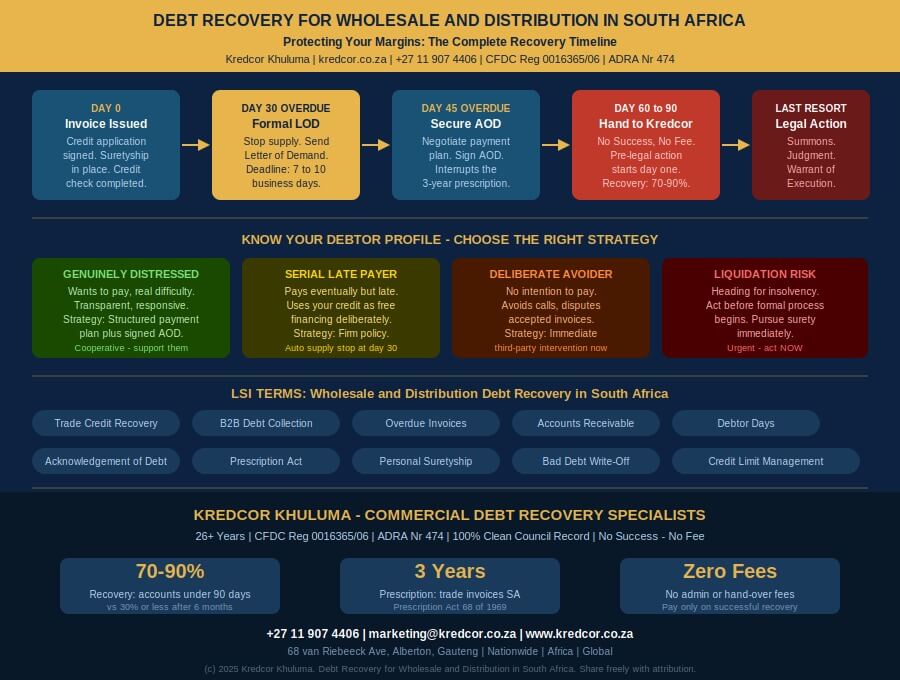
📥 Infographic: Debt Recovery for Wholesale and Distribution in South Africa — Recovery Timeline and Debtor Profiles (Kredcor Khuluma, 2025). Share freely with attribution to https://www.kredcor.co.za.
LSI / Semantic Terms Used in This Article: trade credit recovery, B2B debt collection, overdue invoices, accounts receivable management, debtor days, bad debt write-off, credit limit, personal suretyship, Acknowledgement of Debt (AOD), Letter of Demand (LOD), Prescription Act, National Credit Act (NCA), commercial debt South Africa, business rescue, liquidation, supply chain finance, credit risk assessment, wholesale margin protection, distribution sector collections.
Ready to Protect Your Wholesale Margins?
If your distribution business is carrying overdue accounts — whether they are 45 days old or approaching the 3-year prescription deadline — the most important step you can take right now is to engage professional debt collectors in South Africa who understand the commercial dynamics of your sector. At Kredcor, we bring 26 years of hands-on B2B debt recovery experience, a strict No Success – No Fee model, and a genuine commitment to protecting your business reputation at every stage of the process.
Let Kredcor Recover Your Overdue Trade Invoices
No Admin Fees | No Hand-Over Fees | No Hidden Costs | 26+ Years Commercial Experience
📞 +27 11 907 4406 | 📧 moc.puorgrocderk@idnal Get a Free Consultation — No Obligation
Explore More Expert Guides at Our Articles Library
We publish regular, practical articles written specifically for credit managers, CFOs, financial managers, and business owners across South Africa. Our library covers everything from how the National Credit Act affects your credit applications, to when to hire a debt collector, to how prescription works on commercial debt — and much more. Moreover, every article is written from real, hands-on experience — not theory.
👉 Read more actionable guides at: https://www.kredcor.co.za/kredcor-articles/
Frequently Asked Questions: Debt Recovery for Wholesale and Distribution in South Africa
How does debt recovery for wholesale and distribution businesses differ from other industries in South Africa?
Wholesale and distribution businesses operate on tight margins, high volumes, and extended trade credit terms — often 30, 60, or 90 days. This makes overdue invoices particularly damaging to cash flow. Unlike retail, B2B debt in wholesale involves larger amounts per debtor, longer payment cycles, and complex commercial relationships. Effective debt recovery in this sector therefore requires a structured credit policy, proactive monitoring of debtor days, and a registered commercial debt collector like Kredcor who understands B2B dynamics and can profile debtors accurately.
When should a wholesale distributor hand over overdue invoices to a debt collector in South Africa?
A wholesale or distribution business should hand over overdue accounts to a registered debt collector when the invoice is 60 to 90 days past due with no signed payment arrangement; the debtor is unresponsive to formal Letters of Demand; the debtor is making promises but not paying; or the internal team has exhausted all reasonable in-house collection steps. The earlier you hand over, the higher your recovery rate. Kredcor operates on a No Success, No Fee basis, so there is no financial risk in engaging early.
Can a South African wholesale business recover debt from a debtor who has closed down or gone into liquidation?
Yes, but the process becomes more complex. If a debtor company goes into voluntary or compulsory liquidation, you become a concurrent creditor and must file a claim with the appointed liquidator. Recovery is not guaranteed and depends on available assets. However, if a surety or personal guarantee was signed by a director, you may pursue the guarantor personally. Kredcor assists clients in navigating liquidation claims and pursuing guarantors where applicable — so do not write off the debt without first consulting us.
How does prescription affect overdue trade invoices in South Africa?
In South Africa, commercial debts — including overdue trade invoices — prescribe (legally expire) after 3 years under the Prescription Act 68 of 1969. Once a debt prescribes, you permanently lose the legal right to collect it. Prescription is interrupted by a written Acknowledgement of Debt (AOD) signed by the debtor, a payment towards the debt, or the service of a summons. This is precisely why handing over accounts early — well within the 3-year window — is critical for every wholesale and distribution business.
Conclusion: Protect Your Margins — Act Now, Not Next Month
Debt recovery for wholesale and distribution in South Africa is not a nice-to-have. It is a core business function that directly determines whether your margins survive or disappear. The strategies in this guide — a strong credit policy, proactive debtor monitoring, formal LODs, signed AODs, and early professional escalation — are not complicated. But they require consistency, discipline, and the courage to act before a problem becomes a crisis.
Furthermore, the 3-year prescription deadline means time is always working against you. Every month a debt sits uncollected is a month closer to permanent legal extinction. Therefore, the most important message in this entire guide is this: act early, act consistently, and use the right professional partners when in-house efforts reach their limit.
At Kredcor, we have helped wholesale and distribution businesses across South Africa recover overdue trade invoices for over 26 years — on a strict No Success, No Fee basis. We protect your margins, we protect your relationships, and we get results. Contact us today and let us show you exactly what professional B2B debt recovery looks like.
📞 +27 11 907 4406 | 📧 az.oc.rocderk@gnitekram | 🌐 www.kredcor.co.za
Kredcor Khuluma — Registered with the Council for Debt Collectors (CFDC) (Reg Nr 0016365/06) | 68 van Riebeeck Ave, Alberton, Gauteng, South Africa |
+27 11 907 4406 | 26+ Years | 100% Clean Council Record