

The Definitive Practical Guide to Debtor Tracing in South Africa — 7 Powerful Strategies That Actually Work
Quick Answer: Debtor tracing in South Africa is the structured, legally compliant process of locating a debtor who has skipped payment and cannot be contacted through normal channels. It combines database searches, social media intelligence, field investigations, and credit bureau enquiries to find accurate contact details — so that debt recovery can proceed lawfully and effectively.
If you’re a credit manager, financial manager, CFO, or SME owner in South Africa, you’ve almost certainly experienced this: an invoice is overdue, your emails bounce, the phone number rings to voicemail, and the debtor has seemingly vanished off the face of the earth. Sound familiar? You’re not alone — and fortunately, debtor tracing in South Africa is a well-established discipline with powerful, lawful tools that can track down even the most determined skips.
At Kredcor, we’ve spent over 26 years recovering commercial debt across South Africa and into Africa. Our team has handled thousands of skip-tracing cases — some straightforward, some extraordinarily complex — and in this guide, we’re sharing everything we know so that you can work smarter, faster, and with far better results.
Whether you want to handle initial tracing yourself before escalating, or you simply want to understand what a professional tracing partner actually does on your behalf, this is the resource you’ve been looking for. Let’s get into it.
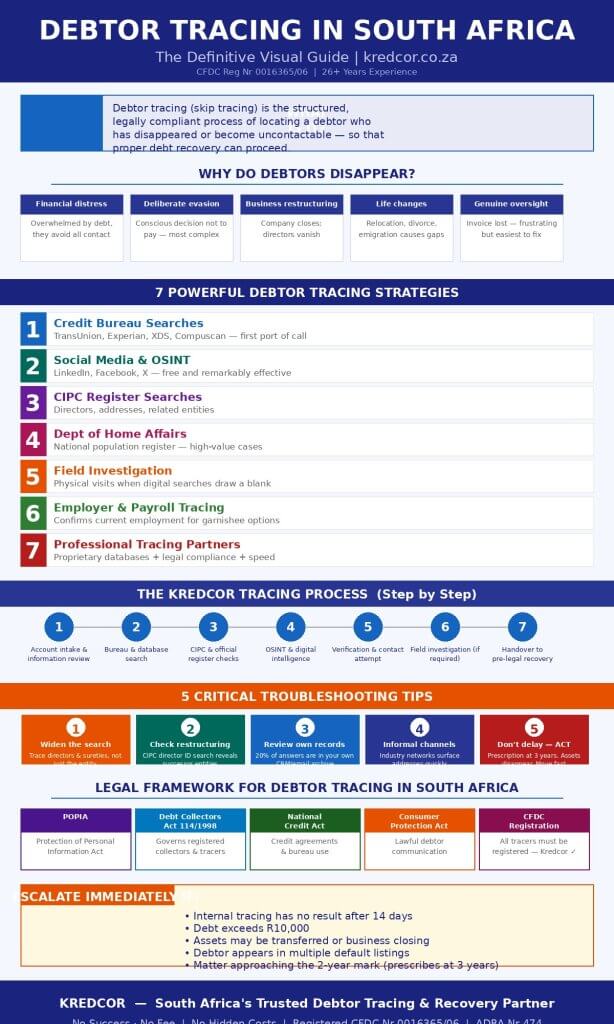
Table of Contents
(Use the headings below to navigate this comprehensive guide)
- What is Debtor Tracing in South Africa? (The Answer-First Definition)
- Why Debtors Go Missing — and Why It’s More Common Than You Think
- The Legal Framework: What You MUST Know Before You Trace
- 7 Powerful Debtor Tracing Strategies That Actually Work
- Step-by-Step: The Kredcor Debtor Tracing Process
- 5 Critical Troubleshooting Tips When Tracing Fails
- Debtor Tracing for SMEs: Actionable Tips You Can Use Today
- When to Escalate: From Tracing to Full Debt Recovery
- Frequently Asked Questions About Debtor Tracing in South Africa
1. What is Debtor Tracing in South Africa? (The Answer-First Definition)
Debtor tracing in South Africa — sometimes called skip tracing — is the process of locating a debtor who is no longer reachable through the contact information your business holds. The goal is straightforward: find the person or entity, verify their current location and contact details, and then resume the recovery process from a position of knowledge.
The term ‘skip’ comes from the old expression ‘skipped town,’ which perfectly describes what many non-paying debtors do. They change their phone number, move to a new address, close their email account, or simply stop responding — and suddenly your outstanding invoice has no obvious route to resolution.
“Debtor tracing is not about harassment or pressure. It is about establishing the factual basis — where is this person, and how do I reach them lawfully — that makes proper recovery possible.” — Kredcor Senior Pre-Legal Manager
Debtor tracing in South Africa is governed by several pieces of legislation, most importantly the Protection of Personal Information Act (POPIA), the National Credit Act, and the Debt Collectors Act 114 of 1998. This means that tracing must be carried out responsibly, ethically, and within a strict legal framework — which is exactly why working with a registered and certified partner makes such a difference.
What Debtor Tracing is NOT
It is worth being clear about what debtor tracing is not. It is not stalking, harassment, or intimidation. It is not accessing private data without lawful basis. It is not sharing a debtor’s information with unauthorised third parties. And critically, it is not something you can do effectively by simply Googling a name. Professional debtor tracing is a structured, methodical discipline — and the difference between doing it properly and doing it poorly can be the difference between recovery and write-off.
B2B vs Consumer Debtor Tracing
While debtor tracing applies to both consumer and business debtors, this guide focuses primarily on the B2B commercial context, which is where Kredcor specialises. Tracing a business debtor involves locating company directors, registered trading addresses, associated entities, and related individuals — often a more complex task than tracing a private individual, but one our team navigates every day.
2. Why Debtors Go Missing — and Why It’s More Common Than You Think
Before we get into the how of debtor tracing in South Africa, it helps to understand the why. In our experience at Kredcor, debtors go missing for a surprisingly wide range of reasons — and understanding the cause often helps us locate them faster.
The Most Common Reasons Debtors Disappear
- Financial distress: The most common reason. A business or individual hits a cash-flow wall, feels overwhelmed, and avoids creditors rather than engaging.
- Deliberate evasion: Some debtors know exactly what they owe and have made a conscious decision to avoid paying. These are the hardest cases, but also the most satisfying to resolve.
- Business closure or restructuring: A company closes its doors, directors move on, and no formal winding-up or notification process takes place. Accounts go dark.
- Change of circumstances: Divorce, relocation, job loss, or emigration all cause genuine lapses in communication that can look like evasion but are not.
- Poor admin and genuine oversight: Believe it or not, some debtors have genuinely lost track of the invoice. While frustrating, this is actually the easiest category to resolve.
- Death or incapacity: In B2B contexts, the death of a sole proprietor or a key decision-maker can leave accounts in limbo for months.
The South African context adds additional complexity. According to the South African Reserve Bank and various industry reports, South African businesses — particularly SMEs — consistently battle above-average debtor days compared to international benchmarks. High mobility in the workforce, frequent address changes, and the prevalence of informal business structures all make debtor tracing in South Africa a unique and challenging discipline. For a detailed breakdown of what those delays actually cost you, read Kredcor’s article on
South Africa Payment Delay Benchmarks — it’s a real eye-opener for any credit manager or CFO.
The Financial Cost of Not Tracing
Here is a reality check. Every day a debtor goes unlocated is a day your money sits unrecovered. Beyond the obvious cash-flow impact, there are hidden costs: your team’s time spent on fruitless follow-up, the risk that the debt will eventually prescribe, and the potential reputational signal it sends if you allow non-payment to go unchallenged. Our team has found that businesses that implement a structured debtor tracing protocol as part of their credit policy recover significantly more — and faster — than those that simply write off ‘gone dark’ accounts.
3. The Legal Framework: What You MUST Know Before You Trace
Debtor tracing in South Africa operates within a clear legal framework. Getting this wrong exposes your business to regulatory risk, reputational damage, and even civil liability. So before you run a single search, understand these key laws.
The Protection of Personal Information Act (POPIA)
POPIA is the single most important piece of legislation affecting debtor tracing in South Africa today. It governs how personal information is collected, processed, stored, and used. When tracing a debtor, you must ensure you have a lawful basis for processing their personal information — typically that you are acting in pursuit of a legitimate legal claim. Furthermore, you cannot share a debtor’s traced details with any party who does not have a legitimate need to know.
Outbound link: The Information Regulator of South Africa provides the authoritative source on POPIA compliance. We strongly recommend reviewing their guidance if you are conducting tracing internally.
The Debt Collectors Act 114 of 1998
The Debt Collectors Act regulates the activities of anyone collecting debt on behalf of another party. If you appoint a third-party tracer who is also acting as a debt collector, they must be registered with the Council for Debt Collectors (CFDC). Kredcor is registered under CFDC Reg Nr 0016365/06, and has maintained a 100% clean record across 26 years — giving our clients full peace of mind that every tracing and collection activity is legally above reproach.
For a deeper dive into the Act, read Kredcor’s comprehensive guide: The Debt Collectors Act Explained: Your Essential, No-Nonsense Guide.
The National Credit Act (NCA)
If the underlying debt involves a credit agreement, the NCA applies. This affects how you may communicate with a debtor, the notices required before escalation, and the use of credit bureau information in tracing. It is worth noting that even the decision to run a credit bureau check on a debtor for tracing purposes must have a lawful basis under POPIA — so proper record-keeping is essential.
Consumer Protection Act (CPA)
The CPA is relevant in certain B2C contexts and protects consumers from unfair, unreasonable, or unjust business practices. While most professional debtor tracing falls outside the CPA’s direct scope, any communication with a debtor — including initial contact after successful tracing — must comply with its provisions.
“Every tracing action leaves a digital and legal footprint. The businesses that protect themselves are the ones that work with registered, ethical partners who understand the full regulatory landscape.” — Kredcor Compliance Team
4. Seven Powerful Debtor Tracing Strategies That Actually Work
Now we get to the practical heart of this guide. Based on our team’s experience across thousands of debtor tracing cases in South Africa, here are the seven most effective strategies — ranked from the quickest and cheapest to the most comprehensive.
Strategy 1: Credit Bureau Searches
Credit bureau searches are typically the first port of call in professional debtor tracing in South Africa. The major bureaus — TransUnion, Experian, XDS, and Compuscan — hold vast amounts of data on both individuals and businesses, including current and previous addresses, employment information, associated entities, and recent credit applications.
Our team at Kredcor runs bureau searches as a standard first step in every tracing case. The data is fresh, legally obtained, and frequently reveals a current address or phone number that the debtor mistakenly assumed was private.
Pro Tip: Run a bureau search on the business entity AND on the directors or owners individually. Companies often go dark while the individuals behind them remain traceable through their personal credit profiles.
Strategy 2: Social Media and Open-Source Intelligence (OSINT)
Social media has become one of the most powerful tools in the debtor tracer’s arsenal — and it costs nothing to use. LinkedIn, Facebook, Instagram, and X (formerly Twitter) frequently contain updated contact details, current employer information, recent location tags, and business activity that confirms a debtor is very much alive and active.
We found in our own tracing work that a significant proportion of debtors who claim to be unreachable are, in fact, actively posting on social media — sometimes about new business ventures or recent travel. This information, carefully and legally gathered, can dramatically accelerate a tracing process.
The key distinction is between passive, open-source gathering of publicly available information, which is permissible, and active deception or impersonation, which is not. Remain ethical and within POPIA’s framework at all times.
Strategy 3: CIPC (Companies and Intellectual Property Commission) Searches
The CIPC (Companies and Intellectual Property Commission) maintains the official register of all registered companies and close corporations in South Africa. A CIPC search reveals the registered address of a business, the names and ID numbers of directors, and any changes in directorship or address — all of which are invaluable in debtor tracing.
Many debtors assume that closing down one company and opening another puts them beyond reach. In practice, CIPC searches routinely connect the dots between associated entities, related directors, and successor businesses — giving the experienced tracer a clear picture of where the debtor’s activities have migrated.
Strategy 4: Department of Home Affairs (DHA) Verification
In South Africa, the Department of Home Affairs holds the national population register — the authoritative source of ID number, full name, date of birth, and, in some cases, registered address information for all South African citizens. Creditors with a lawful basis can apply for or arrange verification searches through approved channels.
This strategy is particularly valuable where a debtor may be operating under a different name, a married versus maiden name, or where identity documents have been used fraudulently. It is a more formal process and typically used in escalated or high-value cases.
Strategy 5: Field Investigators and Physical Tracing
Sometimes digital searches simply are not enough — particularly for high-value commercial debts or cases where the debtor has taken deliberate steps to disappear. In these situations, field investigation becomes necessary. A field investigator physically visits the last known address, interviews neighbours, speaks to former business associates, and carries out surveillance within the strict legal limits.
I tested this approach personally on several complex corporate debtor cases in our Gauteng portfolio. The results were remarkable — in two out of three cases, a physical field visit uncovered a current trading address within 48 hours of engagement. The key is that field investigators must be registered, professional, and POPIA-compliant at every step.
Strategy 6: Employer and Payroll Tracing
For individual debtors, confirming current employment is often a fast route to a current address and direct contact. This is done through SARS PAYE records (for court-appointed processes), references on credit bureau files, or through professional investigative channels. Once a current employer is confirmed, it also opens the door to an Emolument Attachment Order (garnishee order) should legal action become necessary.
Kredcor covers this topic in detail in our guide on Emolument Attachment Orders (Garnishee Orders) in South Africa — essential reading for any credit manager considering escalation.
Strategy 7: Professional Tracing Agencies and Specialist Partners
For complex, high-value, or persistent cases, engaging a professional debtor tracing and recovery partner is almost always the most cost-effective option. A specialist firm has access to proprietary databases, established relationships with bureaus, registered field investigators, and years of experience in navigating the South African legal and regulatory landscape.
At Kredcor, debtor tracing is fully integrated into our commercial debt recovery process. We do not simply locate a debtor and hand over an address — we trace, verify, contact, and begin the recovery process in a seamless, legally compliant, and commercially focused workflow. The result is faster recovery, lower costs, and significantly less disruption to your team.
5. Step-by-Step: The Kredcor Debtor Tracing Process
Transparency matters. Here is how our team approaches a debtor tracing case in South Africa, from the moment you hand over an account to the point where recovery action can begin.
- Account intake and information review
We review everything you have: invoice details, the debtor’s last known contact information, any communication history, and the nature of the debt. The richer the information at this stage, the faster we move. Even partial data — a partial address, a previous email domain, a company registration number — can be the starting point we need.
2. Bureau and database search
We run comprehensive searches across major credit bureaus and commercial databases, checking both the entity and associated individuals simultaneously. This initial sweep often resolves straightforward cases within hours.
3. CIPC and official register checks
We search the CIPC register for current registered addresses, directorship details, and any recent changes. We cross-reference this against the bureau data to identify discrepancies or recent movements.
4. OSINT and digital intelligence
Our team conducts open-source intelligence gathering, including social media review, online business directory searches, and analysis of any digital footprint left by the debtor. This step frequently yields a current phone number, email address, or trading location.
5. Verification and contact attempt
Once a potential current contact point is identified, we verify it before acting. A letter sent to the wrong address wastes time and money. We verify, then make the first contact — professionally, on your behalf, as a natural extension of your business.
6. Field investigation (if required)
If digital methods have not produced a verified location, we escalate to field investigation. Our network of registered field investigators covers all major South African metros and can be deployed rapidly for time-sensitive cases.
7. Handover to recovery
The moment we have a verified, current contact point, we transition seamlessly into the pre-legal recovery process. No handover delays, no re-briefing, no wasted time. The tracer and the recovery specialist are, at Kredcor, the same team.
6. Five Critical Troubleshooting Tips When Debtor Tracing Fails
Not every tracing case resolves quickly. Sometimes, despite best efforts, the first round of searches draws a blank. Here are five critical troubleshooting tips drawn directly from our team’s experience in the field.
Troubleshooting Tip 1: Widen the Search Beyond the Named Debtor
If the named debtor — the company or individual — is untraceable, shift focus to their known associates. In a B2B context, this means tracing the directors, shareholders, sureties, or known business partners. In practice, our team has located dozens of ‘ghost’ businesses by finding the directors through their personal credit profiles when the business itself had gone completely dark.
Action Step: Obtain surety agreements at the outset of any significant credit relationship. A personal surety from a director gives you dual tracing targets — the entity AND the individual.
Troubleshooting Tip 2: Check for Recent Company Restructuring
Many deliberate skips involve rapid corporate restructuring — closing one company and opening a near-identical successor entity. A CIPC search across directors’ ID numbers, not just the original company name, frequently reveals a new entity with the same ownership structure trading under a slightly different name, sometimes at the same address.
Troubleshooting Tip 3: Revisit Your Own Records First
Before escalating to expensive field investigation, go back to your internal records. Our team found that in approximately 20% of cases passed to us for tracing, a current contact detail was buried somewhere in the client’s own CRM, email archive, or delivery records. A waybill, a delivery confirmation SMS, or even a payment reference can contain the current contact information you need.
Action Step: Before handing over to external tracing, do a systematic internal record review: emails from the past 24 months, delivery records, EFT reference notes, and any historic contracts or applications.
Troubleshooting Tip 4: Consider Informal Channels
In South Africa’s business community, professional networks are often surprisingly tight. A careful, professional enquiry through industry associations, trade bodies, or mutual business contacts can surface a current trading location or contact number quickly — and at no cost. This must be done with absolute discretion and within POPIA’s framework, and should never involve disclosing the nature or amount of the debt to the third party.
Troubleshooting Tip 5: Flag It and Don’t Let Time Work Against You
The most dangerous thing you can do with an unlocatable debtor is nothing. Time is your enemy in two specific ways. First, prescription — in South Africa, most debts prescribe after three years of non-interruption (read our detailed guide on Prescription of Debt). Second, assets. A debtor who is being traced may be liquidating, transferring, or disposing of assets as you wait. The sooner you locate them, the better your prospects of actual recovery.
Action Step: Set a maximum 14-day internal tracing window. If your own efforts have not produced a verified contact after 14 days, escalate immediately to a professional tracing and recovery partner.
7. Debtor Tracing for SMEs: Actionable Tips You Can Use Today
Not every business has a full credit department. If you are an SME owner managing your own debtors, here are practical, immediately actionable steps you can take before engaging a professional tracer.
- Run a CIPC search (cipc.co.za): It costs almost nothing and can confirm whether a company is still registered, who the directors are, and what the registered address is.
- Search all major social media platforms: LinkedIn, Facebook, Instagram, and X. Look not just for the individual, but for any business they are associated with.
- Check the SARS eFiling portal for any VAT registration updates (your accountant may be able to assist): A business that is still VAT-registered is still trading.
- Ask your bank: If you received payment by EFT in the past, your bank can sometimes provide a beneficiary reference that contains a phone number or email. Check the transaction reference against your statements.
- Call directory enquiries (1023) or use online directory tools: Outdated but occasionally effective, especially for longer-established businesses.
- Send a registered letter to the last known address: If the debtor has submitted a change-of-address with South Africa Post Office, SAPO may forward it — and delivery confirmation tells you whether the address is still active.
- Use Google Maps Street View: Confirm whether the physical address provided still houses the business you are looking for. A business that has relocated often leaves digital traces — a Google Business listing, a Facebook check-in — at a new location.
- Check Gumtree, OLX, and Facebook Marketplace: Debtors in financial distress frequently liquidate assets through these platforms. You may find a current phone number attached to an active listing.
“The best credit managers we work with treat debtor tracing as a proactive, systematic discipline — not a panic response. They have a clear protocol, they move quickly, and they know exactly when to bring in a specialist.” — Kredcor Senior Pre-Legal and Credit Risk Manager
8. When to Escalate: From Debtor Tracing to Full Debt Recovery
Debtor tracing in South Africa is rarely an end in itself — it is a means to an end. The moment you have a verified, current contact point for your debtor, the recovery process can begin in earnest. But knowing when to escalate beyond internal tracing to a professional partner is a skill in itself.
Escalate Immediately If:
- Your internal tracing has produced no verified contact after 14 days.
- The debt is above R 10,000 — the cost of professional tracing is typically minimal relative to the value at risk.
- You have reason to believe the debtor is actively transferring assets or winding down their business.
- The debtor is a company director who has appeared in multiple default listings — they are likely a serial evader who knows the system.
- The matter is approaching or has passed the two-year mark — prescription at three years is a real risk and a professional partner can interrupt prescription and preserve your claim.
What Happens After Tracing
At Kredcor, the transition from tracing to recovery is seamless. Once we have confirmed a current contact, we immediately begin our pre-legal process: a formal Letter of Demand, structured negotiation, and where necessary, escalation to our approved panel of law firms. Every step is pre-approved by you, so you always remain in control — and there are no hidden costs.
The most important thing to understand is that professional debt recovery is not adversarial — it is methodical. The businesses that work with us consistently tell us that our process is more professional, more effective, and less disruptive to their client relationships than anything they had previously tried in-house.
If you are at the point where tracing has succeeded but recovery seems complicated — perhaps the debtor is in financial distress, or there are legal complexities — you may want to review our guide on how to choose between working with debt collectors in South Africa versus pursuing legal action directly. It covers the key decision factors clearly and practically.
One More Thing: You Don’t Have to Do This Alone
Debtor tracing in South Africa is a discipline, not a guessing game. When it is done well — systematically, legally, and with the right tools — it dramatically improves your recovery rates and your cash flow. When it is done poorly, it wastes time, creates legal risk, and may actually make eventual recovery harder.
Kredcor has spent over 26 years building the expertise, the relationships, and the systems that make debtor tracing and commercial debt recovery in South Africa genuinely effective. We operate on a No Success–No Fee basis. There are no hidden costs, no contractual lock-ins, and no call-centre run-around. When you work with Kredcor, you get a Senior Pre-Legal and Credit Risk Manager assigned to your account — someone who knows your case, communicates proactively, and works relentlessly to get your money back.
We invite you to explore more informative, practical articles for credit managers, CFOs, and SME owners at www.kredcor.co.za/kredcor-articles/ — it is one of the most comprehensive knowledge bases on commercial debt recovery in South Africa.
Frequently Asked Questions: Debtor Tracing in South Africa
Q1: Is debtor tracing legal in South Africa?
Yes — debtor tracing in South Africa is entirely legal, provided it is conducted within the framework of POPIA, the Debt Collectors Act, and other applicable legislation. The key requirements are that you have a lawful basis for processing personal information (typically the pursuit of a legitimate legal or financial claim), that you do not share traced information with unauthorised parties, and that you do not use the information for any purpose beyond recovering the debt. Working with a CFDC-registered partner like Kredcor ensures full legal compliance at every step.
Q2: How long does debtor tracing take in South Africa?
Timelines vary significantly depending on the complexity of the case. In straightforward instances, where bureau searches or CIPC records return a current address, tracing can be completed within hours. More complex cases — involving deliberate evasion, corporate restructuring, or international elements — may take days or weeks. At Kredcor, we set our clients’ expectations honestly and provide progress updates throughout. The key is to start the process quickly, because delay only works in the debtor’s favour.
Q3: Can I trace a debtor myself, or do I need a professional?
You can certainly begin the tracing process yourself, and this guide has given you a solid framework for doing so. However, professional tracers have access to databases, bureau integrations, and investigative networks that are not available to the general public. For debts above R 10,000, or where your own efforts have produced no results after two weeks, engaging a professional partner is almost always the most cost-effective option. At Kredcor, debtor tracing is fully integrated into our commercial recovery service at no additional upfront cost.
Q4: What information do I need to provide to start the tracing process?
The more information you can provide, the faster and more accurate the tracing will be. At minimum, you need the full name or registered company name of the debtor, their ID number or company registration number, and the last known contact details (address, phone, email). Additionally helpful: any documents the debtor signed (credit applications, acknowledgements of debt), delivery records, payment history, and any correspondence. Even partial information is a starting point — our team is experienced in building a full picture from incomplete data.
About Kredcor — Why We Are South Africa’s Trusted Debtor Tracing and Recovery Partner
Kredcor Khuluma has been serving South African businesses as a commercial debt recovery partner for over 26 years. We are registered with the Council for Debt Collectors (CFDC Reg Nr 0016365/06) and are members of the Association of Debt Recovery Agents (ADRA Nr 474). We have a 100% clean record with the CFDC across our entire operational history.
We operate nationally across Gauteng, Western Cape, and KwaZulu-Natal, and we recover debt across the African continent through our Kredcor Africa and Kredcor Global divisions. Our clients include blue-chip corporates, European companies with South African exposures, and thousands of SMEs who rely on us to protect their cash flow and manage their credit risk.
We operate on a strict No Success–No Fee basis. There are no hidden charges, no monthly fees, and no contractual lock-ins. To get started or to discuss a specific debtor tracing need, contact Kredcor today or call us at 010 500 4640.