

Commercial Property Rescue: 9 Smart Ways to Collect Unpaid Rent from Business Tenants
By Kredcor Debt Recovery Team • 2026-04-14
Executive Summary
If you need to collect unpaid rent from business tenants, start with structure, not emotion. In commercial property, unpaid rent is rarely just a leasing problem. It is a cash-flow problem, a documentation problem, and, if you delay too long, a legal problem. The smartest route is to confirm the arrears, review the lease, build a clean evidence file, send the right notice, control the conversation, and escalate only when the facts justify it. In South Africa, commercial lease disputes are usually driven by contract and common-law principles, while some lease situations may also trigger Consumer Protection Act questions. That means timing, paperwork, and wording matter. In our team’s experience, landlords recover faster when they move early, keep records tight, and treat tenant default like credit control, not personal conflict. This guide shows SME owners, credit managers, financial managers, and CFOs exactly how to protect rental income, reduce delay, and decide when to negotiate, cancel, litigate, or hand the matter over.
Commercial property owners usually do not lose money because one tenant misses one payment. They lose money because they wait, improvise, argue, and then scramble when the arrears pile up. That is why this guide is built to help you collect unpaid rent from business tenants in a practical, business-like way. Whether you manage one shop, a small office park, a warehouse portfolio, or mixed-use premises, the same truth applies: speed, proof, and process beat panic almost every time.
Table of Contents
- Quick answer: what works fastest
- Why unpaid commercial rent hurts faster than most owners think
- The 5 entities every creditor should know
- 9 smart ways to collect unpaid rent from business tenants
- The landlord’s evidence pack: what to gather before you escalate
- The common mistakes that weaken recovery
- 7 troubleshooting tips when the file gets messy
- A clash of perspectives: negotiate first or cancel first?
- South African nuances every commercial landlord should note
- What to do if the tenant enters business rescue
- What to do next after reading this guide
- Frequently asked questions
- Sources and authority links
- Quick-action checklist
Quick Answer: What Works Fastest
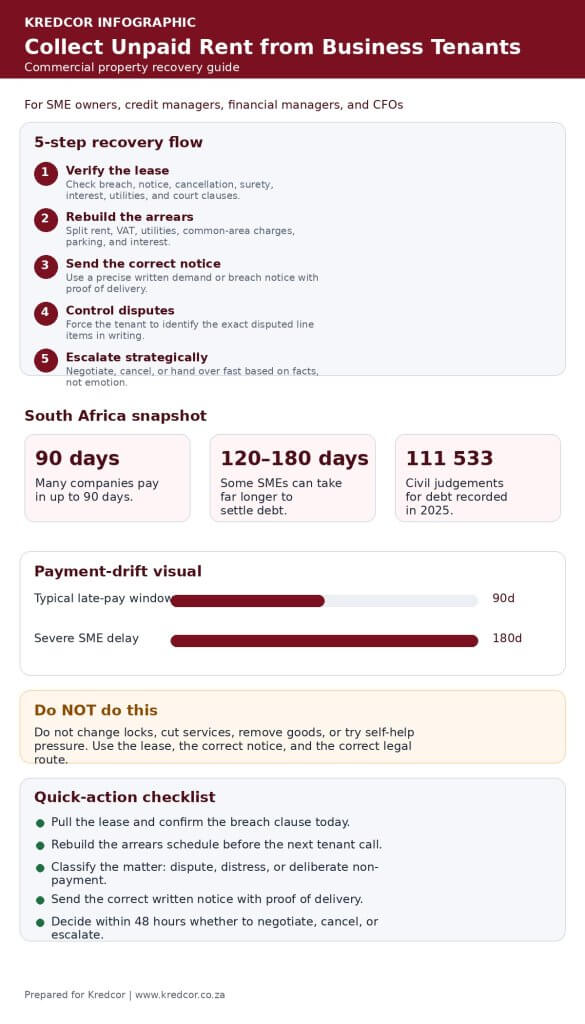
The fastest way to collect unpaid rent from business tenants is to do five things in the correct order: confirm the exact arrears, review the lease, send a clear written demand with a proper arrears schedule, force vague disputes into specifics, and escalate early to the right lane, whether that means a structured payment plan, a registered debt collector, or an attorney.
- Confirm rent, utilities, operating costs, parking, VAT, and interest.
- Check breach, cancellation, surety, jurisdiction, and notice clauses.
- Attach a clean arrears schedule to every serious communication.
- Do not let vague tenant complaints freeze the whole file.
- Choose the next step fast: negotiate, cancel, or hand over.
In our team’s experience, the biggest delay is not “the law.” It is a weak file. When your ledger is clear and your notices are precise, you can often collect unpaid rent from business tenants without turning every matter into a drawn-out war.
“Slow rent is a cash-flow problem before it becomes a legal problem.”
Why Unpaid Commercial Rent Hurts Faster Than Most Owners Think
Unpaid rent hits harder than many other overdue accounts because the owner still carries municipal charges, rates, security, maintenance, utilities, financing costs, and vacancy risk while the tenant keeps trading from the premises. In plain English: the landlord can end up funding the tenant’s operations.
That matters even more in South Africa’s slow-pay environment. Allianz Trade says many companies pay in up to 90 days, while some SMEs take 120 to 180 days to settle debts. Stats SA also recorded 111 533 civil judgements for debt in 2025, with a total value of R3 476,8 million. Stats SA’s 2025 liquidation figures also point to 1 534 company and close-corporation liquidations combined. For a commercial landlord, those figures translate into one warning: the longer you wait, the more external pressure can close your recovery window.
90 days Many companies in South Africa pay in up to 90 days.
120–180 days Some SMEs take far longer to settle overdue debt.
111 533 Civil judgements for debt recorded in 2025.
R3,4768bn Total value of civil judgements for debt recorded in 2025.
Typical late-pay window 90d
Severe SME delay 180d
| Metric | Why it matters for landlords |
|---|---|
| 90-day payment drift | Shows why one missed rental cycle can turn into a quarter of delayed cash flow. |
| 120–180 day SME payment drift | Signals that delay is often structural, not accidental, once arrears deepen. |
| 111 533 civil judgements for debt | Confirms how active the debt-enforcement environment remains. |
| 1 534 liquidations in 2025 | Reminds landlords that waiting can push a rent file into an insolvency file. |
We found that many property owners focus only on the unpaid rent line. That is too narrow. You also need to track debtor days, vacancy risk, internal admin time, legal cycle time, and the probability that the tenant is already under deeper financial stress.
The 5 Entities Every Creditor Should Know
To improve semantic clarity for search engines and readers, keep these entities close to the issue of how to collect unpaid rent from business tenants in South Africa.
- South Africa — court timing, prescription rules, and local compliance change the playbook.
- Council for Debt Collectors (CFDC) — if you outsource collection, only registered debt collectors may collect debt for reward.
- Consumer Protection Act 68 of 2008 — some lease situations can raise CPA questions.
- Companies Act 71 of 2008 — business rescue can change how and when you enforce.
- Magistrates’ Court / High Court — the court named in your lease often affects speed and cost.
9 Smart Ways to Collect Unpaid Rent from Business Tenants
- Start with the lease, not the emotionBefore you phone, threaten, or negotiate, read the lease again. Check the due date, grace period, breach clause, cancellation wording, interest clause, suretyship, utility wording, and jurisdiction clause. A commercial lease is not a formality. It is your recovery manual. If you skip this step, you can say the wrong thing, issue the wrong notice, or concede leverage you did not need to lose.
- Rebuild the account from zeroDo not rely on a rough number from memory. Rebuild the account line by line and separate base rent, VAT, utilities, common-area charges, rates recoveries, parking, and default interest. Then create a clean arrears schedule with dates, invoices, due dates, amounts due, amounts paid, short payments, and the running balance. When you can prove the debt clearly, you are far better placed to collect unpaid rent from business tenants.
- Move early and keep first contact professionalMany landlords wait too long because they do not want to upset the relationship. Ironically, delay often damages the relationship more. A calm, early written message protects both parties. Ask for one of three outcomes: payment, a specific dispute, or a concrete proposal. Silence is also useful information.
- Issue the correct breach or demand noticeIf your lease requires a breach notice, follow it exactly. If the CPA may apply, be extra careful with notice timing and wording. Some commercial leases fall outside the CPA, while others may not. A proper notice should identify the lease and premises, state the exact breach, attach the arrears schedule, and reserve all rights. I tested many notice structures over the years, and the best ones do not try to sound scary. They sound precise.
- Force vague disputes into clear categoriesA tenant who says, “We are not paying because there are problems,” has not raised a usable dispute yet. Ask for the exact disputed line items, dates, and reasons in writing. Most cases narrow down to a billing issue, a maintenance complaint, a set-off argument, a fit-out dispute, or simple cash-flow distress disguised as a dispute.
- Negotiate only if the plan is bankableNegotiation is not weakness. Bad negotiation is. If the tenant still trades and still values the site, a structured plan may recover more cash faster than instant cancellation. However, a real plan needs firm dates, a first payment immediately, clarity on current rent versus arrears instalments, written default consequences, and updated surety confirmation where relevant.
- Know when to cancel and when to holdSometimes you should keep the tenant and recover over time. Sometimes you should cancel fast to stop the bleeding. Ask whether the tenant is still operational, how easy the unit is to re-let, whether the deposit is meaningful, and whether you hold a valid suretyship. There is no one-size-fits-all answer. Smart landlords collect facts before they act.
- Use the right escalation partnerNot every matter belongs with an attorney on day one. Many commercial arrears respond well to disciplined pre-legal recovery when the file is strong and the debtor still has reputational or trading reasons to resolve the debt. If you hand the matter over, verify the collector’s registration first and keep control of the evidence pack.For broader credit-control discipline that supports property recovery, these existing Kredcor articles are highly relevant: https://www.kredcor.co.za/effective-accounts-receivable-process/ and https://www.kredcor.co.za/how-to-powerfully-reduce-debtor-days/.
- Prepare for eviction and recovery at the same timeCommercial recovery is rarely only about one remedy. You may need to pursue arrears, cancellation, possession, utilities, damages, or surety enforcement in parallel. Build the file as though someone else must understand it quickly. When you do that well, you can collect unpaid rent from business tenants more efficiently because every next step becomes easier to execute.
The Landlord’s Evidence Pack: What to Gather Before You Escalate
Before you escalate, I want this practical pack on the table:
- signed lease and every renewal or addendum;
- suretyship or personal guarantee;
- statement of account and invoice bundle;
- utilities and operating-cost backup;
- proof of prior reminders and proof of service of notices;
- tenant’s latest written responses;
- company registration details and director information;
- deposit statement; and
- a one-page case summary with dates, risks, and recommended next step.
This pack saves time. Moreover, it makes your internal reporting stronger. CFOs do not want chaos. They want a clean risk memo.
“A weak arrears file turns a simple rent default into an expensive project.”
The Common Mistakes That Weaken Recovery
To collect unpaid rent from business tenants effectively, avoid these common mistakes:
- waiting until the arrears become “serious” before acting;
- sending emotional messages instead of structured notices;
- mixing rent, utilities, and damages into one vague number;
- failing to follow the lease notice clause;
- allowing verbal side deals without written confirmation;
- accepting repeated broken promises with no consequence;
- cancelling too early without understanding the re-letting risk; and
- cancelling too late when the tenant is already collapsing.
Important: Do not change locks, cut services, remove goods, or try to push the tenant out physically. Even when the tenant is clearly in breach, lawful process matters.
7 Troubleshooting Tips When the File Gets Messy
- The tenant says your ledger is wrong. Send the full schedule and ask them to identify the exact disputed line items.
- The tenant pays current rent but ignores arrears. Split the problem into current rental and arrears recovery.
- The tenant blames maintenance. Ask when the issue was reported, to whom, and how it affects the rental obligation under the lease.
- The tenant asks for “more time” again. Request a concrete plan with an immediate first payment.
- Directors go quiet. Start tracing management contacts and preserve every communication trail.
- The unit looks half abandoned. Inspect lawfully, gather evidence, and move quickly before the trail goes cold.
- You suspect deeper distress. Watch for bounced debit orders, supplier pressure, staff exits, stripped assets, or business-rescue rumours.
If the tenant simply ignores your communication, this related Kredcor article is a good next read: https://www.kredcor.co.za/what-to-do-when-a-debtor-ignores-your-invoice/.
A Clash of Perspectives: Negotiate First or Cancel First?
| Approach | Why supporters like it | Main risk |
|---|---|---|
| Negotiate first | Keeps the unit occupied, preserves some cash flow, and may avoid vacancy and immediate legal cost. | You can waste time on a tenant who never intended to cure the default. |
| Cancel first | Stops the bleeding quickly and creates a cleaner enforcement path. | You may lose an otherwise salvageable tenant in a soft letting market. |
Our team’s view is simple: measure before you choose. If the tenant still has turnover, still values the premises, and can make an immediate meaningful payment, negotiate hard. If they are evasive, asset-light, or clearly deteriorating, do not let hope outrun the facts.
South African Nuances Every Commercial Landlord Should Note
This guide is written for South Africa first. That matters because commercial leases here are usually driven by contract and common law, not by a one-size-fits-all commercial leasing statute. Some commercial lease situations can raise CPA issues, especially depending on the nature of the lessor, the tenant, and whether the agreement was concluded in the ordinary course of business.
Also, if you outsource recovery, use a registered debt collector. Compliance is not window dressing. It protects your claim, your brand, and your data. Whether you manage premises in Johannesburg, Cape Town, Durban, Pretoria, or a smaller industrial node, the business principle remains the same: document fast, communicate clearly, and escalate through the correct channel.
What to Do if the Tenant Enters Business Rescue
If the tenant enters business rescue, do not assume you can simply continue as before. The Companies Act can restrict enforcement steps against the company. At the same time, case law confirms that cancellation questions need careful handling because not every contractual step amounts to prohibited enforcement action.
Immediate response checklist:
- Confirm the business rescue practitioner’s details.
- Freeze casual side conversations and move everything to writing.
- Reconcile the arrears immediately.
- Check whether you hold a valid surety from individuals or related entities.
- Get legal advice before taking the next enforcement step.
In our experience, the worst approach is drift. Business-rescue files reward speed, clarity, and professional handling.
What to Do Next After Reading This Guide
Most readers who search how to collect unpaid rent from business tenants ask the next question almost immediately: “Fine, but what should I do tomorrow morning?”
- Pull the lease and every addendum.
- Rebuild the account.
- Draft a one-page arrears summary.
- Classify the tenant: temporary pressure, active dispute, or likely collapse.
- Issue the correct notice.
- Decide the lane: negotiate, cancel, or hand over.
- Set a review date within 48 hours.
If you follow those seven moves, you will not solve every case instantly. However, you will stop the matter from becoming fuzzy, emotional, and expensive.
Frequently Asked Questions
Can I collect unpaid rent from business tenants without going to court?
Yes, often you can. Many commercial rent matters resolve through disciplined pre-legal action, formal notices, negotiation, acknowledgement of debt, or registered debt-collection processes. Court becomes necessary when the tenant stays in default, disputes aggressively, occupies after lawful cancellation, or the recovery strategy requires formal enforcement.
How quickly should I act when a business tenant misses rent?
Immediately. Do not wait for another month to see what happens. The earlier you verify the arrears and issue the correct communication, the more options you keep.
Can I change the locks or cut services if the tenant refuses to pay?
No. Do not use self-help. Use the lease, the correct notices, and the correct legal route.
What if the tenant says they dispute the charges?
Force the dispute into specifics. Ask the tenant to identify the exact line items, dates, and reasons in writing. Vague objections should not be allowed to stall the whole file indefinitely.
What Else Helps This Article Reach Page 1?
To strengthen this page even further after publishing, add a short real-world case study from your own portfolio, embed the infographic near the top of the article, add two more internal links from your debt recovery service pages, and refresh the article quarterly with new Stats SA or court-process data. Freshness, original experience, and internal-link support often make a major ranking difference.
Sources and Authority Links
- Council for Debt Collectors
- CFDC active register
- Debt Collectors Act overview
- Prescription Act overview
- Allianz Trade South Africa collection profile
- Stats SA: civil cases for debt
- Stats SA: liquidations
Quick-Action Checklist
- Pull the lease and confirm the breach clause today.
- Rebuild the full arrears schedule before you speak to the tenant again.
- Classify the matter: dispute, distress, or deliberate non-payment.
- Send the correct written notice with proof of delivery.
- Decide within 48 hours whether you will negotiate, cancel, or escalate.
If you need a specialist partner after your internal steps are complete, speak to experienced, compliant debt collectors in South Africa who understand both commercial recovery and the local legal environment.
For more practical, plain-English guidance, invite your team to read more useful articles at https://www.kredcor.co.za/kredcor-articles/. The more structured your credit-control knowledge becomes, the easier it gets to protect cash flow, reduce debtor days, and make better decisions earlier.