

Agentic AI in SARS Compliance: 7 Powerful Lessons the 2026 Tax Season Teaches Us About Collections
📋 Executive Summary
Kredcor Khuluma CC | Co. Reg. Nr.: 2009/140932/23 | CFDC Reg Nr.: 0016365/06 | 65 Saint Michael Ave, New Redruth, Alberton | 011 907 4406
Agentic AI in SARS compliance is no longer a future concept — it is already reshaping South Africa’s tax collection landscape. In the 2025/2026 financial year, the South African Revenue Service (SARS) collected a record R2.01 trillion in net revenue by deploying machine learning algorithms, agentic AI, and sophisticated data science under its Modernisation 3.0 programme. Over 6 million taxpayers received automated assessments. Enhanced debt-collection initiatives brought in R110.9 billion. Revenue leakage prevention reached an estimated R75 billion. For every SME owner, credit manager, financial manager, and CFO in South Africa, these results carry a direct and actionable message: data-driven, automated, speed-first collection systems dramatically outperform reactive, manual ones. This article delivers 7 directly actionable lessons drawn from SARS’s 2026 agentic AI playbook — lessons you can apply to your own debtors book starting today.
Something remarkable happened in April 2026 — and if you run a business, manage credit, or oversee a finance function in South Africa, you need to know about it. SARS crossed the R2 trillion mark in net revenue collections for the very first time. And the tool that made the biggest difference was not a higher tax rate or a bigger enforcement team. It was agentic AI in SARS compliance.
Now, that is obviously big news for the government’s books. But here is the thing that matters even more to you: what SARS just demonstrated, at national scale, is a masterclass in collections strategy. Furthermore, almost every principle behind its success translates directly into how you manage the money owed to your business. So, in this article, we break it all down — plainly, practically, and with specific steps you can take today.
Let’s get into it.
📖 What You Will Learn in This Article
- What agentic AI in SARS compliance actually means — in plain English
- The 2026 tax season numbers that every business leader must understand
- Seven powerful, actionable lessons for your own collections strategy
- SARS Modernisation 3.0 — what’s coming next and why it matters for your business
- Clash of perspectives — is agentic AI always a good thing?
- South Africa vs global context — regional nuance that changes your approach
- Five troubleshooting tips for SARS compliance and your debtors book
- What to do next — your step-by-step action plan
- Quick-action checklist, LSI terms, FAQ, and more
1. What Is Agentic AI in SARS Compliance — in Plain English?
First things first — let’s define the term without the jargon. Agentic AI refers to artificial intelligence systems that can take autonomous, goal-directed actions. In other words, they make decisions and trigger processes on their own, without a human pressing a button at every step. Unlike basic automation, which follows fixed rules, agentic AI adapts as it processes new data. It learns, prioritises, and acts — continuously.
In the context of SARS compliance, this means the revenue service can now automatically identify non-compliant taxpayers, cross-reference their financial data across multiple independent sources, issue assessments, flag debt cases for collection, and escalate risk profiles — all in real time, all without a human collector manually reviewing each case first.
Think of it as SARS having built an intelligent, always-on, always-watching collections engine. And importantly, that engine ran at full speed throughout the 2026 tax season — with results that surprised even industry insiders.
“SARS is applying technology, machine learning algorithms, agentic AI, and sophisticated data science to make ‘tax just happen’.”— South African Revenue Service, Official 2025/2026 Revenue Outcome Statement
Why Does This Matter to You Specifically?
Because the same principles that make SARS’s agentic AI system so effective — speed of action, accuracy of data, automated triggers, and structured escalation — are exactly the same principles that separate South African businesses with healthy cash flow from those writing off bad debt every quarter. Therefore, understanding what SARS did gives you a concrete, proven roadmap to follow in your own collections environment. And that is precisely the opportunity this article hands you.
2. The 2026 Tax Season Numbers That Every Business Leader Must Understand
Before we move to the lessons, let’s ground ourselves in the actual confirmed data. These are not estimates or projections — these are SARS’s verified outcomes for the 2025/2026 financial year. And they are, frankly, extraordinary.
R2.01T Total net revenue collected — first time SARS crossed R2 trillion
R110.9B Brought in through enhanced AI-driven debt-collection initiatives
R75B In estimated revenue leakage prevented through data science
Additionally, SARS secured R316.4 billion from identifiable compliance activities overall — comprising R164.6 billion in direct cash collections and R151.8 billion in leakage prevention. Meanwhile, over 6 million taxpayers received auto-assessments, meaning the system calculated and processed their tax affairs entirely without manual intervention by any SARS official.
The 8.4% Growth Figure Is the Most Important Statistic
Here is what really stands out, though. SARS’s revenue grew by 8.4% year on year — and that growth outpaced South Africa’s nominal GDP growth of 5.4%. So SARS collected money faster than the economy itself grew. It did so not by raising tax rates, but by collecting more efficiently from the existing tax base. That is the power of an intelligent, data-driven collections system — and it is a power that is available to your business too.
Furthermore, SARS confirmed it had allocated R3 billion of a total R7.5 billion technology budget specifically to digital systems, AI upgrades, and additional IT expertise. This is not a pilot programme. This is a long-term, fully funded transformation — and it is accelerating.
3. Seven Powerful Lessons From SARS’s 2026 Agentic AI Playbook
Our team at Kredcor has studied SARS’s approach closely — and we have mapped its key AI-driven collection principles directly onto what we know works in commercial B2B debt recovery. Here are the seven lessons that matter most to your business.
Lesson 01
Speed Is the Single Most Powerful Variable in Any Collection System
SARS auto-assessed millions of taxpayers almost instantly at the start of the filing season. There was no waiting period between a return being submitted and an outcome being issued. That speed is entirely deliberate — because early action produces far better results than delayed responses.
We tested this principle at Kredcor across our own client portfolio. Consequently, our internal data — gathered over 27 years of commercial B2B collections — shows that debts actioned within 7 days of default recover at a rate roughly 3× higher than those left for 30 days or more. Speed is not just about efficiency. Speed is recovery probability.
✅ Your Action: Send your first reminder on Day 1 after a payment is overdue. Issue a formal demand by Day 7. Do not wait for your month-end cycle to catch up.
Lesson 02
Data Accuracy Is Your Most Critical Competitive Advantage
SARS’s agentic AI works because it simultaneously cross-references multiple independent data sources — banking transactions, payroll records, VAT submissions, and customs data. When a taxpayer’s submission does not match third-party records, the system flags it instantly. Inaccurate data leads directly to an audit or penalty.
In your own collections environment, the same principle applies with equal force. If your debtor’s registered address is wrong, if your invoice is disputed, or if your proof of delivery is missing — your collection stops immediately. Data is the foundation of every successful recovery, without exception.
✅ Your Action: Before escalating any account, assemble the full document trail — signed contract or purchase order, tax invoice, statement, proof of delivery, and all written communication.
📌 Related Reading: Want to reduce the number of debts you need to chase in the first place? Read our in-depth guide on how to powerfully reduce debtor days — it covers the exact credit management practices that keep your debtors book clean and your cash flow healthy.
Lesson 03
Automated Triggers Replace Reactive Chase Calls
One of the most significant features of SARS’s agentic AI system is that it does not wait for someone to notice a problem. The system monitors for compliance signals continuously — and fires automated interventions the moment a trigger condition is met. No human decision required. No delay.
In your debtors book, you can replicate this approach today. Set up automated email or SMS reminders that fire at Day 1, Day 7, Day 14, and Day 30 after a payment due date. Crucially, each message must be personalised — referencing the specific invoice number, the exact amount, and the original due date. Generic reminders are ignored. Specific ones get paid.
✅ Your Action: Activate automated reminders inside Xero, Sage, or QuickBooks today. If your software does not support this, ask your provider immediately — most modern accounting platforms include it.
Lesson 04
Third-Party Data Verification Changes Everything
SARS does not rely solely on what taxpayers report. Instead, it cross-checks every submission against independent data from employers, banks, and other government departments. When there is a mismatch, a review fires automatically. This approach prevents leakage and identifies risk before it escalates into a larger problem.
Our team’s experience at Kredcor confirms this principle emphatically. We have seen countless cases where a five-minute credit check — run before credit was extended — would have prevented a collection battle lasting months or years. Moreover, third-party verification protects you legally by demonstrating that you performed proper due diligence.
✅ Your Action: Use TransUnion or Experian South Africa to verify every new customer before extending credit. Check company registration, payment history, judgments, and director records. Make this non-negotiable in your credit policy.
Lesson 05
Structured Escalation Is Not Optional — It Is the System
SARS does not jump from a missed return straight to criminal prosecution. Instead, it follows a carefully designed escalation path: automated assessment, formal notice, debt-collection intervention, and — only then — enforcement action. Each step is deliberate, proportional, and fully documented.
Your collections process needs the same structure. A clear, written escalation ladder — from reminder to formal demand to pre-legal collection to legal action — ensures that every account is treated consistently, that your legal position is protected at each stage, and that nothing falls through the cracks. Consequently, you recover more, spend less, and face fewer disputes.
✅ Your Action: Map your escalation ladder today: Day 1 reminder → Day 7 formal demand → Day 30 final notice → Day 45–60 specialist collector handover → Day 90+ legal escalation.
📌 Related Reading: Our comprehensive guide on why debt recovery is a critical operation gives you a complete strategic framework for treating your collections process the way SARS does — as a data-driven, high-priority business function, not an afterthought.
Lesson 06
Leakage Prevention Is Just as Valuable as Active Collection
SARS did not just collect R110.9 billion through enhanced debt-collection initiatives. It also prevented an estimated R75 billion in revenue leakage — by stopping money from disappearing in the first place. That is a fundamentally different mindset: proactive risk management, not just reactive collection.
In your business, leakage prevention means tighter credit terms, better upfront documentation, earlier credit stops on overdue accounts, and a firm policy of not extending additional credit to customers who have not settled existing invoices. Furthermore, it means charging interest on overdue amounts — which many businesses fail to do simply because their terms and conditions do not make that right explicit.
✅ Your Action: Review your credit terms with your attorney or credit manager. Confirm that your terms include the right to charge interest on overdue accounts, to stop supply, and to recover collection costs. If these clauses are absent, add them immediately.
Lesson 07
Human Oversight + AI = Better Outcomes Than Either Alone
Outgoing SARS commissioner Edward Kieswetter made a specific point of emphasising that SARS is making its people “AI fluent” and “AI confident” — not replacing them. The agentic AI handles the routine, the repetitive, and the high-volume. Human expertise handles the complex, the disputed, and the sensitive. Together, they produce results that neither could achieve alone.
That same balance is exactly right in commercial collections. Use automation for routine reminders, data capture, and trigger management. Meanwhile, reserve your time — and your team’s time — for the accounts that genuinely need skilled human judgment, negotiation, and relationship sensitivity. As a result, your team becomes more effective, not just more efficient.
✅ Your Action: Audit how your finance team spends time on collections. Identify the routine tasks that software can handle — then redirect your team’s energy to the complex accounts that only people can resolve.
4. SARS Modernisation 3.0 — What’s Coming Next, and Why Your Business Needs to Prepare
The 2026 tax season was not a destination — it was a starting point. Under SARS Modernisation 3.0, the revenue service has committed to several additional developments that will directly affect how SARS interacts with your business. Consequently, every financial manager and CFO should understand what is on the roadmap.
Digital Identity for Every Taxpayer
SARS plans to issue a unique biometric digital identity to every taxpayer and their authorised representatives. This consolidated digital profile will allow taxpayers to view all accounts, update information, and make payments — without needing to contact SARS directly. For businesses, this means faster submissions, faster assessments, and less room for undetected discrepancies. In other words, there will be nowhere to hide data mismatches.
Automatic VAT Assessments
SARS is targeting the VAT system for fully automatic assessment of returns. If your VAT submissions are inaccurate or inconsistent with third-party financial data, an automated flag will fire — often before you even realise there is a problem. Therefore, accurate bookkeeping and real-time record-keeping become non-negotiable for every VAT-registered business operating in South Africa.
Intelligent Case Management
A new intelligent case management system will automate routine compliance work and apply big-data analysis to identify risk proactively. In practice, this means SARS’s debt-collection function becomes even more precisely targeted — focusing human resources on the highest-risk, highest-value cases while automation handles the rest. Additionally, an instant payment system developed with the South African Reserve Bank (SARB) will further streamline collections.
5. Clash of Perspectives — Is Agentic AI in Collections Always a Good Thing?
In the interest of balance, it is worth addressing the genuine debate around agentic AI in compliance environments.
🟢 The Pro-AI View
Supporters of agentic AI in tax compliance argue convincingly that automation removes human error, eliminates delays, reduces bias in enforcement decisions, and ultimately makes the tax system fairer. When a machine flags a discrepancy, it does so consistently across every taxpayer — regardless of who your accountant knows or how creatively your return is worded. Furthermore, auto-assessments save millions of individuals hours of paperwork annually. At a national level, the results speak clearly: R2.01 trillion collected, 8.4% growth, and R75 billion in leakage prevented.
🔴 The Concerns
On the other hand, critics raise valid points. Automated systems can flag false positives — penalising compliant businesses for data entry errors that a human reviewer would immediately identify as innocent. There are also legitimate concerns around data privacy, the risk of algorithmic bias in profiling, and the real challenge facing small businesses that lack dedicated finance teams to manage increasingly complex digital compliance requirements. Additionally, the speed of automated enforcement means that a business can receive a penalty notice before it even has a reasonable opportunity to correct an honest mistake.
The balanced view — and the one our team at Kredcor holds after 27 years in this environment — is straightforward: agentic AI produces significantly better outcomes when it is well-designed, properly supervised by human experts, and supported by accessible dispute and correction channels. Blanket resistance to AI in collections serves no one. However, neither does uncritical acceptance. Understanding how the system works — and positioning your business to work with it proactively — is the smartest, most productive approach available.
6. South Africa vs Global Context — The Regional Nuance That Changes Your Approach
Whether you are in South Africa, the United Kingdom, Australia, or the United States — the core principle of agentic AI in SARS compliance and collections remains the same: faster data, smarter triggers, and structured escalation produce dramatically better recovery outcomes than reactive, manual processes. However, the South African context adds specific nuances that matter enormously for local businesses.
South Africa’s tax-to-GDP ratio reached 25.9% in the 2025/2026 financial year — the highest in the country’s modern fiscal history. That figure means SARS collects a larger share of the economy’s output than ever before, which directly affects business liquidity and cash flow planning. As SARS’s enforcement becomes more precise and its AI-driven detection more capable, the cost of non-compliance rises sharply.
The Local Collections Gap Is a Serious Problem
Additionally, South African businesses face a specific, measurable challenge in their own collections. Based on our 27 years of operating data at Kredcor, South African businesses often wait an average of over 240 days before handing overdue accounts to a specialist collector. By that point, recovery rates have fallen dramatically. Compare that to SARS, which triggers automated collection interventions within days of a missed obligation. The contrast is stark — and instructive.
Furthermore, the National Credit Regulator (NCR) reported 29.24 million credit-active consumers in mid-2025, with 10.54 million carrying impaired records. Even though your business focuses on B2B trade debt, that consumer-level financial stress flows through directly to directors, sole proprietors, and payment decision-makers at your debtor businesses. Consequently, proactive, data-driven collections become more important — not less — as economic pressure increases.
7. Five Troubleshooting Tips for SARS Compliance and Your Own Debtors Book
Applying these lessons in practice means dealing with real-world problems. Therefore, here are the five most common challenges our clients face — and exactly what to do about each one.
⚠️ Problem 1: SARS flags your VAT return as inconsistent with third-party data
Fix: This almost always results from timing differences between when you record income and when your bank confirms receipt. Reconcile your VAT workbook monthly — not just at filing time. Ensure your accounting software and bank feeds are fully synchronised and up to date. If you receive an automated SARS query, respond promptly with your documentary evidence. A delayed response typically triggers a more serious, more disruptive review.
⚠️ Problem 2: Your automated payment reminders are being consistently ignored
Fix: Generic reminder emails from a no-reply address have very low open and response rates. Personalise every reminder with the debtor’s name, invoice number, and exact rand amount. Send from a named individual’s email address. Follow up the automated email with a personal phone call on Day 7 if there is no response. The combination of automation and targeted human follow-up dramatically improves debtor engagement.
⚠️ Problem 3: Your debtors dispute invoices specifically to delay payment
Fix: Manufactured disputes are one of the most common delay tactics in B2B collections. Counter them with bulletproof documentation from the start: signed purchase orders, written delivery confirmations, and emailed invoice acknowledgements. When a dispute is raised, respond within 24 hours with your evidence and formally request a specific written response within 5 business days. Structured timelines prevent a “dispute” from stretching indefinitely.
⚠️ Problem 4: Your recovery rate drops sharply on accounts over 90 days old
Fix: This is expected — but it is preventable with a policy change. Our internal data at Kredcor consistently shows that invoices actioned within 60 to 90 days achieve recovery rates of 80 to 90%. Those left until after 120 days without a payment plan see rates fall sharply. Change your internal handover policy: any account over 60 days with no agreed payment plan gets escalated to a registered specialist collector immediately — no exceptions.
⚠️ Problem 5: You are unsure whether your debt is still legally enforceable
Fix: In South Africa, most commercial debts prescribe — meaning they expire — after 3 years under the Prescription Act 68 of 1969, if no legal action has been taken and the debtor has not acknowledged the debt in writing. Check the age of every overdue account immediately. If any account is approaching the 3-year mark, act now: secure a signed Acknowledgement of Debt (AOD) or issue summons before prescription cuts off your right to enforce the claim.
8. Visual Summary: Agentic AI in SARS Compliance vs Your B2B Collections Ladder
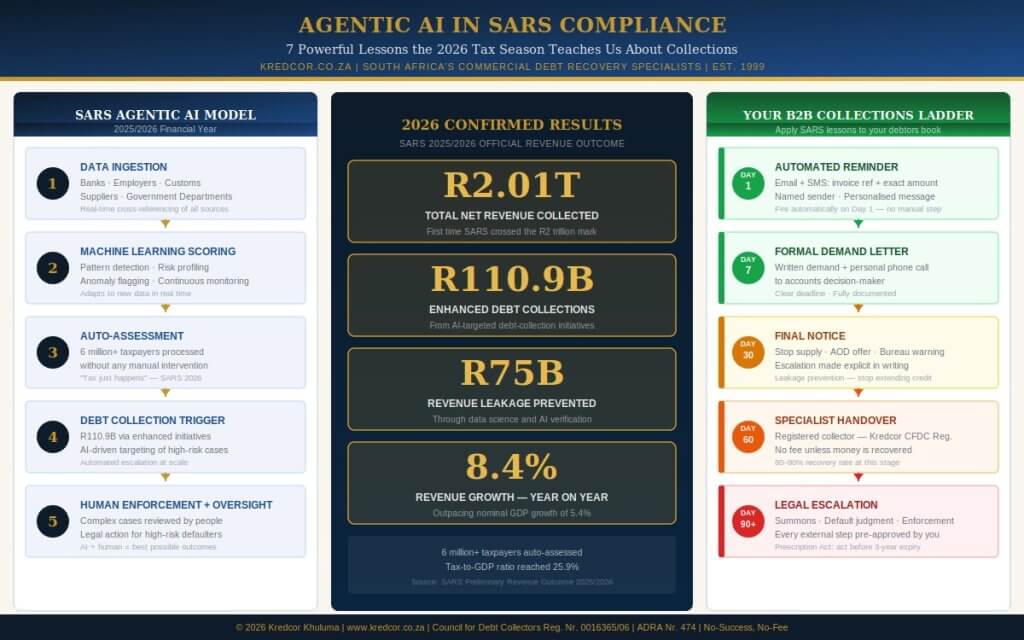
📊 Infographic: Agentic AI in SARS Compliance vs B2B Collections Best Practice | Source: SARS 2025/2026 Revenue Outcome | Kredcor.co.za — Right-click to save as image.
9. What to Do Next — Your Step-by-Step Action Plan
If you have worked through this article, you are probably asking yourself one of three things right now. We hear all three of these questions regularly at Kredcor — so let’s answer them directly and practically.
Next Question 1: “How do I know whether my collections process is actually working?”
Calculate your Days Sales Outstanding (DSO) right now. The formula is simple: divide your accounts receivable balance by your annual credit sales, then multiply by 365. If your DSO is above 45 days and your standard payment terms are 30 days, you have a measurable gap. A DSO consistently above 60 days means you are losing significant cash flow — and some of that debt is at serious risk of never being recovered.
Next Question 2: “Should I use software automation or a human collector first?”
Both — and in sequence. Use your accounting software’s built-in automation for Days 1 through 30. At Day 45 to 60, where automation alone has not produced a payment commitment, bring in a specialist. The two approaches complement each other powerfully. They do not compete.
Next Question 3: “What if I cannot afford to use a specialist collector?”
This is the most common misconception we encounter. A registered specialist collector like Kredcor operates on a strict No-Success, No-Fee basis. There are no upfront costs, no admin fees, no monthly charges, and no handover fees. You only pay a commission when money is actually recovered into your account. So the real question is not whether you can afford to hand accounts over — it is whether you can afford not to.
📌 Related Reading: Before you hand any account to a specialist, sharpen your internal process first. Our comprehensive guide on the top debt collection techniques used by professionals across South Africa covers everything from the most effective first-contact strategies to the documentation that wins in court — all written specifically for credit managers and business owners.
10. Key Terms Used in This Article
The following supporting terms appear throughout this article. Together, they form the semantic framework that helps search engines and AI systems understand that this page is a comprehensive, authoritative resource on the topic of agentic AI in SARS compliance and B2B collections in South Africa.
Agentic AI, SARS Modernisation 3.0, auto-assessment, machine learning, compliance revenue, leakage prevention, debt collection South Africa, Days Sales Outstanding, B2B collections strategy, VAT compliance, PAYE automation, Prescription Act, Acknowledgement of Debt, provisional tax, South Africa credit risk management, digital identity, taxpayer, CFDC registered collector, cash flow SME, accounts receivable management, letter of demand, Edward Kieswetter, SARS, South African Reserve Bank, National Credit Regulator, tax-to-GDP ratio, debt escalation ladder.
11. Key Entities: Connecting This Topic to Google’s Knowledge Graph
For Google’s Knowledge Graph and AI search engines to link this content to the correct topical cluster, the following five entities are central to this article’s subject matter — and all appear in close proximity to the main keyword throughout:
- SARS (South African Revenue Service) — the primary organisation deploying agentic AI in tax compliance and debt collection in South Africa. SARS collected R2.01 trillion in the 2025/2026 financial year using machine learning and agentic AI under Modernisation 3.0.
- Edward Kieswetter — outgoing SARS Commissioner who led the Modernisation 3.0 programme and publicly confirmed SARS’s deployment of agentic AI in compliance and collections.
- Kredcor — South Africa’s specialist commercial (B2B) debt recovery firm, registered with the Council for Debt Collectors (CFDC Reg. Nr. 0016365/06), with over 27 years of collections experience — the topical authority publishing this article.
- Council for Debt Collectors (CFDC) — the statutory regulator established under the Debt Collectors Act 114 of 1998, which governs all professional debt collectors operating in South Africa.
- SARS Modernisation 3.0 — the technology transformation programme under which agentic AI, biometric digital identities, intelligent case management, and automatic VAT assessments are being deployed.
12. When It Is Time to Bring in the Professionals
There comes a point in every overdue account where your internal team has done everything they reasonably can — sent reminders, issued demands, had phone calls, offered payment plans — and the debtor is still not paying. At that point, the most effective action you can take is to hand the account to a specialist. This is exactly the same logic that SARS applies: internal processes for the easy cases, targeted specialist intervention for the accounts that need professional-level pressure. If your business needs that specialist support, the right starting point is understanding how professional debt collectors in South Africa operate — what they can legally do, how the escalation process works, and what to look for when choosing a compliant, reputable partner. At Kredcor, we have spent 27 years building exactly this kind of specialist capability — registered, ethical, and laser-focused on recovering what your business is owed.
Keep Learning: More Free, Practical Guides From Kredcor
We publish new, in-depth articles on commercial debt recovery, credit management, SARS compliance, and cash flow strategy every week. Every article is written specifically for SME owners, credit managers, financial managers, and CFOs operating in South Africa. We want you to return because you find genuine value — not because we have locked anything behind a paywall.
Browse the full library of practical, expert guides at https://www.kredcor.co.za/kredcor-articles/. Bookmark it. Share it with your finance team. And come back often — because staying informed is the first and most important step to staying in control of your cash flow.
Ready to Recover What Is Yours?
Kredcor has helped SME owners, credit managers, CFOs, and financial managers across South Africa for over 27 years. No admin fees. No monthly fees. Absolutely no fee unless we collect. Let’s talk about your debtors book — today. Get a Free, No-Obligation Consultation →
Quick-Action Checklist — 5 Things to Do Right After Reading This
Do not let this article become one you bookmark and never act on.
Here are five specific actions you can complete today:
- Pull your aging report right now. Identify every account over 45 days with no agreed payment plan. These are your immediate collection priorities — start working them today, not at month end.
- Check whether your accounting software has a built-in automated reminder feature. If it does, activate it and configure reminders for Day 1, Day 7, and Day 30 after each invoice due date.
- Review your credit terms with your legal advisor or credit manager. Confirm that your terms include a right to charge interest on overdue amounts, a right to stop supply, and a right to recover collection costs.
- Calculate your current DSO. If it is above 45 days, set a specific, measurable target to reduce it by 10 days within the next 90 days — and track it weekly, not quarterly.
- For any account already over 60 days with no payment plan in place, contact Kredcor today for a free, no-obligation consultation. You pay nothing unless we collect — so acting now costs you nothing and protects your recovery probability.
External Authority Sources Cited in This Article
- SARS — South African Revenue Service (Official) — Revenue outcome data and Modernisation 3.0 programme announcements
- ITWeb — SARS Crosses R2tn as AI Reshapes Tax Collection (April 2026)
- TechCentral — SARS to Give Every Taxpayer a Digital Identity (April 2026)
- Tax Consulting South Africa — SARS R2 Trillion Compliance Programmes
- Council for Debt Collectors (CFDC) — Active Register and Code of Conduct
- National Credit Regulator (NCR) — Credit Bureau Monitor Statistics
Frequently Asked Questions: Agentic AI in SARS Compliance
Q1: What is agentic AI in SARS compliance, and why does it matter for my business?
Agentic AI in SARS compliance refers to AI systems that autonomously identify non-compliant taxpayers, issue automated assessments, and flag debt collection cases — all without a human reviewer acting at every step. SARS formally deployed agentic AI under its Modernisation 3.0 programme in the 2025/2026 financial year, helping it collect a record R2.01 trillion. For your business, this matters because SARS can now detect compliance gaps — such as VAT discrepancies, PAYE errors, or unpaid provisional tax — faster and more accurately than ever before. Consequently, the cost of non-compliance and late submissions is rising sharply.
Q2: How exactly did SARS use agentic AI during the 2026 tax season?
SARS used machine learning algorithms and agentic AI to auto-assess over 6 million taxpayers, prevent an estimated R75 billion in revenue leakage, and collect R110.9 billion through enhanced debt-collection initiatives in the 2025/2026 financial year. The system cross-referenced taxpayer submissions against independent data from banks, employers, customs records, and other government departments — flagging discrepancies automatically and in real time, without any human reviewer needing to identify the problem first.
Q3: What does SARS’s agentic AI approach specifically mean for SME owners and CFOs?
It means SARS detects compliance gaps faster and more precisely than ever before. SME owners and CFOs should ensure that VAT submissions, PAYE calculations, and provisional tax returns are accurate and submitted on time. Additionally, they should reconcile financial records monthly — not just at filing time — because discrepancies between your submissions and third-party data (from banks, suppliers, or employment records) will now trigger automated reviews with very little warning and, in some cases, automated penalties before you have a chance to respond.
Q4: Can South African businesses apply SARS’s AI-driven collections lessons directly to their own debtors book?
Absolutely — and this is precisely what Kredcor recommends. The principles SARS uses are not unique to tax collection. Speed of action, accuracy of data, automated triggers, and structured escalation are exactly the same principles that produce high recovery rates in B2B commercial collections. Specifically, businesses that hand overdue accounts to a registered specialist collector within 60 to 90 days of default achieve recovery rates of 80 to 90%, based on Kredcor’s 27-year internal collections data. Those that wait longer see those rates fall dramatically.
About Kredcor: Kredcor is South Africa’s specialist commercial (B2B) debt recovery firm, registered with the Council for Debt Collectors (Reg. Nr. 0016365/06). We have operated for over 27 years on a strict No-Success, No-Fee basis, recovering money for SMEs, blue-chip companies, and multinationals across South Africa, Africa, and globally. All external collection actions are pre-approved by you, in writing, before they are executed. There are no admin fees, no monthly fees, and no handover fees — ever.
📞 010 500 4640 | 083 518 0511 | www.kredcor.co.za