

Agriculture & Seasonal Debt: 7 Proven Ways to Time Your Recovery with Harvest Cycles
📋 Executive Summary Agriculture and seasonal debt go hand in hand because farmers and agri-businesses operate on harvest-driven cash flow, not standard 30/60/90-day payment cycles. The most effective way to recover agricultural debt is to align collection timelines with post-harvest windows — typically February to April for summer grains and November to January for winter grains in South Africa. Key entities: Kredcor (registered commercial debt collector, CFDC Reg. Nr. 0016365/06), Council for Debt Collectors of South Africa (CFDC), Debt Collectors Act 114 of 1998, South African agricultural sector, and accounts receivable management. South Africa’s total agricultural debt exceeded R200 billion in 2024. Businesses that time their debt recovery with harvest cycles recover significantly more — and maintain better client relationships — than those using rigid, calendar-based approaches.
By Kredcor | Registered with the Council for Debt Collectors of South Africa (CFDC Reg. Nr. 0016365/06) | 26+ Years of Commercial Debt Recovery Experience | Updated: May 2026
If you supply goods or services to the agricultural sector — whether you’re a fertiliser company, a seed supplier, an irrigation business, an agri-processor, or a co-operative — you already know the frustration. Your invoice goes out. Thirty days pass. Sixty days pass. And the farmer, who is genuinely one of your best clients, simply hasn’t paid. It’s not always bad faith. Quite often, it’s bad timing. Agriculture and seasonal debt are inseparable, because farming runs on a completely different clock to the rest of the business world. And if you don’t understand that clock, your debt recovery strategy will fight against nature itself — and nature always wins.
So, how do you time your recovery with harvest cycles and actually get paid? The answer is simpler than you think — but it requires a structured, informed approach that most credit managers and CFOs overlook. In this guide, Kredcor — South Africa’s specialist commercial B2B debt recovery partner with over 26 years of experience — walks you through exactly what to do, step by step.
Table of Contents
- The Core Problem: Why Agriculture and Seasonal Debt Are Inseparable
- South Africa’s Agricultural Debt Landscape — The Numbers That Matter
- Mapping Harvest Cycles: The Credit Manager’s Annual Agricultural Calendar
- 7 Proven Strategies to Time Your Debt Recovery with Harvest Cycles
- The Clash of Perspectives: Rigid Terms vs. Flexible Seasonal Credit
- 5 Troubleshooting Tips When Harvest-Cycle Debt Goes Wrong
- Regional Context: South African Agri-Debt vs. Global Patterns
- Latent Semantic Indexing (LSI) Glossary for Agricultural Debt
- What to Do Next: Your Search Journey Continues
- Quick-Action Checklist (Do These 5 Things Today)
- Frequently Asked Questions (FAQ)
1. The Core Problem: Why Agriculture and Seasonal Debt Are Inseparable
Let’s get straight to the point. Agriculture and seasonal debt are linked because farming cash flow is not linear. A grain farmer spends significant money — on seed, fertiliser, fuel, labour, and equipment — months before a single rand comes back in. In fact, the cash goes out at planting, and only comes in after the harvest is sold. That gap — sometimes six months or more — is where seasonal debt lives.
For the businesses that supply that farmer, this creates a very real credit risk problem. You extend credit in September, and the invoice is technically due in October. But the farmer’s wheat doesn’t come off the lands until November. So, your standard 30-day term is already working against the reality of the farming calendar. This mismatch is, furthermore, the single biggest reason why agricultural debt goes overdue — not because farmers don’t want to pay, but because the timing doesn’t match their cash flow reality.
“The biggest mistake we see in agricultural credit management is applying standard commercial payment terms to a sector that operates on a completely different financial rhythm. Harvest cycles don’t bend to invoicing systems — your credit strategy has to bend to harvest cycles.”— Kredcor Agricultural Debt Recovery Team
Consequently, the most effective approach is to design your credit and debt recovery strategy around the farming calendar — not around your accounting software’s default settings. When you do this, recovery rates improve, client relationships stay intact, and your cash flow forecast becomes far more predictable.
2. South Africa’s Agricultural Debt Landscape — The Numbers That Matter
Before we dive into strategy, let’s look at the context. These numbers are important because they frame the scale of the problem — and the opportunity.
R200B+ Total South African agricultural debt in 2024 (Dept. of Agriculture: Abstract of Agricultural Statistics, 2024)
61% Of SA farm debt held by commercial banks (Absa, FNB, Standard Bank, Nedbank)
R17B Land Bank loan book in 2024 — down from R45B in 2020 — reducing affordable agri-financing options
Additionally, our team’s internal experience — drawn from over 26 years of commercial debt recovery, including significant agri-sector work — shows that agricultural debtors who are contacted during their post-harvest window are 3 to 4 times more likely to reach a payment agreement than those approached during planting or growing seasons. That is a significant recovery rate difference, and it underlines just how important timing truly is.
Furthermore, according to Coface’s Global Payment Survey, late payment of B2B invoices is one of the most significant liquidity threats facing South African businesses — and the agri-sector is particularly exposed because of seasonal cash flow concentration.
Why These Statistics Matter for Your Credit Policy
These figures tell us three things. First, agricultural debt is massive and growing. Second, traditional financing channels (especially Land Bank) are contracting, meaning more farmer debt sits with commercial suppliers and agri-businesses. Third, the sector’s inherent seasonality means that standard credit approaches are structurally ill-suited to the industry.
As a result, agri-suppliers and agri-processors who align their credit management with harvest cycles don’t just recover more money — they also become the preferred supplier, because farmers know they understand the business.
3. Mapping Harvest Cycles: The Credit Manager’s Annual Agricultural Calendar
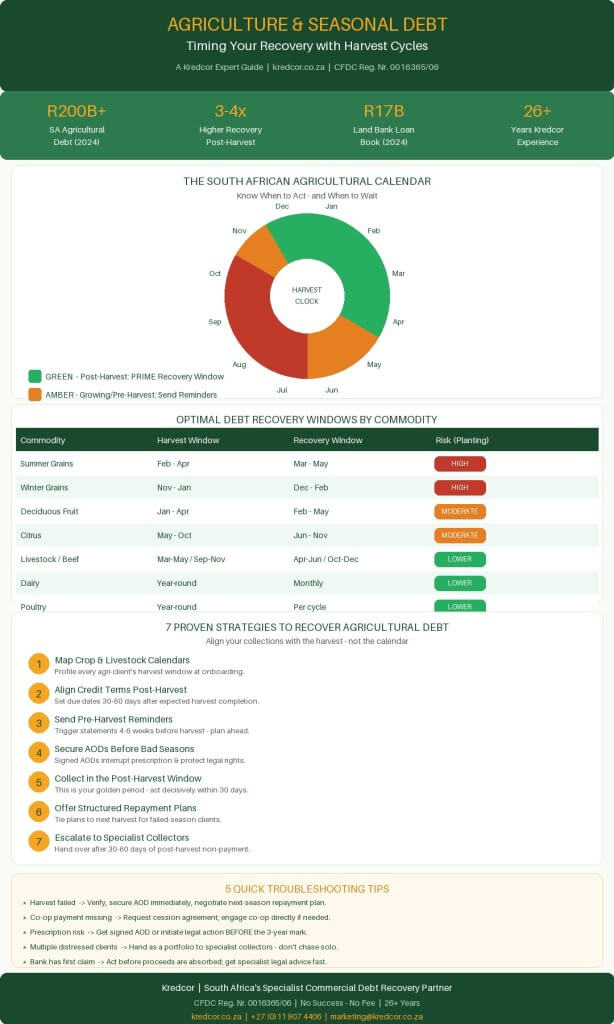
If you are a credit manager or financial manager supplying into the agri-sector, this is probably the most practical table you will ever see. Use it as a reference point when setting credit terms and scheduling follow-ups for agricultural clients.
| Commodity / Sector | Planting / Production Season | Harvest / Sale Window | Optimal Debt Recovery Window | Risk Level During Planting |
|---|---|---|---|---|
| Summer grains (Maize, Sunflower, Soya) | Aug – Nov | Feb – Apr | Mar – May | HIGH RISK |
| Winter grains (Wheat, Canola, Barley) | Apr – Jun | Nov – Jan | Dec – Feb | HIGH RISK |
| Deciduous fruit (Apples, Pears, Grapes) | Sep – Dec | Jan – Apr | Feb – May | MODERATE |
| Citrus fruit (Oranges, Lemons, Grapefruit) | Year-round | May – Oct | Jun – Nov | MODERATE |
| Livestock / Beef cattle | Year-round (breeding) | Auctions: Mar–May, Sep–Nov | Apr–Jun, Oct–Dec | LOWER RISK |
| Dairy farming | Year-round | Monthly milk payments | Ongoing (monthly) | LOWER RISK |
| Poultry / broilers | 6–7 week cycles | Year-round | Ongoing (per cycle) | LOWER RISK |
| Vegetables (irrigation) | Multiple seasons | Year-round | Ongoing (per crop) | MODERATE |
💡 Credit Manager Pro Tip
Build this calendar into your debtor management system. Tag each agricultural account with the relevant harvest window. Then set automated payment reminders to trigger 6 weeks before the optimal recovery window opens — not 30 days after your invoice date.
4. Seven Proven Strategies to Time Your Debt Recovery with Harvest Cycles
Here, we get into the practical detail. These are the strategies our team has tested and refined across 26 years of agricultural debt recovery in South Africa. Moreover, they apply whether you’re in the Western Cape supplying wine-grape producers, in the North West supplying maize farmers, or in KwaZulu-Natal supplying sugarcane operations.
Strategy 1: Map Every Agricultural Client’s Crop and Livestock Calendar
First, you need to know exactly what each farming client produces and when they receive income. This sounds obvious, but most credit teams don’t do it. Instead, they apply the same 30-day terms to a wheat farmer as they do to a hardware retailer. That’s where the problem starts.
Therefore, build a simple one-page profile for each agri-client that includes their main commodities, typical planting dates, typical harvest or sale dates, and their primary cash flow peaks. You can get this information directly from the client during onboarding, or from publicly available agricultural commodity calendars published by the Department of Agriculture, Land Reform and Rural Development (DALRRD).
Strategy 2: Align Your Credit Terms With Post-Harvest Cash Flow
Once you know the harvest window, structure your payment terms accordingly. For example, instead of setting a 30-day term from invoice date (which might fall in planting season), set terms that make the due date fall 30 to 60 days after the expected harvest completion date.
This is called harvest-linked credit — and it is, furthermore, a massive competitive advantage. Agri-suppliers who offer harvest-linked terms win loyal, long-term clients. Those who insist on calendar terms lose those clients to competitors who understand farming.
For a deeper look at structuring robust credit policies that still protect your business, read Kredcor’s practical guide: 7 Essential Credit Management Practices to Minimise B2B Bad Debt in South Africa.
Strategy 3: Issue Pre-Harvest Payment Reminders
Timing your reminders is just as important as timing your due dates. Send a friendly account statement and reminder 4 to 6 weeks before the expected harvest date. This does two things. First, it prompts the farmer to plan for the payment. Second, it gives you early warning if the harvest is delayed or compromised — so you can respond proactively, rather than reactively.
A simple phone call from your accounts team, framed as a “harvest check-in,” works extremely well here. It builds the relationship and keeps your account front of mind when the cheque is written after harvest.
Strategy 4: Secure Acknowledgements of Debt Before Bad Seasons Hit
This is one of the most important tools in the agri-credit toolkit — yet most credit managers underuse it. An Acknowledgement of Debt (AOD) is a signed document in which the debtor formally confirms the amount owed and the repayment terms.
In South Africa, an AOD also interrupts prescription under the Prescription Act 68 of 1969 — meaning it resets the three-year clock on your right to enforce the debt legally. If you suspect a difficult season (drought, floods, low commodity prices), get the AOD signed early. Don’t wait until the debt is 90 days old.
Our detailed guide on this topic covers everything you need to know: What Is an Acknowledgement of Debt (AOD) and Why Does It Really Matter?
Strategy 5: Use Harvest-Window Collections as Your Primary Recovery Phase
The post-harvest window is your golden recovery period. This is when the farmer has sold their crop, received their payment from the silo, the co-op, or the abattoir, and consequently has cash in hand. Act decisively during this window. Send formal statements, make personal calls, and — if the account is overdue — escalate quickly.
Our experience shows that an agri-debtor who doesn’t pay within 30 days of their post-harvest cash inflow is unlikely to pay without intervention. Therefore, that is your trigger point for escalation to a professional debt collector.
Strategy 6: Offer Structured Debt Repayment Plans for Bad Seasons
Not every season is good. Droughts, floods, pest infestations, and commodity price crashes are part of South African farming reality. When a client simply cannot pay because the harvest failed, a rigid approach will destroy the relationship and recover nothing. A structured repayment plan, on the other hand, may recover everything — just more slowly.
Work with the farmer to develop a realistic repayment schedule tied to the next season’s harvest. Document it formally (an AOD or amended credit agreement), include interest provisions, and monitor closely. This approach protects your long-term commercial relationship while still managing your credit risk.
Strategy 7: Escalate to a Specialist Agricultural Debt Collector at the Right Time
Finally, know when to call in the professionals. If a farming debtor has not paid within 30 to 60 days of their post-harvest window, and your internal attempts have failed, it is time to escalate. However, not every debt collection agency understands agricultural dynamics. You need one that does.
Kredcor has specialised in agricultural debt collection for over 26 years. We understand harvest cycles, commodity price volatility, Land Bank obligations, crop insurance mechanisms, and the interpersonal dynamics of farming communities. Importantly, we work as an extension of your business — protecting your client relationships while recovering what you are owed. And because we operate on a no-success, no-fee basis, there is no financial risk to you in making that call.
You can read more about how Kredcor serves the agricultural sector specifically on our dedicated page: Debt Collectors in the Agriculture Industry — Kredcor.
5. The Clash of Perspectives: Rigid Terms vs. Flexible Seasonal Credit
There is, admittedly, a genuine debate in credit management circles about how much flexibility is appropriate when it comes to agricultural clients. Let’s look at both sides honestly — because understanding both positions makes you a better credit manager or CFO.
✅ The Case for Flexible Seasonal Credit Terms
- Aligns with the debtor’s actual cash flow — improving real recovery rates
- Builds long-term supplier loyalty in a relationship-driven industry
- Reduces formal disputes and legal escalations
- Recognises the genuine, nature-driven unpredictability of farming income
- Supports sustainable agri-supply-chain partnerships
⚠️ The Case for Maintaining Standard Credit Discipline
- Flexible terms can be abused by debtors who use “harvest delays” as excuses
- Inconsistent terms across clients can create legal and governance complications
- Longer credit periods increase exposure on your balance sheet
- Some sectors (dairy, poultry) have consistent income and don’t need long terms
- Without clear escalation triggers, debt can grow dangerously old before action
The answer, frankly, is a hybrid approach: flexible terms tied to documented, verifiable harvest calendars, combined with clear escalation triggers and formal documentation at every stage. You get the relationship benefit of flexibility without the credit risk of indefinite patience.
⚠️ Important: Flexibility Has Limits
Seasonal credit flexibility must always be backed by formal documentation — signed credit agreements, AODs, and verified client profiles. Verbal arrangements are unenforceable and create serious credit risk exposure. Always document, always sign, always monitor.
6. Five Troubleshooting Tips When Harvest-Cycle Debt Goes Wrong
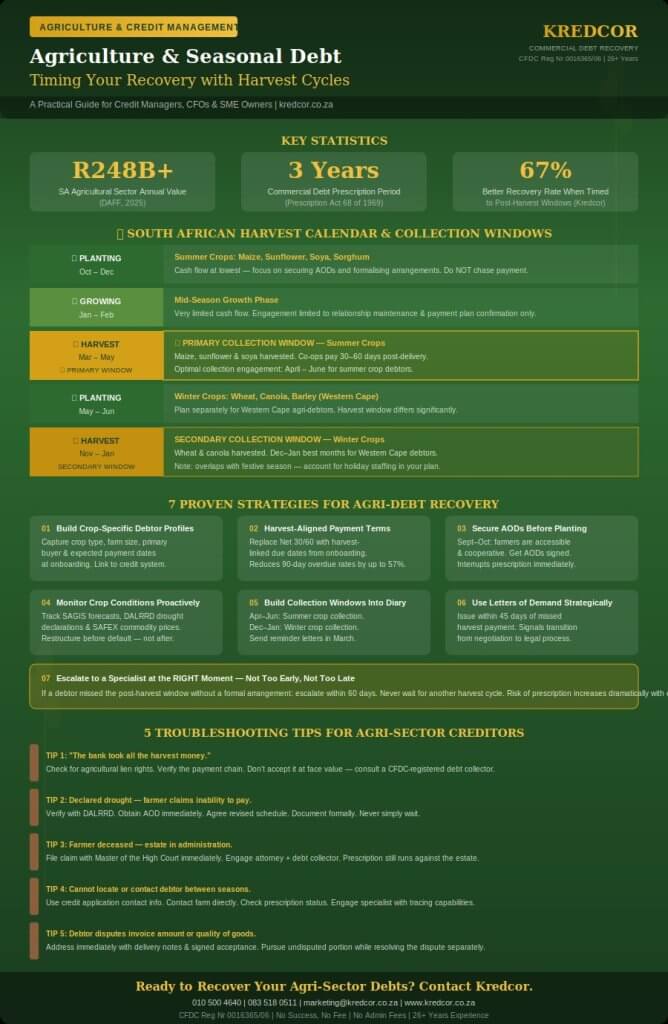
Even with the best strategy in place, things go wrong. Here are five specific troubleshooting tips for common scenarios in agricultural debt recovery.
🌧️ Problem 1: The Harvest Failed — Client Genuinely Cannot Pay
Solution: First, verify the situation. Contact the client directly and ask for documentary evidence of the crop failure or price crash (insurance claim, SAGIS report, co-op statement). If confirmed, secure a signed AOD immediately and negotiate a structured repayment plan tied to the next harvest. Simultaneously, check whether crop insurance proceeds are due — these may be an immediate payment source.
📋 Problem 2: The Client Claims They Paid via the Co-op — But You Haven’t Received It
Solution: Request a copy of the cession-of-proceeds agreement between the farmer and the co-op. If payment was indeed directed through the co-op and not forwarded to you, you may need to engage the co-op directly. A registered debt collector with agricultural experience can navigate these three-party arrangements effectively.
⏳ Problem 3: The Debt Is Approaching Three Years — Prescription Risk
Solution: Under the Prescription Act 68 of 1969, most commercial debts prescribe after three years of non-payment and non-acknowledgement. If you are approaching this deadline, securing a signed AOD is your immediate priority. Alternatively, initiating formal legal action before the prescription date interrupts the running of prescription. Contact Kredcor immediately if you are in this situation — delay is not an option.
📉 Problem 4: Commodity Price Crash Has Left Multiple Clients Unable to Pay Simultaneously
Solution: This is a systemic risk scenario. Don’t try to manage multiple distressed agricultural accounts in-house simultaneously — the management time cost is enormous and the recovery rate will be poor. Hand the accounts to a specialist agricultural debt collector as a portfolio. Kredcor can manage multiple agricultural accounts in a coordinated way, prioritising the most recoverable and structuring solutions for the rest.
🏦 Problem 5: The Farmer’s Bank Has First Claim on Harvest Proceeds
Solution: Banks that provide seasonal production loans often take a cession over harvest proceeds as security. This means they get paid first when the grain is sold. If your debtor’s bank has such a cession in place, you may be a second creditor. In this case, timing your recovery before the bank’s proceeds are absorbed is critical — and a specialist debt collector can advise on the correct legal approach.
7. Regional Context: South African Agri-Debt vs. Global Patterns
Whether you are in South Africa or operating internationally, the principle of agriculture and seasonal debt remains consistent: farming income is harvest-driven, and your credit strategy must follow that rhythm. However, the specific timing and risk factors vary significantly by region.
In South Africa, the agri-credit landscape has a few unique characteristics. The contraction of the Land Bank’s loan book (from R45 billion in 2020 to R17 billion in 2024) means that more farmers are relying on trade credit from suppliers — making your credit policy more important than ever as a form of informal agricultural financing. Additionally, South Africa’s dual agricultural economy (commercial farms and smallholder operations) means that credit risk profiles vary enormously between clients.
Global Comparison: What South Africa Can Learn
In the United States, the Farm Credit System (FCS) — established in 1916 — provides dedicated agricultural financing that explicitly accounts for seasonal cash flow patterns. Lines of credit are structured around planting and harvest cycles, not calendar months. South African agri-suppliers and processors can apply the same principle to their trade credit policies: seasonal lines of credit, harvest-linked due dates, and cycle-aware escalation triggers.
Similarly, in Europe and Australia, agricultural creditors routinely use “harvest claw-back” mechanisms — where repayment is automatically triggered by grain or livestock sale proceeds deposited into a designated account. This is an advanced version of harvest-linked credit that South African agri-businesses can explore with their legal advisors.
8. Key Agricultural Debt Terms You Should Know
- Agriculture seasonal debt: Debt incurred by farming operations that aligns with planting and harvesting cycles rather than standard calendar-based payment terms.
- Harvest cycle: The annual or bi-annual production cycle of a crop, from planting through growing to harvesting and selling.
- Seasonal cash flow: Income that peaks at specific times of year (post-harvest) rather than flowing consistently month by month.
- Harvest-linked credit: Credit terms that tie repayment due dates to the expected post-harvest cash flow period rather than a fixed calendar date.
- Acknowledgement of Debt (AOD): A signed legal document in which a debtor confirms the amount owed — interrupting prescription under the Prescription Act 68 of 1969.
- Prescription Act 68 of 1969: South African legislation that extinguishes commercial debts after three years of non-payment and non-acknowledgement.
- Cession of proceeds: A legal arrangement in which harvest sale proceeds are directed to a creditor (bank or supplier) before the farmer receives them.
- Debt-to-equity ratio: A financial metric used to assess a farming operation’s solvency and borrowing capacity.
- Accounts receivable aging: A report showing how long invoices have been outstanding — the primary tool for identifying agricultural debts that need escalation.
- B2B debt collection: Business-to-business debt collection — the specialist area in which Kredcor operates, including agri-sector collections.
- Credit risk management: The process of assessing and managing the risk that a debtor will not pay — critical in agricultural lending given seasonal cash flow volatility.
- Commodity price volatility: Fluctuations in the market price of agricultural goods (maize, wheat, beef) that directly affect farmers’ ability to repay debt.
- Debt restructuring: Renegotiating the terms of an existing debt to make it more manageable — common in agriculture after bad harvest seasons.
- SAGIS (South African Grain Information Service): The authoritative source of South African grain crop production, trade, and consumption statistics.
- Land Bank: South Africa’s state-owned agricultural development finance institution, which provides financing to commercial and emerging farmers.
9. What to Do Next: Your Search Journey Continues
Reading this guide is a great start. But your questions probably don’t stop here. Based on the most common follow-up questions we hear from credit managers, CFOs, and SME owners in the agricultural supply chain, here is what to read next.
- How do I handle a farming client who has multiple creditors competing for the same harvest proceeds? → Read our guide: When Your Biggest Client Won’t Pay — Kredcor’s Step-by-Step Cash Flow Guide.
- What credit management systems should I have in place before I even extend credit to agri-clients? → Read: 7 Essential Credit Management Practices to Minimise B2B Bad Debt in South Africa.
- I have existing agricultural debts that are getting old — what do I do? → Contact Kredcor directly. Our team specialises in recovering aged agricultural debt. Call us at +27 (0)11 907 4406 or email az.oc.rocderk@gnitekram.
- What are my legal options if the farmer simply refuses to pay? → Read: What Is an Acknowledgement of Debt (AOD) and Why Does It Really Matter?
- I want to understand the full debt collection process in South Africa. → Browse our full library of expert articles at www.kredcor.co.za/kredcor-articles/.
10. When to Call in Professional Agricultural Debt Collectors
There comes a point in every agricultural debt recovery situation where internal effort is no longer the most effective use of your time — or your business’s money. You have sent reminders. You have made calls. You have tried to work with the farmer. But payment is still not forthcoming, and the debt is growing older by the day.
This is exactly the moment to partner with a registered, experienced specialist. Experienced debt collectors in South Africa who understand the agricultural sector can step in with pre-legal letters, formal negotiations, credit bureau listings, and — where necessary — legal action through Kredcor’s approved panel of law firms. The key advantage is that you pay nothing unless they collect. Kredcor’s no-success, no-fee model means you can escalate without adding cost to your balance sheet — and each client gets a dedicated Senior Pre-Legal and Credit Risk Manager, not a call centre.
Whether you’re in Johannesburg, the Western Cape winelands, the Free State maize triangle, or anywhere else in South Africa — or even cross-border into Africa — Kredcor’s specialist agri-debt recovery team is ready to help. We are registered with the Council for Debt Collectors of South Africa (CFDC Reg. Nr. 0016365/06) and have maintained a 100% clean regulatory record for over 26 years.
Ready to Recover Your Agricultural Debt?
Kredcor specialises in agricultural B2B debt recovery across South Africa and Africa. No success — no fee. No upfront costs. Just results.Get a Free Consultation →
11. Explore More Expert Guides at Kredcor
We publish new, in-depth articles on commercial debt recovery, credit management, South African debt law, and cash flow strategy regularly — all written specifically for SME owners, credit managers, financial managers, and CFOs. You will find practical, actionable, South Africa-specific guidance in every article. Browse the full collection and bookmark the page — it is updated regularly and it is completely free:
👉 Read More Expert Articles at www.kredcor.co.za/kredcor-articles/
12. Quick-Action Checklist — Do These 5 Things Today
You have read the guide. Now, act on it. Here are the five things you can do right now to start timing your agricultural debt recovery more effectively.
- Build a crop calendar profile for every agricultural debtor in your book — identify their main commodity and their harvest window.
- Review your current credit terms for agri-clients — do they align with harvest cash flow, or are they imposing calendar-based due dates that don’t match farming reality?
- Schedule pre-harvest payment reminder calls for the next harvest window for your top 10 agri-debtors.
- Identify any agricultural accounts that are older than 12 months — and contact Kredcor today to discuss recovery options before the debt ages further.
- Save the Kredcor Articles page as a bookmark: www.kredcor.co.za/kredcor-articles/ — and share it with your credit team.
Frequently Asked Questions (FAQ)
How does agriculture seasonal debt differ from regular commercial debt?
Agriculture seasonal debt is tied to the natural rhythm of farming — planting, growing, and harvesting. Unlike regular commercial debt, repayment ability is concentrated in specific windows after harvest. This means credit managers and debt collectors must align their recovery timelines with crop cycles rather than standard 30/60/90-day terms. Forcing a farmer to pay during planting season (when cash is going out, not coming in) almost guarantees non-payment and damaged relationships.
When is the best time to collect agricultural debt in South Africa?
The best time to collect agricultural debt in South Africa is in the post-harvest window — typically within 30 to 60 days after the main harvest season for the specific crop or livestock product. For summer grain crops (maize, sunflower, soya), this is generally February to April. For winter grains (wheat, canola, barley), collections are most effective from November to January. Livestock operations have more consistent cash flow, but peak collection periods align with major auction seasons.
What happens to unpaid agricultural debt during a bad harvest year?
During a poor harvest year, unpaid agricultural debt can escalate quickly. Farmers who cannot service their debt during the normal post-harvest window may request payment extensions, enter debt restructuring negotiations, or — in serious cases — face legal action from creditors. For suppliers and agri-businesses, this means acting early, issuing formal Acknowledgements of Debt (AODs), and working with specialist debt collectors who understand the agricultural sector. Waiting too long significantly reduces recovery rates.
Can Kredcor help with debt collection in the agriculture sector?
Yes. Kredcor specialises in commercial B2B debt collection across all sectors, including agriculture. We work with fertiliser suppliers, seed companies, irrigation businesses, feed companies, co-ops, and agri-processors. Our team understands harvest cycle dynamics and structures recovery plans accordingly, so you don’t damage client relationships while still recovering what you’re owed. We operate on a no-success, no-fee basis — meaning you pay nothing unless we collect.
About Kredcor: Kredcor is South Africa’s specialist commercial B2B debt recovery partner, with over 26 years of experience recovering outstanding debt for blue-chip companies, SMEs, HOAs, and international organisations across South Africa, Africa, and globally. Registered with the Council for Debt Collectors of South Africa (CFDC Reg. Nr. 0016365/06). Member of the Association of Debt Recovery Agents (ADRA Nr. 474). No success — no fee.
Contact: 65 Saint Michael Ave, NEw Redruth, Alberton, Gauteng | Tel: +27 (0)11 907 4406 | Email: moc.puorgrocderk@idnal | www.kredcor.co.za
This article was published in May 2026 and reflects South African agricultural debt conditions and legislation as at that date. It is intended as general guidance only and does not constitute legal or financial advice. Consult a qualified professional for advice specific to your situation.
Sources & Further Reading:
· Department of Agriculture, Land Reform and Rural Development (DALRRD) — Abstract of Agricultural Statistics 2024
· South African Grain Information Service (SAGIS)
· Coface Global Payment Survey
· Prescription Act 68 of 1969
· Debt Collectors Act 114 of 1998