

Export Credit Insurance: 7 Powerful Ways to Protect Your South African Business from Global Debt
The definitive, plain-English guide to trade credit insurance for SA SME owners, credit managers, financial managers, and CFOs who export — or plan to.
By Kredcor | Registered Commercial Debt Recovery Specialists since 1999 | Council for Debt Collectors Reg. Nr. 0016365/06 | Updated: May 2026
⚡ Executive Summary
Export credit insurance (ECI) is a financial protection tool that shields South African businesses from non-payment by foreign buyers. It covers both commercial risk (buyer insolvency or protracted default) and political risk (war, sanctions, currency restrictions). In South Africa, the primary state-backed provider is the Export Credit Insurance Corporation of South Africa (ECIC), established in 2001. Private insurers — including Coface, Atradius, and Allianz Trade — also offer trade credit insurance products. According to Dun & Bradstreet, 62% of B2B invoices in South Africa are paid late. Short-term ECI policies typically cover 85–95% of the insured invoice value. Kredcor, South Africa’s specialist commercial debt recovery firm registered since 1999, recommends ECI as a first line of defence — backed by professional debt recovery as a critical second line when claims arise or policies are absent.
Let’s be direct: selling to foreign buyers is exciting. It opens new revenue streams, diversifies your client base, and grows your brand internationally. However, it also introduces a risk that most South African business owners severely underestimate — the very real possibility that your overseas buyer simply doesn’t pay. And when they don’t pay, you’re not just out of pocket; you could be facing a cash flow crisis, an unrecoverable bad debt, or worse, a business you can’t sustain.
That’s precisely where export credit insurance steps in. In short, export credit insurance (ECI) protects your South African business against non-payment by foreign buyers, covering both commercial risks (like insolvency) and political risks (like war or currency restrictions). It’s your financial safety net when trading across borders — and, frankly, it’s one of the most underused tools in the South African exporter’s toolkit.
Whether you’re an SME owner dipping your toes into African markets for the first time, a credit manager managing a growing book of international debtors, a financial manager watching your DSO climb, or a CFO worried about bad-debt write-offs on your income statement — this guide is written specifically for you. By the time you finish reading, you’ll know exactly what export credit insurance is, how it works, who offers it in South Africa, and — crucially — what to do when things go wrong anyway.
📋 Table of Contents
- What Is Export Credit Insurance — and Why Does It Matter Right Now?
- The Two Big Risks ECI Covers: Commercial and Political
- Key Statistics: The Scale of the Problem in South Africa
- Who Offers Export Credit Insurance in South Africa?
- How Export Credit Insurance Works — Step by Step
- Short-Term vs Long-Term ECI: Which One Do You Need?
- 7 Powerful Ways ECI Protects Your Business
- The “Clash of Perspectives” Debate: Is ECI Always Worth It?
- Geo-Specific Insight: South Africa’s Unique Export Environment
- 5 Troubleshooting Tips for When ECI Claims Go Wrong
- What to Do Next: Your Search Journey Continues
- Quick-Action Checklist
- Frequently Asked Questions (FAQ)
1. What Is Export Credit Insurance — and Why Does It Matter Right Now?
Export credit insurance — sometimes called trade credit insurance, ECI, or business credit insurance — is an insurance policy that protects your accounts receivable from the risk of non-payment by a foreign buyer. Simply put, if your international client defaults, your insurer steps in and pays you a substantial portion (typically 85–95%) of the insured invoice amount.
Furthermore, ECI isn’t just about recovering lost money after the fact. It’s a proactive credit risk management tool. Consequently, it lets you offer open-account credit terms to buyers with confidence — which, in turn, makes your business more competitive internationally. Think of it as the difference between selling with a seatbelt on and selling without one.
“The biggest mistake South African exporters make is assuming that because a buyer looks reputable, they will pay. Export credit insurance exists precisely because even reputable buyers default — for reasons that have nothing to do with you.”— Kredcor International Debt Recovery Team
Additionally, the need for export credit insurance has never been more urgent. In 2026, global supply chains remain fragile, geopolitical tensions are elevated, and currency volatility continues to squeeze emerging-market economies. Moreover, many African markets — which are natural targets for South African exporters — carry elevated political and commercial risk profiles that standard bank credit simply can’t mitigate.
Related Semantic Terms You Should Know
Throughout this guide, you’ll encounter these closely related terms.
Therefore, let’s clarify them upfront so there’s no confusion:
- Trade credit insurance (TCI) — the umbrella term, covering both domestic and export receivables.
- Export credit insurance (ECI) — specifically for cross-border, international transactions.
- Export Credit Agency (ECA) — a state-backed body (like the ECIC in South Africa) that provides ECI and investment insurance.
- Accounts receivable insurance — another synonym for TCI/ECI, focusing on protecting your debtors book.
- Political risk insurance (PRI) — a subset of ECI covering government-related risks like expropriation or currency inconvertibility.
- Protracted default — when a buyer simply doesn’t pay within the agreed extended period (often 90–180 days past due date).
2. The Two Big Risks ECI Covers: Commercial and Political
When we talk about export credit insurance in South Africa, we’re really talking about protection against two distinct categories of risk. Understanding the difference between them is essential — because each type requires a slightly different approach in terms of policy design and claim management.
Commercial Risk
Commercial risk refers to the financial failure of your buyer.
Specifically, your policy typically covers the following scenarios:
- Buyer insolvency or bankruptcy — the buyer formally becomes insolvent and can no longer pay creditors.
- Protracted default — the buyer simply refuses or fails to pay within the agreed extended period (commonly 90–180 days past due).
- Pre-shipment risk (if specifically included) — the buyer cancels an order after you’ve already incurred costs.
- Buyer repudiation — the buyer refuses to accept your goods without a valid reason.
Political Risk
Political risk is entirely outside your buyer’s control — and often outside yours too. Nevertheless, it’s every bit as damaging to your receivables.
Consequently, most comprehensive ECI policies also cover:
- War, civil disturbance, and terrorism in the buyer’s country.
- Currency inconvertibility — the buyer’s government blocks conversion of local currency into foreign exchange.
- Transfer restrictions — the buyer can’t transfer funds out of their country.
- Expropriation or nationalisation of the buyer’s business or assets.
- Government embargo or sanctions that prevent payment.
- Licence cancellation — an import or export licence is revoked by either government.
💡 Pro Tip: Most policies offer “comprehensive cover” — meaning both commercial and political risk are bundled together. However, you can sometimes purchase political risk-only cover if your buyers are creditworthy but the country risk is elevated. Always ask your insurer or broker about the structure of your specific policy.
3. Key Statistics: The Scale of the Problem in South Africa
Before we dive into how ECI works, let’s first look at the numbers — because the data really does underline just how important this protection is for South African businesses.
62% of SA B2B invoices are paid late (Dun & Bradstreet)
85–95% of insured invoice value typically recovered through ECI claims
60 days the critical handover window for highest debt recovery rates (Kredcor internal data, 26 years)
US$430B+ of business activity underwritten by Export Credit Agencies globally each year (Berne Union)
Moreover, our team’s experience at Kredcor — built over 26 years of commercial debt recovery across South Africa and internationally — confirms what the statistics show: the longer you wait to act on a default, the more difficult and costly recovery becomes. Therefore, combining export credit insurance with a clear escalation plan (including professional debt recovery) gives your business the strongest possible protection.
Additionally, according to the Berne Union — the international association of credit and investment insurers — ECAs and private insurers collectively support over US$2.5 trillion of international trade annually. That tells you that this is not a niche product; it’s a mainstream risk management tool used by exporters of every size, in virtually every country.
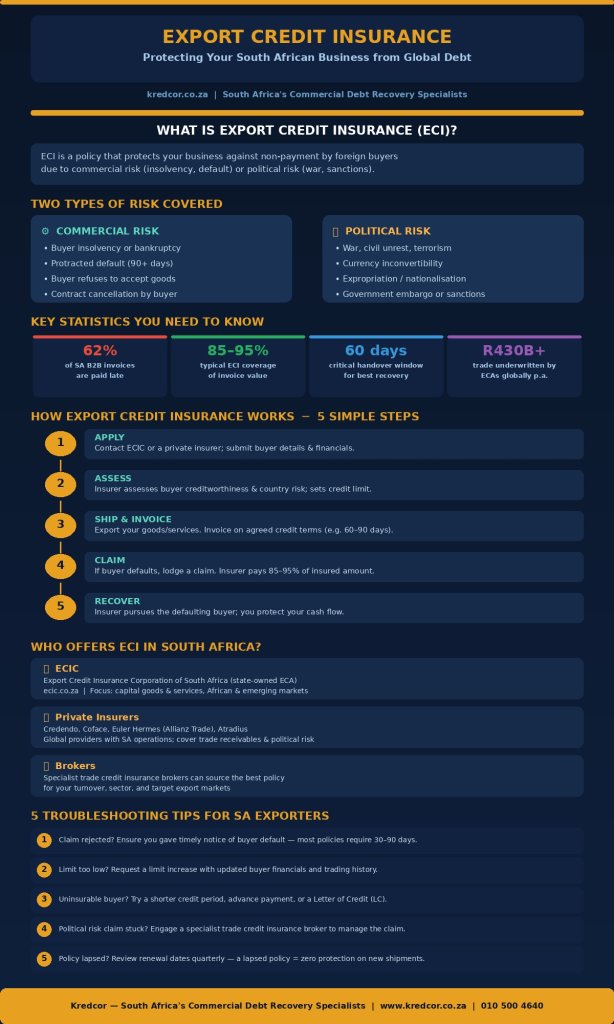
📥 Download this infographic (JPG) — free to use with credit to kredcor.co.za
4. Who Offers Export Credit Insurance in South Africa?
South African exporters are fortunate to have both state-backed and private-sector options for export credit insurance. Here’s a clear breakdown of your main choices.
The Export Credit Insurance Corporation of South Africa (ECIC)
The ECIC is South Africa’s state-owned export credit agency, established in 2001. Its mandate — directly from the South African government, its sole shareholder — is to support South African exporters of capital goods and related services, with a particular focus on emerging markets and the African continent.
Furthermore, the ECIC is especially valuable for large infrastructure, energy, and industrial projects across Africa, where conventional insurers often shy away from the political and country risk involved. If you’re exporting capital equipment, engineering services, or large-scale services to other African nations, the ECIC should be your first port of call.
| ECIC Product | What It Covers | Best For |
|---|---|---|
| Export Credit Insurance | Capital goods & services, political & commercial risk | Large project exporters, African markets |
| Investment Insurance | Cross-border investments against political risk | SA companies investing in African nations |
| Small & Medium Transactions Programme | Smaller deals with simplified underwriting | SMEs entering new African markets |
| Performance Bond Insurance | Protects against unfair calling of performance bonds | Contractors, engineering & construction firms |
Private Trade Credit Insurers
For shorter-term, higher-volume trade receivables — particularly across multiple international markets — private insurers are often a better fit.
The main players with a meaningful South African presence include:
- Coface — a global trade credit insurer with deep expertise in Africa and emerging markets.
- Atradius — one of the world’s largest trade credit insurers, with broad global coverage.
- Allianz Trade (formerly Euler Hermes) — part of the Allianz Group, offering comprehensive TCI and ECI solutions.
- Credendo — a Belgian export credit agency with significant African exposure.
Specialist Brokers
Finally, specialist trade credit insurance brokers can access multiple insurers simultaneously and negotiate the most competitive terms for your specific situation. If your export portfolio spans several markets and buyer types, working with a broker often results in better coverage at a lower premium than going directly to a single insurer.
5. How Export Credit Insurance Works — Step by Step
Understanding the mechanics of ECI is important — because if you ever need to make a claim, you’ll want to know exactly what to do, and when.
Therefore, here’s the process broken down into six clear steps.
- Apply for cover. Contact the ECIC, a private insurer, or a specialist broker. Submit information about your export buyers, the countries you trade with, your payment terms, and estimated annual export turnover.
- Insurer assesses risk. Your insurer evaluates the creditworthiness of each buyer and the risk profile of the destination country. Based on this assessment, they assign a credit limit per buyer — the maximum invoice amount they’ll cover.
- Policy is issued. Once the policy is in place and premiums are agreed, you’re covered. Export your goods or deliver your services on open-account or agreed credit terms, staying within each buyer’s approved credit limit.
- Monitor and update. As your export relationships grow or change, notify your insurer. Crucially, if a buyer shows signs of financial stress, report this early — insurers can adjust your cover before a default occurs.
- Notify of default promptly. If a buyer misses a payment, notify your insurer immediately. Most policies require notification within 30 to 90 days of the missed payment. Late notification is the most common reason claims are reduced or rejected.
- Submit your claim. Provide the required documentation — invoices, contracts, proof of delivery, correspondence — and your insurer processes the claim. Once approved, you receive 85–95% of the covered amount. The insurer then pursues the defaulting buyer for recovery, protecting your time and resources.
6. Short-Term vs Long-Term ECI: Which One Do You Need?
Not all export credit insurance policies are the same. Specifically, the term structure of your policy should match the nature of your export transactions. Here’s how the two main categories compare.
Short-Term Export Credit Insurance
Short-term ECI typically covers transactions with credit periods of up to 180 days (6 months), and in some cases up to 360 days for specific commodity types.
It’s most suitable for:
- Consumer goods, fast-moving goods, and raw materials.
- Services with short payment cycles.
- Exporters with multiple, recurring international buyers.
- SMEs entering new export markets for the first time.
Furthermore, short-term policies typically offer 90–95% coverage of the insured invoice value and are available from both the ECIC and private insurers.
Medium and Long-Term Export Credit Insurance
Medium-term ECI covers transactions with credit periods of 2 to 5 years, while long-term cover extends beyond 5 years (sometimes up to 10–15 years for major infrastructure projects). Typically, this type of cover provides slightly lower coverage ratios (around 85%) but for much larger transaction values.
It’s ideal for:
- Capital equipment exports (machinery, industrial plant, vehicles).
- Large engineering, procurement and construction (EPC) contracts.
- Energy, infrastructure, and mining projects across Africa.
- Transactions where the ECIC or a foreign ECA is providing buyer credit support.
💼 Our Team’s Experience
At Kredcor, we’ve worked with South African exporters whose uncovered international receivables became unrecoverable bad debts precisely because they had the wrong type of cover — or no cover at all. In our experience, the most dangerous assumption exporters make is: “We’ve traded with this buyer for years, so they’re safe.” The truth is that even long-standing buyers default — often because of economic shocks, political changes, or currency crises in their home country, none of which you can predict or control. Export credit insurance neutralises that risk. And when it fails to pay out in full, that’s exactly when professional debt recovery partners like Kredcor step in.
Speaking of international recovery — if you’re already dealing with an overseas debtor who hasn’t paid, and you don’t have an ECI policy in place, you still have options. Our Kredcor Global international debt recovery service operates directly in markets worldwide, on a no-success-no-fee basis — without networks, partners, or subcontractors. We chase your money ourselves.
7. Seven Powerful Ways Export Credit Insurance Protects Your Business
Let’s get specific. Here are seven concrete ways that export credit insurance — also known as trade credit insurance or accounts receivable insurance — actively protects your South African business right now.
1. It Secures Your Cash Flow Against Foreign Buyer Default
Your cash flow is the lifeblood of your business. Therefore, when a foreign buyer fails to pay a large invoice, the impact can be immediate and severe — affecting payroll, supplier payments, and your ability to fund the next shipment. Export credit insurance ensures that a significant portion of that invoice (85–95%) flows back to you even if the buyer disappears.
2. It Lets You Offer Competitive Open-Account Terms
Buyers prefer open-account credit terms. In fact, in many international markets, refusing to offer credit terms essentially means losing the deal. With ECI in place, you can confidently offer 30-, 60-, or even 90-day terms without the sleepless nights. Consequently, this competitive advantage often directly translates into higher sales volumes.
3. It Protects Against Geopolitical Shocks You Cannot Predict
Whether it’s a sudden government coup in a Sub-Saharan market, new economic sanctions, or a country imposing capital controls overnight — political risks are entirely beyond your control. However, with the right ECI policy, you transfer that risk to your insurer. Moreover, the ECIC specifically has deep expertise in African political risk, which is invaluable for SA exporters targeting the continent.
4. It Improves Your Access to Trade Finance
Banks and financial institutions are far more willing to advance trade finance facilities — invoice discounting, factoring, or pre-shipment finance — against insured receivables. So, in addition to protecting your debtors book, ECI can actually unlock working capital that was previously inaccessible. This is a particularly important consideration for growing SMEs.
5. It Provides Intelligence on Buyer and Country Risk
Most ECI providers conduct ongoing credit monitoring of your covered buyers and their countries. Therefore, they alert you early when a buyer’s financial health deteriorates — long before a missed payment. This early warning system is, frankly, priceless for credit managers trying to stay ahead of defaults.
6. It Reduces the Cost of Bad Debt Provisions
Financial managers and CFOs know that provisioning for bad debt is expensive. However, with insured receivables, your provision requirements drop dramatically — because the insurer absorbs the majority of the credit loss. Consequently, your income statement looks healthier, and your auditors are happier.
7. It Complements Your Professional Debt Recovery Strategy
Export credit insurance is your first line of defence. Professional debt recovery is your second. Even with the best ECI policy in place, situations arise where a quick, expert intervention before the formal claim process can recover the full invoice value — without affecting your claims history. That’s where proven debt collection techniques from a specialist firm like Kredcor can save you significant time and money.
8. The Honest Debate: Is Export Credit Insurance Always Worth It?
To maintain our commitment to honest, expert guidance, we need to address a real debate that exists in the South African credit management community. Not everyone agrees that ECI is always the right tool for every exporter. Here are both sides of the argument, fairly presented.
✅ The Case FOR Export Credit Insurance
- Protects cash flow and accounts receivable against unpredictable foreign buyer defaults.
- Enables competitive credit terms that win international business.
- Unlocks bank trade finance at better rates.
- Provides ongoing buyer monitoring and country risk alerts.
- Especially valuable for SMEs without large balance sheet buffers.
⚠️ The Case AGAINST (or the Caveats)
- Premiums add to the cost of doing business — especially on tight-margin exports.
- Policies have exclusions, sub-limits, and notification requirements that can reduce or void claims.
- Not all buyers or countries are insurable — leaving gaps in your coverage.
- For businesses with strong balance sheets and diversified buyer bases, the premium cost may outweigh the benefit.
- Some businesses prefer Letters of Credit (LCs) or advance payment instead, which eliminate the credit risk entirely.
Our view at Kredcor: For most South African SMEs and mid-sized exporters, the risk of a single large uninsured default significantly outweighs the annual premium cost of ECI. Nevertheless, the right answer for your business depends on your export volume, your buyers’ risk profiles, your margins, and your balance sheet resilience. We strongly recommend a professional assessment from a specialist trade credit broker before making a decision.
9. South Africa’s Unique Export Credit Insurance Landscape
Whether you’re exporting from South Africa to Mozambique, Kenya, or the United Kingdom — or whether you’re a US or European business trying to understand how ECI works in the South African context — the fundamental principles of export credit insurance remain the same. However, there are important local nuances you need to understand.
The African Continental Free Trade Area (AfCFTA) Factor
The AfCFTA — the world’s largest free trade area by number of participating countries — is gradually reducing tariffs and trade barriers across Africa. Consequently, South African exporters have unprecedented opportunities to reach new markets across the continent. However, many of these markets carry elevated political and commercial risk profiles. Therefore, ECI — particularly through the ECIC, which has a specific mandate to support SA exporters in African emerging markets — becomes even more critical in this context.
The Rand and Currency Volatility
South African exporters face a unique double-edged challenge: our foreign buyers often pay in foreign currencies (USD, EUR, GBP), while our costs are in rand. Therefore, when the rand weakens, export revenues look attractive — but when it strengthens unexpectedly, or when a foreign buyer’s currency becomes inconvertible, the consequences can be severe. ECI with political risk cover specifically protects against currency transfer restrictions, which is essential for exporters into some African markets.
The National Credit Act and Export Transactions
It’s worth noting that South Africa’s National Credit Act (NCA) primarily governs consumer credit and certain domestic B2B transactions. Most international B2B export transactions fall outside the NCA’s scope. Consequently, the credit risk framework for international sales is different — and ECI fills the regulatory and protective gap that domestic credit legislation doesn’t cover.
While we’re on the subject of managing debtor risk — if high debtor days are already affecting your cash flow, our in-depth guide on how to powerfully reduce debtor days gives you a step-by-step framework that works for both domestic and export receivables.
10. Five Troubleshooting Tips When Your ECI Claim Goes Wrong
Despite your best planning, ECI claims don’t always go smoothly. Here are the five most common problems South African exporters encounter — and exactly what to do about them.
Problem 1: Your claim was rejected because you notified too late.
Most ECI policies require you to notify your insurer of a payment default within 30 to 90 days of the missed payment. If you delay — perhaps hoping the buyer will pay — you risk voiding your claim. Solution: Set a calendar alert for every invoice due date. The moment a foreign buyer misses payment, notify your insurer in writing on Day 1, even if you’re still communicating with the buyer.
Problem 2: Your credit limit was too low to cover the invoice.
Insurers assign credit limits per buyer. If you invoice beyond that limit without prior approval, the excess is uninsured. Solution: Before issuing any invoice that approaches or exceeds a buyer’s credit limit, contact your insurer or broker to apply for a limit increase — ideally with updated buyer financials.
Problem 3: The buyer is not insurable due to country or credit risk.
Some buyers or countries are simply considered too risky for standard ECI. Solution: Consider alternative risk mitigation tools — a Letter of Credit (LC) from the buyer’s bank, advance payment, or a reduced credit period. The ECIC’s African focus means it covers markets that private insurers won’t touch, so always check ECIC eligibility first.
Problem 4: Your political risk claim is stalled in bureaucratic complexity.
Political risk claims — particularly those involving currency inconvertibility or government actions — can take considerably longer to process and may involve complex legal and diplomatic processes. Solution: Engage a specialist trade credit insurance broker immediately to manage the claim on your behalf. Their expertise in navigating claim processes can significantly accelerate your settlement.
Problem 5: Your policy lapsed and you didn’t realise it.
A lapsed policy provides zero protection on new shipments — even if you’ve been covered for years. Solution: Build a simple compliance calendar: set quarterly reminders to verify your policy renewal status, premium payment records, and updated buyer credit limits. Your broker should also send renewal reminders, but don’t rely solely on them.
Is an International Debtor Already Causing You Problems?
Even without ECI in place, Kredcor Global can still pursue your foreign debtors — directly, without subcontractors, on a No-Success No-Fee basis.Talk to Kredcor Global →
11. What to Do Next: Your Search Journey Continues Here
You’ve now answered the main question: what is export credit insurance and how does it protect my South African business? But your search journey doesn’t end here. Typically, the next questions credit managers and CFOs ask after understanding ECI are about implementation, cash flow management, and what happens when a debtor doesn’t pay despite all precautions.
If a Foreign Debtor Already Owes You Money
Act immediately. The 60-day rule applies internationally just as it does domestically — your recovery probability drops sharply with every additional month of inaction. Contact Kredcor Global and hand the account over within 60 days of default for the highest possible recovery rate.
If You Need to Understand Your Domestic Debt Recovery Options Too
Export credit insurance protects your international receivables. But what about your South African customers who don’t pay? Your next resource is our comprehensive guide to working with debt collectors in South Africa — where we walk through exactly how professional debt collection works, what it costs, and how to choose the right firm for your business.
Build a Complete Credit Risk Management Framework
ECI is one pillar of a solid credit risk strategy. Additionally, you should be monitoring your debtor days, running credit checks on new buyers, maintaining a clear letter of demand process, and having a professional debt recovery partner ready to activate when needed. Taken together, these practices form a complete credit management framework that significantly reduces your bad debt exposure — whether you’re trading locally or globally.
For even more practical, actionable guidance written specifically for South African credit professionals — and updated regularly — explore our full resource library at https://www.kredcor.co.za/kredcor-articles/. Every article is written by our team, based on real-world experience, and designed to make your job easier and your business more resilient.
12. Your Quick-Action Checklist — Do These Five Things Today
Now that you’ve read this guide, here are five specific actions you can take immediately to strengthen your export credit risk position. Don’t wait — start today.
- Review your current export receivables book. Identify your top 5 foreign buyers by invoice value. Are any of them currently uninsured? How long has the oldest outstanding invoice been outstanding?
- Contact the ECIC or a private trade credit insurer. Request a no-obligation quote for export credit insurance tailored to your industry and export markets. The ECIC’s Small and Medium Transactions Programme is specifically designed for SMEs.
- Set notification alerts for every foreign invoice due date. The most costly ECI mistake is late notification. A simple spreadsheet or calendar alert can protect your claims record.
- Verify the credit limits on each of your existing insured buyers. If your trading volumes have grown, your credit limits may be outdated — leaving excess invoices uninsured without your knowledge.
- Identify your debt recovery escalation path. If a foreign buyer defaults today, who do you call, and what’s your timeline? If you don’t have a clear answer, contact Kredcor now and let us help you build that process — before you need it urgently.
Kredcor — South Africa’s Commercial Debt Recovery Specialists
Registered with the Council for Debt Collectors | Reg. Nr. 0016365/06 | Member of ADRA Nr. 474 | 26+ Years of B2B Debt Recovery Experience | National & International Operations
Kredcor has been South Africa’s trusted commercial debt recovery partner since 1999. We work with SMEs, blue-chip companies, and multinational corporations across South Africa, Africa, and globally — on a strict No-Success, No-Fee basis. This article was written by our senior credit and recovery team based on 26 years of real-world experience in South African and international commercial debt.
🔗 Authoritative External Resources
- Export Credit Insurance Corporation of South Africa (ECIC) — the state-backed SA export credit agency.
- The Berne Union — international association of credit and investment insurers; global ECI data and research.
- U.S. International Trade Administration: Export Credit Insurance — useful international framework reference.
- Council for Debt Collectors (CFDC) — verify registered debt collectors in South Africa.
- National Credit Regulator (NCR) — South Africa’s consumer credit regulator.
13. Frequently Asked Questions About Export Credit Insurance
What is export credit insurance in South Africa?
Export credit insurance (ECI) is a policy that protects South African exporters against non-payment by foreign buyers. It covers both commercial risks (buyer insolvency, protracted default) and political risks (war, sanctions, currency restrictions). In South Africa, the primary state-backed provider is the Export Credit Insurance Corporation (ECIC), established in 2001, while private insurers like Coface, Atradius, and Allianz Trade also offer ECI and trade credit insurance products.
How much does export credit insurance cost in South Africa?
ECI premiums vary based on your buyer’s creditworthiness, the destination country’s risk rating, your industry sector, and the credit terms you offer. Typically, short-term ECI premiums range from approximately 0.2% to 1.5% of the insured invoice value per annum. Longer-term cover on larger capital transactions is priced differently. Contact the ECIC directly or use a specialist broker to obtain a tailored quote for your specific export portfolio.
What does export credit insurance NOT cover?
Most ECI policies exclude losses arising from: disputes about quality or delivery (unless goods were unconditionally accepted), your own breach of contract, pre-shipment risks (unless specifically added), cash-in-advance or pre-paid transactions, domestic (local) sales, and in some cases, transactions with related or connected parties. Always read your policy schedule carefully. Your insurer or broker should walk you through all exclusions before you finalise your cover.
What is the difference between trade credit insurance and export credit insurance?
Trade credit insurance (TCI) is the broader term — it protects both domestic and international accounts receivable against buyer default. Export credit insurance (ECI) is specifically for cross-border, international transactions. The ECIC provides state-backed ECI for capital goods and services exported to foreign markets. Private insurers like Coface, Atradius, and Allianz Trade offer both domestic TCI and international ECI products tailored to various business sizes and sectors.
Final Thoughts: Build Your Export Risk Safety Net Before You Need It
Export credit insurance is, ultimately, about one thing: keeping your business whole when the international trading environment lets you down. It’s not a sign of weakness or pessimism to insure your foreign receivables — it’s the mark of a financially sophisticated business that understands where its risks truly lie.
Throughout this guide, we’ve covered the mechanics of ECI, the two main risk types (commercial and political), the providers available to South African exporters, how to navigate the claims process, and what to do when things go wrong despite your best precautions. Furthermore, we’ve been transparent about the debate around whether ECI is always the right fit — because we believe you deserve honest, expert guidance, not just sales talk.
However, export credit insurance is only one layer of your protection. When a foreign — or domestic — buyer defaults and your insurer doesn’t cover the full amount, or when no policy was in place at all, you need a professional recovery partner in your corner. That’s where our team at Kredcor comes in.
For businesses dealing with domestic delinquent accounts, our network of experienced debt collectors in South Africa provides the same no-success-no-fee, relationship-first approach that has made Kredcor South Africa’s trusted commercial debt recovery partner for over 26 years. Whether your debtor is down the road or across the ocean, we’re built to help you get paid.
We invite you to explore more practical, expert articles written specifically for South African credit professionals, SME owners, financial managers, and CFOs at https://www.kredcor.co.za/kredcor-articles/. Our library is updated regularly with actionable, real-world guidance — because your job is too important to rely on generic advice.
Ready to Strengthen Your Credit Risk Strategy?
Contact Kredcor for a free, no-obligation consultation. Whether it’s domestic debt recovery, international collections, or credit management advisory — we’re your partner. Get Started with Kredcor →
Kredcor — South Africa’s Commercial Debt Recovery Specialists
Registered with the Council for Debt Collectors | Reg. Nr. 0016365/06 | ADRA Member Nr. 474
68 Van Riebeeck Ave, Alberton, Gauteng | 010 500 4640 | az.oc.rocderk@gnitekram
www.kredcor.co.za
© 2026 Kredcor. All rights reserved. This article is for general informational purposes and does not constitute legal, financial, or insurance advice. Consult a qualified professional for advice specific to your situation.