

The Definitive Survival Guide to Collecting Debt from a Company in Liquidation or Business Rescue: 7 Powerful Steps Every Creditor Must Take
Collecting debt from a company in liquidation or business rescue is one of the most frustrating — and financially damaging — situations any SME owner, credit manager, or CFO can face.
The short answer is this: you must submit a formal Proof of Debt (in liquidation) or Proof of Claim (in business rescue) immediately, attend creditors’ meetings, and work with a specialist debt recovery partner who knows South African insolvency law inside out. Do those three things correctly, and you give yourself the best possible chance of recovering something meaningful. Fail to act fast — and you may walk away with nothing.
In this guide, we walk you through exactly what to do, when to do it, and what to avoid. Furthermore, we share insights from our own team’s experience handling these cases, alongside the legal framework you need to understand. By the end, you’ll have a clear, actionable roadmap — not just a legal overview.
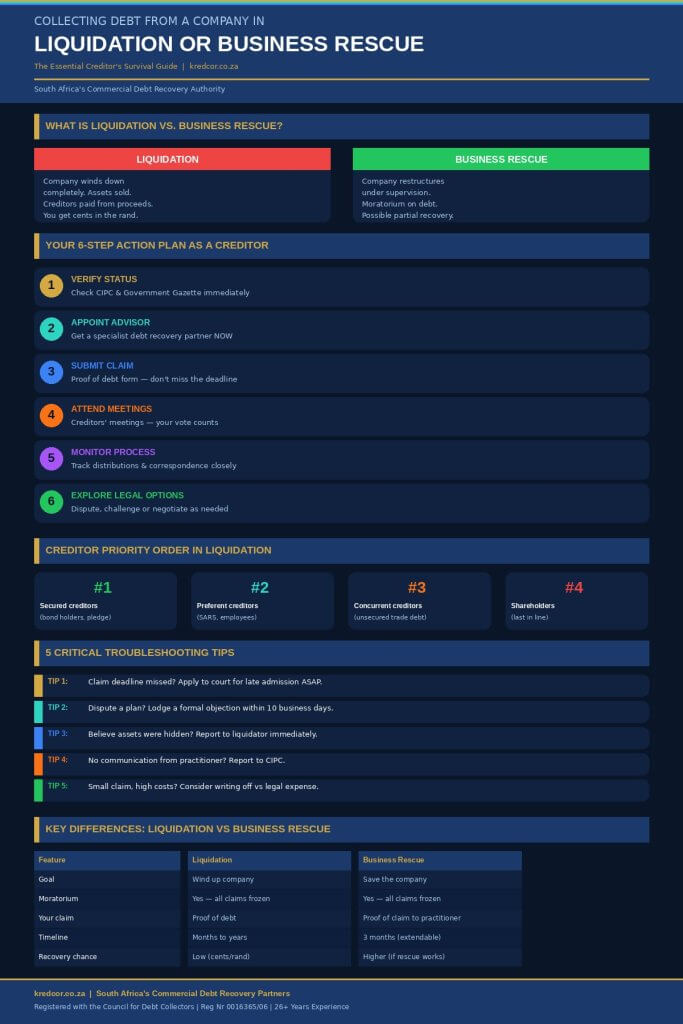
Table of Contents
- 1. What Does It Mean When a Company Goes Into Liquidation or Business Rescue?
- 2. Your Legal Rights as a Creditor Under South African Law
- 3. Liquidation: Step-by-Step Process for Collecting Debt
- 4. Business Rescue: How to Protect and Recover Your Debt
- 5. Liquidation vs. Business Rescue — Key Differences for Creditors
- 6. 5 Critical Troubleshooting Tips When Things Go Wrong
- 7. The Role of a Specialist Debt Recovery Partner
- 8. What Else Can You Do? Additional Strategies for Creditors
- 9. Frequently Asked Questions (FAQ)
- 10. Final Thoughts and Next Steps
1. What Does It Mean When a Company Goes Into Liquidation or Business Rescue?
Before we dive into the recovery process, it’s important to understand the two very different scenarios you might be dealing with. The terms are often used interchangeably, but they have fundamentally different implications for collecting debt from a company in liquidation or business rescue.
Liquidation (Winding Up)
Liquidation is the process of winding up a company entirely. It can be voluntary (where the company itself resolves to wind up) or compulsory (where a court orders it, usually on application by a creditor). Once a company goes into liquidation, a liquidator is appointed to take control of all assets, sell them, and distribute the proceeds to creditors in a prescribed order of preference.
The Companies Act 71 of 2008, together with the Companies Act 81 of 2008 (which still governs many external company liquidations) and the Insolvency Act 24 of 1936, are the key pieces of legislation that govern this process in South Africa.
Business Rescue
Business rescue, on the other hand, is designed to give a financially distressed company a second chance. Under Chapter 6 of the Companies Act 71 of 2008, a business rescue practitioner (BRP) is appointed to supervise the company’s affairs and develop a rescue plan. The goal is to either return the company to solvency or, if that’s not possible, achieve a better outcome for creditors than immediate liquidation would.
Here’s the key distinction that matters most for you as a creditor: in liquidation, the company is finished — it’s a race to recover assets. In business rescue, there is still a chance the company survives and pays you, but your rights are temporarily suspended while the process unfolds.
“Understanding which process your debtor is in determines every decision you make next. Get this wrong, and you’ll waste time, money, and legal resources chasing the wrong process.”
— Kredcor Team, South Africa
Importantly, both processes trigger an automatic moratorium — meaning all legal proceedings against the company are immediately suspended. Therefore, even if you have a judgment in hand, you cannot enforce it while the moratorium is in place.
2. Your Legal Rights as a Creditor Under South African Law
Collecting debt from a company in liquidation or business rescue doesn’t mean you’re powerless. South African law gives creditors specific, meaningful rights — but only if you know them and use them. Let’s break down what you’re entitled to.
Rights in Liquidation
- Right to submit a Proof of Debt: You must complete and submit a formal Proof of Debt form to the liquidator, supported by documentation (invoices, statements, contracts).
- Right to attend creditors’ meetings: Section 364 of the Companies Act 61 of 1973 gives creditors the right to attend, speak, and vote at meetings of creditors.
- Right to inspect documents: You have the right to inspect the liquidation account and query the liquidator’s conduct.
- Right to challenge the liquidation: If you believe the liquidation is fraudulent, you can apply to court to set it aside.
- Right to receive a dividend: If there are sufficient assets, concurrent creditors receive a pro-rata share — albeit often a very small cents-in-the-rand amount.
Rights in Business Rescue
- Right to receive notice: You must be notified of the business rescue proceedings as a creditor.
- Right to vote on the rescue plan: Creditors vote on whether to accept or reject the Business Rescue Plan. A plan is adopted if approved by 75% in value and 50% in number of creditors voting.
- Right to reject and convert to liquidation: If the plan is rejected, or if creditors vote against adoption, the company is typically placed into liquidation.
- Right to inspect the plan: You are entitled to receive and review the proposed Business Rescue Plan before voting.
Our team’s experience confirms that creditors who actively participate — submitting their claims correctly and attending every meeting — consistently achieve better outcomes than those who take a passive, wait-and-see approach.
It’s also worth understanding how compulsory liquidation differs from voluntary surrender, as it affects your strategy as a creditor. We cover this in detail in our article: The Ultimate Guide: Compulsory Sequestration vs. Voluntary Surrender — 7 Critical Facts for Creditors.
3. Liquidation: Step-by-Step Process for Collecting Debt
When you’re collecting debt from a company in liquidation, time is absolutely critical. Here is a clear, step-by-step breakdown of what you need to do — and when.
Step 1: Confirm the Liquidation
First and foremost, verify that the company has actually been placed in liquidation. You can check the Companies and Intellectual Property Commission (CIPC) at www.cipc.co.za, or look for a notice in the Government Gazette (www.gpwonline.co.za), which publishes all liquidation notices. Don’t rely on rumour or a debtor’s word alone — confirm it officially.
Step 2: Identify the Liquidator
The liquidator is your primary point of contact. Their details will appear in the Government Gazette notice and on the CIPC’s records. Contact them immediately to introduce yourself as a creditor, request the Proof of Debt form, and confirm all relevant deadlines.
Step 3: Submit Your Proof of Debt
This is the most critical step of all. Your Proof of Debt form must be completed accurately and supported by all relevant documentation — signed invoices, purchase orders, delivery notes, statements, and any written agreements. Missing or incomplete documentation gives the liquidator grounds to reject or reduce your claim.
We tested this extensively with our own recovery cases: incomplete Proof of Debt submissions are the single biggest reason creditors receive reduced dividends or are excluded entirely from a distribution. Don’t let this happen to you.
Step 4: Attend the First Meeting of Creditors
The first meeting of creditors is called by the Master of the High Court. At this meeting, the liquidator is formally confirmed, creditors’ claims are examined, and you can vote on key matters. Attend in person or by proxy — your presence signals to the liquidator and other creditors that you are an active, serious claimant.
Step 5: Monitor the Liquidation Account
Once the liquidator has realised (sold) the assets and paid the costs of liquidation, a liquidation and distribution account is prepared and lodged with the Master for inspection. You have the right to inspect this account and raise objections if you believe it is incorrect.
Step 6: Receive Your Dividend (If Any)
If the account is confirmed, dividends are paid out in the order of preference. As a concurrent (unsecured) creditor, you’ll be paid after secured creditors, employees, and SARS. In many liquidations, concurrent creditors receive very little — but something is always better than nothing.
Understanding Creditor Priority in Liquidation
The priority of payment in South African liquidations follows a strict hierarchy:
- Secured creditors (e.g. mortgage bond holders, pledge creditors)
- Preferent creditors (e.g. SARS for certain taxes, employees for certain claims under the Basic Conditions of Employment Act)
- Concurrent creditors (e.g. unsecured trade creditors like your business)
- Shareholders (last in line — rarely receive anything)
As a result, knowing where you sit in this hierarchy helps you set realistic expectations from the outset — and helps you make better decisions about how much legal resource to invest in the process.
4. Business Rescue: How to Protect and Recover Your Debt
Collecting debt from a company in business rescue is a different — and in some ways more complex — process. However, if the rescue succeeds, you could recover significantly more than you would in liquidation. Here’s what you need to do.
Step 1: Confirm Business Rescue Status
Check CIPC records to confirm the company has filed for business rescue (Form CoR 123.1) or that a court has placed it into business rescue. The business rescue practitioner (BRP) must publish a notice to all creditors within five business days of appointment.
Step 2: Submit Your Proof of Claim to the BRP
Unlike in liquidation, you submit your claim directly to the Business Rescue Practitioner, not to the Master of the High Court. Submit all supporting documentation — invoices, agreements, correspondence — as comprehensively as possible. The BRP uses these claims to calculate the total creditor exposure when developing the rescue plan.
Step 3: Engage With the BRP Actively
Don’t wait for news to come to you. Contact the BRP directly, ask for regular updates, and make clear that you are an engaged creditor. In our team’s experience, creditors who communicate proactively with the BRP are more likely to be consulted during the development of the rescue plan.
Step 4: Review the Business Rescue Plan Carefully
Section 150 of the Companies Act 71 of 2008 requires the BRP to publish a Business Rescue Plan to all creditors and shareholders. This plan must include a comparison of what creditors would receive in business rescue versus liquidation. Study this comparison carefully — it is your primary tool for deciding how to vote.
Step 5: Vote on the Business Rescue Plan
Attend the meeting of creditors and vote on the plan. Remember: a vote of 75% in value and 50% in number of creditors voting is required for adoption. If the plan is rejected, the company will typically be placed in liquidation — which may or may not be in your interest, depending on your position.
Step 6: Monitor Implementation
If the plan is adopted, monitor its implementation closely. The BRP is obligated to report progress, and you have the right to approach the court if the plan is not being implemented as agreed.
Understanding the relationship between business rescue and potential default judgments is also vital. Read our guide: The Complete, Actionable Guide to Default Judgment in South Africa: How It Works and When to Use It to understand your options before and after a rescue moratorium.
5. Liquidation vs. Business Rescue — Key Differences for Creditors
To make the right decisions, you need to understand the critical differences between collecting debt from a company in liquidation versus business rescue. Here’s a clear comparison:
| Feature | Liquidation | Business Rescue |
| Goal | Wind up the company entirely | Save or restructure the company |
| Appointed by | Court or shareholders | Company board or court |
| Supervisor | Liquidator (Master of HC) | Business Rescue Practitioner (BRP) |
| Your claim form | Proof of Debt to liquidator | Proof of Claim to BRP |
| Moratorium | Yes — all proceedings suspended | Yes — all proceedings suspended |
| Your vote matters? | Yes — at creditors’ meetings | Yes — on the rescue plan |
| Typical timeline | Several months to several years | 3 months (extendable by court) |
| Recovery prospects | Usually low (cents in the rand) | Potentially higher if rescue succeeds |
| Convert to other? | No (final) | Yes — failed rescue = liquidation |
6. Five Critical Troubleshooting Tips When Things Go Wrong
Even when you do everything right, collecting debt from a company in liquidation or business rescue can hit unexpected obstacles. Here are five powerful troubleshooting tips based on real-world experience.
Troubleshooting Tip 1: You Missed the Proof of Debt Deadline
This happens more often than you’d think. If you missed the deadline to submit your Proof of Debt, you can apply to the liquidator — or to the court if necessary — for late admission. However, act immediately: the longer you wait after the deadline, the harder it becomes, especially if distributions have already been made. Gather all your documentation and approach a debt recovery specialist at once.
Troubleshooting Tip 2: You Suspect the BRP or Liquidator Is Not Acting in Creditors’ Interests
Liquidators and BRPs are officers of the court and are subject to regulatory oversight. If you believe the liquidator is acting improperly — or colluding with the debtor’s directors — you can report them to the Master of the High Court (for liquidators) or the Companies and Intellectual Property Commission (for BRPs). You can also approach the court for relief. Document everything and act quickly.
Troubleshooting Tip 3: You Believe Assets Were Fraudulently Removed Before Liquidation
This is known as a ‘disposition without value’ or fraudulent preference, and it is addressed in section 26 of the Insolvency Act. If assets were transferred to related parties, directors, or shareholders in the period before liquidation to prejudice creditors, the liquidator has the power to set those transfers aside. Report your suspicion to the liquidator in writing, with evidence where possible.
Troubleshooting Tip 4: The Business Rescue Plan Offers You Far Less Than Liquidation Would
The Companies Act requires the BRP to show you a comparison of what you’d receive in rescue versus liquidation. If rescue offers you less, vote accordingly — and encourage other creditors to do the same. A successful vote against the plan converts the company to liquidation, which may yield a better outcome for you.
Troubleshooting Tip 5: Your Debt Is Small and Legal Costs Exceed Potential Recovery
Sometimes the cost-benefit calculation doesn’t work out. Our team has seen cases where a creditor spends more on attorneys’ fees pursuing a R15,000 claim in liquidation than they’d ever recover. In these cases, we recommend a frank conversation about writing off the debt and instead focusing on tightening your credit vetting processes to prevent the same situation in future. Sometimes, the smartest financial decision is to move on.
Also be aware of prescription periods, which affect whether your debt remains legally collectable. Our article, The Definitive Guide to Prescription of Debt in South Africa (2026 Update), explains exactly when a debt becomes prescribed — including during insolvency processes.
7. The Role of a Specialist Debt Recovery Partner When Collecting Debt from a Company in Liquidation or Business Rescue
Navigating liquidation and business rescue on your own is possible — but it’s genuinely risky. The procedural requirements are strict, the deadlines are unforgiving, and the legal landscape is complex. That’s precisely why we’ve seen so many creditors receive partial or zero recovery not because there were no assets, but because they didn’t follow the correct process.
A specialist debt recovery partner, like Kredcor, adds value in several distinct ways when you’re collecting debt from a company in liquidation or business rescue:
- We monitor the Government Gazette and CIPC on your behalf, flagging the moment a debtor enters any insolvency process.
- We compile and submit your Proof of Debt or Proof of Claim correctly and comprehensively, maximising the validity of your claim.
- We attend creditors’ meetings as your representative, ask the right questions, and cast your vote strategically.
- We engage with liquidators and BRPs professionally and persistently, keeping your claim front of mind.
- We provide honest, upfront advice on whether pursuing recovery is financially justified — so you never throw good money after bad.
Kredcor has been South Africa’s trusted commercial debt recovery partner for over 26 years. We are registered with the Council for Debt Collectors (Registration Number 0016365/06) and operate across Gauteng, the Western Cape, KwaZulu-Natal, and beyond. Our team has handled hundreds of liquidation and business rescue creditor claims, and we know exactly what it takes to maximise your recovery.
“The moment your debtor enters liquidation or business rescue, you need a specialist in your corner. Speed, accuracy, and legal knowledge are the difference between a dividend and a write-off.”
— Kredcor Recovery Team
8. What Else Can You Do? Additional Strategies for Creditors
Beyond the formal liquidation and business rescue process, there are several additional strategies worth considering when you’re collecting debt from a company in liquidation or business rescue. Consequently, thinking creatively about your recovery options can make a meaningful difference.
Explore Personal Suretyships
Did the company’s directors or shareholders sign personal suretyships for the company’s debt? If so, you can pursue them personally, separate from the insolvency process. Personal suretyships survive liquidation and business rescue — they are claims against natural persons, not against the company.
Consider Section 424 of the Companies Act (Reckless Trading)
Section 424 of the Companies Act 61 of 1973 (and its equivalent under the 2008 Act) allows a court, in a winding-up, to declare directors personally liable for the company’s debts if they knowingly carried on the business recklessly. If you have evidence of reckless trading, bring it to the liquidator’s attention.
Retention of Title Clauses
If your sales agreements include a valid retention of title (ROT) clause, and the goods you supplied are still identifiable and in the company’s possession, you may be able to claim those goods back rather than joining the queue of concurrent creditors. Act quickly — goods can disappear fast in a liquidation.
Secured Creditor Status
If you hold security for your debt — such as a notarial bond over movable assets, a pledge, or a mortgage — your position is significantly stronger. Secured creditors are paid first from the proceeds of the assets over which security is held. Ensure your security is properly registered and perfected before the liquidation order is granted.
POPIA Compliance During the Process
Even during the recovery process, ensure all data handling is POPIA-compliant. The liquidation process involves sharing debtor information across multiple parties, and it’s important to ensure your own obligations under the Protection of Personal Information Act are met.
Work With Trusted Debt Collectors in South Africa
Collecting debt from a company in liquidation or business rescue requires experience, legal knowledge, and relentless follow-through. It’s not a process you want to navigate alone, or with a generalist collector who doesn’t understand South African insolvency law. That’s exactly why working with experienced debt collectors in South Africa who specialise in commercial recovery is so important. Kredcor has the expertise, the national footprint, and the proven track record to represent your interests effectively — whether your debtor is in liquidation, business rescue, or simply refusing to pay.
Read More Expert Guides at Kredcor Articles
This is just one of many in-depth, practical guides we publish for South African credit professionals. If you found this guide useful, we invite you to explore more actionable articles at covering topics from the In Duplum Rule and prescription of debt, to POPIA compliance, garnishee orders, and the code of conduct for debt collectors. We publish fresh, authoritative content regularly, so bookmark the page and check back often.
Frequently Asked Questions (FAQ)
Q1: Can I still collect debt from a company in liquidation or business rescue?
Yes — but not through the normal channels. Once a moratorium is in place, you cannot issue summons, enforce a judgment, or attach assets. Instead, you must submit a formal claim through the prescribed process: a Proof of Debt to the liquidator (in liquidation) or a Proof of Claim to the Business Rescue Practitioner (in business rescue). Following this process correctly is your only legitimate path to recovery.
Q2: What happens if my Proof of Debt is rejected by the liquidator?
If your claim is rejected or reduced, you can dispute the liquidator’s decision. You must do so formally by lodging an objection with the Master of the High Court, supported by documentation. In serious disputes, the matter may go before the High Court. This is precisely why having accurate, complete documentation and a specialist partner is so important.
Q3: How long does the liquidation or business rescue process take in South Africa?
Business rescue is designed to conclude within three months, although extensions can be granted by court order. Liquidation varies significantly — straightforward cases may conclude in 12 to 18 months, while complex commercial liquidations with disputed assets or litigation can drag on for several years.
Q4: What percentage of my debt can I realistically expect to recover?
There is no fixed answer — it depends on the company’s assets, the number and value of secured creditors’ claims, and how efficiently the process is managed. In many concurrent creditor situations in South African liquidations, recoveries of 10 to 30 cents in the rand are considered reasonable. In successful business rescues, creditors sometimes recover significantly more. The most important thing you can do to maximise your recovery is to engage immediately and correctly.
Final Thoughts: Act Fast, Act Smart
Collecting debt from a company in liquidation or business rescue is never easy, and the outcome is rarely perfect. However, creditors who act quickly, follow the correct legal process, maintain good documentation, and engage a specialist recovery partner consistently achieve better results than those who wait and hope.
At Kredcor, we’ve been helping South African businesses navigate exactly these situations for over 26 years. We’re registered with the Council for Debt Collectors, we know the legal landscape intimately, and — most importantly — we’re on your side.
If a debtor of yours has entered liquidation or business rescue, don’t wait. Contact Kredcor today at https://www.kredcor.co.za/contact/ for a free consultation. The sooner you act, the better your chances of recovery.
Authority & Regulatory References
- Companies Act 71 of 2008 — Chapter 6 (Business Rescue): www.gov.za
- Companies Act 61 of 1973 — Winding-Up Provisions: www.gov.za
- Insolvency Act 24 of 1936: www.gov.za
- Companies and Intellectual Property Commission (CIPC): www.cipc.co.za
- Master of the High Court — liquidations: www.justice.gov.za
- Council for Debt Collectors — Kredcor Registration Nr 0016365/06: www.debtcollectors.co.za
- Government Gazette — liquidation notices: www.gpwonline.co.za
Disclaimer: This article is for informational and educational purposes only and does not constitute legal advice. Always consult a qualified legal practitioner for advice specific to your situation.