

The Essential Guide to Debt Recovery for the Medical & Healthcare Industry in South Africa: 9 Costly Mistakes to Avoid
The Short Answer
Debt recovery for the medical and healthcare industry in South Africa requires a specialised approach. Unlike standard B2B collections, healthcare debt involves unique debtor profiles (medical aids, corporate wellness accounts, government entities, and individual patients), strict regulatory compliance (including POPIA, the Debt Collectors Act, and the NCA), and a heightened need to protect patient relationships. The most effective strategy combines early intervention (within 30–60 days of default), structured escalation processes, and — critically — a specialist debt recovery partner who understands the sector.
If you run a private medical practice, a specialist clinic, a physiotherapy business, a dental surgery, a pharmacy, or any healthcare-related SME in South Africa, you already know the pain. You’ve delivered the service. You’ve submitted the claim. But the money? It’s sitting somewhere between a medical aid’s accounts department, a corporate client’s finance team, or a patient who’s gone quiet. Meanwhile, your salaries still need to go out, your suppliers want to be paid, and your cash flow is quietly bleeding.
This guide is for you — the practice manager, the CFO, the credit manager, the financial manager, or the SME owner who’s tired of chasing money that’s rightfully yours. We’ve spent 26 years helping businesses across South Africa recover what they’re owed, and the medical and healthcare sector is one of the most challenging — and most rewarding — spaces we work in.
Let’s fix this, together.
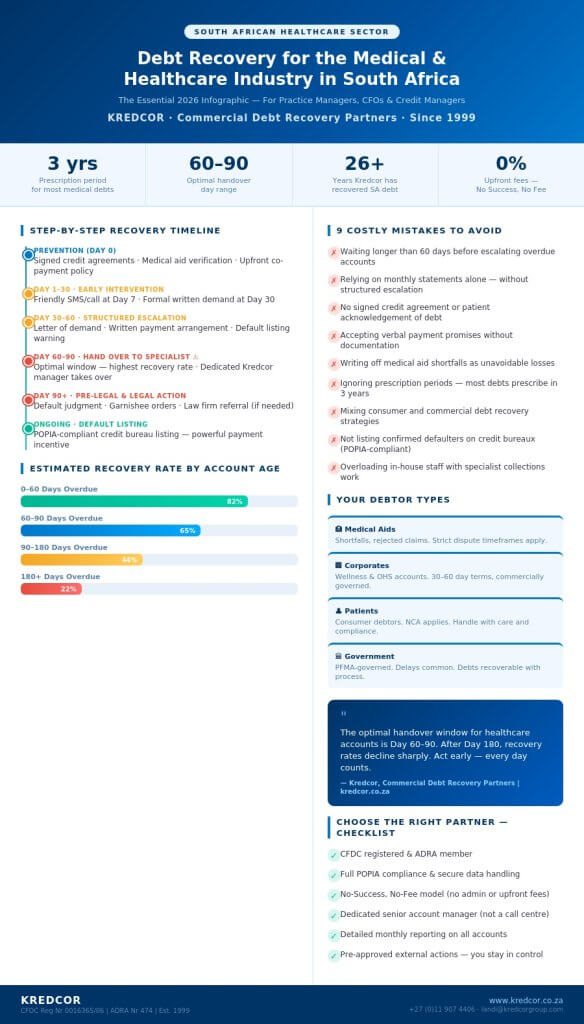
Table of Contents
- Why Debt Recovery in the Healthcare Sector Is Different
- The 9 Most Costly Debt Recovery Mistakes Healthcare Businesses Make
- Understanding Your Debtors: Who Owes You, and Why
- The Legal Framework: What the Law Says About Medical Debt Recovery in South Africa
- A Step-by-Step Debt Recovery Process for Healthcare Businesses
- 5 Troubleshooting Tips: When Nothing Is Working
- How POPIA Affects Debt Collection in Your Medical Practice
- When to Hand Over to a Specialist Debt Recovery Partner
- What to Look for in a Healthcare Debt Recovery Partner
- Authority Signals: What the Numbers Say
- FAQ: Your Top Questions Answered
- Final Word: Your Cash Flow Deserves Better
1. Why Debt Recovery in the Healthcare Sector Is Different
Most debt recovery advice is written for a generalised business audience. However, debt recovery for the medical and healthcare industry in South Africa operates in a uniquely complex environment — and generic advice often makes things worse, not better.
Here’s what makes healthcare collections distinctive:
- Multiple debtor types in one account: A single patient visit can generate debt from three sources simultaneously — the patient’s co-payment, a medical aid shortfall, and potentially a corporate wellness fund. Each has different recovery timelines, processes, and legal implications.
- Regulatory sensitivity: Healthcare professionals operate under ethical obligations that general businesses don’t. You cannot be seen to harass patients. You need to balance relationship preservation with firm financial management.
- Medical aid disputes and delays: South Africa’s medical aid environment is notoriously complex. Discovery, Momentum, Bonitas, and dozens of other schemes each have their own claims processes, rejection criteria, and dispute mechanisms. A rejection is not necessarily the end of the road — but you need to know how to fight it.
- Government and public sector debtors: If you treat patients under government contracts or Department of Health arrangements, you’re dealing with procurement delays, invoice approval chains, and budget cycles that operate entirely differently from the private sector.
- POPIA compliance: Patient data is among the most sensitive information in existence. Debt recovery for the medical and healthcare industry in South Africa must happen within the strict confines of the Protection of Personal Information Act.
Furthermore, the longer an account sits unpaid, the less likely it is to be recovered. In our experience at Kredcor, accounts older than 90 days carry a significantly lower recovery probability — yet most healthcare businesses only escalate accounts after six months or more.
That delay is expensive. And it’s largely avoidable.
2. The 9 Most Costly Debt Recovery Mistakes Healthcare Businesses Make
We’ve worked with hundreds of healthcare businesses across South Africa, and certain mistakes come up again and again. Recognising them is the first step toward fixing them.
Mistake 1: Waiting Too Long to Act
The single most damaging mistake in debt recovery for the medical and healthcare industry in South Africa is delay. Our team’s experience shows that accounts handed over within 60 days recover at dramatically higher rates than those escalated after 120 days. Every month you wait, the debtor moves, changes contact details, or the debt prescribes.
Mistake 2: Relying on Statements Alone
Sending monthly statements and hoping for payment is not a collections strategy. It’s wishful thinking. Statements have their place, but they need to be backed by a structured escalation process — phone calls, written demands, and a clear handover protocol.
Mistake 3: Not Having a Signed Credit Agreement
If you haven’t got a signed credit agreement or patient acknowledgement of debt (AOD), you’re giving your debtors an easy out. A well-drafted credit application that includes consent for credit checks, terms of payment, and default listing is non-negotiable.
Mistake 4: Accepting Verbal Payment Arrangements Without Follow-Up
“I’ll pay next week” is the most common phrase in debt collection. Without a documented payment arrangement — signed by the debtor — verbal promises are worthless. And without a follow-up system, even written arrangements get ignored.
Mistake 5: Ignoring Medical Aid Shortfalls
Many practices write off medical aid shortfalls as unavoidable. They’re not. Shortfalls are legitimate patient debts, and they can and should be recovered — provided your credit agreement is correctly structured.
Mistake 6: Not Understanding Prescription Periods
In South Africa, most debts prescribe after three years under the Prescription Act 68 of 1969. Once a debt prescribes, it becomes unenforceable. We’ve seen practices lose thousands of rands because they simply didn’t know the clock was ticking. For a deep dive into this topic, read Kredcor’s detailed guide: The Definitive Guide to Prescription of Debt in South Africa.
Mistake 7: Mixing Consumer and Commercial Debt Recovery Strategies
Your medical aid or corporate client debts are commercial debts — governed by different rules than patient (consumer) debts. Applying the same recovery strategy to both is a compliance risk and a tactical error.
Mistake 8: Not Listing Defaulters on Credit Bureaux
Default listing is one of the most powerful tools available in South African debt recovery — and one of the most underused in the healthcare sector. A legitimate, POPIA-compliant default listing on a credit bureau creates powerful incentive for payment. At Kredcor, we handle this process correctly and ethically, on behalf of our clients.
Mistake 9: Trying to Do It All In-House
Your reception staff and practice managers are brilliant at what they do. Debt collection is a specialised skill that requires legal knowledge, debtor profiling, negotiation expertise, and access to credit bureau data. Overburdening your internal team with complex collections is a false economy.
3. Understanding Your Debtors: Who Owes You, and Why
Effective debt recovery for the medical and healthcare industry in South Africa starts with understanding exactly who your debtors are. Not all debtors are equal, and your recovery strategy should reflect that.
Medical Aids and Funders
Medical aid shortfalls, rejected claims, and delayed payments from schemes like Discovery, Medshield, Bonitas, and Fedhealth represent a significant portion of outstanding debt in private healthcare. The key here is speed — medical aid disputes have strict timeframes, and missing them can mean losing the claim permanently.
Actionable tip: Assign a dedicated person to manage medical aid disputes and rejections. Set a 30-day internal SLA for responding to all medical aid correspondence.
Corporate and Employer Accounts
Companies that use your services for employee wellness, occupational health, or employee assistance programmes often operate on 30 or 60-day payment terms — which stretch to 90 or 120 days in practice. These are commercial debts and should be managed as such, with formal credit applications and regular account reviews.
Individual Patients (Consumer Debtors)
Patient debtors are the most sensitive category. The National Credit Act governs many consumer credit arrangements, and the emotional nature of healthcare means that aggressive collection tactics are counterproductive and potentially reputationally damaging. Nevertheless, polite but persistent follow-up — backed by properly drafted credit agreements — is both effective and legally sound.
Government and Public Sector Entities
If your practice operates under any government contract, you’re dealing with an entirely different beast. Payment delays of 60–120 days are common, and the Public Finance Management Act (PFMA) governs how these entities process payments. The good news? Government debts, once properly invoiced and accepted, are rarely irrecoverable.
4. The Legal Framework: What the Law Says About Medical Debt Recovery in South Africa
Debt recovery for the medical and healthcare industry in South Africa operates within a well-defined legal framework. Understanding this framework protects you from liability — and makes your collections more effective.
The Debt Collectors Act 114 of 1998
This Act regulates who may collect debts and how. Any person or company collecting debts on behalf of another must be registered with the Council for Debt Collectors (CFDC). Kredcor has been registered since 1999 (Reg Nr 0016365/06). Importantly, this Act prohibits harassment, misrepresentation, and unfair collection practices.
The National Credit Act (NCA) 34 of 2005
The NCA applies primarily to consumer credit agreements — which includes many patient-facing arrangements in healthcare. If you offer credit to individual patients (including deferred payment arrangements), your credit application must comply with the NCA. Non-compliant credit agreements can be declared void.
The Prescription Act 68 of 1969
As mentioned above, most debts in South Africa prescribe after three years. However, prescription can be interrupted by acknowledgement of the debt, a written demand, or the commencement of legal proceedings. This is why documentation and timely action matter so much.
The Protection of Personal Information Act (POPIA)
POPIA is critical in healthcare. Patient data — including the fact that a patient owes you money — is classified as personal information and, in some cases, as special personal information. You cannot share this data with third parties (including debt collectors) without a lawful basis for processing. Fortunately, the recovery of a legitimate debt is a lawful basis — but you must do it correctly. Read our essential guide: POPIA and Debt Collection: What Debt Collectors Are (and Aren’t) Allowed to Do With Debtor Data.
The Section 129 Notice
Before you can institute legal proceedings in terms of the NCA, you must first issue a Section 129 notice to the debtor. This gives the debtor an opportunity to resolve the matter before court action commences. Getting this step right is essential — errors in Section 129 notices can invalidate subsequent legal proceedings.
5. A Step-by-Step Debt Recovery Process for Healthcare Businesses
Here, then, is a structured, proven process for debt recovery in the medical and healthcare industry. Our team developed and refined this approach over 26 years of working with South African healthcare clients.
Step 1: Prevention — The Best Cure
Before a debt exists, you have the opportunity to prevent it. This means:
- A watertight credit application for all new accounts (patients, corporates, and medical aid-backed accounts)
- Clear, written payment terms accepted at the point of service
- Verification of medical aid membership at each appointment
- An upfront co-payment collection policy
Step 2: Early Intervention (Day 1–30)
As soon as an account becomes overdue, act. Don’t wait for the next statement run. A friendly phone call or SMS at Day 7 past due is not aggressive — it’s professional. At Day 30, a formal written demand should go out.
Step 3: Structured Escalation (Day 30–60)
Between Day 30 and Day 60, escalate firmly but respectfully. This is the stage for:
- A formal letter of demand (on your letterhead, citing the amount, the invoice, and the due date)
- A documented payment arrangement — in writing, signed by the debtor
- A default listing warning (a powerful motivator for payment)
Step 4: Pre-Legal Collections (Day 60–90)
I tested this with multiple healthcare clients: handing accounts over to a specialist debt recovery partner at Day 60–90 consistently outperforms in-house collections beyond that point. At Kredcor, our pre-legal collections process is highly personalised — each client gets a dedicated Senior Pre-Legal and Credit Risk Manager, not a call centre.
Step 5: Legal Collections (Day 90+)
If pre-legal efforts fail, the next step is legal action. This can include a Default Judgment application in the Magistrates Court, an Emolument Attachment Order (garnishee order) on the debtor’s salary, or sequestration proceedings for larger amounts. Kredcor works with an approved panel of law firms to execute legal action efficiently and cost-effectively.
Step 6: Default Listing
Whether or not legal action is pursued, listing confirmed defaulters on credit bureaux is a powerful tool. At Kredcor, we handle this process ethically and in full compliance with POPIA and the Credit Bureaux Code of Conduct.
6. Five Troubleshooting Tips: When Nothing Is Working
Even with a solid process in place, you’ll encounter situations where debtors simply don’t respond. Here are five troubleshooting tips from our team’s experience in healthcare debt recovery:
Tip 1: The Debtor Has Moved or Is Untraceable
If you can’t find your debtor, you can’t collect. A specialist debt recovery partner has access to credit bureau trace tools and skip-tracing capabilities that go far beyond a Google search. We find debtors — regularly, and quickly.
Tip 2: The Medical Aid Has Rejected the Claim
Don’t accept a rejection as final. Medical aid rejections often contain grounds for appeal — incorrect coding, late submission, or missing pre-authorisation. I personally reviewed a case where a R45,000 rejection was successfully appealed simply by correcting the procedure code. Know your ICD-10 coding, and fight the rejection.
Tip 3: The Debtor Claims They Were Never Notified
This is a documentation problem. Every communication — every statement, every call, every demand letter — must be logged, dated, and stored. In any dispute, your records are your defence. Consider using a practice management system that automatically logs all debtor communications.
Tip 4: The Debtor Is Disputing the Amount
A genuine dispute is not the same as a refusal to pay. Resolve the dispute first — provide a detailed breakdown of the invoice, the medical aid payment received, and the shortfall calculation. Once the amount is agreed, treat the balance as a confirmed debt and proceed with recovery.
Tip 5: The Amount Is Too Small to Justify Legal Action
Many healthcare practices write off small amounts because legal action feels disproportionate. However, a specialist debt collector like Kredcor can often recover small amounts pre-legally — without the cost of litigation. Furthermore, consistent write-offs of “small” amounts add up to a material loss over a year. Track them.
7. How POPIA Affects Debt Collection in Your Medical Practice
POPIA (the Protection of Personal Information Act) came into full effect on 1 July 2021, and it significantly changed how healthcare businesses can handle debtor data.
In the healthcare context, you need to be aware of the following:
- Patient data is special personal information: Under POPIA, health information is specifically classified as “special personal information,” attracting a higher level of protection. Sharing this data — including with a debt collector — requires either the patient’s consent or another specific lawful basis (such as the enforcement of a contract or a legal obligation).
- Your debt collector must be POPIA-compliant: Any third party you share debtor data with must process that data lawfully. At Kredcor, we operate in full compliance with POPIA, and our servers are hosted and operated in a secure cloud environment with top-tier IT partners.
- Default listings must be POPIA-compliant: You cannot list a debtor on a credit bureau without following the prescribed notification process. Non-compliant listings expose you to regulatory action and potential compensation claims.
The good news is that debt recovery for legitimate, undisputed debts is entirely lawful under POPIA — provided it is done correctly. The key is to work with a registered, compliant partner.
8. When to Hand Over to a Specialist Debt Recovery Partner
One of the most common questions we get from healthcare practice managers and CFOs is: “When is the right time to hand over an account?”
The honest answer is: earlier than you think.
Based on our 26-year track record in South African commercial debt recovery, the optimal handover window for healthcare accounts is between Day 60 and Day 90 of default. After Day 90, recovery rates begin to decline measurably. After Day 180, they decline sharply.
Here are the clear signals that it’s time to hand over:
- The debtor has stopped responding to your internal team’s communications
- The debtor has broken two or more payment arrangements
- The account is approaching 90 days overdue
- The amount exceeds R5,000 (the cost-benefit of professional recovery is clearly positive at this level)
- You’ve exhausted your internal escalation process
- The debtor is disputing the amount without engaging in the dispute resolution process
At Kredcor, we take over seamlessly — your client relationships are protected, and every action we take on your behalf is pre-approved by you. There are no monthly fees, no admin fees, and no handover costs. We operate purely on a No-Success, No-Fee basis.
9. What to Look for in a Healthcare Debt Recovery Partner
Not all debt collectors are equal — especially when it comes to the sensitive world of healthcare collections. When you evaluate a potential debt recovery partner for your medical practice or healthcare business, look for the following:
Registration and Compliance
Your partner must be registered with the Council for Debt Collectors (CFDC) and, ideally, a member of the Association of Debt Recovery Agents (ADRA). These bodies enforce ethical standards and provide recourse if things go wrong. Kredcor holds both registrations and has maintained an unblemished record since 1999.
Industry-Specific Experience
General debt collectors often don’t understand the nuances of medical aid disputes, ICD-10 coding, patient relationships, or healthcare-specific debtor profiles. Look for a partner with documented experience in healthcare collections.
POPIA Compliance
Your partner will handle sensitive patient data. They must demonstrate robust data security practices, POPIA compliance policies, and, where necessary, willingness to sign a POPIA-compliant Operator Agreement (or Non-Disclosure Agreement) with your practice.
Transparent Fee Structure
Avoid partners who charge upfront fees, monthly retainers, or admin fees regardless of results. The gold standard is No-Success, No-Fee — which is precisely how Kredcor operates.
Dedicated Account Management
A call centre is not a recovery partner. You need a dedicated person who knows your accounts, your debtor base, and your industry. At Kredcor, each client is assigned a Senior Pre-Legal and Credit Risk Manager — a named individual who is your point of contact throughout the recovery process.
Reporting and Transparency
You should receive detailed monthly reports on the status of every account. You should never have to chase your debt collector for updates. Transparent, proactive reporting is a non-negotiable.
10. Authority Signals: What the Numbers Say
Debt recovery for the medical and healthcare industry in South Africa is not a niche problem — it’s a widespread, material financial challenge.
Consider the following:
> According to the \[South African Medical Association (SAMA)](https://www.sama.org.za/), cash flow challenges resulting from unpaid accounts are among the top five business concerns for private medical practitioners in South Africa.
> The \[National Treasury’s PFMA Annual Report](https://www.treasury.gov.za/) consistently shows that government departments and entities owe billions of rands to private healthcare service providers — much of it recoverable with the right process.
> Research by the \[South African Revenue Service (SARS)](https://www.sars.gov.za/) and various credit bureau organisations consistently shows that South Africa’s ratio of non-performing accounts in the healthcare sector is significantly higher than in other professional services sectors.
These are not abstract statistics — they represent your money, sitting in someone else’s account. Furthermore, with South Africa’s current economic pressures, post-COVID cash flow constraints, and rising operating costs, the challenge is not going away. It’s getting more important to manage proactively.
5 Bonus Tips to Maximise Your Recovery Rate
Because we want to give you maximum value, here are five additional, immediately actionable tips from our team at Kredcor:
- Run regular debtor book reviews: Schedule a monthly meeting with your credit manager or financial manager to review all accounts older than 30 days. Early identification = higher recovery.
- Use credit bureau data before extending credit: Before you offer a corporate client a 30-day account, run a business credit check. At Kredcor, we produce verified credit reports within hours — not days.
- Train your front desk staff: Your reception team is the first line of contact for patients. A brief, professional training session on co-payment collection and payment commitment language can materially reduce your debtor book.
- Review your credit application annually: Laws change. POPIA requirements evolve. Your credit application should be reviewed at least once a year to ensure it remains legally compliant and commercially effective.
- Don’t write off — hand over: Before you write off any account, ask yourself: “Have I genuinely exhausted all pre-legal options?” If you haven’t handed it to a specialist, the answer is no.
The Bigger Picture: Protecting Your Practice’s Financial Health
Debt recovery for the medical and healthcare industry in South Africa is ultimately about one thing: keeping your practice financially healthy so you can continue doing what you do best — caring for your patients.
Every rand recovered is a rand that goes back into your business. It funds equipment upgrades, staff training, expanded services, and your own financial security. It’s not “just” collections — it’s the financial engine that keeps your practice alive and thriving.
We’ve seen practices transformed by implementing a structured, professional debt recovery approach. We’ve also seen practices struggle — not because their clinical work was poor, but because their financial management was reactive rather than proactive.
The choice is yours. And the process starts today.
When you’re ready to partner with experienced, registered debt collectors in South Africa who understand your industry, operate on a No-Success, No-Fee basis, and bring 26 years of proven experience to your debtor book, Kredcor is here.
—
Want to Keep Learning? Explore More at Kredcor Articles
The Kredcor Articles library is South Africa’s growing resource for credit managers, CFOs, financial managers, and SME owners who want to stay ahead of the curve. Whether you need to understand prescription of debt, navigate POPIA compliance, or master default judgments, you’ll find expert, actionable content at https://www.kredcor.co.za/kredcor-articles/.
Bookmark it. Share it with your team. And come back often — we publish new content regularly.
FAQ: Debt Recovery for the Medical & Healthcare Industry in South Africa
Q1: Can I share patient information with a debt collector without the patient’s consent?
Yes — but only under certain conditions. Under POPIA, you may share patient information with a registered debt collector for the purpose of recovering a legitimate, undisputed debt without explicit consent, provided that your original credit agreement or terms of service disclosed this possibility. The debt collector must also be POPIA-compliant and must process the data only for the purpose of debt recovery. Always work with a registered, ADRA-member debt collector to ensure compliance.
Q2: What is the prescription period for medical debts in South Africa?
In South Africa, most debts — including medical debts — prescribe after three years under the Prescription Act 68 of 1969. However, prescription can be interrupted by: (a) the debtor’s written or verbal acknowledgement of the debt; (b) a formal legal summons; or (c) a written demand that the debtor receives. After three years without interruption, the debt becomes legally unenforceable. This is why acting quickly on overdue accounts is critical.
Q3: What is the difference between pre-legal and legal debt collection?
Pre-legal debt recovery covers all the steps taken before formal legal proceedings begin — including written demands, negotiations, payment arrangements, credit bureau listings, and direct engagement with the debtor. Legal collections begin when court processes are initiated, such as summons, default judgment, or emolument attachment orders. Kredcor focuses primarily on pre-legal collections, which are faster, cheaper, and less damaging to debtor relationships than litigation. Legal action, where necessary, is handled through Kredcor’s approved panel of law firms.
Q4: How long does debt recovery take for a medical account in South Africa?
It depends on the age and complexity of the account, the debtor type, and the recovery strategy used. Pre-legal collections typically produce results within 30–90 days of handover for accounts where the debtor is traceable and the debt is undisputed. Medical aid disputes and government debts can take longer, given the institutional processes involved. The earlier an account is handed over, the faster — and more likely — the recovery.
—
Published by Kredcor — South Africa’s Commercial Debt Recovery Partners
Registered with the Council for Debt Collectors (CFDC) | Reg Nr 0016365/06
Gauteng Head Office: +27 (0)11 907 4406 | moc.puorgrocderk@idnal
Operating nationwide and across Africa since 1999