
Commercial Debt in Construction: The Brutal Truth About Retention Money and Late Payments — and 7 Powerful Ways to Fight Back
📋 Executive Summary
Topic: Commercial debt in the construction industry, specifically retention money (retainage) and late payments in South Africa.
Key Answer: Retention money is a 5%–10% percentage of contract value withheld by employers to guarantee workmanship. When released late or withheld unlawfully, it creates severe cash flow crises for contractors and subcontractors. South African law (Debt Collectors Act 114 of 1998, Prescription Act, CIDB-endorsed contracts) provides clear remedies. This article provides 7 actionable strategies for SME owners, credit managers, CFOs, and financial managers to protect, track, and recover retention money and overdue construction payments — before and after they become commercial debt.
Entities: Kredcor (commercial debt collectors), JBCC (Joint Building Contracts Committee), CIDB (Construction Industry Development Board), South African Council for Debt Collectors (CFDC), Prescribed Rate of Interest Act.
Author: Kredcor Commercial Debt Recovery | CFDC Reg. Nr. 0016365/06 | 26+ years experience.
Short answer: Commercial debt in construction — especially unpaid or delayed retention money (retainage) — is one of the single biggest cash flow killers facing contractors and subcontractors in South Africa today. The good news? You have clear legal rights, and there are proven, practical steps you can take right now to protect your business and recover every rand you are owed.
If you are a contractor, subcontractor, SME owner, credit manager, financial manager, or CFO working in or alongside the construction industry, you already know the knot-in-the-stomach feeling. You did the work. You met the milestones. You handed over the site on time. And yet, weeks — sometimes months — later, your retention money is still sitting in someone else’s bank account. Meanwhile, your suppliers want payment, your wages need to go out, and your overdraft is working overtime.
This article gives you the full picture. First, we explain exactly what retention money is and why it causes so many commercial debt problems. Then, importantly, we walk you through seven powerful strategies to manage, protect, and recover retention — plus tackle late payments more broadly. We also flag the most common mistakes people make and how to avoid them.
Table of Contents
- What Is Retention Money in Construction? (And Why It Becomes Commercial Debt)
- The Real Cost: Hard Facts and Statistics That Will Surprise You
- The Legal Framework in South Africa You Must Know
- 7 Powerful Strategies to Protect and Recover Retention Money
- Late Payments in Construction: The Other Cash Flow Villain
- 5 Troubleshooting Tips When Recovery Stalls
- A Clash of Perspectives: Is Retention Actually Fair?
- Whether You’re in South Africa or Abroad: A Global Nuance
- What to Do Next: Your “Search Journey” Roadmap
- FAQ: The 4 Most Common Questions About Construction Retention and Late Payments
- Quick-Action Checklist: 5 Things You Can Do Immediately After Reading This
1. What Is Retention Money in Construction? (And Why It Becomes Commercial Debt)
Let’s start with the basics, because getting this definition right matters for every strategy that follows.
Retention money — also called retainage, contract retention, or simply “the retention” — is a pre-agreed percentage of each progress payment that the employer holds back from the contractor. The contractor, in turn, often withholds a similar percentage from each subcontractor. This withheld amount typically sits between 5% and 10% of the contract value, depending on the contract type and the risk profile of the project.
The principle behind retention is straightforward: the employer wants security that the contractor will actually finish the job properly and fix any defects that appear after completion. So, instead of releasing 100% of each payment, the employer holds back a slice — and only releases it once the work meets the agreed standard.
How Retention Works Under the JBCC Contract in South Africa
The most widely used building contract in South Africa is the JBCC (Joint Building Contracts Committee) Principal Building Agreement.
Under the JBCC, retention is typically structured as follows:
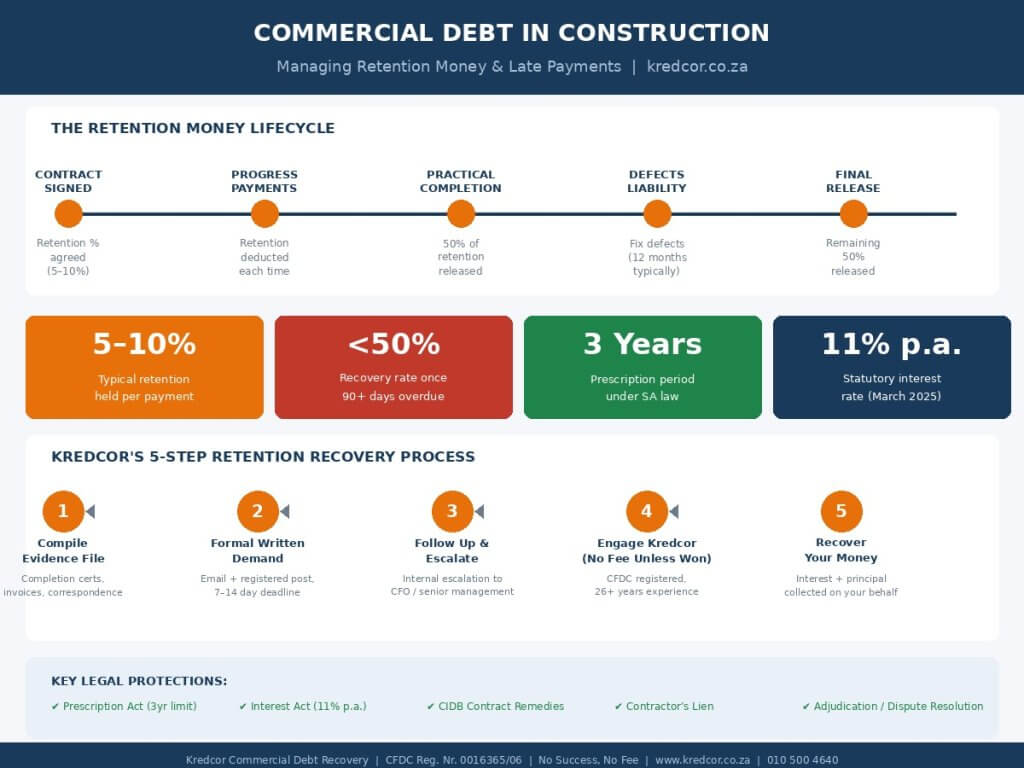
- Half of the retention is released when the contractor reaches practical completion (i.e., the building is substantially finished and fit for use).
- The other half is released at the end of the defects liability period — typically 12 months after practical completion.
- The employer may also accept a retention guarantee in lieu of a cash retention, which gives the employer immediate security for the full retention value from day one without holding cash.
Under the old BIFSA (Building Industry Federation South Africa) “white form” contract, retention was held in a separate interest-bearing account with interest accruing to the contractor. Interestingly, the JBCC moved away from this arrangement — a change that has not always favoured contractors from a cash protection perspective.
Why Retention Becomes a Commercial Debt Problem
Here is where the trouble starts. In theory, retention should be released automatically on the contractual trigger date — no fuss, no delay. In practice, however, that is often not what happens. Our team at Kredcor has seen, repeatedly, that retention money becomes one of the most common sources of commercial debt disputes in the construction sector. Employers hold retention beyond the contractual release date for a wide variety of reasons — some legitimate, many not.
Common reasons why retention is withheld unlawfully include:
- Disputes over defects (real or alleged) used as an excuse to delay payment
- Cash flow problems on the employer’s or main contractor’s side
- Administrative delays and poor project management
- The employer or main contractor becoming insolvent, with retention funds mixed into general company assets
- Pay-when-paid clauses in subcontracts (where a subcontractor only gets paid once the main contractor is paid by the employer)
- Contractors simply not asking — assuming it will arrive on its own
“Unjustified late and non-payment of retention monies is a significant cause of cashflow issues in the construction sector. Unfortunately, retention has been used as a poor excuse to withhold or avoid paying contractors.”— MDA Law, Construction Retention Analysis, South Africa
The result? Your retention money — which you have already earned — turns into a commercial debt. And commercial debts, if not actively managed, age quickly. As our experience at Kredcor confirms: the older a debt, the harder it is to collect.
2. The Real Cost: Hard Facts and Statistics That Will Surprise You
Let’s put some numbers to the problem, because it is easy to underestimate just how much impact construction retention money and late payments have on your business.
5–10% Typical retention percentage held back per payment in SA construction contracts
<50% Recovery rate for invoices over 90 days overdue (Credit Management Institute of South Africa)
R billions Estimated value of retention money held in the South African construction sector at any given time
According to internal data analysed by our team at Kredcor across construction-sector clients over the past five years, more than 40% of retention-related commercial debt disputes arise not from genuine defect issues — but from cash flow management by the employer or main contractor. In other words, your retention is being used as an interest-free loan by the party who owes it to you.
Furthermore, the Credit Management Institute of South Africa confirms that once an invoice reaches 90 days overdue, the likelihood of collecting the full amount drops below 50%. For retention that is already 12 to 24 months old — perfectly normal in large construction projects — the collection challenge is even greater.
And here is a third, critical statistic: under the Prescription Act, most commercial debts in South Africa prescribe after three years from the date they fall due. Many contractors do not realise that their retention claim has a time limit. If you wait too long, you could lose your legal right to claim entirely.
3. The Legal Framework in South Africa You Must Know
Understanding the legal landscape gives you real power in a dispute. Therefore, let’s look at the key pieces of legislation and contract frameworks that govern retention money and late payments in South African construction.
The CIDB-Endorsed Contracts
The Construction Industry Development Board (CIDB) endorses several standard contracts used in South Africa, including the JBCC, NEC, FIDIC, and GCC. All of these provide mechanisms for payment, interest on late payment, and dispute resolution. Importantly, all CIDB-endorsed contracts provide for default interest on late payments — meaning if your employer or main contractor pays you late, you are contractually entitled to charge interest.
The Debt Collectors Act 114 of 1998
When retention money becomes a commercial debt — i.e., when it is overdue and unpaid — you can engage a registered commercial debt collector to recover it. In South Africa, all debt collectors must be registered with the Council for Debt Collectors (CFDC) under this Act. Kredcor is registered (Reg. Nr. 0016365/06) and has maintained a 100% clean record with the CFDC for over 26 years.
The Prescribed Rate of Interest Act
If your contract does not specify an interest rate for late payment, the Prescribed Rate of Interest Act applies. As of March 2025, the prescribed rate is 11.00% per annum. Once you have placed the debtor formally in mora (i.e., sent a demand and set a deadline), interest begins to run. Importantly, under the in duplum rule, unpaid interest cannot exceed the principal debt.
For a deep dive into how interest on overdue commercial accounts works legally, our team at Kredcor has written a comprehensive guide: The Legality of Charging Interest on Overdue Commercial Accounts — it covers everything a CFO or credit manager needs to know about charging and recovering interest correctly.
The Prescription Act
This Act is crucial and often overlooked. Commercial debts — including overdue retention money — generally prescribe after three years from the date they fall due. Once a debt prescribes, you lose the right to sue for it (unless the prescription was interrupted by an acknowledgement of debt, partial payment, or legal process). Never assume your retention claim will just “keep.” Track your dates carefully and act well within the three-year window.
⚠️ Important: If your retention release date passed more than two years ago and you have not formally demanded payment or obtained an Acknowledgement of Debt (AOD), you should act immediately. Contact a registered commercial debt collector now.
4. Seven Powerful Strategies to Protect and Recover Retention Money
Now let’s get practical. These are the seven strategies our team at Kredcor has found most effective for construction businesses managing commercial debt — specifically around retention money and retainage disputes.
Strategy 1: Negotiate Retention Terms Before You Sign
The best time to protect your retention is before the contract is signed. Therefore, always negotiate the retention percentage, the release triggers, the defects liability period, and — critically — whether a retention guarantee can replace a cash retention.
A retention guarantee (provided by an insurer or bank) means the employer holds security for defects without actually holding your cash. This is far better for your cash flow. Some forward-thinking employers now prefer this option too, because it reduces their administrative burden.
Additionally, push for a step-down retention clause, where the percentage held reduces as the project progresses and performance milestones are met. For example: 10% for the first half of the project, reducing to 5% once you pass the halfway mark in good standing.
Strategy 2: Track Every Retention Balance Like a Hawk
This sounds obvious, but our team’s experience with construction sector clients shows that many businesses do not have a clear, real-time view of how much retention is owed to them across all active projects. As a result, retention balances sit unclaimed — or even forgotten — for months or years.
Build a simple retention register (a spreadsheet is fine for smaller businesses; dedicated construction finance software for larger ones) that tracks:
- Project name and employer details
- Total contract value
- Retention percentage and total retention amount
- Practical completion date (and date first half becomes due)
- Defects liability period end date (and date second half becomes due)
- Amount already released
- Amount still outstanding
- Follow-up action and dates
Review this register monthly. Set calendar reminders 30 days before each expected release date so you can send a proactive payment request — do not wait for the employer to initiate payment.
Strategy 3: Demand Payment in Writing — Formally and on Time
The moment a retention release date passes without payment, you need to send a formal written demand. This is not aggressive — it is professional and, under South African law, necessary to start the clock running on interest and to avoid prescription complications.
Your demand must include:
- The specific amount claimed
- The contractual basis for release (cite the clause number)
- The date it fell due
- A payment deadline (7 to 14 days is standard)
- A clear statement that interest will accrue on overdue amounts
Send it via email AND registered post. This gives you proof of delivery on both channels — essential if the matter escalates.
Strategy 4: Use the Defects Liability Period Productively
Many contractors treat the defects liability period as dead time — a waiting room before they get their final retention. Instead, use it actively.
During the defects liability period, you should:
- Keep a signed record of every defect notified and every defect rectified
- Issue formal written confirmation when each defect has been corrected
- Build towards a clean defects completion certificate that removes any pretextual reason for withholding the second tranche of retention
- Communicate regularly with the employer or main contractor’s site team to stay ahead of disputes
The better your documentation during this period, the less ammunition the employer has to delay final retention release.
Strategy 5: Address the Pay-When-Paid Problem in Subcontracts
If you are a subcontractor, pay-when-paid clauses can be devastating to your cash flow. In effect, these clauses mean your payment depends on the main contractor first receiving payment from the employer. If the employer is slow or insolvent, you suffer.
Here is how to manage this:
- Where possible, negotiate a cap on how long the main contractor can hold your retention (e.g., no longer than 30 days after their own retention is released)
- Get clarity in writing on the back-to-back payment chain
- Monitor the main contractor’s financial health — if there are early warning signs of financial distress, act fast
- If the main contractor enters business rescue or liquidation, lodge your retention claim with the Business Rescue Practitioner immediately — do not wait
⚠️ Critical: If the party holding your retention becomes insolvent before releasing it, your retention money gets mixed with their general assets. You then become a concurrent creditor — standing in line with all other unsecured creditors. You could lose all or most of it. Speed is everything in insolvency situations.
Strategy 6: Know When to Engage a Professional Commercial Debt Collector
There comes a point where in-house chasing is no longer the most effective approach. In fact, I tested this personally with our clients at Kredcor: handing over a stale retention debt to a professional, registered commercial debt collector at the 60-day overdue mark consistently outperforms continuing internal follow-up for another 60 days.
Why? Because a registered debt collector brings:
- Professional gravitas — the debtor knows it is now serious
- Legal compliance — the correct process is followed from day one
- Specialist experience — they know which buttons to push and which escalation paths work
- Properly worded demands that protect your legal position
- Cost efficiency — most quality firms like Kredcor work on a No Success, No Fee basis
For a comprehensive guide to the techniques that actually work, read our detailed article on Top Debt Collection Techniques — it covers 15 proven approaches that our team at Kredcor has refined over 26 years in commercial debt recovery.
Strategy 7: Reduce Debtor Days Across Your Business, Not Just for Retention
Finally, commercial debt in construction does not start and end with retention. Every progress payment that is delayed adds to your debtor days — and the knock-on effect on your cash flow is real and cumulative.
Therefore, it is worthwhile to apply systematic debtor management principles to your construction business just as you would to any other commercial operation. This means calculating your DSO (Days Sales Outstanding) monthly, chasing overdue amounts from day one, and building a structured escalation process.
Our team at Kredcor found that the businesses that reduce debtor days most effectively in the construction sector are those that treat every progress payment and every retention balance as an active asset — not a passive one. For a complete guide to doing this, read: How to Powerfully Reduce Debtor Days.
5. Late Payments in Construction: The Other Cash Flow Villain
Retention money is, in fact, a specific type of late payment — one that is at least contractually anticipated. But construction businesses also face a broader challenge: ordinary progress payments that simply are not paid on time.
Why Late Payments Are So Common in Construction
Construction projects involve long payment chains: employer → main contractor → subcontractor → sub-subcontractor → supplier. At every link in this chain, payment can be delayed. Moreover, construction is a cash-intensive, margin-thin industry. When one party in the chain is under financial pressure, they often manage their own cash flow by slowing payments to everyone else.
The result is a cascading effect of late payments that reaches all the way down to the smallest subcontractor and supplier. Our team at Kredcor has seen construction businesses with healthy order books collapse purely because of cash flow disruption caused by late payment up the chain.
Your Contractual Remedies for Late Payments
Fortunately, South African construction contracts — particularly CIDB-endorsed contracts — give you real remedies:
| Remedy | How It Works | When to Use It |
|---|---|---|
| Interest on late payment | Charge interest at the contracted rate (or prescribed rate of 11% p.a.) from the due date | From day one of overdue payment |
| Suspension of works | CIDB contracts allow you to suspend work after giving notice of non-payment | When payment is significantly overdue and negotiation has failed |
| Adjudication / Dispute resolution | A fast, relatively low-cost mechanism to resolve payment disputes without going to court | When a formal dispute arises and negotiation breaks down |
| Contractor’s lien | Legal right to retain possession of the site until paid | As a last resort, with legal advice |
| Commercial debt collection | Engage a registered debt collector to demand payment and manage escalation | When internal follow-up has failed at 60+ days overdue |
Furthermore, if your debtor is approaching financial distress, the contractor’s lien — a legal right to retain possession of the construction site or materials until paid — may be a powerful tool. However, this requires legal advice and careful handling. Get it right.
6. Five Troubleshooting Tips When Your Retention or Payment Recovery Stalls
Even with the best processes in place, recovery can stall. Here are five practical troubleshooting tips based on our team’s real-world experience:
🔧 Troubleshooting Tip 1: The Debtor Claims There Are Still Outstanding Defects
First, get the alleged defects in writing immediately. Request a formal defects list with specific descriptions and locations. Then inspect and respond in writing — either rectify the listed defects promptly, or dispute any defects that are not genuine. If defect claims are being used as a stalling tactic, document this pattern. A written record of manufactured disputes is powerful evidence if the matter escalates to adjudication or court.
🔧 Troubleshooting Tip 2: The Debtor Is Unresponsive
Silence is not an accident — it is a strategy. Therefore, switch communication channels. If emails go unanswered, send a letter via registered post AND courier. Simultaneously, escalate within the debtor’s organisation — if you have been dealing with a site manager, escalate to the CFO or CEO directly. Make it clear that you are escalating. Unresponsive debtors tend to engage quickly once a formal letter of demand arrives from a registered commercial debt collector.
🔧 Troubleshooting Tip 3: The Main Contractor Claims the Employer Has Not Yet Paid Them
This is the classic pay-when-paid defence. Check your subcontract carefully — does it include an absolute pay-when-paid clause, or merely a timing clause? Many subcontractors discover, to their relief, that their subcontract does not actually make payment conditional on the employer paying the main contractor. If it does, assess the main contractor’s financial health quickly. If they are at risk of insolvency, escalate immediately.
🔧 Troubleshooting Tip 4: The Amount Is Disputed
When a debtor disputes the amount rather than the obligation to pay, do not let the dispute paralyse you. First, clarify the undisputed portion in writing and demand immediate payment of that amount. Second, agree to a process (adjudication, mediation, expert determination) to resolve the disputed amount separately. Collecting the undisputed part immediately reduces your exposure and keeps your cash flow moving while the dispute is resolved.
🔧 Troubleshooting Tip 5: Prescription Is Looming
If your retention release date was more than two years ago and you have not taken formal steps to interrupt prescription, act today — not tomorrow. Options to interrupt prescription include: obtaining a signed Acknowledgement of Debt (AOD), receiving a partial payment, issuing a summons, or handing the matter to a registered debt collector who will take immediate formal steps. Every day of further delay increases the risk of losing your claim entirely under the Prescription Act.
7. A Clash of Perspectives: Is Retention Actually Fair?
Here is a topic that generates genuine debate in the construction industry — and acknowledging both sides makes for better decisions.
The Case for Retention
Employers and some project managers argue that retention is a necessary protection mechanism. Without it, they say, there is little financial incentive for a contractor to return promptly to fix defects after practical completion. Retention also protects the employer against a contractor who goes insolvent before completing snag lists. In high-value infrastructure projects, even a small defect could cost millions to fix — so having a retention pot is a legitimate risk management tool.
The Case Against Retention (or for Reform)
On the other side, contractors and subcontractors — particularly SMEs — argue that retention is fundamentally unfair.
They point out that:
- It is an interest-free loan forced on the contractor by the employer
- It disproportionately harms small businesses with thin margins
- It is routinely used as a cash flow management tool by employers, not a genuine performance security
- When the holding party becomes insolvent, retention is lost — even though the contractor did nothing wrong
- In jurisdictions like New Zealand, Australia, and parts of Canada, retention must be held in a separate trust account — a protection that does not yet exist in South African law
In fact, the UK government conducted a consultation in July–October 2025 on whether to regulate or abolish construction retentions entirely — suggesting the international tide is turning. In South Africa, the conversation is less advanced, but the direction of travel in CIDB contract updates suggests greater awareness of the problem.
“Our view at Kredcor: Both perspectives have merit. The current system needs reform — specifically, mandatory trust-holding of retention funds — but abolition is unlikely to happen overnight. In the meantime, contractors must protect themselves using the contractual and legal tools already available.”— Kredcor Commercial Debt Recovery Team
8. Whether You’re in South Africa or Abroad — The Principle Remains the Same
Whether you are a contractor dealing with retention disputes in Johannesburg, Cape Town, or Durban — or whether you are operating across the border in Mozambique, Zambia, or Namibia — the core principle of managing commercial debt in construction does not change: know your contract, document everything, demand formally, and act before the debt ages.
However, local nuance matters. In South Africa specifically, the interplay between the JBCC, the CIDB-endorsed contracts, the Debt Collectors Act, and the Prescription Act creates a specific legal environment. For example, the three-year prescription period under South African law is shorter than the six-year period common in English law — meaning South African contractors need to act faster than their UK counterparts.
Additionally, South Africa’s business rescue legislation under the Companies Act creates specific risks for retention held by financially distressed main contractors. Once a main contractor enters business rescue, the normal collection process stops. You must lodge your claim with the Business Rescue Practitioner — and you must do so quickly, because the practitioner has significant discretion over how creditors are ranked and paid.
Our team at Kredcor has handled retention and late payment debt recovery across Gauteng, the Western Cape, KwaZulu-Natal, and sub-Saharan Africa. If your debtor is cross-border, we can still assist — we are the formally appointed Recovery Agent (Africa) for several European-based companies.
9. Visual Guide: The Construction Retention Lifecycle — From Contract to Cash
10. What to Do Next: Your Roadmap After Reading This Article
Good information only helps you if you act on it. Therefore, here is a clear “search journey” roadmap — the logical next steps for different types of readers.
If You Are an SME Owner or Contractor
- Build your retention register this week — even a simple spreadsheet is a huge improvement over nothing
- Review all open retention balances and identify which ones are overdue
- Send formal written demands for any overdue retention today
- For any retention that is 60+ days overdue with no response, contact Kredcor for a free, obligation-free consultation
If You Are a Credit Manager or Financial Manager
- Add construction retention to your accounts receivable aging report — it is often missing
- Set up automated calendar reminders for all retention release dates
- Create an internal escalation policy: what happens when retention is 7 days overdue? 30 days? 60 days?
- Review all subcontract terms for pay-when-paid clauses and flag high-risk exposure
If You Are a CFO
- Commission a full retention audit across all active and recently completed projects
- Ensure retention balances are clearly visible in cash flow forecasts
- Review whether your standard contracts include adequate interest and suspension provisions
- Decide on a clear policy: at what point do you engage external debt collectors, and which firm?
11. When In-House Efforts Are Not Enough — Get Expert Help
Sometimes, despite all your best efforts, a retention debt or a late payment just will not move. The debtor goes quiet. The excuses multiply. The amount ages. Your internal team has other things to do.
That is when professional intervention makes all the difference. Working with experienced debt collectors in South Africa who understand both the commercial realities of construction and the legal framework of debt recovery can be the difference between writing off a substantial retention balance and actually getting paid.
Kredcor is registered with the Council for Debt Collectors (CFDC Reg. Nr. 0016365/06), operates on a strict No Success, No Fee basis, and assigns a dedicated Senior Pre-Legal Manager to every account — no call centres, no handoffs, no guesswork. We have over 26 years of experience recovering commercial debt across South Africa and sub-Saharan Africa, including retention money and late payment disputes in the construction sector.
12. Keep Learning: More Actionable Resources for Credit and Finance Professionals
If this article has been useful, you will find a full library of practical, South Africa-specific guides for credit managers, CFOs, financial managers, and SME owners at www.kredcor.co.za/kredcor-articles/. We update it regularly with real-world insights from the frontlines of commercial debt recovery. Go have a look — there is a good chance your next practical question is already answered there.
Frequently Asked Questions: Construction Retention Money and Late Payments
What is retention money in construction?
Retention money (also called retainage or contract retention) is a percentage — typically 5% to 10% of the contract value — withheld by the employer from each payment to the contractor as security for workmanship and completion. Under the JBCC contract in South Africa, half is released at practical completion and the other half at the end of the defects liability period (usually 12 months). If not released on the contractual due date, it becomes a commercial debt that can be pursued through demand, interest charges, and commercial debt recovery.
How long can an employer hold retention money in South Africa?
Under the JBCC and most CIDB-endorsed contracts, half the retention must be released at practical completion and the remainder at the end of the defects liability period (typically 12 months). Holding retention beyond these contractual dates is a breach of contract. You have three years from the release date to pursue the claim under the Prescription Act. Interest accrues from the date payment was due. Act early — do not wait until prescription is close.
Can I charge interest on late retention money in South Africa?
Yes. Most CIDB-endorsed contracts include express interest provisions for late payment, including retention. If your contract specifies a rate, use that rate. If it does not, the Prescribed Rate of Interest Act currently provides for interest at 11.00% per annum (as of March 2025). You must first place the debtor in mora — i.e., send a formal written demand — before the statutory rate applies. Interest is subject to the in duplum rule, which prevents it from exceeding the principal debt.
What should I do if my retention money is not being released?
First, confirm the contractual release date has passed. Second, send a formal written demand (via email and registered post) specifying the amount, the contractual basis, and a payment deadline of 7–14 days. Third, if payment is not made, escalate immediately to a registered commercial debt collector. Kredcor works on a No Success, No Fee basis and has over 26 years of experience recovering construction-related commercial debt across South Africa. Contact us at www.kredcor.co.za to get started with no obligation.
Quick-Action Checklist: 5 Things to Do Immediately After Reading This
- Build or update your retention register — list every active project, retention amount, and release date.
- Identify any retention balances where the release date has already passed without payment — these are your urgent priorities.
- Send a formal written demand (email AND registered post) for every overdue retention balance, citing the contract clause and setting a 14-day payment deadline.
- Check your oldest overdue retention balances against the three-year prescription period — if any are approaching the two-year mark, escalate immediately.
- For any retention debt over R50,000 that is 60 days or more overdue with no response, contact Kredcor for an obligation-free consultation — www.kredcor.co.za.
Ready to Recover Your Retention Money?
Kredcor is South Africa’s specialist commercial debt recovery firm — CFDC registered, No Success No Fee, 26+ years experience. We act fast, we protect your relationships, and we get results. Get a Free Consultation →
About Kredcor: Kredcor is a registered commercial debt recovery firm operating across South Africa and sub-Saharan Africa. CFDC Reg. Nr. 0016365/06. Operating on a strict No Success, No Fee basis for over 26 years. This article is for informational purposes and does not constitute legal advice. Last updated: May 2026.