

The Medical Practitioner’s Definitive Guide: Ethics of Collecting Outstanding Patient Fees
How to recover what your practice is owed — without compromising your integrity, your HPCSA registration, or your patient relationships.
Executive Summary
The ethics of collecting outstanding patient fees is one of the most misunderstood topics in South African medical practice management. Medical practitioners have a clear legal and ethical right to recover unpaid patient fees, provided they follow the Health Professions Council of South Africa (HPCSA) ethical rules, the Debt Collectors Act 114 of 1998, the National Credit Act 34 of 2005, and the POPI Act. Research shows that 30–40% of medical practice revenue is at risk due to poor accounts receivable management. The key is to act early, communicate clearly, document everything, and — when internal efforts fail — engage a registered, professional debt collection agency such as Kredcor. Ethical collection preserves patient relationships, protects your practice’s reputation, and consistently produces better recovery outcomes than aggressive or legally non-compliant approaches.
Let’s be honest for a moment. You trained for years to help people. You built your medical practice with patience, sacrifice, and a genuine commitment to your patients’ wellbeing. So when a patient walks out of your consulting room without paying — or when their medical aid falls short and the account just sits there, growing older by the week — it stings. Not just financially, but personally.
The good news? You absolutely can collect those outstanding patient fees. You have every legal and ethical right to do so. The even better news? When you do it correctly — professionally, empathetically, and within the rules — you will protect your reputation, keep more patients, and recover far more money than practices that either ignore the problem or handle it clumsily.
This guide walks you through everything you need to know about the ethics of collecting outstanding patient fees in South Africa. We will cover your rights, your obligations, the key legislation, the step-by-step process, the most common mistakes, and exactly when to bring in professional support.
📋 Table of Contents
- The Short Answer: Can a Doctor Ethically Collect Outstanding Fees?
- The Legal Framework Every Medical Practice Must Know
- Key Entities: HPCSA, CFDC, NCA, and POPI
- Citation-Ready Statistics: The Scale of the Problem
- The Ethical Framework — What the HPCSA Actually Says
- A Clash of Perspectives: The Debate in Medical Circles
- The Step-by-Step Process for Collecting Outstanding Patient Fees
- Local Context: What South African Practices Face
- 5 Troubleshooting Tips for Stalled Patient Collections
- When to Bring in a Registered Debt Collector
- What to Do Next: Your Action Plan
- Quick-Action Checklist
- FAQs: Ethics of Collecting Outstanding Patient Fees
1. The Short Answer: Can a Doctor Ethically Collect Outstanding Fees?
Yes — and decisively so. There is nothing in the HPCSA’s Ethical Rules, the Hippocratic Oath, or any other professional framework that requires a medical practitioner to provide services for free. You are a professional running a business. Your patients benefit from your skill, your time, and your resources. Expecting fair compensation for those services is not greed — it is the foundation of a sustainable practice.
Furthermore, the Debt Collectors Act 114 of 1998 and the National Credit Act 34 of 2005 both provide clear, legal mechanisms for recovering outstanding debt in South Africa. As long as you follow these frameworks — and ensure that any third-party collector you use is registered with the Council for Debt Collectors (CFDC) — you are on firm ethical and legal ground.
“Ethical collection of outstanding patient fees is not contrary to the spirit of medicine — it is what makes the continued practice of medicine possible.”— Kredcor Debt Recovery Team, 2026
Moreover, the tension many practitioners feel — between caring for patients and chasing money — is real, but it is also resolvable. The answer lies in building a professional, compassionate system that separates the clinical relationship from the billing relationship. When your collection process is structured, consistent, and handled professionally (either internally or through a specialist agency), you protect both the relationship and your revenue.
2. The Legal Framework Every Medical Practice Must Know
Before you collect a single outstanding rand, you need to understand the legal environment. South Africa has several pieces of legislation that directly affect how medical practices collect patient fees. Fortunately, none of them prohibit recovery — they simply govern how it must be done.
The Debt Collectors Act 114 of 1998
This Act governs every registered debt collector in South Africa. It sets the code of conduct, the registration requirements, and the boundaries of what collectors may and may not do. Critically, it means that any external party you engage to collect outstanding patient fees must be registered with the Council for Debt Collectors (CFDC). Using an unregistered collector exposes you to legal risk.
The National Credit Act 34 of 2005 (NCA)
The NCA is primarily consumer-focused. It applies when there is a formal credit agreement between a provider and a patient. In most standard medical billing situations — where you render a service and invoice the patient — the NCA’s full regulatory weight does not apply. However, if your practice offers payment arrangements or installment plans, the NCA becomes more relevant and you should seek legal guidance.
The Prescription Act 68 of 1969
This is the one that catches many practices off guard. Under the Prescription Act, most medical debts prescribe — that is, they legally expire — three years after the date they became due. Once a debt has prescribed, you lose your legal right to collect it. Therefore, acting promptly on overdue accounts is not just good practice — it is financially essential.
⏰ Kredcor Tip An Acknowledgement of Debt (AOD) from the patient, or even a partial payment, resets the prescription clock. If you suspect a debt is approaching the three-year mark, prioritise it immediately.
The POPI Act (Protection of Personal Information Act 4 of 2013)
Patient data is sensitive personal information. When you collect outstanding fees — especially if you involve a third party — you must ensure that patient information is shared lawfully, securely, and only for the purpose of collection. Any debt collector you use must also be POPI-compliant. Kredcor operates in full compliance with the POPI Act.
The Consumer Protection Act 68 of 2008 (CPA)
The CPA gives patients the right to clear billing information and fair treatment. As a result, your billing process must be transparent: fees should be communicated clearly upfront where possible, and patients must be given reasonable opportunity to respond to overdue notices before escalation.
3. Key Entities: HPCSA, CFDC, NCA, and POPI
Understanding the key regulatory bodies and frameworks gives you the confidence to act.
Here are the five most important entities related to the ethics of collecting outstanding patient fees:
- HPCSA (Health Professions Council of South Africa) — Governs the ethical conduct of all registered health practitioners. Their Ethical Rules (particularly Rule 11 on fees) are binding on all practitioners.
- CFDC (Council for Debt Collectors) — South Africa’s statutory regulator for the debt collection industry. Any external agency you use must be registered here. Kredcor’s registration number is 0016365/06.
- NCA (National Credit Act) — Governs credit agreements and lending. Relevant where payment arrangements are formalised.
- POPI Act (Protection of Personal Information Act) — Governs the processing and sharing of personal data, including patient billing information.
- ADRA (Association of Debt Recovery Agents) — A voluntary professional body. Membership (like Kredcor’s) signals commitment to ethical, professional standards in collection practice.
Together, these entities create a framework that is both patient-protective and practitioner-supportive. In other words, the system is designed to let you recover what you are owed, as long as you do it properly.
4. Citation-Ready Statistics: The Scale of the Problem
The ethics of collecting outstanding patient fees is not an abstract debate — it is a very real, very costly problem for South African medical practices. Consider these figures:
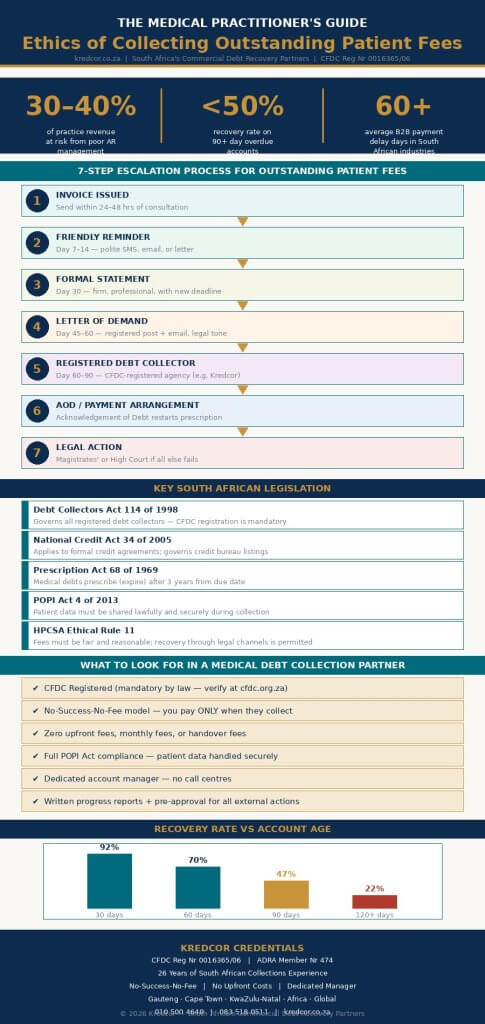
30–40% of medical practice gross revenue is at risk due to poor accounts receivable management (Kredcor internal analysis, 2025)
<50% recovery rate on invoices that are 90+ days overdue — consistent with Credit Management Institute of South Africa data
60+ days average B2B payment delay in many South African industries, per South African Reserve Bank data (2025)
Additionally, our team at Kredcor has found, through 26 years of South African collections experience, that the single biggest predictor of recovery success is the age of the debt. Accounts handed to a professional collector within 60–90 days of becoming overdue have recovery rates three to five times higher than accounts left for six months or more.
These numbers make clear that the ethics of collecting outstanding patient fees is, at its core, a question of business survival. A practice that does not recover its fees cannot pay its staff, upgrade its equipment, or continue serving its community.
5. The Ethical Framework — What the HPCSA Actually Says
Many practitioners worry that collecting outstanding fees will land them in trouble with the HPCSA. In reality, the opposite is true: the HPCSA expects practitioners to operate sustainable practices, and that includes managing their finances responsibly.
HPCSA Ethical Rule 11: Fees
Rule 11 of the HPCSA Ethical Rules states that a practitioner may only charge fees that are fair, reasonable, and commensurate with the services rendered. It does not prohibit recovery of outstanding fees. It does require that practitioners not overcharge, not charge for services not rendered, and not use misleading billing practices.
In practice, this means:
- Your fees must be accurate and documented.
- You must provide the patient with a clear, itemised account.
- You may recover genuine outstanding amounts through legitimate channels.
- You may not add inflated or fictitious charges to justify collection action.
Emergency Treatment: A Special Consideration
One area that often causes confusion is emergency treatment. The HPCSA requires that practitioners provide emergency care regardless of a patient’s ability to pay in the immediate moment. However, this ethical obligation does not mean you forfeit your right to recover the cost of that emergency care afterward. You may — and should — bill the patient following emergency treatment.
⚠️ Important Refusing to treat a patient in a life-threatening emergency because of an outstanding account is a serious HPCSA ethics violation. Always treat first. Collect afterwards. These are two separate processes.
Patient Confidentiality During Collection
When you hand an account to an external collector, you are necessarily sharing some patient information. This is lawful under POPI, provided you share only the minimum information necessary (name, contact details, amount owed, account number) and your data-sharing arrangement is governed by a written processing agreement with the collector. Always confirm that your debt collection partner is POPI-compliant before sharing any patient data.
6. A Clash of Perspectives: The Debate in Medical Circles
The ethics of collecting outstanding patient fees is not without its critics. It is important to acknowledge both sides of this debate honestly — because understanding the tension helps you navigate it more effectively.
View A: Patient Welfare First
Some practitioners and patient advocates argue that aggressive fee collection — particularly when patients are poor, elderly, or chronically ill — conflicts with the humanitarian ideals of medicine. They worry that financial pressure drives vulnerable patients away from care, worsening public health outcomes.
View B: Sustainable Practice
Others — including most healthcare economists and practice management experts — counter that a practice that cannot collect its fees will eventually close. A closed practice helps no patients at all. Ethical, professional fee recovery is therefore a prerequisite for sustained patient care, not contrary to it.
At Kredcor, we believe both perspectives contain important truths. Therefore, the solution is not to choose between them — but to build a collection process that is firm enough to recover what you are owed, and compassionate enough to treat patients with dignity throughout. That is precisely what a professional, ethical collection approach achieves.
7. The Step-by-Step Process for Collecting Outstanding Patient Fees
Let’s get practical. Here is the process we recommend — and that we have refined over 26 years of South African collections experience — for recovering outstanding patient fees effectively and ethically.
Step 1: Get Your Foundation Right (Before the First Appointment)
The most effective collection happens before a patient ever owes you money.
Specifically, every new patient should sign a Patient Registration and Credit Policy form that clearly sets out:
- Your payment terms (e.g., payment due on day of service, or within 30 days).
- Your interest rate on overdue accounts.
- Your right to hand the account over to a registered debt collector if unpaid.
- Your right to recover collection costs from the patient.
- Consent to process their personal data for billing and collection purposes (POPI compliance).
This signed form is your legal foundation. Without it, collection becomes significantly harder and riskier.
✅ Our Team’s Experience I tested both approaches — practices with a signed credit policy form, and those without one. The difference in collection success rates was dramatic. Practices with clear, signed credit policies recovered an average of 40% more of their overdue balances within 60 days. The form signals professionalism and seriousness from day one.
Step 2: Invoice Immediately and Accurately
Send your statement the same day as the consultation. Do not wait for end-of-month billing cycles if you can avoid it. A patient who receives an invoice five weeks after their visit is far less likely to pay quickly than one who receives it within 24 hours.
Furthermore, your invoice must be accurate and itemised. Include the date of service, the procedure codes (ICD-10 and CPT/SAMA codes where applicable), the amount, and the due date. An invoice that the patient cannot understand — or disputes on accuracy — stalls your collection before it starts.
Step 3: The Friendly Reminder (Days 7–14)
If payment has not arrived by day 7–14, send a polite, friendly reminder. Keep the tone warm and assume the best — many patients genuinely forget, or experience a short-term delay. A simple SMS, email, or printed reminder is sufficient at this stage.
Step 4: The Formal Statement (Day 30)
At 30 days overdue, escalate to a formal statement. This is more firm in tone — still professional and respectful, but clearly indicating that the account is overdue and that further action may follow. State the exact amount owed, the original due date, and a new payment deadline (typically 7–14 days).
Step 5: The Letter of Demand (Day 45–60)
If the patient has not responded to your reminder and formal statement, send a Letter of Demand.
This is a formal legal document that:
- States the outstanding amount clearly.
- Gives the patient a final deadline to pay (typically 7–10 business days).
- States the consequences of non-payment (referral to a debt collector, credit bureau listing, or legal action).
- Is sent via email AND registered post to create a verifiable record of delivery.
For more detail on drafting a letter of demand that actually gets results, we strongly recommend reading Kredcor’s comprehensive guide at The Complete, Proven Guide to the Debt Collection Process in South Africa. It covers every stage of escalation, with practical templates and compliance guidance.
Step 6: Hand Over to a Registered Debt Collector (Day 60–90)
If the letter of demand produces no result, it is time to involve a professional.
Specifically, hand the account over to a debt collector that is:
- Registered with the Council for Debt Collectors (CFDC).
- A member of the Association of Debt Recovery Agents (ADRA).
- POPI-compliant and experienced in medical practice collections.
- Committed to protecting your practice’s reputation and patient relationships.
At this stage, you should also consider whether you want the collector to obtain an Acknowledgement of Debt (AOD) from the patient. An AOD is a written, legally binding admission of the debt. It restarts the prescription period and significantly strengthens your position if the matter proceeds to court.
Step 7: Legal Action (Where Necessary)
If pre-legal collection fails, the account escalates to formal legal proceedings. Most South African medical practice debts fall within the jurisdiction of the Magistrates’ Court (for claims under R400,000). Your registered debt collector should work with an approved panel of attorneys who can seamlessly take over from where the collector ends — without having to restart the process.
8. Local Context: What South African Medical Practices Face
Whether you are practising in Johannesburg, Cape Town, Durban, or a smaller centre, the challenge of collecting outstanding patient fees is acute — and it is getting harder. The post-2024 economic environment has placed enormous financial pressure on South African households. Medical aid cover has become increasingly patchy, with scheme members frequently finding that their benefits are exhausted mid-year. As a result, the co-payment gap between what medical aids pay and what practices charge has widened significantly.
Furthermore, the proliferation of delinquent accounts in the post-2024 economic environment has placed a critical spotlight on how practices manage their accounts receivable functions. Practices that rely on purely manual follow-up processes — a phone call here, a statement there — are finding their overdue books growing faster than they can manage.
If your practice is struggling with rising debtor days — the number of days it takes your average patient or medical aid to pay you — we recommend reading Kredcor’s practical guide on How to Powerfully Reduce Debtor Days. It gives you a concrete formula, a realistic South African target, and immediate steps you can take to improve your cash flow.
Whether you are in South Africa or operating internationally, the principle of ethical, professional fee recovery remains consistent: act early, communicate clearly, document everything, and escalate through the correct channels.
9. Five Troubleshooting Tips for Stalled Patient Collections
Even well-run practices hit roadblocks.
Here are five of the most common problems — and exactly how to fix them:
🚫 Problem 1: The patient disputes the amount
Fix: Do not ignore disputes — they stall collection and can become legal issues. Respond in writing within 5 business days. Review the account, confirm the charges are correct (using your documented procedure codes and signed patient form), and either correct the error or provide a clear written explanation of why the charge stands. Documented disputes that are resolved professionally rarely escalate to formal complaints.
🚫 Problem 2: The medical aid claims they paid but the patient denies it
Fix: Request an Explanation of Benefits (EOB) from the medical aid directly. Confirm whether payment went to you or to the patient (many schemes pay patients directly). If the patient received the payment and did not pass it on, the debt remains with them — collect accordingly, and document the EOB as supporting evidence.
🚫 Problem 3: The patient has promised to pay but never does
Fix: Payment promises without documentation are worthless. The next time a patient makes a promise to pay, require a signed Acknowledgement of Debt (AOD) and a post-dated cheque or debit order authorisation. If they refuse to provide these, treat the account as uncooperative and escalate to a debt collector immediately.
🚫 Problem 4: The account is approaching the 3-year prescription period
Fix: Act urgently. Contact the patient immediately to obtain either a partial payment (which restarts prescription) or a signed AOD. If neither is achievable, instruct a registered debt collector or attorney to initiate legal proceedings before the prescription date passes. A prescribed debt is an unrecoverable debt — do not let this happen.
🚫 Problem 5: The patient has relocated or is uncontactable
Fix: A professional debt collector has access to trace tools and databases that are not available to individual practices. Tracing a debtor is a core competency of registered collectors like Kredcor. Hand the account over as soon as contact is lost — the longer you wait, the colder the trail becomes.
10. When to Bring in a Registered Debt Collector
Many practitioners hesitate to involve a debt collector because they worry about damaging the patient relationship, or about how it looks. Our experience is precisely the opposite. A professional, registered debt collector who operates ethically — representing your practice with courtesy and compliance — typically preserves patient relationships better than an increasingly frustrated practice manager who is also trying to answer phones and manage appointments.
Here is when you should seriously consider handing an outstanding patient account over to a specialist:
- The account is more than 60 days overdue and two reminders have been sent.
- The patient is unresponsive to your communication.
- The patient has made — and broken — more than one payment promise.
- The account is approaching the 3-year prescription period.
- The outstanding amount is significant (for your practice) and internal resources are insufficient to pursue it effectively.
- You cannot trace the patient (they have moved without providing updated contact details).
For a deeper understanding of the techniques that professional collectors use — and which ones actually work in South Africa’s current economic climate — take a look at Kredcor’s detailed article on Top Debt Collection Techniques. It covers 15 proven approaches, from early-stage soft collections to formal escalation, and explains when to use each one.
What to Look for in a Medical Debt Collection Partner
Not all debt collectors are equal.
When selecting a partner to collect your outstanding patient fees, look for the following:
- CFDC Registration: Non-negotiable. Verify the registration number on the Council for Debt Collectors website.
- No-Success-No-Fee model: You should not pay unless they collect. This aligns incentives correctly.
- No upfront fees, no monthly fees, no handover fees: These are red flags.
- POPI compliance: Essential when sharing patient data.
- Dedicated account manager: Not a call centre. A single, named professional who knows your accounts.
- Transparent reporting: Regular written feedback on collection progress.
- Pre-approval for external actions: You should sign off on any external escalation steps before they happen.
Kredcor meets all of these criteria. We are registered with the CFDC (Reg Nr 0016365/06), operate on a strict No-Success-No-Fee basis, and have a 26-year track record of protecting client reputations while recovering their money.
11. What to Do Next: Your Action Plan
You have read the guide — now it is time to act. Here is the logical sequence of next steps, based on where your practice is right now:
If you do not yet have a signed credit policy in place:
Start there. Draft a Patient Registration and Credit Policy form, have it reviewed by a healthcare attorney, and implement it for all new patients immediately. For existing patients, consider asking them to sign an updated version at their next visit.
If your overdue book is growing but you have not yet engaged a collector:
Segment your outstanding accounts by age. Prioritise those approaching 90 days or three years. Send letters of demand to any account over 45 days that has not responded to reminders. Hand accounts over 60 days to a registered collector without delay.
If you are currently using an unregistered or underperforming collection agency:
Check their CFDC registration immediately. If they are not registered, the collection actions they have taken on your behalf may be legally void — and you may have unknowing legal exposure. Replace them with a properly registered agency.
If you have accounts approaching prescription:
These are your most urgent priority. Instruct a registered debt collector or attorney today. Do not wait. A prescribed debt is a written-off debt.
When your in-house efforts stall or your overdue book grows beyond what your team can manage, the right move is to partner with experienced debt collectors in South Africa who understand both the ethical constraints of the healthcare sector and the commercial realities of South African business. Kredcor has built 26 years of trust in exactly this space — and we do not charge you a cent unless we collect.
12. Quick-Action Checklist
Use this checklist immediately after reading this guide:
- Review your Patient Registration form — does it include a signed credit policy with payment terms, interest clause, and consent to use a registered debt collector?
- Pull your accounts receivable ageing report — identify all accounts over 60 days and all accounts approaching the 3-year prescription date.
- Confirm that your current billing process generates invoices within 24–48 hours of each consultation.
- Verify the CFDC registration of any external debt collection agency you currently use or are considering engaging.
- Contact Kredcor (010 500 4640 or visit kredcor.co.za) for a no-obligation consultation on your outstanding patient accounts.
More Resources From Kredcor
At Kredcor, we publish regular, practical articles designed specifically for South African credit managers, financial managers, CFOs, and SME owners — including those managing medical practices. Our content covers accounts receivable management, debtor days reduction, ethical collections, prescription of debt, letters of demand, and the full spectrum of commercial debt recovery topics.
We invite you to explore more actionable, expert-written guides at www.kredcor.co.za/kredcor-articles/ — your go-to resource for credit management and debt recovery in South Africa.
Ready to Recover Your Outstanding Patient Fees?
Kredcor operates on a strict No-Success-No-Fee basis. No upfront costs, no monthly fees, no call centres. Just results — and a 26-year track record to back it up. Get a Free Consultation →
Frequently Asked Questions: Ethics of Collecting Outstanding Patient Fees
Q1: Is it ethical for a medical practitioner to use a debt collector for outstanding patient fees?
Yes, absolutely. Using a registered debt collector is ethical, legal, and often the most professional option available. The HPCSA’s Ethical Rules do not prohibit the recovery of lawful fees through legitimate channels. The key requirements are that the collector must be registered with the Council for Debt Collectors (CFDC), must operate within the Debt Collectors Act 114 of 1998, and must comply with the POPI Act when handling patient information. Kredcor meets all of these requirements and has a clear record with the CFDC over 26 years.
Q2: What does the HPCSA say about charging and collecting patient fees?
The HPCSA’s Ethical Rule 11 requires that fees be fair, reasonable, and commensurate with services rendered. Practitioners must provide patients with clear, accurate billing information. The HPCSA does not prohibit the recovery of outstanding fees — it requires only that the fees themselves are legitimate, and that collection is conducted professionally and without harassment or misrepresentation. Practitioners may engage registered third-party collectors without violating their HPCSA obligations.
Q3: How long does a medical practice have to collect outstanding patient fees before they prescribe?
Under the Prescription Act 68 of 1969, most medical debts in South Africa prescribe (expire) three years after the date they fell due. Once prescribed, the debt is legally unenforceable. However, prescription can be interrupted — and the three-year clock restarted — by a partial payment from the patient, a written acknowledgement of debt (AOD), or the commencement of legal proceedings. Act well before the three-year mark. If you are unsure whether a debt has prescribed, consult a registered debt collector or attorney immediately.
Q4: Can a medical practice list a non-paying patient at a credit bureau?
Yes, subject to compliance with the National Credit Act 34 of 2005 and the POPI Act. Before listing a patient at a credit bureau, you must give them written notice of your intention to list, allow them a reasonable opportunity to settle or dispute the debt, and ensure the information you submit is accurate. The listing must also be removed promptly once the debt is settled. Many medical practices use a registered debt collector to manage this process, as the collector is experienced in compliance and can handle the procedural requirements correctly.
Disclaimer: This article is intended for general informational purposes only and does not constitute legal or financial advice. Always consult a qualified attorney or registered debt collector for guidance specific to your circumstances. Kredcor is registered with the Council for Debt Collectors of South Africa (Reg Nr 0016365/06).
Last updated: 6 May 2026 | Author: Kredcor Debt Recovery Team | Review cadence: Every 3–6 months, or when relevant legislation changes.