

Commercial Payment Arrangements: The SME Owner’s Practical Guide
How to turn a stalling invoice into a structured, written plan the debtor keeps to — and one you can act on immediately if they do not. Then Commercial Payment Arrangements are defenitely the way to go.
By Kredcor Senior Pre-Legal & Credit Risk Team — Kredcor, South Africa’s Commercial Debt Recovery Partners.
Registered with the Council for Debt Collectors (Reg Nr 0016365/06) | 26+ years of commercial debt recovery experience
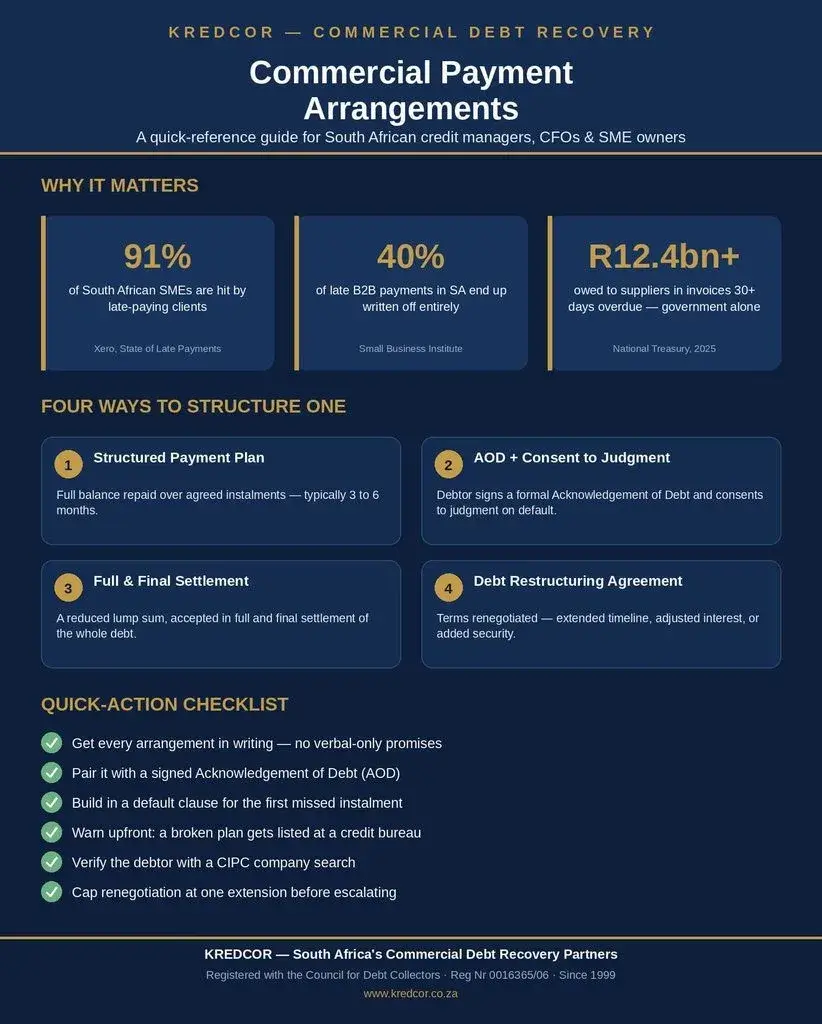
Ninety-one percent of South African SMEs are affected by late-paying clients, and the average overdue invoice is still not settled until eighteen days past terms. For most credit managers, the real question is no longer whether to offer a commercial payment arrangement — it is how to structure one that actually holds. Done properly, a commercial payment arrangement converts a stalling, undocumented promise into a written, enforceable schedule the debtor commits to, and one a business can act on immediately if that debtor defaults.
At a glance: A commercial payment arrangement is a written agreement, usually paired with an Acknowledgement of Debt, that lets a business debtor repay an overdue invoice over time instead of all at once or through court. Structured well — realistic instalments, a signed AOD, a clear default clause — it recovers money that would otherwise become a write-off.
Table of Contents
- What Is a Commercial Payment Arrangement?
- Why Negotiate Instead of Writing Off or Suing
- The Four Structures You Will Actually Use
- Building an Arrangement That Holds Up If It Breaks
- The South African Legal Backdrop: NCA Thresholds and Section 129
- Five Troubleshooting Tips When an Arrangement Breaks Down
- Another Way to See It: Is a Payment Plan Always the Right Move?
- What to Do Next
- Quick-Action Checklist
- FAQ
What Is a Commercial Payment Arrangement?
A commercial payment arrangement is a negotiated agreement between a business creditor and a business debtor that spreads repayment of an overdue invoice over an agreed schedule, instead of demanding the full balance immediately or heading straight to court. It sits firmly in the soft-collection stage of the debt recovery process — the same territory as amicable debt recovery and pre-litigation negotiation — and it is usually the first serious tool a credit manager reaches for once a friendly reminder has not worked, but the relationship is still worth protecting.
Kredcor’s own guide to early delinquency management places a commercial payment arrangement squarely inside the 31-to-60-day window: past the point where a polite nudge fixes things, but well before a matter needs an attorney’s letterhead. Get it right at this stage, and most accounts never progress to formal legal action at all.
Do not confuse a commercial payment arrangement with consumer debt review under the National Credit Act (NCA). Debt review is a statutory process for over-indebted individual consumers, run through the National Credit Regulator (NCR) and a registered debt counsellor. A commercial payment arrangement between two businesses is a private, contractual matter — one that, as Section 5 below explains, usually falls outside the National Credit Act altogether.
Why Negotiate Instead of Writing Off or Suing
The business case starts with a hard number. According to the Small Business Institute, as much as 40% of late payments in South Africa end up written off entirely, and SMEs report typically waiting up to 101 days for payment — more than three times the standard 30-day term. Left unmanaged, that pattern is a genuine survival risk: the Institute puts SME failure within the first two-and-a-half years at around 70%, with unpredictable cash flow named as a leading cause (Small Business Institute, via Sierra Leone Times).
At the same time, Xero’s State of Late Payments research found that 91% of South African SMEs are affected by late payment, with a full order-to-cash cycle that can stretch past 150 days once buying, delivery and collection are all accounted for. Government departments are not immune either: by mid-2025, National Treasury data showed departments carrying more than R12.4 billion in invoices older than 30 days.
Litigation looks like the obvious answer, but it is slow, costly, and — even after judgment — still requires enforcement. A well-structured commercial payment arrangement can convert a stalled invoice into cash within weeks, keeps legal costs off the table entirely if it holds, and, done with the right documentation, remains just as enforceable as a court order if it does not. In our experience managing pre-legal accounts across South Africa, debtors offered a realistic, structured plan settle at meaningfully higher rates than debtors sent straight to a final demand with no alternative on the table — and every arrangement that closes out cleanly instead of dragging on is a small, compounding win for a business’s DSO (Days Sales Outstanding).
The Four Structures You Will Actually Use
Most commercial payment arrangements fall into one of four structures. None is inherently better than the others — the right one depends on the debtor’s actual financial position, not just what a creditor would prefer to receive.
| Structure | What It Means | Best For |
|---|---|---|
| Structured Payment Plan | Full balance repaid over agreed instalments, typically three to six months. | A debtor with the will to pay but not the immediate liquidity. |
| Acknowledgement of Debt (AOD) + Consent to Judgment | Debtor signs a formal AOD admitting the debt and consents to judgment being entered if they default. | Any arrangement of real value — converts a soft agreement into an enforceable document. |
| Full and Final Settlement | Debtor pays a reduced lump sum, accepted as full and final settlement of the whole debt. | A debtor who genuinely cannot pay in full, where a partial recovery beats a likely write-off. |
| Debt Restructuring Agreement | Formal renegotiation of terms — extended timeline, adjusted interest, sometimes added security. | Larger commercial accounts and long-standing clients worth keeping. |
Whichever structure is right for a given debtor, put it in writing before the conversation ends. Kredcor’s detailed playbook on debt settlement negotiations walks through the tactics — anchoring, structured options, strategic deadlines — that get a debtor from “I can’t pay” to a signed agreement in the first place; this guide assumes that conversation has already happened and focuses on choosing and documenting the right structure.
Building an Arrangement That Holds Up If It Breaks
Keep the numbers realistic. An instalment schedule built around a business’s ideal recovery timeline, rather than the debtor’s actual cash flow, is a schedule that fails within one or two payments. Ask for supporting evidence of the debtor’s position before agreeing — even a simple cash-flow statement — rather than accepting a number pulled out of the air.
Make the AOD the centerpiece. A signed Acknowledgement of Debt, ideally with consent to judgment, is what separates an enforceable commercial payment arrangement from a polite understanding. It converts a disputed or informal balance into a liquid document a court can act on quickly.
Build in a default clause. Decide, in writing, exactly what happens on the first missed instalment — the full outstanding balance becomes immediately due, and the matter moves to a registered debt collector or the attorney panel — so nobody has to make that decision emotionally in the moment.
Verify before extending further trust. A CIPC (Companies and Intellectual Property Commission) company search on the debtor entity takes minutes and tells a business whether they are dealing with a going concern, a company in business rescue, or one already flagged for deregistration. Checking the debtor’s history with a commercial credit bureau, such as Experian or TransUnion, adds a second layer of insight into whether this debtor is worth the extra time.
Warn about the default listing upfront. Telling a debtor clearly, before they sign, that a broken arrangement will be reported to a credit bureau is not an idle threat — it is one of the simplest ways to improve compliance with the plan they have just agreed to.
The South African Legal Backdrop: NCA Thresholds and Section 129
Here is the piece of the National Credit Act that trips up more credit managers than any other: most business-to-business commercial payment arrangements do not trigger a Section 129 notice requirement at all. Section 4(1) of the National Credit Act exempts a credit agreement where the debtor is a juristic person whose asset value or annual turnover equals or exceeds the threshold set by the Minister — currently R1 million. South African courts have repeatedly upheld this exemption where a business debtor’s financials clear that bar, meaning the Act, and the Section 129 notice it requires before legal action, simply does not apply.
That matters in practice: for most Kredcor clients dealing with reasonably established business debtors, a creditor can proceed straight to negotiation and, if necessary, summons, without the ten-business-day Section 129 notice period that governs consumer credit agreements. The reverse is just as important, though. Where the debtor is a smaller juristic person sitting below that R1 million threshold, or an individual trading as a business, the National Credit Act and its Section 129 notice requirement do apply — and skipping that notice has been enough, in more than one reported case, to get a subsequent judgment set aside.
The practical takeaway: confirm which side of that threshold a debtor sits on — a CIPC company search is a reasonable starting point — before assuming a Section 129 notice is, or is not, required. This is a genuine legal determination, not a formality, so where real doubt exists, confirm the position with an attorney before proceeding to judgment.
Five Troubleshooting Tips When an Arrangement Breaks Down
If the debtor misses the first instalment entirely — do not wait for the second one to arrive before acting. Call within 48 hours; a missed first payment is one of the strongest predictors that an arrangement will not hold on its own, and early contact is the best chance of saving it.
If the debtor asks to renegotiate before the ink is dry — get the new terms in writing immediately, and treat it as an updated arrangement with its own AOD, not a verbal exception layered on top of the old one.
If partial payments arrive but never the full instalment — apply payments to interest and costs first, where the terms of trade allow it, so the capital balance does not quietly stall while the debtor believes they are on track.
If the debtor stops responding altogether — do not keep extending silently. Move to the default clause: escalate to a registered debt collector or the attorney panel, and list the account with a credit bureau if that consequence was disclosed upfront.
If it becomes clear mid-arrangement that the debtor’s position is worse than disclosed — run a fresh CIPC company search and check for business rescue or liquidation proceedings before agreeing to extend the plan further. A payment arrangement with an insolvent debtor is often just a slower route to the same loss.
Another Way to See It: Is a Payment Plan Always the Right Move?
Some credit managers argue that offering a payment arrangement signals weakness and trains slow-paying clients to expect leniency every time — better, in their view, to hold a hard line and escalate immediately. There is something to that argument: a debtor who has negotiated three separate payment plans in two years is not a cash-flow problem, they are a credit-risk problem, and no amount of renegotiation fixes that. For most first-time or genuinely distressed debtors, though, the data does not support a hardline default — negotiated recovery beats immediate litigation on cost and speed in the large majority of B2B cases. The realistic position: extend a structured arrangement once, generously and well-documented. Extend a second one only with new security or a shorter leash. A third request is not a negotiation anymore — it is a collections referral.
What to Do Next
If a business does not yet have a standard AOD template it can issue the same day a debtor asks for a payment plan, that is the single highest-leverage document to get in place first. If an arrangement is already mid-way through and has broken once, resist the pull to offer a third informal extension — trigger the default clause and run a fresh CIPC check instead. And if a business is already past that point on a meaningful number of accounts, the next call worth making is to a CFDC-registered debt recovery partner, not another reminder email.
Quick-Action Checklist
- Pull every overdue account currently running on an informal “I’ll pay when I can” promise and move it onto a signed AOD this week.
- Confirm whether the debtor is a juristic person above the R1 million NCA threshold before assuming a Section 129 notice is required.
- Run a CIPC company search on any debtor requesting a second payment extension.
- Build a default clause into every arrangement, specifying exactly what happens on the first missed instalment.
- Tell debtors upfront that a broken arrangement gets reported to a credit bureau — then follow through if it happens.
- Set a hard cap of one renegotiated arrangement per debtor before the account moves to a registered debt collector.
FAQ
Is a commercial payment arrangement legally binding?
Yes, once it is reduced to writing and signed, particularly when paired with an Acknowledgement of Debt. An AOD that also includes consent to judgment lets a creditor approach the court for judgment quickly if the debtor defaults, without having to prove the underlying debt from scratch.
Do I need to send a Section 129 notice before enforcing a commercial payment arrangement?
Only if the National Credit Act actually applies to the agreement. Where the debtor is a juristic person whose asset value or annual turnover meets the Minister’s threshold — currently R1 million — the Act does not apply and no Section 129 notice is required. Where the debtor falls below that threshold, or is an individual, the notice requirement does apply, so confirm which side of the line the debtor sits on before proceeding.
How many instalments is reasonable to offer a struggling debtor?
There is no fixed rule, but three to six months is the range most South African commercial payment arrangements settle on. Longer than that, and a business is effectively financing the debtor’s cash flow for free; shorter, and it risks offering a plan the debtor cannot realistically keep.
What happens if a debtor breaks a signed payment arrangement?
If the arrangement includes an Acknowledgement of Debt with consent to judgment, a creditor can generally proceed straight to obtaining judgment without a fresh round of litigation. Without that clause, a letter of demand and, if that fails, summons will usually be needed — which is exactly why the documentation stage matters as much as the negotiation itself.
Should I involve a professional debt collector to set up a payment arrangement, or handle it myself?
Many businesses negotiate a first arrangement in-house successfully, especially where there is an existing client relationship worth protecting. Where the debtor has already broken one promise, where the amount is material, or where internal capacity to track instalments and follow up on time is limited, a registered debt collector working on a no-success, no-fee basis is usually the lower-risk option.
A well-structured commercial payment arrangement recovers money most businesses would otherwise write off — but it only works if it is documented properly, monitored consistently, and backed by a credible default position if it breaks. Where a business does not have the internal capacity to negotiate, document and chase every instalment itself, professional debt collectors in South Africa bring exactly that capacity, usually on a no-success, no-fee basis that makes the decision close to risk-free.
For more plain-English guidance on protecting cash flow, browse the full library at Kredcor Articles.
Published by Kredcor Senior Pre-Legal & Credit Risk Team — Kredcor, South Africa’s Commercial Debt Recovery Partners.
Registered with the Council for Debt Collectors (CFDC), Reg Nr 0016365/06. Operating nationwide since 1999.
Disclaimer: This article is for general informational purposes only and does not constitute legal or financial advice. Always consult a qualified attorney or registered debt collector for guidance specific to your business.