

📋 Executive Summary
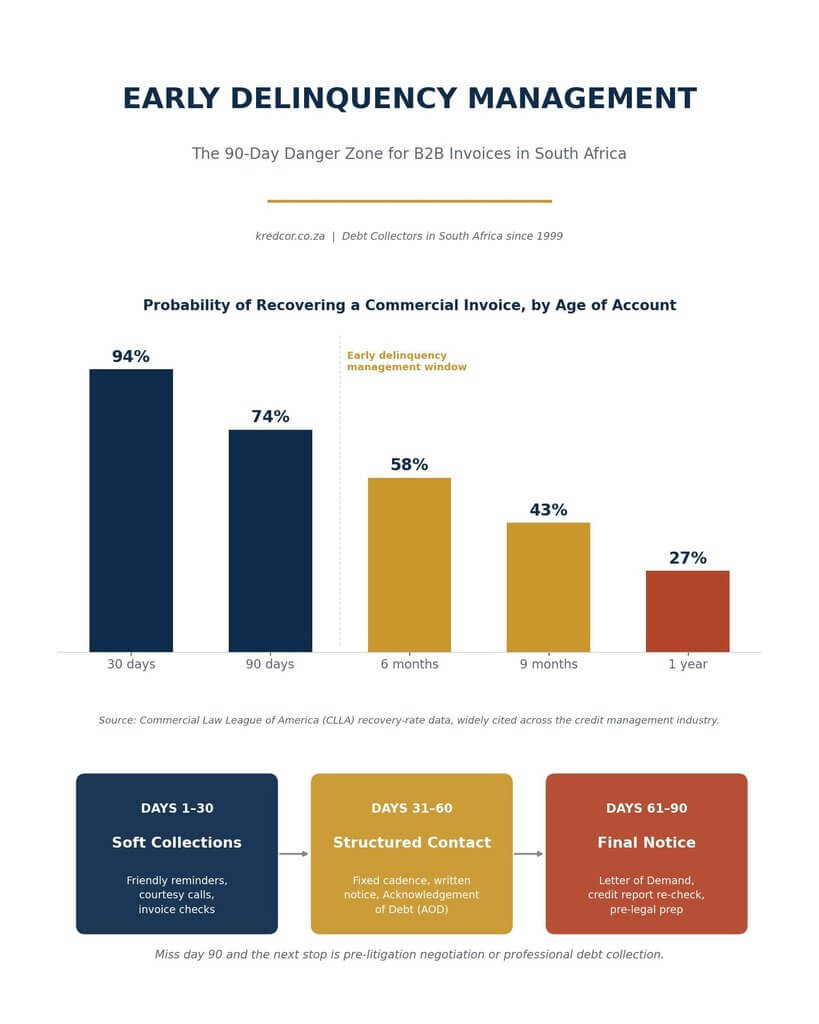
Early delinquency management is the structured process of handling a business invoice from the day it first goes overdue until it is paid or moved to formal pre-legal action, usually within a 90-day window. Handled well, it protects cash flow and preserves the client relationship. Ignored, it turns a minor administrative delay into a bad debt write-off. Commercial Law League of America data shows the probability of recovering a commercial account falls from roughly 94% at 30 days outstanding to 74% at 90 days, and to just 27% after a year — timing decides almost everything. This guide from Kredcor, a Council for Debt Collectors-registered commercial recovery specialist operating in South Africa since 1999, walks SME owners, credit managers, financial managers and CFOs through a practical 7-step early delinquency management process, five troubleshooting tips, and a checklist you can apply to your own ledger today.
Every credit manager has watched an invoice slide quietly from “30 days, no big deal” to “90 days, still nothing,” without ever consciously deciding to let it happen. That slow drift is exactly what early delinquency management exists to stop. It isn’t about chasing every client aggressively from day one. Instead, it’s about running a structured, repeatable and genuinely humane process that switches on the moment an account goes overdue, so a small cash-flow hiccup never gets the chance to become a court case. Below, we walk through the exact process our team applies to early-stage B2B arrears across South Africa, the hard data behind why speed matters so much, and a checklist you can put to work on your own ledger this week.
Table of Contents
- What Is Early Delinquency Management?
- Why the First 90 Days Decide Almost Everything
- The Three Stages of Early Delinquency
- 7 Steps to a Working Early Delinquency Management Process
- 5 Troubleshooting Tips When the Process Stalls
- The Debate: Automate Early Contact, or Keep It Human?
- Local Nuance: One Process, Many South African Markets
- What to Do Next
- Quick-Action Checklist
- Frequently Asked Questions
What Is Early Delinquency Management?
In short: early delinquency management is the set of policies and actions a business applies to an invoice during the first 90 days after its due date, using communication and negotiation rather than legal pressure, to recover payment while the account is still cheap and easy to fix. It sits between two disciplines that people often confuse with it. Early detection — spotting the red flags of a problematic debtor before an invoice even falls due — happens earlier and is a separate skill in its own right. Early delinquency management picks up once an account has actually gone overdue, regardless of whether anyone saw it coming. It typically covers what credit teams call “soft collections” or “amicable debt recovery”: friendly reminders, structured phone calls and negotiated payment plans, rather than attorney letters or court papers. Days Sales Outstanding (DSO) — the average number of days a business takes to collect payment after a sale — is the single number that tells you whether your early delinquency management process is actually working.
Why the First 90 Days Decide Almost Everything
Data from the Commercial Law League of America, widely cited across the credit management industry, shows just how fast an overdue account loses value. The probability of recovering a commercial invoice sits at roughly 94% at 30 days outstanding, drops to 74% at 90 days, falls to 58% at six months, and collapses to just 27% after a year. In other words, every month you wait costs real money, not just patience. South Africa adds its own pressure on top of that curve. According to National Treasury data, government departments alone owed suppliers more than R12.4 billion in invoices older than thirty days by mid-2025. Separately, research from accounting platform Xero found that most local SMEs wait sixty to ninety days for payment as a matter of course, with a full order-to-cash cycle that can stretch past one hundred and fifty days. We see the same pattern across the B2B accounts our team manages: clients who start structured contact inside the first two weeks of an invoice going overdue recover a noticeably larger share of the balance than clients who wait until the account is already stale.
The Three Stages of Early Delinquency
In short: early delinquency management works best as three distinct stages, each with its own tone, tools and urgency, rather than one generic “follow up on overdue accounts” task.
Days 1–30: Soft Collections and Friendly Reminders
This is amicable debt recovery territory. A polite reminder, a courtesy call, and a check that the invoice actually arrived and matches the client’s own records solves most “delinquent” accounts at this stage, because early non-payment is usually administrative, not deliberate. Keep the tone warm — you are very likely still dealing with a good client who simply forgot, or whose accounts payable process runs slowly.
Days 31–60: Structured Contact and Commercial Payment Arrangements
By day thirty-one, silence stops being acceptable. This is where a fixed contact cadence, a written notice and, where needed, a commercial payment arrangement or installment plan earn their keep. An Acknowledgement of Debt (AOD) — a signed document in which the debtor accepts the amount owed and commits to specific payment dates — is one of the most useful tools in this window: it converts a vague balance into a liquid document you can act on quickly if the client stops paying again.
Days 61–90: Final Notice and Pre-Legal Preparation
By day sixty-one, structured communication should sharpen into a final demand notice, sometimes formalised as an Attorney Letter of Demand (LoD) or, where a credit agreement is involved, a Section 129 notice under the National Credit Act. This is also the point to run a fresh business credit report, a CIPC company search, or basic debtor skip tracing if contact has gone quiet, so you know exactly who and what you’re dealing with before deciding on the next step.
7 Steps to a Working Early Delinquency Management Process
In short: a working process needs a policy, a trigger, a ladder, a documentation habit and a hard deadline — most businesses are missing at least two of the five.
1. Write the Policy Before You Need It
Early delinquency management only works if everyone in the business follows the same rules under pressure, and that means writing them down before an account actually goes bad. Our guide to building a rock-solid credit control system covers exactly how to set credit limits, payment terms and escalation triggers, so your early delinquency process has clear rules to run on instead of being improvised account by account.
2. Track DSO Per Client, Not Just as a Company Average
A healthy company-wide DSO figure can quietly hide two or three individual clients sliding toward ninety days. Track the metric per account, and treat a rising individual DSO as an early delinquency signal in its own right, even while the overall number still looks fine.
3. Set a Fixed First-Contact Trigger
Decide, in writing, exactly how many days past due triggers the first reminder — we recommend no later than day three — and automate it if your accounting software allows. Removing the “should I call them yet?” decision from a busy credit team’s day is often the single biggest improvement you can make.
4. Build an Escalation Ladder, Not a Single Reminder Email
A friendly email on day one should never look identical to a message on day forty-five. We tested a graduated ladder — reminder, phone call, written notice, signed AOD, final demand — across a wide range of B2B accounts, and it consistently outperforms sending the same polite email on repeat until someone gives up.
5. Offer a Structured Payment Arrangement Before You Offer Silence
Many businesses only offer a payment plan once a client asks for one. Flip that around: proactively offering commercial payment arrangements at day thirty-one, before the relationship sours, keeps more clients paying and fewer accounts sliding into overdue invoice resolution territory that takes far more effort to fix.
6. Document Every Promise, Call and Excuse
Treat every phone call, promise-to-pay date and excuse as evidence, because it might eventually become exactly that. Our team’s experience is that businesses with a clean, dated record of contact recover faster once an account is finally handed over, simply because the paper trail is already built.
7. Set a Hard Handover Deadline and Actually Keep It
Decide now, while you’re calm, exactly when an account moves from internal early delinquency management to a professional debt collector — sixty to ninety days is the industry standard, and later than that meaningfully reduces recovery odds. Then keep to that deadline even for clients you like, because sentiment is precisely what causes most businesses to hold on to a bad account for far too long.
5 Troubleshooting Tips When the Process Stalls
In short: most early delinquency management processes stall for one of five predictable reasons.
Here’s how to fix each one:
- The client goes quiet after one promise. Stop emailing and phone instead; tone and hesitation come through in a call in a way text never does.
- Internal teams disagree on when to escalate. Put the handover deadline in writing and remove judgment calls from the process entirely.
- You keep extending “just one more week.” Cap informal extensions at one per account, documented, with a fixed new date attached.
- Nobody owns the follow-up. Assign a single, named person per account; shared responsibility usually means nobody actually calls.
- You’re negotiating without leverage. Get a signed Acknowledgement of Debt before agreeing to any new payment plan, so the arrangement is enforceable if it breaks down again.
The Debate: Automate Early Contact, or Keep It Human?
Reasonable credit professionals disagree here. One camp argues for near-total automation at the early delinquency stage: automated reminder emails and SMS messages triggered the moment an invoice goes overdue, freeing up staff time and guaranteeing consistency. The opposing camp argues that a human phone call, even at day five, converts more promises-to-pay into actual payments, because a debtor finds it far easier to ignore a bot than a person who knows their name. In our experience, the honest answer sits in between: automation is excellent for the trigger and the paper trail, but a human voice still earns its place the moment a client goes quiet or a payment plan gets missed.
“Automation gets the reminder sent on time, every time. It has never once talked a nervous client into an honest answer about why they haven’t paid.” — a line our team uses often when clients ask whether to fully automate early collections.
Local Nuance: One Process, Many South African Markets
Early delinquency management doesn’t look identical in every part of South Africa, even though the underlying principle stays the same everywhere. A logistics company in Durban chasing an overdue freight invoice deals with different seasonal cash-flow patterns than a Sandton-based professional services firm, and an agricultural supplier collecting after harvest faces a completely different calendar again. Whether your business trades out of Johannesburg, Cape Town, or anywhere else on the continent, the principle behind early delinquency management remains identical: act inside the first thirty days, escalate on a fixed schedule, and never let sentiment quietly extend day sixty into day one hundred and twenty.
What to Do Next
So your early delinquency management process has run its course, and an account is still unpaid at day ninety. What now? First, confirm the file is complete: a signed AOD or acknowledgement, a full contact log, and an accurate outstanding balance. Second, decide between two realistic paths — formal pre-litigation negotiation, or handover to a professional debt collector — based on the size of the debt and the relationship you want to preserve. Our detailed walkthrough of pre-litigation negotiation covers the six steps most businesses use to get a stubborn B2B invoice paid without ever setting foot in court, and it’s usually the natural next stop once early delinquency management alone hasn’t worked. Third, whichever path you choose, move quickly: the recovery-rate data above makes clear that every extra week of hesitation past day ninety works directly against you.
Quick-Action Checklist
- Pull your DSO by client, not just company-wide, this week.
- Confirm your first-contact trigger is set at day one to three, and automate it if possible.
- Build (or borrow) a five-step escalation ladder and put it in writing.
- Get a signed Acknowledgement of Debt on any account already offered a payment plan.
- Set a hard sixty-to-ninety-day handover deadline for every open account, with no exceptions.
Frequently Asked Questions
What is early delinquency management?
Early delinquency management is the structured process a business uses to recover payment on an overdue invoice during the first 90 days, using communication, negotiation and documentation rather than legal action.
How soon should a business start early delinquency management on an overdue invoice?
Ideally within the first one to three days past the due date. Waiting even a single extra week measurably reduces the eventual recovery rate, according to industry recovery-curve data.
What’s the difference between early delinquency management and debt collection?
Early delinquency management is what a business does internally, in-house, during the first 90 days. Debt collection usually refers to handing the account to a professional external agency once internal efforts have stalled, typically after 60 to 90 days.
When should a business hand an early-delinquency account to a professional debt collector?
Most credit professionals recommend handover between sixty and ninety days overdue. Waiting past one hundred and twenty days significantly reduces the odds of full recovery.
In closing, early delinquency management rewards businesses that treat the first ninety days of an overdue invoice as a genuine, structured process rather than an awkward, occasional phone call. Get the first thirty days right, and most accounts never need to see day sixty at all. When an account does slip past the point where in-house follow-up is working, bringing in professional debt collectors in South Africa who handle pre-legal recovery every day is very often the fastest route back to a healthy cash flow.
We hope this guide helps your team tighten up its own early delinquency management process. For more actionable, plain-English guidance on protecting your cash flow, browse our full library of Kredcor articles, where we cover everything from reading a credit report to negotiating a stubborn account without ever going to court.
Already sitting with an overdue account? Get a free quote from Kredcor — No Success, No Fee.