

The Essential Guide to the Council for Debt Collectors: 7 Powerful Facts Every South African Business Must Know
If you manage overdue accounts, appoint collection agencies, or deal with outstanding commercial debt, the Council for Debt Collectors is the single most important regulatory body you need to understand. Established under the Debt Collectors Act 114 of 1998, the CFDC is South Africa’s statutory watchdog for the entire debt collection industry — and knowing how it works can save your business money, protect your reputation, and dramatically improve your recovery rates.
Table of Contents
- What Is the Council for Debt Collectors?
- Why the CFDC Was Created — and Why It Still Matters Today
- The 7 Most Important Things the Council for Debt Collectors Does
- How CFDC Registration Works: A Step-by-Step Breakdown
- The Code of Conduct: The Golden Rules of Ethical Collection
- How the Council for Debt Collectors Benefits Your Business
- How the CFDC Protects Debtors (And Why That’s Good for You)
- 5 Critical Troubleshooting Tips for Businesses
- What to Do If a Debt Collector Breaks the Rules
- FAQ: Council for Debt Collectors
1. What Is the Council for Debt Collectors?
The short answer: The Council for Debt Collectors (CFDC) is a statutory body created by the South African Parliament to regulate, register, and discipline all debt collectors operating in the country.
Formally constituted under the Debt Collectors Act 114 of 1998, the CFDC is a juristic person — meaning it has legal standing in its own right. Its core mandate is simple but powerful: no person or company may act as a debt collector for reward in South Africa unless they are registered with the Council for Debt Collectors.
This means that every debt collection agency, every collector, and every director of a collection company must be verified, registered, and monitored. Attorneys are excluded (they fall under the Legal Practice Council), but every other party in the commercial and consumer collection space falls firmly under the CFDC’s jurisdiction.
“The Council for Debt Collectors is the foundation of an ethical, functioning credit economy. Without it, the line between legitimate recovery and harassment disappears.” — Kredcor Commercial Debt Recovery
The official CFDC website is cfdc.org.za, where you can verify the registration of any collector before engaging them.
2. Why the CFDC Was Created — and Why It Still Matters Today
Before 1998, the debt collection industry in South Africa was something of a Wild West. Collectors used aggressive, often illegal tactics. Fees were arbitrary. Debtors had little recourse. Even creditors suffered — because unethical collection practices destroyed customer relationships, created legal exposure, and ultimately reduced the likelihood of actually recovering money.
Parliament created the Council for Debt Collectors to fix all of this. Furthermore, the Act legitimised the charging of collection fees by registered agencies — creating a sustainable business model for compliant operators and, at the same time, building real accountability into the system.
The result? A transformation. Today, South Africa’s debt collection regulatory framework is one of the most structured in Africa. The Council for Debt Collectors ensures that only vetted, ethical professionals operate in the space. As a consequence, businesses that work with CFDC-registered agencies are protected by law on both sides of the transaction.
This is exactly why, at Kredcor, full CFDC compliance is a non-negotiable part of our operational model. Our registration number is 0016365/06 — and we encourage every client to verify it.
3. The 7 Most Important Things the Council for Debt Collectors Does
Here’s where it gets truly practical. Understanding the Council for Debt Collectors’ functions helps you make smarter decisions about who you appoint, what rights you have, and how to protect your business.
1. Mandatory Registration
The CFDC operates a national register of all authorised debt collectors. Registration is not optional — it is a legal requirement. Any collector operating without registration is committing a criminal offence in terms of the Debt Collectors Act.
2. “Fit and Proper” Verification
Before registering, every applicant must prove they are fit and proper. This means no convictions for dishonesty, fraud, extortion, or violence. The Council for Debt Collectors scrutinises the backgrounds of directors, shareholders, and operational staff alike.
3. Maintaining the Public Register
The CFDC maintains a publicly accessible register. This is a powerful tool — as a business owner or credit manager, you can verify any collector’s status at cfdc.org.za in minutes. If they are not on the register, do not use them.
4. Regulating Fees and Tariffs
One of the Council for Debt Collectors’ most critical functions is controlling the fees that collectors may charge. These tariffs are legislatively prescribed and updated periodically. Neither the debtor nor the creditor may be charged more than the legal maximum.
5. Enforcing the Code of Conduct
The CFDC has a detailed Code of Conduct governing every aspect of collector behaviour — from the hours they may call to the language they may use. We cover this in full in Section 5 below.
6. Investigating Complaints
Any person — debtor or creditor — may lodge a formal complaint with the Council for Debt Collectors. The CFDC investigates these claims with full legal authority. If a collector is found guilty of misconduct, the consequences can be severe.
7. Disciplinary Hearings and Sanctions
The Council for Debt Collectors can impose fines, suspend registrations, or permanently remove a collector from the register. This creates real accountability — and gives you genuine protection when appointing an agency.
4. How CFDC Registration Works: A Step-by-Step Breakdown
So, how does a legitimate debt collection company actually get registered with the Council for Debt Collectors? Here’s the process, based on our own experience going through it at Kredcor:
Step 1 — Submit a formal application to the CFDC, including proof of identity, company registration documents, and declarations regarding criminal history.
Step 2 — Background verification of all directors, shareholders, and staff involved in collection activities. This is thorough. The Council for Debt Collectors takes the “fit and proper” requirement seriously.
Step 3 — Open a dedicated trust account. This is a hard requirement. All client funds collected on behalf of creditors must be held in a separate trust account — mixing client money with operational funds is a serious offence and grounds for immediate deregistration.
Step 4 — Receive a registration number and be listed on the public CFDC register. This number is your proof of legitimacy.
Step 5 — Ongoing compliance. Registration must be maintained annually. Registered collectors are subject to ongoing monitoring, random audits, and complaint investigation at any time.
Our team went through this process and, importantly, have maintained it for over 26 years. In our experience, the registration process is rigorous — but that rigour is precisely what makes CFDC registration a meaningful quality signal.
5. The Code of Conduct: The Golden Rules of Ethical Collection
The Council for Debt Collectors’ Code of Conduct is the most detailed and operationally significant part of the regulatory framework. As a credit manager or CFO appointing a collection agency, you need to know what your appointed collector is — and isn’t — allowed to do.
What Collectors ARE Allowed to Do
- Contact a debtor between 06:00 and 21:00, Monday to Saturday
- Request payment on an outstanding account
- Add legislatively prescribed collection fees to the debt
- Negotiate payment arrangements on behalf of the creditor
- Issue formal demand letters
- Refer accounts to attorneys for legal action when necessary
What Collectors ARE NOT Allowed to Do
- Contact a debtor before 06:00 or after 21:00, or on Sundays and public holidays
- Use obscene, threatening, or abusive language
- Impersonate a police officer, attorney, or court official
- Send documents that simulate legal proceedings (e.g., fake summons)
- Harass or embarrass a debtor by contacting their employer or family members about the debt
- Charge fees above the prescribed CFDC tariff
- Fail to identify themselves and their registration number on request
- Threaten violence or any form of physical harm
“Ethical collection isn’t the soft option — it’s the effective option. Our experience consistently shows that professional, compliant collection achieves higher recovery rates than aggressive tactics.” — Kredcor Commercial Debt Recovery Team
This matters deeply to you as a business owner. When a collector breaches the Code of Conduct in your name, your brand’s reputation is at risk — even if you didn’t directly instruct the bad behaviour. This is why choosing a CFDC-registered, ethically-operated agency is so critically important.
For a deeper dive into how the Code of Conduct affects recovery rates in practice, read our dedicated article: Proven Recovery Playbook: The Code of Conduct for Debt Collectors — Why Ethical Collections Result in Better Recovery Rates
6. How the Council for Debt Collectors Benefits Your Business
Let’s be direct. As an SME owner, credit manager, or CFO, your primary concern is cash flow. Here is exactly how the CFDC framework makes your job easier:
Protecting Your Brand
When you hand a customer account to a CFDC-registered collector, you have legal assurance that they will act professionally. Your customer — even if they owe you money — will be treated with dignity. That preserves the possibility of a future business relationship.
Predictable Costs
Because fees are prescribed by the Council for Debt Collectors, you know exactly what the collection process will cost. There are no surprise charges or inflated invoices. This makes it far easier to calculate the ROI of your recovery activities.
Legal Protection
Using a registered collector protects you from legal liability. If an unregistered agency causes harm to a debtor in your name, you could be exposed to civil or even criminal liability. Registered collectors carry that accountability themselves.
Higher Recovery Rates
Counter-intuitively, ethical collection (as mandated by the Council for Debt Collectors) actually achieves better results. Debtors are more likely to engage, negotiate, and pay when they are not being harassed or intimidated. Our 26+ years of experience at Kredcor consistently confirms this finding.
Access to Legal Escalation
A CFDC-registered agency can, when necessary, refer accounts to attorneys for legal action — including emolument attachment orders (garnishee orders), which are one of the most powerful tools available to creditors. To understand how these work in practice, see our guide: Emolument Attachment Orders (Garnishee Orders) in South Africa
7. How the CFDC Protects Debtors — And Why That’s Good for You
Here’s something many creditors don’t initially grasp: the protections that the Council for Debt Collectors provides to debtors are, ultimately, good for creditors too.
When debtors trust that the collection process is fair, they are far more willing to engage. They are more likely to negotiate a payment plan. They are less likely to seek legal advice to evade the debt. And they are far more likely to make good on what they owe.
The CFDC’s debtor protections include:
- Right to verify registration: Any debtor can check whether the collector is CFDC-registered
- Right to a written breakdown: Capital amount, interest, and prescribed fees — all in writing, on request
- Protection from harassment: The Code of Conduct provides meaningful recourse against abusive tactics
- Protection from excessive fees: Tariff limits prevent the debt from ballooning beyond the original amount
Furthermore, the CFDC interacts closely with other protective legislation, including the National Credit Act and POPIA (the Protection of Personal Information Act). The result is a layered system of debtor rights that, far from making collection harder, actually creates a more functional and ultimately more recoverable debt environment.
8. Five Critical Troubleshooting Tips for Businesses
Based on our experience working with hundreds of South African businesses over 26+ years, here are the most important troubleshooting tips related to the Council for Debt Collectors:
Troubleshooting Tip 1: Always Verify CFDC Registration BEFORE You Sign
We found that many businesses only verify a collector’s credentials after a problem occurs — by which point the damage is done. Before appointing any collection agency, visit cfdc.org.za and confirm their registration number is active. It takes under two minutes and protects you completely.
Troubleshooting Tip 2: Don’t Ignore the Prescription Risk
One of the most common and costly mistakes we see is businesses waiting too long to act on overdue accounts. In South Africa, most commercial debts prescribe after three years — meaning the debtor’s legal obligation to pay can fall away completely. The moment an account is significantly overdue, engage a CFDC-registered collector immediately. For more on how prescription works, read: The Definitive Guide to Prescription of Debt in South Africa (2026 Update)
Troubleshooting Tip 3: Request a Fee Breakdown Before Signing Any Mandate
Always request a complete, written fee schedule from your collection agency before signing a mandate. Fees must align with the CFDC prescribed tariff. If an agency proposes fees outside this tariff — whether higher or structured differently — that is a red flag. A legitimate CFDC-registered agency will provide this breakdown transparently and without hesitation.
Troubleshooting Tip 4: Document Every Debtor Interaction
Whether you’re managing the debt internally or through a registered collector, document everything. Every call, every email, every payment arrangement. If a debtor later claims harassment or disputes the debt amount, detailed records are your most powerful protection. The Council for Debt Collectors expects registered practitioners to maintain these records — and so should you.
Troubleshooting Tip 5: Know When to Escalate to Legal Action
CFDC-registered collectors handle the pre-legal phase of collection. However, if a debtor refuses to engage after formal demand, the account may need to be referred to an attorney for a summons, default judgment, or emolument attachment order. Don’t allow accounts to stagnate in the collection phase indefinitely — have a clear escalation policy and timeline built into your mandate from day one.
9. What to Do If a Debt Collector Breaks the Rules
Whether you’re a creditor whose appointed agency has acted improperly, or you’re personally being subjected to harassment, the process for reporting a Code of Conduct violation to the Council for Debt Collectors is straightforward:
- Document the misconduct — dates, times, nature of the behaviour, and any witnesses
- Obtain the collector’s name and CFDC registration number (they are legally required to provide this)
- Lodge a formal complaint directly with the Council for Debt Collectors at cfdc.org.za or by contacting the CFDC directly
- Follow the CFDC’s investigation process — the Council for Debt Collectors has full authority to investigate, hold disciplinary hearings, and impose sanctions
- Consider parallel legal remedies if the misconduct also constitutes a criminal offence (e.g., threats of violence, impersonation of a law enforcement officer)
The CFDC takes complaints seriously. Collectors found guilty of serious misconduct can be permanently deregistered — which is a severe commercial consequence that incentivises compliance across the industry.
Additionally, South African businesses and consumers can seek guidance from the National Credit Regulator (NCR) at ncr.org.za and the National Consumer Tribunal for matters involving the National Credit Act.
10. Kredcor and the Council for Debt Collectors: Our Commitment
At Kredcor, the Council for Debt Collectors isn’t just a regulatory hurdle we’ve cleared. It is a framework that aligns completely with our core philosophy: that ethical, professional, and legally compliant collection achieves the best commercial outcomes for our clients.
Our team has navigated the CFDC registration and compliance process for over 26 years. We have seen what happens when businesses appoint unregistered collectors — the brand damage, the legal exposure, the poor recovery rates. And we’ve seen what CFDC-compliant collection can achieve: faster resolution, better debtor engagement, and dramatically improved recovery.
When you work with Kredcor, you work with a team that knows every nuance of the Council for Debt Collectors’ requirements — and applies them in your favour, every single day.
If you are looking for professional, ethical, and highly effective debt collectors in South Africa, Kredcor is ready to become your most reliable commercial debt recovery partner.
Read More Practical Guides for Credit Professionals
We publish new, in-depth articles every week to help South African credit professionals, SME owners, and financial managers do their jobs better, faster, and more confidently. Browse our full library of expert resources at https://www.kredcor.co.za/kredcor-articles/ — you’ll find guides on everything from garnishee orders to prescription law, POPIA compliance, and commercial recovery strategy.
📥 Free Downloadable Infographic
Save this infographic for quick reference — it covers the CFDC registration process, the Code of Conduct rules, and the 5 critical troubleshooting tips in a single visual summary.
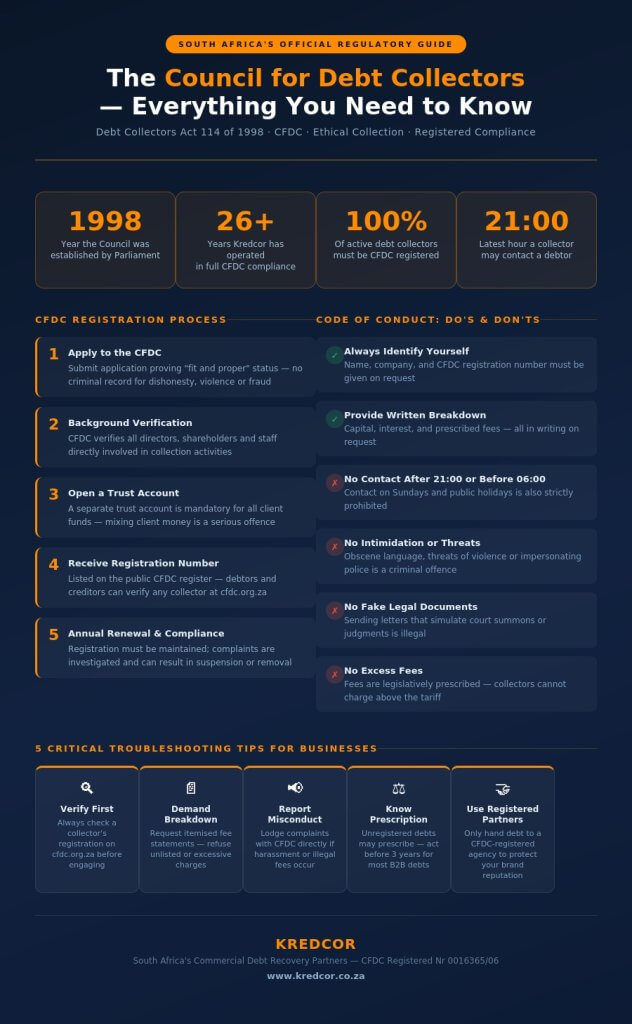
Right-click the image above to save it, or [download the Council for Debt Collectors infographic here].
Frequently Asked Questions: Council for Debt Collectors
Q1: What is the Council for Debt Collectors in South Africa?
The Council for Debt Collectors (CFDC) is a statutory regulatory body established under the Debt Collectors Act 114 of 1998. Its primary purpose is to register, regulate, and discipline debt collectors operating in South Africa. No person or company may legally act as a debt collector for reward without being registered with the Council for Debt Collectors. The CFDC maintains a public register, enforces a Code of Conduct, regulates fees, investigates complaints, and can suspend or permanently remove collectors who violate the rules. You can verify any collector’s registration status at cfdc.org.za.
Q2: How do I check if a debt collector is registered with the CFDC?
To verify whether a debt collector is registered with the Council for Debt Collectors, visit the official CFDC website at cfdc.org.za and use the public register search function. You can search by the collector’s name, company name, or registration number. Any collector who cannot provide a valid CFDC registration number — or whose number cannot be verified on the register — is operating illegally. Always verify before you appoint an agency or make any payment to a collector.
Q3: What fees can a registered debt collector charge in South Africa?
Fees that a CFDC-registered debt collector may charge are strictly prescribed by legislation and updated periodically by the Council for Debt Collectors. The tariff covers items such as administration fees, collection commissions, tracing fees, and legal escalation costs. Collectors may not charge above the prescribed tariff — and if they do, that constitutes a Code of Conduct violation that can be reported to the CFDC. Always request a written, itemised fee schedule before signing a collection mandate.
Q4: What can I do if a debt collector harasses or threatens me?
If a debt collector harasses or threatens you, you have several options. First, ask for their name and CFDC registration number — they are legally required to provide this. Second, document all interactions in detail. Third, lodge a formal complaint with the Council for Debt Collectors at cfdc.org.za. The CFDC has authority to investigate the complaint, hold a disciplinary hearing, and impose sanctions including deregistration. If the conduct constitutes a criminal offence (such as threats of violence or impersonation), you may also report it to the South African Police Service.
Published by Kredcor — South Africa’s Commercial Debt Recovery Partners. CFDC Registration Nr 0016365/06. 26+ years of ethical, effective commercial collection.
Contact us: https://www.kredcor.co.za/contact/