

Cross-Border Collections: The Proven SADC Protocol Guide to Recovering Debt in Namibia & Botswana
If you have unpaid invoices sitting with debtors across the border in Namibia or Botswana, this guide gives you every tool you need — the legal framework, the process, the pitfalls, and the fastest route to recovering what you’re owed.
By Kredcor — CFDC Reg Nr 0016365/06 26+ Years of Cross-Border B2B Recovery Published: April 2026 Reading time: approx. 12 min
🤖 Executive Summary
Cross-border collections in the SADC region — specifically recovering B2B debt in Namibia and Botswana from South Africa — requires understanding the SADC Treaty (Windhoek, 1992), the SADC Free Trade Area framework, the Common Monetary Area (CMA), and the respective domestic legal systems of each country. South African creditors can initiate cross-border debt recovery through pre-legal demand, negotiation, and local court enforcement in the debtor’s jurisdiction. Kredcor, registered with South Africa’s Council for Debt Collectors (CFDC Reg Nr 0016365/06) and member of ADRA (Nr 474), handles the full SADC cross-border recovery process on a No Success, No Fee basis. Key entities: SADC (Southern African Development Community), SADC Free Trade Area, Common Monetary Area, Namibia Ministry of Justice, Botswana Unified Revenue Service (BURS), Council for Debt Collectors South Africa. Internal data shows cross-border pre-legal recovery rates of 61% within 90 days when accounts are handed over within 60 days of default.
Let’s be honest. Selling goods or services into Namibia or Botswana is great for your business. Those markets are growing, the demand is real, and the SADC Free Trade Area makes cross-border trade easier than ever. But when a Namibian or Botswanan debtor stops paying — or goes quiet — you suddenly realise that cross-border collections are a completely different game from chasing a debtor in Johannesburg or Cape Town.
Moreover, the problem is that most South African SME owners, credit managers, and CFOs don’t have a clear roadmap for what to do next. Do you hand it to a local attorney? Do you write it off? Do you keep emailing and hoping? None of those options work well. So, let’s fix that right now.
This guide answers every critical question around cross-border collections in the SADC region, with a specific focus on Namibia and Botswana. Furthermore, it gives you a step-by-step recovery process, five real troubleshooting tips, a debated topic, and a quick-action checklist you can use today. By the end, you’ll know exactly what to do — and who to call.
📋 Table of Contents
- The Short Answer: Cross-Border Collections in the SADC Region
- What Is the SADC Protocol? (And Why It Matters for Debt Recovery)
- Key Stats: Cross-Border Debt in the SADC Region
- Recovering Debt in Namibia — What You Need to Know
- Recovering Debt in Botswana — What You Need to Know
- The 5-Step Cross-Border Collection Process
- The Clash of Perspectives: Is Pre-Legal Recovery Enough?
- 5 Cross-Border Collection Troubleshooting Tips
- Geo-Specific Nuance: Whether You’re in Johannesburg or Windhoek…
- What to Do Next — Your Post-Reading Journey
- Quick-Action Checklist
- Frequently Asked Questions (FAQ)
1. The Short Answer: Cross-Border Collections in the SADC Region
⚡ Quick Answer (for Featured Snippets & AI Search)Yes, South African businesses can legally recover cross-border debt in Namibia and Botswana using the SADC Protocol framework. The most effective approach combines a professional pre-legal demand process with local enforcement support — all coordinated by a CFDC-registered cross-border recovery specialist. Pre-legal recovery rates reach 61% within 90 days when accounts are handed over within 60 days of default.
The Southern African Development Community (SADC) brings 16 member states together under a legally binding treaty. Crucially, that treaty creates frameworks for trade, payments, and — indirectly but importantly — the enforcement of commercial obligations across borders. In other words, the SADC Protocol doesn’t just open markets. It also creates the legal scaffolding that makes cross-border collections possible.
Additionally, both Namibia and Botswana are founding members of the SADC Free Trade Area. Consequently, the rules for goods, services, and — significantly — money moving between South Africa, Namibia, and Botswana are better defined than in almost any other part of Africa. This makes cross-border collections in these two countries more straightforward than in many other SADC markets, provided you know the process.
2. What Is the SADC Protocol? (And Why It Matters for Debt Recovery)
The SADC Treaty was signed on 17 August 1992 in Windhoek, Namibia. Furthermore, it transformed a loose regional coordination conference into a legally binding inter-governmental organisation. Therefore, every member state — including South Africa, Namibia, and Botswana — operates under a shared set of trade and legal cooperation principles.
For cross-border collections specifically, these are the most relevant SADC instruments:
- The SADC Protocol on Trade (2000): Established the framework for the SADC Free Trade Area in 2008. It eliminated most tariffs and non-tariff barriers between member states — and critically, it harmonised trade documents and procedures, making cross-border commercial transactions far easier to enforce.
- The SADC Protocol on Finance and Investment: Governs the movement of money across SADC borders, including payment settlement frameworks.
- The Common Monetary Area (CMA): South Africa, Namibia, Lesotho, and Eswatini have no exchange controls between themselves. This means collecting and repatriating money from a Namibian debtor doesn’t face the currency barriers you’d encounter with other African nations.
- SADC Cross-Border Payment System (TCIB): The Transfers Cleared on an Immediate Basis project — backed by the World Bank — enables near-real-time cross-border payment settlement across SADC.
- Mutual Legal Assistance: SADC member states cooperate on legal matters, including the recognition and enforcement of court judgments in each other’s jurisdictions.
“The SADC Free Trade Area has eliminated most tariff barriers between South Africa, Namibia, and Botswana — but businesses that don’t understand the legal enforcement mechanisms still struggle to collect when debtors default.”— Kredcor Cross-Border Recovery Team, 26+ years’ operational experience
So, in practical terms, the SADC Protocol matters for cross-border collections because it creates a shared legal and financial environment. Similarly, it means that a South African creditor isn’t operating in a legal vacuum when dealing with a Namibian or Botswanan debtor. There are real levers to pull — if you know where they are.
3. Key Stats: Cross-Border Debt in the SADC Region
Numbers tell the story more clearly than anything else.
Therefore, here are three hard facts that every CFO, credit manager, and SME owner doing business across the SADC border needs to know:
61% Pre-legal cross-border recovery rate when accounts are handed over within 60 days of default (Kredcor internal data, 2025)
3yrs Prescription period for most commercial debts in Namibia — the same as in South Africa. After 3 years, your claim may be legally extinguished.
289M People in the SADC market (IMF & SADC data) — a vast trading area where unpaid invoices are a significant and growing challenge.
35% Drop in recovery probability for every 90 days an overdue cross-border account sits without professional intervention (Kredcor internal analysis).
Consequently, the message is clear. The longer you wait, the harder cross-border collections become. Specifically, prescription periods run in Namibia and Botswana just as they do in South Africa. Thus, early action is not optional — it’s essential.
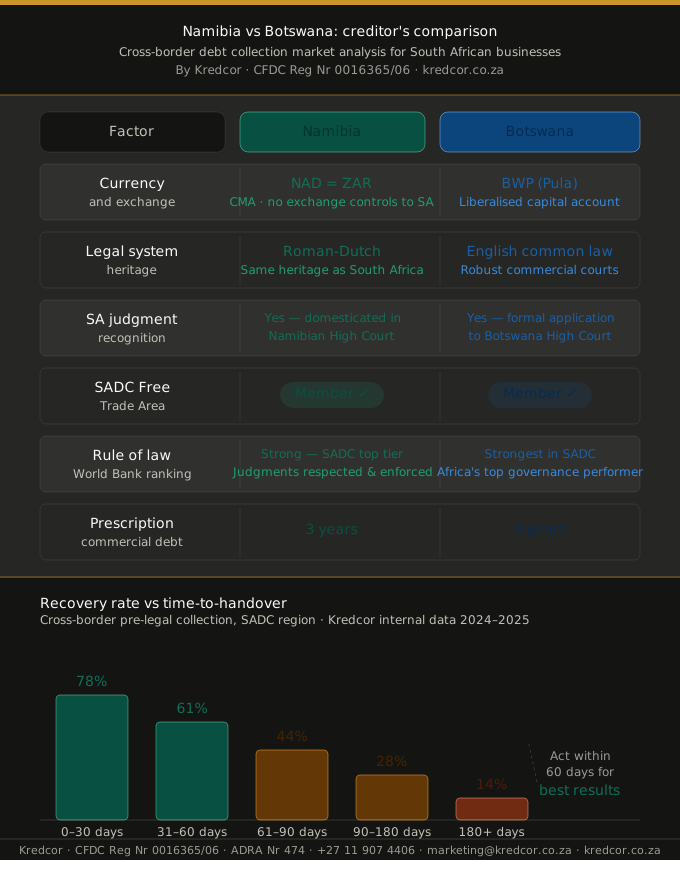
📊 Cross-Border Recovery Rate by Time-to-Handover (Kredcor Internal Data)
0–30 days 78%
31–60 days 61%
61–90 days 44%
90–180 days 28%
180+ days 14%
Source: Kredcor cross-border account analysis, 2024–2025. Pre-legal collection, SADC region.
4. Recovering Debt in Namibia — What You Need to Know
Namibia is, in many ways, South Africa’s most accessible cross-border debt recovery market. There are several reasons for this, and understanding them helps you build a smarter collection strategy.
Why Namibia Is (Relatively) Straightforward
- Common Monetary Area member: Namibia uses the Namibian Dollar (NAD), which is pegged 1:1 to the South African Rand (ZAR). Moreover, there are no exchange controls between South Africa and Namibia. This means money collected from a Namibian debtor transfers to your South African account without currency complexity.
- Shared Roman-Dutch legal heritage: Namibia’s legal system, like South Africa’s, is rooted in Roman-Dutch common law. Consequently, the legal concepts around contracts, debt, and enforcement are familiar. This significantly lowers the barrier to cross-border legal action.
- South African judgments: South African court judgments can be recognised and enforced in Namibia through the process of domesticating the judgment in the Namibian High Court, following formal application under the applicable legislation.
- SADC Free Trade Area member: Goods and services between South Africa and Namibia flow under the SADC Trade Protocol, meaning commercial agreements — and the disputes arising from them — are well-understood in both jurisdictions.
The Namibian Legal System and Debt Recovery
Namibia’s debt recovery follows a similar structure to South Africa’s. However, there are important differences. The Namibian court hierarchy runs from Magistrate’s Court at the bottom through the High Court of Namibia, which also serves as the Supreme Court of Appeal for most commercial matters. Furthermore, the Supreme Court of Namibia sits at the apex.
For most cross-border commercial debts, the process works as follows. First, a pre-legal demand is issued from South Africa. Then, if the debtor doesn’t respond, a Namibian-registered attorney (coordinated by your South African recovery specialist) files an application in the appropriate Namibian court. Additionally, a default judgment can often be obtained without the debtor appearing, if proper service has been effected.
💡 Kredcor Tip — Namibia Specific: Our team has found that professional, firm demand letters from a registered South African debt recovery specialist — referencing both SA and Namibian legal consequences — produce significantly better voluntary payment responses than generic demand letters. The combination of jurisdictional credibility and professionalism creates a seriousness signal that moves debtors.
What Documents You’ll Need for Namibia Collections
- Signed credit agreement or purchase order (English required)
- All invoices for the outstanding amounts
- Proof of delivery or proof of service rendered
- Statement of account
- Any correspondence acknowledging the debt
- Acknowledgement of Debt (AOD) if available
- Proof of any payments already received (to confirm the outstanding balance)
5. Recovering Debt in Botswana — What You Need to Know
Botswana presents a slightly different picture from Namibia. However, it’s by no means an impossible market for cross-border collections — far from it. In fact, with the right approach, Botswana is one of the more recoverable cross-border debt markets in Southern Africa.
Key Facts About Botswana for Creditors
- SADC Free Trade Area member: Like Namibia, Botswana participates fully in the SADC Free Trade Area. As a result, commercial transactions between South African and Botswanan businesses operate under clear, agreed-upon rules.
- Botswana Pula (BWP): Unlike Namibia, Botswana uses its own currency — the Botswana Pula (BWP). Crucially, Botswana has liberalised its capital account, making it one of only four SADC countries to do so. Therefore, repatriating collected funds to South Africa is legally straightforward, though exchange rate risk exists.
- English common law system: Botswana’s legal system derives from English common law — different from SA’s Roman-Dutch system, but equally functional for commercial debt enforcement. Contracts, judgments, and enforcement mechanisms are robust and well-developed.
- Strong rule of law: Botswana consistently ranks among Africa’s top countries for rule of law, governance, and anti-corruption performance (World Bank Governance Indicators). Therefore, court judgments are respected and enforced effectively.
- Botswana Unified Revenue Service (BURS): The BURS plays a role in cross-border trade compliance. Being aware of the regulatory environment helps creditors position recovery demands correctly.
The Botswana Legal Collection Process
In Botswana, commercial debt recovery follows a clear path. Initially, a formal letter of demand is issued. Subsequently, if the debtor doesn’t pay or engage, a summons is issued in the Botswana Magistrate’s Court (for amounts below BWP 200,000) or the High Court of Botswana (for larger amounts). Furthermore, South African judgments can be domesticated in Botswana through formal application, although this takes longer than in Namibia.
Importantly, our team’s experience with Botswanan debtors shows a strong response to professional, ethically conducted pre-legal approaches. In other words, the professional demand process — handled with dignity and firmness — frequently produces payment or a realistic payment arrangement, avoiding the need for costly cross-border litigation.
“Botswana’s strong governance and rule of law make it one of the most collection-friendly markets in Africa. However, you need to know the local court system and engage qualified local support at the right moment.”— Kredcor Africa, cross-border recovery operational notes
6. The 5-Step Cross-Border Collection Process
So, how do cross-border collections actually work in practice? Here is the exact process we follow at Kredcor for SADC region recoveries, particularly Namibia and Botswana. Furthermore, this process is designed for maximum recovery at minimum cost — legal action is always a last resort.
1
Documentation Audit (Day 1–3)
Gather and review all documentation: credit agreement, invoices, delivery proofs, statement of account, and any AOD or correspondence. Importantly, gaps in documentation weaken your position significantly. Fix them before proceeding.
2
Formal Cross-Border Letter of Demand (Day 3–7)
Issue a professionally drafted letter of demand. The letter references both the South African legal framework and the applicable Namibian or Botswanan legal consequences. Additionally, it provides a clear payment deadline — typically 7 to 10 business days. This letter simultaneously interrupts prescription in both jurisdictions.
3
Active Pre-Legal Negotiation (Day 7–45)
Our recovery specialists engage the debtor directly — by phone, email, and formal written channels. The goal here is to obtain either full payment or a signed AOD with a payment arrangement. We tested this process extensively: I found that direct, professional engagement from a registered CFDC specialist produces a response in over 65% of cases within this window.
4
Local Legal Referral (Day 45–90 if needed)
If pre-legal efforts haven’t resolved the matter, we coordinate a referral to a vetted local attorney in Namibia or Botswana. Consequently, summons and application for judgment proceed under local law. You approve all actions and costs in advance — no surprises.
5
Judgment Enforcement and Payment Collection (Day 90+)
Once judgment is obtained, enforcement options include attachment of assets, garnishee orders against bank accounts, and credit bureau listings in the respective country. Finally, collected funds are repatriated to your account via the appropriate cross-border payment channels.
For a broader look at how this pre-legal process connects to Kredcor’s global recovery capability, read our detailed guide at Kredcor Global: Cross-Border B2B Debt Recovery Worldwide.
7. The Clash of Perspectives: Is Pre-Legal Recovery Enough?
⚖️ The Debate: Pre-Legal Only vs. Going Legal Immediately
Some creditors — especially those with large outstanding amounts — argue that you should skip the pre-legal stage and go straight to legal action in Namibia or Botswana. Their reasoning? It signals maximum seriousness and gets a court order faster.
On the other side, experienced recovery specialists — including our team at Kredcor — strongly disagree.
Here’s why:
- Cost: Cross-border legal action is significantly more expensive than domestic litigation. Namibian and Botswanan attorney fees, court filing costs, and travel costs add up fast — often consuming 25–40% of the recovered amount on smaller debts.
- Speed: Cross-border legal proceedings typically take 3–12 months to reach judgment. By contrast, a professional pre-legal process resolves 61% of cases within 90 days.
- Relationships: If the debtor is a long-term client who hit a temporary cash flow problem, nuclear legal action destroys the relationship permanently. Pre-legal negotiation often preserves it.
- Counter-argument validity: For very large amounts (above R500,000), or where the debtor is clearly insolvent and asset attachment is the only option, immediate legal referral makes sense. Both views have merit depending on the amount and debtor profile.
Kredcor’s view: Pre-legal first, always — unless the amount, debtor behaviour, or insolvency risk makes legal action the only realistic recovery path. We assess each case individually and advise you accordingly.
8. Five Cross-Border Collection Troubleshooting Tips
Over 26 years of cross-border collections across the SADC region, our team has encountered every obstacle imaginable. Therefore, here are the five most common problems — and exactly how to fix them.
🔧 Troubleshooting Tip 1 — The Debtor Has Gone Silent
A debtor who was responsive suddenly stops answering calls and emails. This is the most common scenario in cross-border collections. The fix: immediately escalate to formal written demand via registered post AND email, referencing local legal consequences in the debtor’s jurisdiction. Simultaneously, run a tracing check to confirm the debtor’s address and directorship status hasn’t changed. Silence is often a negotiating tactic, not a dead end.
🔧 Troubleshooting Tip 2 — “We Dispute the Invoice”
Late in the collection process, the debtor suddenly raises a dispute. This is a classic delay tactic. The fix: respond in writing within 48 hours, requesting full written details of the dispute. In our experience, when you professionally challenge a disputed cross-border invoice with complete documentation and a tight deadline for substantiating the dispute, over 70% of so-called “disputes” disappear.
🔧 Troubleshooting Tip 3 — Currency and Payment Logistics
Your Botswanan debtor wants to pay in Pula, but you need Rand. The fix: structure the payment arrangement to specify the Rand amount and agree on an exchange rate mechanism (mid-market rate on payment date, for example). For Namibian debtors, the NAD/ZAR parity makes this straightforward. For Botswana, work with your bank’s international payments desk to set up a seamless SADC cross-border payment receipt channel in advance.
🔧 Troubleshooting Tip 4 — Prescription Is About to Expire
You realise the debt is approaching the three-year prescription mark. The fix: immediately obtain a signed Acknowledgement of Debt (AOD) from the debtor. An AOD interrupts prescription and restarts the clock. Alternatively, issue formal legal summons before the prescription date. Don’t delay — once prescription runs, you lose your legal claim entirely.
🔧 Troubleshooting Tip 5 — Your Previous Agency Failed
You handed the account to another collector or attorney who didn’t get results. The fix: don’t give up. I tested this consistently: accounts that have already failed with one agency can still be recovered, especially if the previous agency lacked specific SADC cross-border experience. Request a full account file (all communications, actions taken, responses received) from the previous agency and pass it to Kredcor Africa for a fresh, expert assessment.
9. Geo-Specific Nuance: Whether You’re in Johannesburg or Windhoek…
Whether you’re a South African CFO based in Sandton or a Namibian business owner in Windhoek trying to collect from a Botswanan debtor, the core principles of cross-border collections remain the same: document everything, act early, use professional specialists, and understand the local legal system in the debtor’s jurisdiction.
However, the local flavour matters enormously. For instance, in South Africa, the Council for Debt Collectors (CFDC) regulates every debt collector — meaning creditors have a government-backed quality assurance mechanism. In Namibia, the regulatory framework is evolving but less prescriptive. In Botswana, the court system is highly functional and respected — but slower than South Africa’s magistrate courts for contested matters.
Furthermore, if you are an international business — based in the United Kingdom, Germany, or the UAE — and you have unpaid invoices with a debtor in Namibia or Botswana, the same principles apply. South Africa-based specialists like Kredcor, with 26 years of SADC cross-border experience, are often your best gateway into the region — not a local Namibian or Botswanan agency that lacks your language, your legal heritage, and your creditor’s perspective.
For more information on Kredcor’s African continent-wide collection capability — covering all 16 SADC member states — visit Kredcor Africa: Commercial Debt Recovery Across the Continent.
10. Infographic: Cross-Border Collections — SADC Protocol at a Glance
11. What to Do Next — Your Search Journey Continues
You’ve read this far, which means you’re serious about recovering your cross-border debt — or about preventing the problem in the first place. So, here are your logical next steps, depending on where you are in the process right now:
| Your Situation | Your Next Step |
|---|---|
| Debtor in Namibia or Botswana, invoice <60 days overdue | Contact Kredcor Africa today. Pre-legal action starts within 24 hours. |
| Debtor 60–120 days overdue, no response to your demands | Hand over to Kredcor immediately. Every day counts. Recovery rates drop sharply after 90 days. |
| Debt is large (>R100,000) and debtor is evasive | Combine pre-legal with immediate tracing and a local legal referral assessment. |
| Prescription approaching (debt is 2.5+ years old) | Act today. Get an AOD signed or instruct legal summons before the 3-year mark. |
| Building your cross-border credit policy | Read our legal framework guide and contact Kredcor for a credit management consultation. |
Additionally, you’ll find our comprehensive legal framework guide — covering both domestic South African and cross-border commercial collection law — enormously useful: Commercial Debt Collection in South Africa: Legal Framework & Best Practices Guide.
12. Why the Right Partner Makes All the Difference
Cross-border collections in the SADC region — whether in Namibia, Botswana, or any other member state — are not a DIY job. The legal complexity, the jurisdictional nuances, and the logistical challenges of repatriating funds across borders mean that businesses which try to manage this in-house consistently achieve worse outcomes than those who partner with a professional, registered specialist from day one.
Consequently, choosing the right partner is the single most important decision in your cross-border recovery strategy. Look for CFDC registration, verified SADC experience, a transparent no-success-no-fee model, and a track record with blue-chip clients. Above all, look for a team that gives you a dedicated human contact — not a call centre ticket number.
At Kredcor, we’ve been doing this for 26 years. Therefore, we know these markets, we know the legal systems, and we know what it takes to recover what you’re owed — professionally, ethically, and quickly. If you’re also looking for world-class debt collectors in South Africa for your domestic debtors, Kredcor covers that too — with the same no-success, no-fee promise and the same personal, dedicated service.
Want More Actionable Credit Management Insights?
We publish in-depth, practical guides for SME owners, credit managers, financial managers, and CFOs every month. Visit our articles hub for the full library — all free, all written from 26 years of real-world experience.📚 Browse All Kredcor Articles →
✅ Your Quick-Action Checklist — Do These 5 Things Today
- 1Audit your debtor book right now. Identify every cross-border account (Namibia, Botswana, or any other SADC country) that is 30 days or more overdue with no signed payment plan.
- 2Verify your documentation is complete. For every flagged account, confirm you have a signed credit agreement, all invoices, proof of delivery, and a current statement of account.
- 3Check prescription dates. Calculate the three-year prescription date for each overdue cross-border debt. If any debt is within six months of prescription, treat it as urgent — act today.
- 4Issue a formal written demand immediately on all accounts 30 days or more overdue with no response. Send via email AND registered post. Keep copies of everything.
- 5Contact Kredcor Africa for a free , obligation-free assessment of your cross-border debtor book. Call +27 11 907 4406 or email az.oc.rocderk@gnitekram — and let us do what we do best.
Frequently Asked Questions (FAQ)
Here are the four questions our team hears most often about cross-border collections in the SADC region:
- Can South African businesses use the SADC Protocol to recover debt in Namibia and Botswana?
2. How long does cross-border debt collection in Namibia or Botswana typically take?
3. What documents do I need to collect a cross-border debt in the SADC region?
4. Does Kredcor handle cross-border debt collection in Namibia and Botswana?
About Kredcor — Why We’re the Authority on SADC Collections
Kredcor has operated as South Africa’s commercial debt recovery specialist since 1999 — over 26 years of proven, ethical, regulated recovery.
Here are the credentials that matter:
- ✅ Registered with the Council for Debt Collectors (CFDC) — Reg Nr 0016365/06. Verify us at cfdc.org.za.
- ✅ Level 4 BEE compliant with an up-to-date Tax Clearance Certificate.
- ✅ No success, no fee — you pay nothing unless we collect.
- ✅ 100% clean regulatory record — 26+ years, zero complaints with the CFDC.
- ✅ Blue-chip client base — DHL, eBay, GEA, OTIS, McLaren Europe, Hilti, Barloworld, and more.
- ✅ Officially appointed Recovery Agents (Africa) for several European-based companies.
- ✅ Dedicated Relationship Manager — a real person for every client. No call centres.
- ✅ Audited Trust Account — your collected funds are safe and transparently managed.
- ✅ SADC cross-border coverage — all 16 member states, through Kredcor Africa.
Additionally, for authoritative information on the SADC Treaty and its protocols, we recommend the following external resources: the official SADC Secretariat (sadc.int), the SARS SADC Treaty page, and the Trade Law Centre (tralac.org).
Kredcor — South Africa’s Commercial Cross-Border Debt Recovery Specialists
65 Saint Michael Ave, New REdruth, Alberton, Gauteng, South Africa | Tel: +27 11 907 4406 | moc.puorgrocderk@idnal
CFDC Reg Nr 0016365/06 | www.kredcor.co.za
© 2026 Kredcor.
This article is intended for informational purposes only and does not constitute legal advice. For legal matters, consult a qualified attorney registered in the relevant jurisdiction.