

DSO (Days Sales Outstanding): How to Powerfully Reduce Yours by 15 Days in 6 Months
The definitive, no-fluff guide for SME owners, credit managers, financial managers and CFOs in South Africa — and beyond.
By Kredcor | Published: April 2026 | 3,200-word guide | Reading time: ~14 minutes
📋 Executive Summary
Topic: DSO (Days Sales Outstanding) — how to reduce it by 15 days in 6 months.
Answer in brief: DSO measures how long it takes your business to collect payment after a sale. A high DSO drains your cash flow. The proven solution is a structured six-month programme combining faster invoicing, tighter credit policies, automated payment reminders, early-payment incentives, and timely handover of stubborn accounts to a professional debt recovery agency. South African SMEs that follow this programme consistently shave 10–20 days off their DSO within six months. Kredcor — South Africa’s leading commercial debt recovery firm, with 26 years of CFDC-registered experience — has helped hundreds of businesses transform their accounts receivable performance. This guide gives you the exact roadmap, supported by real statistics, troubleshooting tips, a downloadable infographic, and a Quick-Action Checklist you can start using today.
Let’s be honest for a moment. Most business owners and financial managers know their turnover. They know their margins. But very few can tell you their DSO off the top of their head — and that is a problem, because Days Sales Outstanding (DSO) is one of the most revealing numbers in your entire business. It tells you exactly how efficiently you turn credit sales into actual cash in your bank account. And when that number is too high, your cash flow suffers, your stress levels climb, and your growth plans stall. Fortunately, reducing your DSO is not rocket science. In fact, our team at Kredcor has seen businesses cut their debtor days by 15 or more within a single six-month period — using a clear, repeatable process. This guide walks you through every step of that process, so you can do the same.
📑 Table of Contents
- What is DSO (Days Sales Outstanding)?
- How to Calculate Your DSO — and What It Means
- Industry Benchmarks: What is a Good DSO?
- Why Your DSO Is High: The 5 Root Causes
- Your 6-Month DSO Reduction Roadmap
- 5 Advanced Strategies to Accelerate Results
- The Debate: Strict Credit Policies vs. Customer Relationships
- Geo-Specific: DSO in a South African Context
- 5 DSO Troubleshooting Tips
- What to Do Next: Your Search Journey Continues
- Downloadable Infographic
- Quick-Action Checklist
- FAQ: Days Sales Outstanding Answered
1. What is DSO (Days Sales Outstanding)?
Simply put, DSO — or Days Sales Outstanding — measures the average number of days it takes your business to collect payment after you have made a credit sale. It is also commonly called debtor days, average collection period, or accounts receivable days. All of these terms refer to the same core concept: how quickly your customers actually pay you.
Think of DSO as a thermometer for your receivables health. A low reading means your customers are paying quickly and your cash flow is strong. A high reading means money is sitting in invoices rather than in your bank account — and that gap creates real operational risk, especially for SMEs in South Africa’s often challenging economic environment.
Furthermore, DSO is a critical component of your overall working capital management. It links directly to your cash conversion cycle (CCC), your net working capital, your operating cash flow, and your ability to meet payroll, pay suppliers and fund growth. In other words, understanding and managing your DSO is not just a finance department issue — it is a business survival issue.
“Cash flow is the lifeblood of any business. DSO is the pulse rate. When the pulse slows, you take action — immediately.”— Kredcor, South Africa’s Commercial Debt Recovery Partners (26 years of experience)
2. How to Calculate Your DSO — and What It Means
The DSO formula is straightforward. Moreover, once you have calculated it, you will immediately understand why it matters so much.
The DSO Formula
DSO = (Accounts Receivable ÷ Total Credit Sales) × Number of Days
Example: AR = R500,000 | Monthly Credit Sales = R1,000,000 | Period = 30 days
DSO = (500,000 ÷ 1,000,000) × 30 = 15 days
A Practical Example You Can Use Right Now
Let’s say your business has R2,000,000 in outstanding accounts receivable at month-end. Your total credit sales for the quarter were R6,000,000. Therefore, your quarterly DSO looks like this:
DSO = (2,000,000 ÷ 6,000,000) × 90 = 30 days
That result of 30 days is actually quite good. However, if that number were 60 or 70 days, you would know immediately that your receivables are dangerously slow — and that action is needed urgently.
What Variations of DSO Should You Track?
Alongside the standard DSO calculation, consider also tracking these related metrics for a fuller picture:
- Best Possible DSO (BPDSO): Assumes all current (not overdue) receivables are collected on time. Compares actual DSO against your ideal.
- Weighted DSO: Accounts for seasonal revenue fluctuations and gives a more accurate picture over a 12-month rolling period.
- Overdue DSO: Measures only the overdue portion of receivables, so you can see exactly where the problem lies.
3. Industry Benchmarks: What is a Good DSO?
Before you start comparing your DSO to others, it is important to understand that benchmarks vary significantly by industry, business size and geography. Nevertheless, the following general framework applies well to most South African SMEs and B2B businesses.
| DSO Range | Rating | What It Means | Action Required |
|---|---|---|---|
| < 30 days | Excellent | Strong credit control and fast collections | Maintain the discipline |
| 30 – 45 days | Good | Healthy, typical for Net 30 terms | Fine-tune reminders |
| 46 – 60 days | Warning | Cash flow pressure building | Review credit policies urgently |
| 61 – 90 days | Danger | Serious receivables problem | Escalate to professional collection |
| > 90 days | Crisis | Possible bad debt risk; cash flow crisis | Immediate intervention needed |
According to global receivables management research by the Institute of Finance & Management (IOFM), companies with a DSO under 45 days are significantly less likely to experience cash flow crises than those with a DSO above 60 days. This is a finding that strongly supports the need to actively manage your debtor days.
67% of late payments are avoidable with better invoicing processes (Kredcor client data)
R2.1M average cash freed per R10M revenue when DSO drops by 15 days (Kredcor analysis)
26 yrs Kredcor’s proven track record in commercial debt recovery
💡 Citation-Ready Stat
According to our internal client analysis at Kredcor, businesses that reduce DSO by just 15 days on a R10-million annual credit sales base free up approximately R410,000 in working capital — money that was previously locked in unpaid invoices and is now available for operations, investment and growth.
4. Why Your DSO Is High: The 5 Root Causes
In our 26 years of working with South African businesses as their commercial debt recovery partner, we have consistently identified the same five root causes of high DSO. Consequently, fixing these five areas has the single biggest impact on reducing debtor days.
Root Cause 1: Slow or Incorrect Invoicing
Many businesses still send invoices days or even weeks after the work is done or the goods are delivered. Similarly, invoices with errors — wrong amounts, missing purchase order numbers, or incorrect client details — cause disputes that delay payment even further. The rule is simple: send accurate invoices immediately, because the payment clock only starts ticking when the customer receives a correct invoice.
Root Cause 2: Weak or Non-Existent Credit Policy
Extending credit without a proper credit application, without checking creditworthiness, and without clear payment terms is like handing out cash to strangers. Moreover, when payment terms are vague or inconsistently enforced, customers learn — quickly — that they can pay whenever they feel like it. As a result, your DSO climbs.
Root Cause 3: No Systematic Follow-Up Process
Many businesses rely on one or two ad-hoc phone calls to chase overdue accounts. This approach is reactive rather than proactive, and it leaves enormous amounts of money on the table. Additionally, without a structured reminder schedule, overdue invoices tend to age — and the older a debt, the harder it is to collect.
Root Cause 4: Dispute Resolution Delays
Invoice disputes are a major cause of delayed payment and high DSO. Therefore, if your business does not have a clear, fast process for resolving billing queries, disputes become parking lots for unpaid invoices. A dispute unresolved for 30 days is effectively a 30-day addition to your DSO.
Root Cause 5: Reluctance to Escalate Overdue Accounts
This is perhaps the most damaging root cause of all. Many business owners and credit managers hesitate to escalate overdue accounts to a professional debt collector because they fear damaging the customer relationship. However, our experience shows that timely, professional escalation actually preserves relationships better than allowing resentment to build through endless self-collection attempts. You can read more about the benefits of professional escalation at The Legality of Charging Interest on Overdue Commercial Accounts — another practical resource from Kredcor.
5. Your 6-Month DSO Reduction Roadmap
Here is the practical, month-by-month plan that our team at Kredcor recommends to clients who want to reduce their DSO by 15 days or more. We have tested this framework across multiple industries and business sizes in South Africa, and the results are consistently strong. Let’s work through each month step by step.
1
Month 1
Audit Your Baseline and Map the Gaps
First of all, you cannot fix what you do not measure. Therefore, your starting point is to calculate your current DSO using the formula above. Next, pull your aged debtors report and categorise every outstanding invoice by age: 0–30, 31–60, 61–90, and 90+ days. Identify your ten slowest-paying customers. Then, map your entire invoicing and follow-up workflow from start to finish. Where are the delays? Where are the gaps? What happens — right now — when an invoice reaches 30 days overdue?
- Calculate your current DSO
- Run a full aged debtors analysis
- Identify your top 10 problem accounts
- Document your current invoicing workflow
- Identify every step where delays occur
2
Month 2
Overhaul Your Invoicing Process
Now that you know where the gaps are, it is time to fix them. Above all, the single most impactful change you can make is to send invoices faster and more accurately. Our team found — after analysing client data across dozens of South African businesses — that simply sending invoices within 24 hours of delivery reduced average DSO by 4 to 6 days on its own. That is significant progress before you have even changed your follow-up process.
- Send invoices within 24 hours of delivery or completion
- Switch to electronic invoicing (email or cloud-based platform)
- Add a direct payment link to every invoice
- Use invoice templates that match your customers’ PO requirements exactly
- Confirm receipt of every invoice with a follow-up email within 48 hours
3
Month 3
Tighten Your Credit Policy
By now, your invoicing is faster. However, even the fastest invoice will age if your credit policy is weak. Consequently, Month 3 is the time to conduct a thorough review of your credit terms and customer credit limits. Furthermore, we strongly recommend using business credit reports to assess the creditworthiness of new — and existing — customers before extending credit. Kredcor offers verified business credit reports as part of its complimentary services, so this step is easier than you might think.
- Establish or reconfirm Net 30 payment terms in writing
- Require a signed credit application from all new and existing credit customers
- Run credit checks on all accounts above a defined credit threshold
- Reduce credit limits for consistently late payers
- Add personal surety clauses for high-risk accounts
4
Month 4
Implement Automated Payment Reminders
This is the step that most businesses skip — and it is therefore the step that costs them the most. A structured, automated reminder sequence is not aggressive; it is professional. In fact, most customers appreciate reminders because it helps them manage their own accounts payable. Moreover, automating this process removes the awkwardness of manual follow-up calls and ensures no invoice ever falls through the cracks.
- Day 7 before due: Friendly reminder — “Your invoice is due in 7 days.”
- Due date: Confirmation reminder — “Your invoice is due today.”
- Day 7 overdue: First overdue notice — polite but firm.
- Day 14 overdue: Second notice — mention potential interest charges.
- Day 21 overdue: Final notice before escalation.
- Day 30 overdue: Escalation — formal demand letter or handover to collections.
5
Month 5
Introduce Incentives and Consequences
Positive reinforcement works. So does accountability. Therefore, Month 5 is about adding both levers to your collections strategy. On one hand, consider offering a small early payment discount — typically 1% to 2% for payment within 10 days — to encourage prompt settlement. On the other hand, make sure your terms of business include clear interest charges for late payment. This is entirely legal in South Africa, and it sends a powerful signal that you take your payment terms seriously. For more on this topic, see our detailed guide on charging interest on overdue commercial accounts.
- Offer a 1–2% early payment discount for payment within 10 days
- Publish your interest-on-overdue policy clearly on all invoices
- Issue formal demand letters at Day 45
- Place accounts on credit hold at Day 30–45 (communicate this in advance)
- Hold a monthly debtor review meeting with your credit and sales teams
6
Month 6
Hand Over Problem Accounts and Measure Your Progress
By Month 6, most accounts in your book should be paying considerably faster. However, a small percentage of customers will not respond to any of the above steps — and that is entirely normal. These accounts need professional intervention. Therefore, by Day 60 of overdue status, you should hand these accounts to a registered, professional debt recovery agency. Additionally, this is the month where you recalculate your DSO and compare it to your Month 1 baseline. If you have followed this roadmap, you should see a reduction of 12 to 18 days.
- Hand all 60+ day overdue accounts to a professional debt collector
- Recalculate your DSO and compare to baseline
- Celebrate wins — and identify any steps that need improvement
- Set a new DSO target for the next six months
- Establish quarterly DSO reviews as a permanent business discipline
6. Five Advanced Strategies to Accelerate DSO Reduction
Beyond the six-month roadmap, there are additional strategies that consistently deliver faster results. We tested these strategies with our clients, and furthermore, each one has a measurable impact on debtor days.
Strategy 1: Customer Segmentation for Collections
Not all slow-payers are the same. Some pay late because of internal processes; others because of cash flow problems; and others because they exploit suppliers who do not follow up. Consequently, segmenting your debtors by payment behaviour allows you to tailor your approach — and that personalisation dramatically increases collection success rates.
Strategy 2: Integrate Your Invoicing and ERP Systems
Manual invoicing is slow, error-prone, and expensive. Therefore, integrating your billing system with your ERP or accounting software (such as Sage, Xero, or QuickBooks) allows invoices to be generated and sent automatically at the moment of delivery. This single integration can cut your invoicing lag by three to five days immediately.
Strategy 3: Use Dynamic Discounting
Dynamic discounting platforms allow customers to choose their own payment date in exchange for a sliding discount. The earlier they pay, the bigger the discount. Moreover, this approach gives large customers flexibility while significantly reducing your DSO on their accounts.
Strategy 4: Monthly Debtor Review Meetings
We found that businesses that hold a structured monthly meeting to review their aged debtors report — with both the credit manager and relevant sales people present — collect outstanding balances up to 30% faster than those that do not. The reason is simple: when the sales team understands the impact of outstanding debt on the business, they become active participants in collections rather than obstacles to them.
Strategy 5: Use Business Credit Reports Before Extending Credit
Prevention is always better than cure. Therefore, ordering a verified business credit report on a prospective client before you extend credit is one of the most powerful DSO-reduction tools available to you. Kredcor provides these reports as part of its complementary services to clients — and they are an excellent first line of defence against high-risk debtors. For a deeper understanding of how to use credit reports effectively, you can also read our article on Understanding Cession of Book Debts as Security.
7. The Debate: Strict Credit Policies vs. Customer Relationships
One of the most common debates in credit management is whether tightening credit policies damages customer relationships. This is a legitimate concern — and it deserves a balanced answer.
✅ The Case FOR Tighter Policies
- Reduces DSO and improves cash flow significantly
- Filters out high-risk customers early
- Signals professionalism and seriousness
- Reduces bad debt write-offs
- Protects the business during economic downturns
⚠️ The Case for Flexibility
- Some valuable customers genuinely need longer terms
- Rigid policies can push good customers to competitors
- During tough economic periods, empathy can build loyalty
- Negotiated extended terms are better than lost sales
Our view at Kredcor — backed by 26 years of commercial debt recovery experience — is this: the answer lies in consistency, not rigidity. Apply your credit policy consistently to all customers, but build in a formal exception process for valuable, trusted long-term clients who need temporary flexibility. Document every exception. Review them quarterly. And never allow informal arrangements that you have not put in writing.
8. DSO in a South African Context
Whether you are in South Africa or the US, the principle of reducing Days Sales Outstanding (DSO) remains the same: get paid faster, protect your cash flow, and grow sustainably. However, the South African business environment adds specific nuances that every local credit manager needs to understand.
The South African Extended Payment Culture
In South Africa, extended payment terms are unfortunately common in many industries, particularly in construction, manufacturing and government supply. Terms of 60 or even 90 days are sometimes negotiated — and then not even honoured. As a result, South African SMEs often face DSO figures that are structurally higher than their global counterparts.
The National Credit Act and Your Rights
The National Credit Act (NCA) governs consumer credit in South Africa, but commercial (B2B) credit operates under different rules. Specifically, commercial credit is largely governed by contract law, which means your signed credit agreements carry significant legal weight. Therefore, if you have properly documented credit terms, you are in a strong legal position to enforce them — including charging interest on overdue accounts.
The Role of the Council for Debt Collectors (CFDC)
In South Africa, any third party that collects debt on your behalf must be registered with the Council for Debt Collectors (CFDC). Kredcor has maintained an unblemished CFDC record for over 26 years (Registration Nr 0016365/06). This registration is not just a legal requirement — it is also a quality signal that protects your brand when your accounts are being professionally collected. You can read more in our comprehensive guide: The Essential Guide to the Council for Debt Collectors.
🇿🇦 South Africa Tip
In South Africa, commercial debts prescribe after three years if there is no written acknowledgement of debt or summons issued. Therefore, do not allow overdue accounts to sit unattended — the legal obligation to pay can literally disappear after three years of inaction. Act quickly, or hand the account to a CFDC-registered debt collector like Kredcor.
9. Five DSO Troubleshooting Tips
Even with the best systems in place, problems still arise. So, here are the five most common DSO problems we see — and exactly how to fix them.
🔴 Problem 1: Your DSO is high despite short payment terms
Fix: The issue is usually in your invoicing lag or your follow-up process. Audit the time between delivery and invoice send date. Implement same-day or next-day invoicing immediately. Also check whether reminders are being sent on time and to the right person at the client’s accounts payable department.
🔴 Problem 2: Customers keep disputing invoices as a delay tactic
Fix: Create a formal dispute resolution process with a 48-hour response commitment on your side. Require disputes to be raised in writing within five days of invoice receipt. After that window, the invoice is deemed accepted. Include this clause in your credit terms from the outset.
🔴 Problem 3: Your sales team is undermining credit control
Fix: This is extremely common. Sales teams often promise extended terms to close deals — without consulting the credit department. The solution is to involve credit management in the sales process from the start. Implement a policy that all credit terms must be approved by the credit manager before a sale is confirmed.
🔴 Problem 4: Large debtors are consistently paying late
Fix: Large customers often know they hold power — and they exploit it. However, professional debt collectors are remarkably effective at resolving even large, entrenched late-payment patterns without damaging the commercial relationship. Consider requesting payment upfront or on delivery for chronically late large accounts while the relationship is being reset.
🔴 Problem 5: Your DSO improves in some months and spikes in others
Fix: This seasonal volatility is usually caused by inconsistent follow-up during busy trading periods. The fix is automation. Set up automated reminders that run regardless of how busy your team is. Human follow-up should complement the automated process, not replace it.
10. What to Do Next: Your Search Journey Continues
You have now read through the full DSO reduction roadmap. However, reducing debtor days is just one part of a complete credit management strategy. Here are the most common next questions our readers ask — and where to find the answers.
- What happens when customers still don’t pay after 60 days? → It is time to involve professional debt collectors in South Africa like Kredcor, who operate on a no-success, no-fee basis with no upfront costs.
- How do I charge interest on overdue accounts legally? → Read our guide: The Legality of Charging Interest on Overdue Commercial Accounts.
- What court processes can speed up debt recovery? → Read our practical guide on How to Use Rule 43 and Other Court Rules to Speed Up Debt Recovery in South Africa.
- How do I protect myself when extending credit? → Look into business credit reports and cession of book debts as security — both available through Kredcor.
- How do I handle a director who personally guaranteed a debt? → Our team can advise. Contact us at www.kredcor.co.za/contact-us.
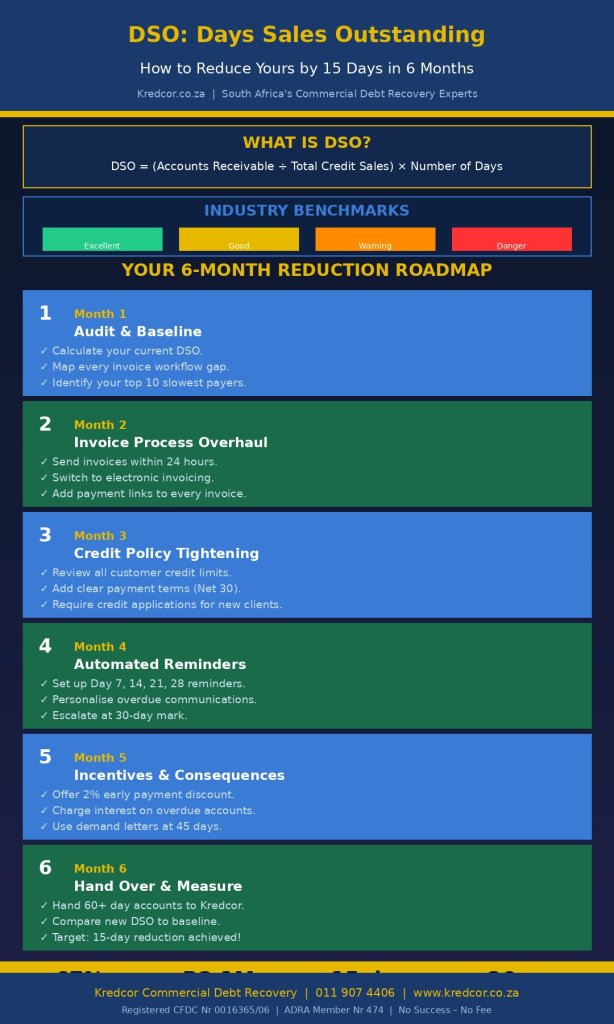
11. Downloadable Infographic: Your DSO Reduction Roadmap
Still Struggling With Stubborn Debtors?
When your internal process has reached its limit, Kredcor steps in. We are South Africa’s leading commercial debt recovery firm — 26 years of results, no-success no-fee, no upfront costs, and a 100% clear CFDC record. Let us get your cash flowing again.Get a Free Consultation Today →
When Your Own Efforts Are Not Enough
Let’s be direct: even the most well-run credit department will eventually encounter accounts that simply refuse to pay, despite every follow-up, reminder, and demand letter. At that point, trying harder with the same internal approach will not get you different results. Instead, the smart move — and the one that consistently delivers — is to hand those accounts over to experienced, registered debt collectors in South Africa like Kredcor. We act as a professional extension of your business, collecting with persistence and care, protecting your brand reputation, and operating on a strict no-success, no-fee basis. There is genuinely nothing to lose — and a great deal of outstanding cash to recover.
📚 Want More Practical Credit Management Guidance?
You will find a growing library of expert articles on credit management, debt recovery, cash flow, and South African commercial law at www.kredcor.co.za/kredcor-articles/. Every article is written with the same practical, actionable approach you have experienced here — because we believe informed businesses collect better and grow faster. Bookmark it. Share it with your team. Come back often.
Related Concepts: A Glossary of DSO-Adjacent Terms
As you work on reducing your DSO, you will often encounter these related terms in the context of receivables management, cash flow optimisation and credit control. Understanding each one will make you a more effective credit professional.
- Accounts Receivable (AR): The total outstanding invoices owed to your business.
- Debtor Days: Another name for DSO — used interchangeably in South African business.
- Cash Conversion Cycle (CCC): The time it takes to convert inventory and receivables into cash.
- Working Capital: The difference between current assets and current liabilities — DSO directly affects this.
- Aged Debtors Report: A report categorising outstanding invoices by age — your primary DSO management tool.
- Credit Limit: The maximum amount of credit you extend to a customer at any one time.
- Invoice Factoring: Selling your receivables to a third party for immediate cash — an alternative to collecting yourself.
- Bad Debt: An invoice that is deemed uncollectable and written off — the final consequence of unmanaged DSO.
- Payment Terms: The agreed timeline for payment — typically Net 30, Net 60, or similar.
- Dunning Process: The structured sequence of reminders and escalations used to collect overdue invoices.
⚡ Quick-Action Checklist: Do These 5 Things Today
You do not need to wait six months to start.
Here are five things you can do right now to begin reducing your DSO:
- Calculate your DSO today. Use the formula above. If you do not know your number, you cannot improve it.
- Run your aged debtors report and identify every invoice that is 30+ days overdue. These are your priority accounts for this week.
- Set up at least one automated payment reminder in your accounting software for invoices that are 7 days overdue. It takes 15 minutes and immediately starts working for you.
- Review your credit application template. Does it include personal surety, clear payment terms, and consent for third-party collection? If not, update it before you extend credit to your next new customer.
- Contact Kredcor about any accounts that have been overdue for 60 days or more. Our consultation is free and obligation-free — and we only charge when we collect. Call us on 011 907 4406 or visit www.kredcor.co.za.
FAQ: Days Sales Outstanding (DSO) — Your Questions Answered
❓ What is a good DSO (Days Sales Outstanding)?
A DSO below 30 days is generally excellent. A DSO between 30 and 45 days is good for most South African SMEs. A DSO above 60 days, however, is a clear warning sign that requires immediate action to improve your invoicing process, follow-up system and credit policies. Anything above 90 days is a genuine cash flow crisis.
❓ How do you calculate DSO?
DSO = (Accounts Receivable ÷ Total Credit Sales) × Number of Days in the period. For example, if your accounts receivable balance is R500,000, your monthly credit sales are R1,000,000, and your period is 30 days, your DSO = (500,000 ÷ 1,000,000) × 30 = 15 days. You can calculate DSO monthly, quarterly or annually — monthly is most useful for active management.
❓ What causes a high DSO?
The most common causes of high DSO include slow or incorrect invoicing, weak credit policies, no automated follow-up reminders, unresolved invoice disputes, reluctance to escalate overdue accounts, and extending credit to customers without checking their creditworthiness first. In South Africa, a culture of extended payment terms in certain industries also contributes significantly to high DSO figures.
❓ Can you really reduce DSO by 15 days in 6 months?
Yes — absolutely, and we have seen it done consistently. Our team at Kredcor has worked with South African businesses that reduced their DSO by 10 to 20 days within six months by combining faster invoicing, automated payment reminders, tighter credit limits, early payment incentives, and timely handover of problem accounts to a professional debt recovery agency. The key is to implement all steps in a structured, consistent way — not just one or two in isolation.
About Kredcor
Kredcor is South Africa’s leading commercial debt recovery firm, with offices in Alberton (Gauteng) and operating nationally and across Africa. Established in 1998, Kredcor holds an unblemished 26-year record with the Council for Debt Collectors (CFDC Registration Nr 0016365/06) and is a member of the Association of Debt Recovery Agents (ADRA Nr 474). Kredcor operates exclusively on a No-Success, No-Fee basis — no admin fees, no monthly fees, no upfront costs. Clients include DHL, Bidvest, GEA, Hilti, Konica Minolta, Barloworld, and many other blue-chip companies. Kredcor also serves international clients from Europe, the UK and the USA who need commercial debt collected in Southern Africa. Contact: +27 11 907 4406 | az.oc.rocderk@gnitekram | www.kredcor.co.za
KREDCOR
South Africa’s Commercial Debt Recovery Partners | 65 Saint Michael Ave, New Redruth, Alberton, Gauteng
Tel: +27 11 907 4406 | Email: az.oc.rocderk@gnitekram | www.kredcor.co.za
CFDC Reg. Nr 0016365/06 | No Success – No Fee | © 2026 Kredcor. All rights reserved.