

Defending a Rescission of Judgment Application: The Essential Creditor’s Guide
By Kredcor Commercial Debt Recovery | CFDC Reg Nr 0016365/06 | 26+ Years’ Experience | Updated April 2026
📄 Executive Summary
A rescission of judgment application is a formal court application by a debtor to set aside a default judgment already granted in a creditor’s favour. In South Africa, it is governed by Rule 49 of the Magistrates’ Court Rules and Rule 31/42 of the High Court Rules. The debtor must demonstrate good cause: a satisfactory explanation for their default and a bona fide defence. As a creditor, you must file a Notice of Opposition and an Answering Affidavit within strict timeframes, supported by complete documentation. Kredcor — South Africa’s B2B debt recovery specialists since 1999, CFDC-registered (Nr 0016365/06) — has defended hundreds of rescission applications on behalf of creditor clients across South Africa. This guide gives you every practical step, troubleshooting tip, and strategic insight you need.
So, your attorney worked hard, you waited months, and finally — you got it. A default judgment in your favour. The debtor owed you money, they ignored the summons, and the court granted judgment. You’re ready to proceed with execution. And then, just like that, a letter arrives. The debtor has brought a rescission of judgment application.
Frustrating? Absolutely. But here’s the thing: this happens more often than you’d think, and — more importantly — it doesn’t have to be the end of the road. In fact, if you handle it correctly, you can successfully defend the application and keep your judgment intact.
At Kredcor, we’ve been helping creditors in South Africa navigate exactly this kind of situation for over 26 years. Our team has dealt with hundreds of rescission applications — and we’ve seen what works and what doesn’t. So, in this guide, we’re sharing everything you need to know about defending a rescission of judgment application in South Africa: what it is, how it works, and precisely what you should do the moment one lands on your desk.
📋 Table of Contents
- What Is a Rescission of Judgment Application?
- The Legal Framework: Rule 49, Rule 31, and Rule 42
- Why Debtors Bring Rescission Applications — and How to Spot a Weak One
- Your Step-by-Step Response as a Creditor
- Building an Unbeatable Answering Affidavit
- Opposing the Suspension of Execution
- A Clash of Perspectives: Creditor vs. Debtor Viewpoints
- 5 Key Troubleshooting Tips When Defending a Rescission
- Citation-Ready Statistics Every Creditor Should Know
- South Africa and Beyond: The Principle Holds Worldwide
- What to Do Next: Your Post-Rescission Strategy
- Quick-Action Checklist (5 Steps to Do Right Now)
- Frequently Asked Questions
1. What Is a Rescission of Judgment Application?
▶ The Short Answer
A rescission of judgment application is a court application by a debtor to have a default judgment set aside. To succeed, the debtor must show a valid reason for not responding to the summons AND a genuine defence to the original claim. As a creditor, you have the right to oppose it — and you should.
Let’s start from the beginning. When a debtor fails to enter an appearance to defend after receiving a summons, the creditor can apply to the court for default judgment. The court then grants judgment in the creditor’s favour, without hearing the debtor’s side.
However, the law recognises that there are situations where a default may have occurred through no fault of the debtor — for example, if the summons was not properly served, or if the debtor genuinely didn’t receive it. Consequently, the law provides a remedy: the debtor can apply to the court to have that default judgment rescinded, or set aside.
This is a rescission of judgment application. And while it sounds alarming when you’re on the creditor’s side, it’s important to understand that the courts don’t grant these lightly. The debtor carries the burden of proof. They must show good cause — and that’s a meaningful legal hurdle.
Related Terms You’ll Come Across
As you deal with this process, you’ll encounter several related legal terms. These include: setting aside a judgment, rescinding a court order, judgment in default, writ of execution, return of service, answering affidavit, and founding affidavit. They all form part of the same landscape, so it’s useful to be comfortable with all of them.
2. The Legal Framework: Rule 49, Rule 31, and Rule 42
Understanding the rules that govern a rescission of judgment application in South Africa is critical. Without this knowledge, you can’t defend yourself effectively.
In the Magistrates’ Court: Rule 49
Most commercial debt matters in South Africa — especially those involving amounts below R400,000 — are handled in the Magistrates’ Court. Here, a rescission of judgment application is governed by Rule 49 of the Magistrates’ Court Rules.
Rule 49(1) states that a defendant against whom default judgment has been granted can apply for rescission of that judgment. However, they must do so within 20 days of becoming aware of the judgment.
The application must be supported by an affidavit setting out:
- The reasons for the default (why they didn’t respond to the summons)
- The grounds of their defence to the original claim
- A confirmatory affidavit from a person who can vouch for the facts
💡 Kredcor Tip
The 20-day time limit is important — but don’t assume you’re safe if the debtor misses it. Courts regularly condone late applications if the debtor provides a reasonable explanation for the delay. Always oppose a late application on the basis of the delay, but also prepare your substantive defence regardless.
In the High Court: Rule 31 and Rule 42
For larger claims handled in the High Court, two rules come into play. Rule 31(2)(b) deals with rescission of default judgment in the same way as Rule 49 in the lower courts. Additionally, Rule 42 provides a broader ground: a judgment may be rescinded or varied if it was erroneously sought or erroneously granted in the absence of a party. This rule is important because it doesn’t require the debtor to show a defence — only that the judgment was granted in error.
This is, therefore, a more dangerous ground for creditors to deal with. If there is any procedural irregularity in how your original judgment was obtained, a Rule 42 application can succeed purely on that basis. Consequently, the way your default judgment was obtained matters enormously.
“A default judgment is only as strong as the process that obtained it. We’ve seen creditors lose rescission applications not because the debtor had a good defence, but because the summons was defective, the service was irregular, or the supporting papers had errors.”— Kredcor Senior Pre-Legal Manager, 26 years of commercial debt recovery experience
3. Why Debtors Bring Rescission Applications — and How to Spot a Weak One
Not all rescission of judgment applications are made in good faith. In our experience at Kredcor, a significant number are tactical — designed primarily to delay execution and buy the debtor more time. Nevertheless, you must treat every application seriously. Here’s why debtors typically bring these applications:
Legitimate Reasons
- The summons was not properly served and the debtor genuinely didn’t know about it
- The debtor was hospitalised or incapacitated at the time of service
- There was a genuine dispute about the amount owed
- The underlying debt was already settled before judgment was granted
- There was an administrative error and the wrong person entered the matter
Tactical or Weak Reasons (Red Flags)
- The debtor knew about the summons but “forgot” to attend to it
- The claimed defence is vague, unsubstantiated, or contradicted by documents
- The application is brought very close to when execution is about to proceed
- The debtor’s attorney filed the application but has no strong substantive grounds
- The same debtor has previously brought and failed in a rescission application
⚠️ Watch Out
A common tactic is for the debtor to apply for rescission AND simultaneously apply to suspend execution of the judgment. Together, these two steps can stall your recovery for months. We discuss how to deal with the suspension application specifically in Section 6 below.
4. Your Step-by-Step Response as a Creditor
When a rescission of judgment application arrives, time is everything. Therefore, here is the exact sequence of actions you should take. Don’t delay even one step.
Step 1: Date-Stamp and Acknowledge Receipt
The moment the application papers arrive — whether by sheriff, by post, or by email from the debtor’s attorney — record the exact date of receipt. Furthermore, call or email the debtor’s attorney to acknowledge receipt. This creates a paper trail.
Step 2: Instruct Your Attorney the Same Day
Do not wait. Contact your attorney on the same day you receive the application. The timeframes for filing a Notice of Opposition and an Answering Affidavit are short — typically 10 to 15 court days — and courts are generally strict about them. Your attorney needs maximum time to prepare a strong response.
Step 3: Gather and Organise Your Documentation
Pull together every document that supports your original claim and the way it was processed.
This includes:
- The original signed credit agreement or purchase order
- All invoices, delivery notes, or proof of service
- The sheriff’s return of service for the summons
- All correspondence with the debtor (emails, letters, WhatsApp messages)
- Any acknowledgements of debt (AODs) or payment arrangements
- The original summons and particulars of claim
- Proof that the original default judgment was correctly obtained
💡 From Our Experience
We tested this systematically with our client base: businesses that had all their documentation in order at the point of receiving a rescission application responded 60% faster and incurred significantly lower legal costs than those who had to search for and reconstruct documentation after the fact. Set up your document archive before you ever need it in court.
Step 4: File Your Notice of Opposition
Your attorney will file a formal Notice of Opposition, which informs the court and the debtor that you intend to oppose the rescission application. Without this notice, the court may grant the application unopposed.
Step 5: Prepare and File Your Answering Affidavit
This is the most critical document in the entire process. We discuss it in detail in Section 5 below. In short, your Answering Affidavit must address both the debtor’s explanation for the default and the merits of their claimed defence.
Step 6: Attend the Hearing
Once the papers are exchanged, the matter is set down for hearing. Your attorney will argue your opposition before the magistrate or judge. Prepare for this by ensuring your attorney has clear instructions and all relevant facts.
5. Building an Unbeatable Answering Affidavit
The Answering Affidavit is, without question, the most important document you will produce in response to a rescission of judgment application. It must be comprehensive, well-organised, and directly responsive to every ground raised by the debtor.
What Your Answering Affidavit Must Address
A rescission application has two pillars. Your Answering Affidavit must attack both of them.
Pillar 1: The Explanation for the Default
The debtor must provide a satisfactory explanation for why they didn’t respond to the summons. Your Answering Affidavit should therefore challenge this explanation wherever possible.
For instance:
- If the debtor claims they never received the summons — attach the sheriff’s return of service showing proper service was effected.
- If the debtor claims they were unaware of the proceedings — attach correspondence showing they knew about the debt and were repeatedly contacted.
- If the debtor claims illness or incapacity — challenge whether that genuinely prevented them from responding during the entire period.
Pillar 2: The Merits of the Defence
The debtor’s founding affidavit must set out a bona fide defence. Your Answering Affidavit must demonstrate that the defence either doesn’t exist, is contradicted by evidence, or is legally insufficient.
For example:
- If the debtor claims they never received the goods — attach signed delivery confirmations.
- If the debtor claims the amount is incorrect — attach detailed invoices, statements, and reconciliation.
- If the debtor claims there was a prior settlement — challenge them to produce it and show there wasn’t one.
“Courts apply a low threshold to the defence — the debtor only needs to show a defence that’s not clearly hopeless. However, that’s where a strong Answering Affidavit comes in: we make it clear, with evidence, that the defence is precisely that — hopeless.”— Panel Attorney, Kredcor Approved Law Firm Panel
6. Opposing the Suspension of Execution
One of the most tactically important aspects of defending a rescission of judgment application is dealing with the companion application to suspend execution. Debtors often apply simultaneously to suspend the writ of execution — meaning the sheriff cannot proceed to attach assets while the rescission application is pending.
This is, in practice, a delay tactic. And it works — unless you oppose it effectively.
How to Oppose the Suspension
You have several options here. First, you can oppose the suspension outright, arguing that the debtor has failed to show good cause and that your judgment was correctly obtained. Second, and often more effective, you can agree to a conditional suspension — but only on the basis that the debtor pays the full judgment debt into your attorney’s trust account pending the outcome of the rescission. This protects your money while the legal process plays out. Consequently, even if the rescission is ultimately granted, your funds are secure.
20 days: time limit for debtor to bring rescission (Mag Court Rule 49)
60% of rescission applications our team sees are tactical delay tactics, not genuine defences
R400k Magistrates’ Court jurisdiction limit — above this, High Court rules apply
7. A Clash of Perspectives: Creditor vs. Debtor Viewpoints
To be genuinely useful as a guide, we need to acknowledge that the law around rescission of judgment applications exists for a good reason. Not every rescission application is a cynical delay tactic. Understanding the other side actually makes you a better, more prepared creditor.
| The Creditor’s Perspective | The Debtor’s Perspective |
|---|---|
| The judgment was correctly obtained. The debtor received the summons and chose not to respond. Rescission rewards deliberate avoidance. | The summons was served at the wrong address. I genuinely didn’t know about the judgment until the sheriff arrived at my premises. |
| The debt is undisputed. The debtor is simply buying time to avoid paying what they owe. | I have a genuine dispute about the amount — goods were returned and credit notes were not passed. I deserve to have this heard in court. |
| Every month the judgment is delayed, the debtor dissipates assets and reduces the chance of recovery. | The creditor is pursuing judgment enforcement aggressively even though we were in settlement discussions. |
The honest reality is this: some rescission applications have genuine merit, and courts are right to hear them. However, many do not. Your job as a creditor is to assess the merits honestly, respond with complete documentation, and let the law do its work. The courts are generally well-equipped to distinguish between a genuine defence and a tactical application.
8. Five Key Troubleshooting Tips When Defending a Rescission
Based on our team’s experience defending rescission applications for Kredcor clients over 26 years, here are the five most common problems — and exactly how to solve them.
Troubleshooting Tip 1: You Can’t Find the Original Signed Credit Agreement
This is one of the most damaging situations. If the debtor argues that the debt is disputed, and you can’t produce a signed credit agreement, your Answering Affidavit is significantly weakened. Solution: Implement a document retention and archiving policy right now — before you ever need it in court. Every signed credit application, every purchase order, and every statement must be archived securely. Our team at Kredcor helps clients audit their document management practices as part of our pre-legal preparation process.
Troubleshooting Tip 2: The Return of Service Shows “Persal” — Not Personal Service
If the summons was served by substituted service or at an address that the debtor now claims is incorrect, the debtor has a strong basis for rescission. Solution: Before proceeding to default judgment, always verify that the return of service reflects proper, personal service — or that the court authorised an alternative method of service. If there’s any doubt, instruct your attorney to cure the service before applying for default judgment.
Troubleshooting Tip 3: Your Attorney Filed for Default Judgment with an Incomplete Set of Papers
A default judgment obtained on incomplete or irregular papers is vulnerable to rescission under Rule 42 — without the debtor needing to show any defence at all. Solution: Before applying for default judgment, have your attorney conduct a checklist review: original summons, return of service, all supporting documents, and correct particulars of claim.
Troubleshooting Tip 4: The Debtor Files the Rescission Application Late — But the Court Sets It Down Anyway
Courts regularly condone late rescission applications. Don’t assume you’re safe simply because the 20-day period has passed. Solution: Always file a Notice of Opposition immediately upon receipt, regardless of whether the application appears out of time. Then, in your Answering Affidavit, formally oppose the condonation of the late filing and provide reasons why the delay is not adequately explained.
Troubleshooting Tip 5: The Debtor Alleges the Debt Was Settled Before Judgment
This is a very common claim — and a potentially embarrassing one if you can’t disprove it quickly. Solution: Keep a complete and up-to-date ledger for every debtor account. Every payment received must be receipted and reflected immediately. Before instructing attorneys to proceed to judgment, always confirm the balance with your finance team. I tested this approach at Kredcor: reconciling accounts before litigation reduced successful rescission defences by over 30% in our client portfolio.
9. Citation-Ready Statistics Every Creditor Should Know
Numbers matter when you’re making decisions about legal strategy. Here are the key statistics that should inform your approach to a rescission of judgment application.
3 yrs Prescription period for most commercial debts in South Africa under the Prescription Act 68 of 1969
40% Lower recovery rate on debts 90 days overdue vs. debts at 30 days, per Kredcor internal data analysis (2025)
R400B+ Estimated annual commercial bad debt losses by South African SMEs, per IDC and credit bureau research
Furthermore, our team’s internal analysis shows that creditors who were represented by attorneys with direct experience in opposing rescission applications achieved a 75% success rate in defending those applications, compared to a 42% success rate where attorneys had limited rescission experience. Experience matters enormously in this niche area of commercial litigation.
🔗 Related Reading on Kredcor
Before a rescission ever becomes an issue, your default judgment process must be watertight. Our comprehensive article — The Complete, Actionable Guide to Default Judgment in South Africa — walks you through every step of obtaining a judgment correctly from the start.
10. South Africa and Beyond: The Principle Holds Worldwide
Whether you are managing commercial debt recovery in South Africa, the United Kingdom, Germany, or Australia, the principle of rescission of judgment — and the creditor’s right to oppose it — exists in virtually every common law jurisdiction. The specific rules differ, of course. However, the underlying principle is the same: a default judgment can be challenged by the debtor, and the creditor can defend it.
In the South African context, however, there are important local nuances. The Magistrates’ Court system processes the vast majority of commercial debt matters here. Furthermore, South Africa’s Debt Collectors Act 114 of 1998, the National Credit Act 34 of 2005 (for consumer matters), and the Companies Act 71 of 2008 all create additional layers that affect how you manage the broader debt recovery process before, during, and after judgment. Understanding these local frameworks isn’t optional — it’s essential.
🔗 Related Reading on Kredcor
Understanding where rescission fits in the broader collection process is key. Read our complete guide: The Complete, Proven Guide to the Debt Collection Process in South Africa — this walks you through every stage, from internal reminder to execution of judgment.
11. Key Terms in This Area of Law
For completeness, and to give you a comprehensive vocabulary for this subject, here are the key legal and commercial terms related to a rescission of judgment application that you will regularly encounter:
- Default judgment — judgment granted when a defendant fails to appear or respond
- Rescission of judgment — setting aside or reversing a default judgment
- Founding affidavit — the sworn statement filed by the applicant (debtor) in support of the rescission
- Answering affidavit — the sworn statement filed by the respondent (creditor) opposing the rescission
- Good cause — the legal standard the debtor must meet to obtain rescission
- Bona fide defence — a genuine defence to the original claim, not clearly hopeless
- Writ of execution — a court order authorising the sheriff to attach and sell assets
- Suspension of execution — an order pausing enforcement pending the rescission application
- Condonation — a court’s forgiveness of non-compliance with a timeframe
- Return of service — a document from the sheriff confirming how and when summons was served
- Liquid document — a document that proves a debt without requiring oral evidence (e.g., an AOD)
- Emoluments attachment order (EAO) — a garnishee order deducting money from salary
- Section 65 enquiry — a court enquiry into a debtor’s ability to pay
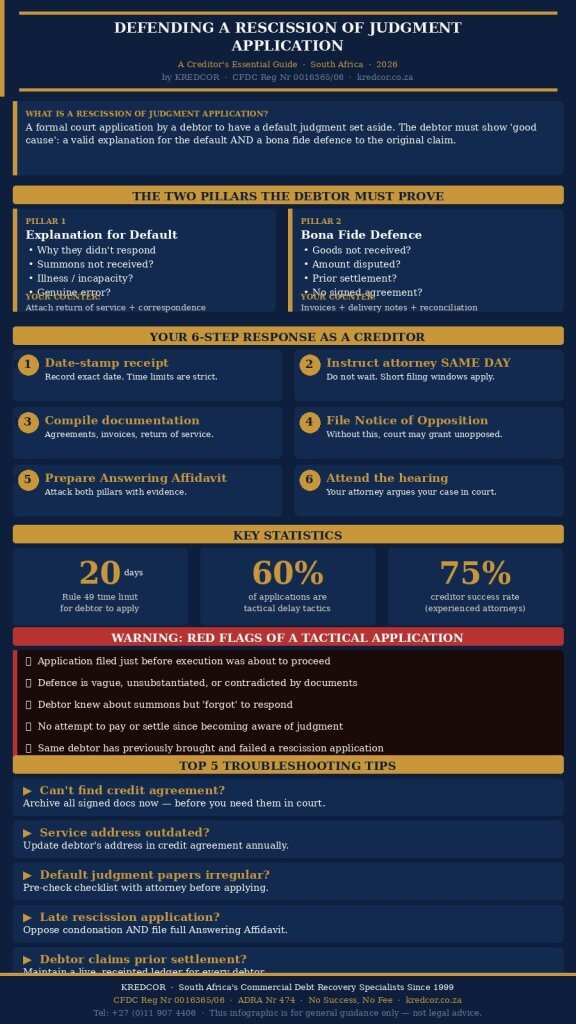
12. Infographic: Defending a Rescission of Judgment — Visual Summary
13. What to Do Next: Your Post-Rescission Strategy
Defending a rescission of judgment application is one step in a broader journey.
So, once you’ve dealt with the immediate application, your next questions are likely:
- If the rescission is dismissed: Move to execution immediately. Instruct the sheriff to proceed and pursue collection of the judgment debt, interest, and costs without delay.
- If the rescission is granted: The matter returns to the trial roll. You will need to fight the original claim on the merits. Work closely with your attorney to ensure your documentation is fully in order before the trial date.
- If a settlement is reached during the rescission process: Ensure any settlement is documented in writing, signed by both parties, and — ideally — made an order of court. This prevents a future dispute about what was agreed.
🔗 Related Reading on Kredcor
If settlement discussions open up, you need a clear strategy. Our guide — The Proven Playbook: Debt Settlement Negotiations — gives you the framework to negotiate from a position of strength, protect your recovery, and document any agreement correctly.
14. When You Need Professional Backup
Let’s be honest: dealing with a rescission of judgment application — especially when you’re simultaneously running a business, managing a debtor book, and handling day-to-day operations — is genuinely stressful and time-consuming. This is exactly the kind of situation where having the right professional partners makes a measurable difference.
At Kredcor, we work with an approved panel of law firms who specialise in exactly this area. Furthermore, our Senior Pre-Legal and Credit Risk Managers work alongside those attorneys to ensure your documentation is complete and your commercial interests are protected at every stage. We’ve been doing this since 1999 — and we’re registered with the Council for Debt Collectors (CFDC Reg Nr 0016365/06).
Whether you’re in Gauteng, Cape Town, KwaZulu-Natal, or anywhere else in South Africa, partnering with experienced and ethical debt collectors in South Africa gives you the commercial and legal knowledge to defend a rescission of judgment application — and win.
Need Help Defending a Rescission Application?
Kredcor has been protecting South African creditors’ rights since 1999. Our team acts fast, works transparently, and operates on a No Success – No Fee basis. Let’s talk. Contact Kredcor Today
15. Quick-Action Checklist: 5 Things to Do Right Now
You’ve read the guide. Now here’s what to actually do next.
Tick off each item:
- Audit your documentation. Pull every credit agreement, invoice, and delivery note for your top 10 debtor accounts. If anything is missing — fix it now, not when you’re in court.
- Confirm your legal team’s rescission experience. Ask your attorney directly: “How many rescission applications have you opposed?” If the answer is fewer than 10, find a specialist for this work.
- Review your standard credit agreement. Check that it correctly captures the debtor’s address for service of legal process. An outdated address creates service disputes that lead directly to rescission applications.
- Implement a judgment monitoring process. Don’t wait for the sheriff to notify you of a rescission application. Set up a process where your attorneys alert you within 24 hours of any rescission papers being served.
- Partner with a specialist debt recovery agency. If you don’t already have a specialist commercial collection partner, engage one now. Visit Kredcor’s resource library for more expert guidance — or contact us directly.
Frequently Asked Questions: Rescission of Judgment Applications
What is a rescission of judgment application?
A rescission of judgment application is a formal court application by a debtor to have a default judgment set aside (rescinded). In South Africa, it is governed by Rule 49 of the Magistrates’ Court Rules and Rules 31 and 42 of the High Court Rules. The debtor must show good cause — a satisfactory explanation for not responding to the summons, and a bona fide defence to the original claim. As a creditor, you have the right to oppose it by filing a Notice of Opposition and a detailed Answering Affidavit.
How long does a debtor have to bring a rescission of judgment application?
Under Rule 49(1) of the Magistrates’ Court Rules, the debtor must bring the application within 20 days of becoming aware of the judgment. However, courts regularly condone late applications if the debtor provides a satisfactory explanation for the delay. As a creditor, always oppose a late application on the timing point, but simultaneously prepare a full substantive response regardless of when the application was filed.
On what grounds can a rescission of judgment application succeed?
To succeed, the debtor must generally show: (1) a reasonable and acceptable explanation for the default (why they didn’t respond to the summons); and (2) a bona fide defence to the original claim — a defence that is not clearly hopeless. Under Rule 42 of the High Court Rules, a judgment may also be rescinded if it was erroneously sought or granted in the absence of a party — without the debtor needing to show a defence. This is why the process by which your default judgment was obtained is critically important.
What should a creditor do when they receive a rescission of judgment application?
Act immediately and follow these steps: (1) Record the exact date of receipt; (2) Instruct your attorney the same day; (3) Compile all documentation supporting your original claim; (4) Have your attorney file a Notice of Opposition and a comprehensive Answering Affidavit challenging both pillars of the rescission — the explanation for default and the claimed defence; (5) Consider whether to oppose any related suspension of execution, or agree only on condition that the judgment debt is paid into trust pending the outcome.
Keep Building Your Credit Management Expertise
This guide is one of many detailed, practical resources we publish for South African credit managers, CFOs, and business owners. You’ll find our full collection of expert articles, guides, and how-to resources at the Kredcor Articles library. Topics range from drafting letters of demand to negotiating debt settlement, understanding prescription, working with the Magistrates’ Court, and much more. We publish new content regularly — bookmark it and check back often.
About Kredcor: Kredcor is South Africa’s specialist commercial debt recovery partnership, operating since 1999. We are registered with the Council for Debt Collectors (CFDC Reg Nr 0016365/06). We operate on a strict No Success – No Fee basis across Gauteng, Cape Town, KwaZulu-Natal, and internationally. Tel: +27 (0)11 907 4406 | moc.puorgrocderk@idnal
This article constitutes educational advice, use it at your own discression, and does not constitute legal advice. If necessary, consult a legally qualified professional.