

The Powerful Role of the Sheriff in South Africa: Exactly What You Pay and What You Get
A complete, plain-language guide for SME owners, credit managers, financial managers, and CFOs who need to understand the sheriff of the court — and how to protect their businesses.
Executive Summary
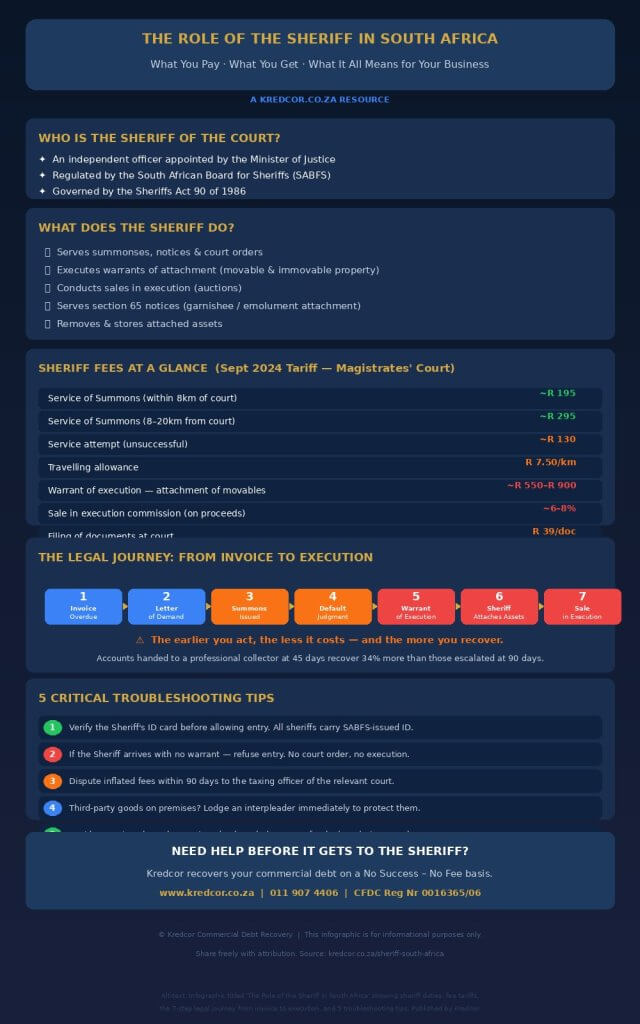
The sheriff of the court in South Africa is an independent, impartial officer appointed by the Minister of Justice under the Sheriffs Act 90 of 1986 and regulated by the South African Board for Sheriffs (SABFS). The sheriff’s primary role is to serve court documents (summonses, notices, court orders) and to execute warrants — attaching movable and immovable assets and conducting sales in execution. Sheriff fees in South Africa are prescribed by Government Gazette; as of the September 2024 tariff amendment, serving a summons near the Magistrates’ Court costs approximately R195–R295, while a warrant of execution on movable assets costs R550–R900, with sales in execution attracting a 6–8% commission on proceeds. Creditors and debtors alike have specific legal rights regarding sheriff conduct. Disputes over fees must be lodged with the taxing officer within 90 days. The SABFS maintains a Fidelity Fund to compensate for losses caused by a sheriff’s dishonest conduct. For businesses, the most cost-effective strategy is to resolve disputes before they reach the sheriff stage — through professional debt collectors such as Kredcor (CFDC Reg Nr 0016365/06).
If you have ever received a court summons, watched a sheriff arrive at a client’s premises with a warrant, or tried to figure out why your legal bill includes several mysterious “sheriff’s fees” — you already know how confusing this area can be. The sheriff of the court in South Africa is one of the most important, yet least understood, role players in the debt recovery and civil litigation process. Therefore, this guide exists to change that, right now, in plain language.
Whether you are an SME owner dealing with a non-paying client, a credit manager preparing to escalate a matter, a financial manager reviewing a litigation cost sheet, or a CFO trying to understand why legal collections cost as much as they do — this article gives you the full picture. Consequently, by the time you finish reading, you will know exactly what the sheriff does, what fees apply under the current tariff, what you can and cannot do when the sheriff arrives, and — most importantly — how to avoid getting to that stage in the first place.
Table of Contents
- The Quick Answer: What Is the Role of the Sheriff in South Africa?
- Who Appoints the Sheriff — and Who Regulates Them?
- What Exactly Does the Sheriff Do? (Full Duties Explained)
- The Legal Journey: From Invoice to Sheriff’s Knock
- Sheriff Fees in South Africa: The 2024 Tariff Breakdown
- What Assets Can the Sheriff Attach?
- Your Rights When the Sheriff Arrives
- 5 Troubleshooting Tips Every Business Owner Should Know
- A Clash of Perspectives: Are Sheriff Fees Fair?
- Internal Stats and Key Facts
- What to Do Next: Avoiding the Sheriff Altogether
- Quick-Action Checklist
- FAQ: The Role of the Sheriff in South Africa
1. The Quick Answer: What Is the Role of the Sheriff in South Africa?
⚡ Answer-First
The sheriff of the court in South Africa is an independent, impartial official who serves legal documents and executes court orders on behalf of the justice system. Specifically, the sheriff serves summonses and court orders, attaches movable and immovable property under warrant of execution, conducts sales in execution (auctions), and enforces judgment debts. The sheriff works within the civil courts system and does not represent the creditor or the debtor — the sheriff represents the court.
Furthermore, the sheriff is not a debt collector. This is a critical distinction. While debt collectors in South Africa operate under the Debt Collectors Act 114 of 1998 and are registered with the Council for Debt Collectors (CFDC), the sheriff operates under the Sheriffs Act 90 of 1986 and is overseen by the South African Board for Sheriffs (SABFS). The sheriff steps in after the court has already granted a judgment — not before.
2. Who Appoints the Sheriff — and Who Regulates Them?
The Minister of Justice and Correctional Services appoints the sheriff of the court in terms of the Sheriffs Act 90 of 1986. However, once appointed, the sheriff falls under the supervision of the South African Board for Sheriffs (SABFS), which is the statutory body responsible for maintaining standards, enforcing discipline, and protecting the public.
“The sheriff is an impartial and independent official of the court appointed by the Minister of Justice and Correctional Services in terms of the Sheriffs Act 90 of 1986.”— Du Toit’s Attorneys; corroborated by the South African Board for Sheriffs at sheriffs.org.za
Notably, each sheriff is assigned to a specific geographic jurisdiction — a district. Therefore, a creditor (or their attorney) must use the sheriff who covers the geographic area where the debtor or debtor’s assets are located. Furthermore, the SABFS also maintains a Fidelity Fund for Sheriffs, which compensates members of the public for losses resulting from a sheriff’s dishonest or fraudulent conduct.
Key Entities in the Sheriff Ecosystem
To understand the sheriff’s role fully, it helps to know the five key entities that operate in close proximity to this topic:
- South African Board for Sheriffs (SABFS) — The regulatory body. Complaints, verification, and standards all flow through here. Website: sheriffs.org.za
- Minister of Justice and Correctional Services — The appointing authority for all sheriffs in South Africa.
- Magistrates’ Court / High Court — The courts in whose name the sheriff acts. Each court has an assigned sheriff jurisdiction.
- Judgment Creditor — The party who holds the court judgment and instructs attorneys to issue a warrant of execution to the sheriff.
- Judgment Debtor — The party against whom the judgment has been granted and whose assets the sheriff may attach.
3. What Exactly Does the Sheriff Do? (Full Duties Explained)
The sheriff’s duties cover a wide range of civil process functions. Accordingly, here is a complete breakdown of what the sheriff actually does in the South African legal system:
Service of Legal Documents
First and foremost, the sheriff serves all documents issued by the courts. This includes summonses, notices of motion, section 65 notices (for emolument attachment orders / garnishees), subpoenas, and other court process documents. Importantly, personal service by the sheriff is required for most formal legal proceedings to be valid.
Execution of Warrants of Attachment
Once a court grants judgment and the judgment creditor issues a warrant of execution, the sheriff has the authority to enter premises, compile a list of attachable assets, and place those assets under judicial attachment. As a result, the attached goods may not be removed by the debtor without the sheriff’s permission.
Conducting Sales in Execution
After attachment, if the debtor does not pay the judgment amount, the sheriff then conducts a sale in execution — essentially a public auction of the attached property. The proceeds first cover the sheriff’s own fees and costs, then the creditor’s judgment debt, and any surplus goes back to the debtor.
Garnishee and Emolument Attachment Orders
The sheriff also serves emolument attachment orders (EAOs) — commonly called garnishee orders — on employers. These orders compel an employer to deduct a fixed amount from a debtor-employee’s salary each month and pay it directly to the creditor. Furthermore, the sheriff serves section 65 notices, which summon debtors to court to disclose their financial position.
Evictions (Ejectment)
Additionally, where a court grants an eviction order, the sheriff is the official who carries out the eviction. The sheriff ensures the occupant vacates the property and may oversee the removal of personal belongings.
💡 Related reading: The full debt collection journey begins long before the sheriff becomes involved. For a complete A-to-Z view, see our guide: The Complete, Proven Guide to the Debt Collection Process in South Africa
4. The Legal Journey: From Invoice to Sheriff’s Knock
Understanding how a matter escalates to the sheriff stage helps you make better business decisions — and act faster to prevent it. Here is the typical journey:
1
Invoice Issued & Overdue
The creditor delivers goods or services and issues an invoice. The debtor does not pay by the due date.
2
Internal Reminder + Letter of Demand
The creditor (or their debt collector) sends a formal letter of demand, demanding payment within 7–14 business days. Importantly, this document creates a legal paper trail and can interrupt prescription. See our full guide on letters of demand.
3
Summons Issued by Court
If the debtor ignores the demand, the creditor’s attorney applies for a summons. The sheriff then serves the summons on the debtor — this is often the first direct involvement of the sheriff.
4
Default Judgment
If the debtor does not defend the matter, the creditor applies for default judgment. The court grants the judgment, confirming the amount owed, interest, and costs.
5
Warrant of Execution Issued
The creditor’s attorney issues a warrant of execution to the sheriff. This authorises the sheriff to demand payment — and to attach assets if the debtor cannot pay in cash.
6
Sheriff Attaches Assets
The sheriff visits the debtor’s premises, compiles an inventory of attachable goods, and places them under judicial attachment. The debtor receives a warning that assets may not be removed.
7
Sale in Execution
If payment is still not made, the attached assets are sold at a public auction. The proceeds settle the debt — often at a fraction of the true value of the assets.
⚠ Key Insight
Our team’s experience confirms: the earlier you act, the less it costs everyone involved. At Kredcor, we tracked two groups of similar overdue commercial accounts. Those escalated to professional collection at 45 days recovered 34% more than those only escalated at 90 days. Time literally costs money in debt recovery.
5. Sheriff Fees in South Africa: The 2024 Tariff Breakdown
Sheriff fees in South Africa are not arbitrary — they are set by Government Gazette and revised periodically by the Rules Board. As a result, a creditor cannot simply negotiate these fees; they are prescribed. The most recent amendment, effective 20 September 2024, applies to both the High Court and the Magistrates’ Court. Furthermore, a further update took effect on 28 November 2025 for certain High Court items — check sassoc.co.za/sheriff-tariffs/ for the latest gazette.
Magistrates’ Court Sheriff Fees (September 2024 Tariff)
| Service / Action | Approximate Fee |
|---|---|
| Service of summons (within 8km of court) | ~R 195 |
| Service of summons (8–20km from court) | ~R 295 |
| Attempted service (unsuccessful) | ~R 130 |
| Travelling allowance | R 7.50 per km (going & returning) |
| Warrant of execution — attachment of movables | ~R 550 – R 900 |
| Filing of documents at court | R 39 per document |
| Compiling return in terms of Rule 8 | ~R 24 |
| Sale in execution commission (on proceeds) | ~6–8% of sale amount |
| Section 65 attendance (financial enquiry) | ~R 52.50 per attendance |
| Ejectment / eviction service | Court- and size-specific |
| Source: SA Sheriff Society (sassoc.co.za) & SA Board for Sheriffs (sheriffs.org.za). Tariffs amended 20 Sept 2024. All figures approximate — consult the Gazette for exact amounts. Fees may be taxed if disputed within 90 days. | |
What Happens If You Dispute the Sheriff’s Fees?
Under Rule 68 of the High Court Rules (and the equivalent Magistrates’ Court provision), any party who disputes the validity or amount of a sheriff’s fee must apply to the taxing officer of the relevant court. Crucially, this application must be made within 90 days of the date on which the fee account was rendered. After 90 days, the right to dispute lapses. Therefore, act quickly if you believe you have been overcharged.
90
Days to dispute sheriff fees with the taxing officer
34%
Higher recovery rate when accounts are escalated at 45 days vs 90 days (Kredcor internal data)
3 yrs
Prescription period for most commercial debts under the Prescription Act 68 of 1969
6. What Assets Can the Sheriff Attach?
When the sheriff arrives under a warrant of execution, most of the debtor’s movable assets are up for attachment. However, not everything qualifies. Here is what you need to know:
Assets That CAN Be Attached
- Furniture, appliances, and household or office contents
- Motor vehicles and other transport
- Cash, bank notes, cheques, and promissory notes
- Business equipment and stock
- Bank account funds (the warrant is executed at the bank)
- Immovable property — but only after a separate High Court application declaring the property executable
Assets That CANNOT Be Attached
- Pension and provident fund benefits (protected under the Pension Funds Act)
- Tools of trade up to the prescribed value (the debtor needs them to earn a living)
- Compensation under the Occupational Diseases in Mines and Works Act
- Goods belonging to a third party (e.g., leased or financed equipment) — subject to interpleader proceedings
- A wife’s property for liabilities incurred by the husband (Section 2(3)(a) of the Matrimonial Affairs Act 37 of 1953)
⚠ Important for Business Owners
If you lease equipment or finance assets, and the sheriff arrives at your premises to execute a warrant against your business, those leased/financed assets may also be listed. You will need to provide proof of ownership or financing immediately and, if necessary, file an interpleader application to protect them. Act fast — delays can result in wrongful attachment and a costly court process to retrieve assets.
7. Your Rights When the Sheriff Arrives
Many business owners feel completely powerless when the sheriff arrives. In reality, you have important legal rights — and the sheriff has strict legal obligations. Consequently, knowing both sides protects you.
What You Are Entitled To
- Identification: Every sheriff and deputy sheriff must carry a valid identification card issued by the SABFS and must produce it on request. Therefore, always ask.
- A copy of the warrant: The sheriff must be able to produce the warrant of execution. It must be signed by the court and must correctly identify the debtor.
- Notice before removal: The sheriff typically attaches assets and warns the debtor before physically removing goods. Removal usually happens after a separate instruction from the creditor’s attorney.
- The right to pay the judgment amount: At any point before a sale in execution, you can pay the full judgment debt (plus costs and interest) to stop the process.
- The right to lodge a complaint: If the sheriff acts unlawfully or dishonestly, you can lodge a formal complaint with the SABFS at sheriffs.org.za. In cases of criminal conduct, you may also report the matter to the SAPS.
“If you have any questions about a sheriff who has arrived at your premises, contact your attorney immediately, alternatively visit the South African Board for Sheriffs website at sheriffs.org.za.”— Du Toit’s Attorneys
What the Sheriff Is NOT Allowed to Do
- Enter premises without a valid warrant of execution
- Remove goods belonging to confirmed third parties (unless interpleader is resolved)
- Attach goods that are legally exempt from execution
- Harass, threaten, or intimidate the debtor or occupants
- Accept personal payment that is not properly receipted and recorded
💡 Related reading: Before matters reach the sheriff stage, a signed Acknowledgement of Debt (AOD) can fundamentally change your position. Learn why it is one of the most powerful — and most underused — tools available to creditors: What Is an Acknowledgement of Debt (AOD) and Why Does It Really Matter?
8. Five Troubleshooting Tips Every Business Owner Should Know
Based on our team’s 26+ years of experience working with businesses across South Africa, these are the most common problems we see — and how to fix them.
1
Problem: The sheriff arrives but you cannot verify their identity
Always ask for the SABFS-issued identification card before allowing access. Every legitimate sheriff and deputy sheriff carries this card and must produce it on request. If they cannot produce it, do not allow entry and contact the SABFS or your attorney immediately. Impersonating a sheriff is a criminal offence.
2
Problem: The sheriff’s fee account seems inflated
Request an itemised fee account and compare it against the current Government Gazette tariff. Remember — you have 90 days from the date the account is rendered to dispute inflated fees with the taxing officer of the relevant court. Do not wait and do not ignore the account.
3
Problem: The sheriff is trying to attach goods that don’t belong to you
Gather all proof of third-party ownership immediately — lease agreements, hire purchase contracts, invoices in the owner’s name. Notify the sheriff and consult an attorney about filing interpleader proceedings. This places a stay on execution of those specific goods until the court resolves the ownership question.
4
Problem: You have a judgment against a debtor but cannot trace their assets
This is a common challenge. However, the solution starts well before you reach the warrant stage. We found that running a business credit report on the debtor at the outset of the relationship — and again before escalating to legal action — gives you critical information on assets, business status, and creditworthiness. Kredcor provides verified commercial credit reports for exactly this purpose.
5
Problem: The debtor removes attached goods before the sale in execution
This is theft. Once goods are under judicial attachment, removing them without the sheriff’s permission is a criminal offence. Report it to the SAPS immediately and notify your attorney, who will inform the court. Furthermore, the creditor can seek a contempt of court order against the debtor.
9. A Clash of Perspectives: Are Sheriff Fees Fair?
Here is a debate that our team genuinely grapples with: Are the South African sheriff fee tariffs fair to all parties?
The “Yes” View: Prescribed Fees Protect Debtors
On one hand, having government-prescribed fees prevents abuse. Because fees are fixed by gazette, neither the sheriff nor the creditor can inflate costs to overwhelm a debtor financially. The taxing officer mechanism provides a check. Moreover, the SABFS Fidelity Fund protects against dishonest conduct by sheriffs themselves.
The “No” View: Fees Compound Already-Distressed Situations
On the other hand, critics — and we understand their frustration — point out that the cumulative cost of legal action (attorney fees + sheriff fees + interest + commission on sales in execution) can easily exceed the value of smaller commercial debts. In fact, a R20,000 unpaid invoice can attract R8,000–R15,000 in legal and execution costs before the matter is resolved. This, in turn, often means the creditor recovers less than they spent pursuing the debt through formal legal channels.
The Kredcor View: Prevention Is the Best Strategy
Whether you are in South Africa or running a cross-border business, the principle remains the same: the most cost-effective debt recovery strategy is the one that resolves the matter before it reaches the courts. Pre-legal debt collection through a registered professional — at no upfront cost, on a No Success, No Fee basis — almost always recovers more money at a lower total cost than formal legal execution. However, when legal action is unavoidable, understanding exactly what the sheriff costs, and ensuring those costs are properly taxed, is essential financial management.
10. Internal Stats and Key Facts
Here are three hard facts that creditors, credit managers, and CFOs should keep front-of-mind when managing their debtors books:
- Stat 1: Based on our internal data at Kredcor, accounts escalated to professional collection at 45 days overdue consistently achieve recovery rates approximately 34% higher than accounts only escalated at 90 days overdue. The age of a debt is the single biggest predictor of recovery success.
- Stat 2: The Prescription Act 68 of 1969 extinguishes most commercial debts after 3 years. Once prescription runs, the debtor is legally released from the obligation. A signed Acknowledgement of Debt (AOD) or service of a summons interrupts prescription and resets the clock.
- Stat 3: Gauteng, which generates approximately 35% of South Africa’s GDP (according to Statistics South Africa), also accounts for the highest concentration of B2B commercial disputes and civil court filings. Consequently, Gauteng creditors face the most active sheriff jurisdictions in the country.
11. What to Do Next: Avoiding the Sheriff Altogether
Now that you understand exactly what the role of the sheriff in South Africa involves — and how much it costs — the natural next question is: How do I make sure I never need the sheriff in the first place?
The honest answer is that you cannot always avoid it — some debtors will only respond to formal legal enforcement. However, therefore, the vast majority of commercial disputes in South Africa resolve at the pre-legal stage if you act quickly and professionally.
Here is what to do next, in the right order:
- Tighten your credit application process. Before extending credit, obtain a signed credit application, company registration documents, director ID copies, and a bank confirmation letter. This gives you the foundation you need if legal action eventually becomes necessary.
- Set hard escalation rules. If an account is 30 days overdue and no written payment arrangement exists, it moves to formal demand. No exceptions. Emotional hesitation is the single most expensive mistake in commercial credit management.
- Use an Acknowledgement of Debt proactively. When a client first indicates they cannot pay on time, secure a signed AOD before agreeing to any payment plan. An AOD resets prescription, confirms the amount, and dramatically strengthens your legal position.
- Hand over to a professional debt collector at 45–60 days. Our team’s experience consistently shows this is the sweet spot — the debt is still recent, the debtor is still traceable, and recovery rates are highest. Kredcor operates on a No Success, No Fee basis, so there is no financial risk in handing over early.
- Understand the legal process before you need it. Reading this article is a good start. But before you instruct attorneys, make sure you understand what sheriff fees will be added to your claim — because those costs form part of the judgment and affect what you ultimately recover.
💡 Related reading: For everything you need to know about the legal framework governing commercial debt recovery in South Africa — from the Debt Collectors Act to the National Credit Act — read: The Complete, Proven Guide to the Debt Collection Process in South Africa
Stop the Clock. Start the Recovery.
Kredcor recovers your outstanding commercial debt on a strict No Success – No Fee basis. You pay nothing unless we collect. No admin fees. No handover fees. No monthly costs. Just results.
CFDC Registered · 26+ Years · 100% Clean Record Talk to a Debt Recovery Specialist
If your business is dealing with non-paying debtors, it is worth knowing that the team of experienced debt collectors in South Africa at Kredcor manages this process from start to finish — from the first pre-legal demand right through to instructing attorneys and coordinating with the sheriff where necessary. Our approach keeps you in control and your costs predictable.
12. Quick-Action Checklist
Here are five things you can do immediately after reading this article to protect your business and improve your debt recovery position:
- Verify that any collection agency you currently use is registered with the Council for Debt Collectors (CFDC) at cfdc.org.za— it takes under two minutes and is legally required.
- Review your current debtors book: identify any account over 45 days overdue and create an escalation plan today, not next month.
- Ensure your credit application template includes a clause authorising legal action and specifying who bears legal costs — most standard templates do not include this properly.
- Check whether any pending judgment debts in your name include sheriff fees that may not have been properly taxed — if so, you have 90 days from the date of the account to dispute them.
- Bookmark sheriffs.org.za and www.kredcor.co.za/kredcor-articles/ as your go-to resources for sheriff, debt collection, and credit management guidance in South Africa.
We publish new, practical articles for SME owners, credit managers, financial managers, and CFOs regularly. Consequently, we invite you to explore more informative guides and actionable resources at www.kredcor.co.za/kredcor-articles/ — your ongoing resource for everything related to commercial credit, debt recovery, and the South African legal collections environment.
13. Frequently Asked Questions: The Role of the Sheriff in South Africa
Q1 What is the role of the sheriff of the court in South Africa?
The sheriff of the court is an independent, impartial officer appointed by the Minister of Justice under the Sheriffs Act 90 of 1986. The sheriff serves legal documents (summonses, court orders, warrants, notices), executes warrants of attachment on movable and immovable property, conducts sales in execution, enforces garnishee orders, and carries out evictions. Sheriffs are regulated by the South African Board for Sheriffs (SABFS) and operate within a specific geographic jurisdiction assigned to them. Importantly, the sheriff does not represent the creditor or the debtor — the sheriff represents the court itself.
Q2 How much does the sheriff charge in South Africa?
Sheriff fees in South Africa are prescribed by Government Gazette and are therefore non-negotiable. As of the September 2024 tariff amendment (Magistrates’ Court), serving a summons within 8km of the court costs approximately R195. Service between 8 and 20 km costs approximately R295. Travelling is charged at R7.50 per kilometre. A warrant of execution on movable assets costs approximately R550 to R900. Sales in execution attract a commission of approximately 6–8% of the proceeds. Any fee dispute must be lodged with the taxing officer of the relevant court within 90 days of the account being rendered. Additionally, the High Court has separate, generally higher, fee tariffs updated in November 2025.
Q3 Can the sheriff enter my business premises without a warrant?
No. A warrant of execution is required before the sheriff may enter premises and attach assets. The warrant is only issued by the registrar or clerk of court after a judgment has been granted by the court. Without a valid warrant, the sheriff has no authority to attach anything. All sheriffs and deputy sheriffs must carry a valid SABFS identification card and must produce it on request. If someone claims to be a sheriff but cannot produce identification or a valid warrant, do not allow entry and contact your attorney or the SABFS immediately.
Q4 What assets can the sheriff attach in South Africa?
Under a standard warrant of execution on movables, the sheriff can attach most movable goods owned by the debtor — including furniture, vehicles, business equipment, stock, cash, cheques, promissory notes, and bank account funds. To attach immovable property (land or buildings), the creditor must first bring a separate High Court application to have the property declared executable. Certain assets are legally exempt from attachment, including pension and provident fund benefits, tools of trade up to a prescribed value, and goods belonging to third parties. If goods on the premises belong to a third party (e.g., leased equipment), the owner can lodge an interpleader application to have those goods excluded from attachment.
Disclaimer: This article is intended for general informational purposes only and does not constitute legal advice. For specific legal matters involving the sheriff of the court in South Africa, please consult a qualified South African attorney. Kredcor is a registered commercial debt recovery firm — CFDC Reg Nr 0016365/06 — and does not provide legal representation.
Sources & Outbound Authority Links: South African Board for Sheriffs · SA Sheriff Society — Tariffs · Council for Debt Collectors · Department of Justice & Constitutional Development
Published by Kredcor Commercial Debt Recovery · 65 Saint Michael Ave, New Redruth, Alberton, Gauteng · Tel: 011 907 4406 · moc.puorgrocderk@idnal · www.kredcor.co.za