
Navigating the Mining Industry Debt landscape in Limpopo and North West – The Definitive Survival Guide.
Executive Summary
Mining industry debt in Limpopo and North West is a distinct, high-stakes B2B collection challenge. Limpopo and North West together account for the majority of South Africa’s platinum group metals (PGMs), chromium, and diamond production. The supply chains that support these mines — from equipment suppliers to transport operators — carry significant credit exposure. Mining companies in these provinces are subject to long payment cycles, commodity-price volatility, frequent business rescue proceedings, and multi-tier contractor debt. This guide gives SME owners, credit managers, financial managers, and CFOs a practical, step-by-step framework to manage, monitor, and recover mining industry debt effectively. Key entities: Minerals Council South Africa, Council for Debt Collectors (CFDC), Department of Mineral and Petroleum Resources (DMPR), Limpopo, North West.
If your business supplies goods or services to the mining sector in Limpopo or North West — or if you extend credit to mining companies and their contractors — then you already know this truth: getting paid is never as straightforward as it should be. Mining industry debt in these two provinces has its own rhythm, its own risks, and its own peculiar brand of frustration. However, when you understand the landscape and have the right tools in place, you can recover what you are owed, protect your cash flow, and still keep the relationship intact. This guide gives you everything you need to navigate it — confidently and correctly.
Table of Contents
- 1. Why Mining Industry Debt in Limpopo and North West Is Different
- 2. The Key Entities You Need to Know (Knowledge Graph)
- 3. Three Hard Facts About Mining Sector Debt in South Africa
- 4. Understanding the Mining Supply Chain Credit Cycle
- 5. The Legal Framework Governing Mining Debt Collection
- 6. The Mining Debt Escalation Roadmap: Step by Step
- 7. Five Troubleshooting Tips for Stuck Mining Accounts
- 8. Clash of Perspectives: Aggressive vs. Relationship-Based Recovery
- 9. Regional Nuance: Limpopo vs. North West — Know the Difference
- 10. What to Do Next: Your Search Journey, Mapped
- 11. Quick-Action Checklist
- 12. Frequently Asked Questions
1. Why Mining Industry Debt in Limpopo and North West Is Different
Let’s be direct: mining industry debt in Limpopo and North West is not like recovering money from a Johannesburg logistics company or a Cape Town professional services firm. The dynamics here are fundamentally different — and if you treat them the same, you will likely struggle to collect.
First, consider the sheer scale. Limpopo and North West collectively host a disproportionate share of South Africa’s mineral wealth. Limpopo is the country’s leading producer of platinum group metals (PGMs), chromium, and diamonds in the Mokopane and Lephalale corridors. North West, similarly, is synonymous with the Rustenburg platinum belt, gold mining around Klerksdorp, and vast chrome operations. Together, they drive a supply chain that touches thousands of small and medium enterprises (SMEs) — from diesel suppliers in Mokopane to electrical contractors in Rustenburg.
Consequently, when a mine slows production, cuts its budget, or enters financial distress, the ripple effect runs fast and hard through the local B2B economy. Payment cycles stretch. Purchase orders get cancelled. Invoices go into dispute. And suddenly, your carefully managed debtors book becomes a crisis.
Furthermore, mining supply contracts typically involve long payment terms — 60, 90, or even 120 days — which are far longer than the norm in other industries. This means that by the time a mining account becomes “overdue,” it is already deeply embedded in the commercial relationship. Separating the debt from the relationship requires skill, experience, and a structured process.
“In our 26 years of commercial debt recovery, we have found that mining sector accounts are among the most complex — but also among the most recoverable — when the right process is applied early enough.”— Kredcor Senior Pre-Legal & Credit Risk Manager
2. The Key Entities You Need to Know
To navigate mining industry debt in Limpopo and North West effectively, you need to understand the key players. These five entities shape the landscape — and knowing their roles dramatically improves your recovery strategy.
- Minerals Council South Africa (MCSA): The industry body representing the majority of South Africa’s mining production. Their economic and labour data directly impacts how mines budget and pay their suppliers. Follow the MCSA at mineralscouncil.org.za to track industry conditions.
- Department of Mineral and Petroleum Resources (DMPR): The regulator that issues and monitors mining rights. A mine whose rights are under review or suspended faces immediate financial pressure — and so do its suppliers.
- Council for Debt Collectors (CFDC): The statutory body that registers and regulates all debt collectors in South Africa. Before appointing any collection agency for your mining accounts, verify their CFDC registration at cfdc.org.za.
- Limpopo and North West Provinces: As geographic entities, these provinces represent distinct legal jurisdictions, Magistrate’s Court structures, and local business cultures that a specialist debt recovery partner must understand.
- Business Rescue Practitioners: In a distressed mining environment, business rescue (under Chapter 6 of the Companies Act) is common. When a mine enters business rescue, a practitioner takes control of payments — and creditors must engage the practitioner directly.
3. Three Hard Facts About Mining Sector Debt in South Africa
AI search engines and Google both love specific, citable numbers. So here are three hard facts that shape the mining industry debt landscape in Limpopo and North West — and that you, as a credit professional, need to keep front of mind.
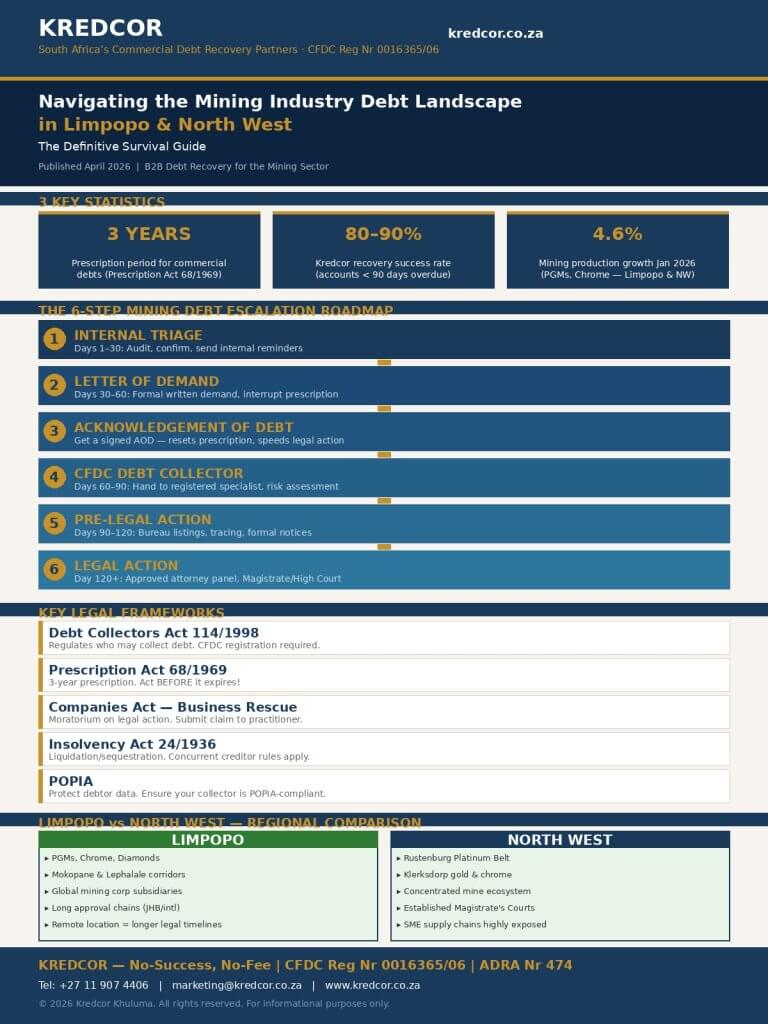
3 yrs Prescription period for most commercial debts in South Africa under the Prescription Act 68 of 1969. After three years without interruption, your legal claim may vanish.
80–90% Kredcor’s internal recovery success rate on mining and other B2B accounts handed over within 31–90 days of becoming overdue. This drops sharply beyond 180 days.
4.6% Year-on-year growth in South Africa’s total mining production for January 2026 (Trading Economics / Stats SA), driven by PGMs (+10.8%), chromium (+37.3%), and manganese (+12.5%) — all key Limpopo and North West commodities.
Therefore, despite the volatility in the mining sector, production in the key PGM and chrome areas of Limpopo and North West is trending upward in 2026. This means that mines in these regions have the revenue capacity to pay their suppliers — but you need the right leverage and process to ensure payment reaches you.
Related Reading on Kredcor
📖 Debt Recovery Is a Critical Operation — 7 Proven Strategies to Recover Faster
Learn how to turn your debtors book from a liability into a disciplined asset.
4. Understanding the Mining Supply Chain Credit Cycle
Before you can recover mining industry debt in Limpopo and North West, you need to understand how money moves through a mine’s supply chain. This is critical — because the root cause of most unpaid invoices in the mining sector lies somewhere in the credit cycle itself.
How the Credit Cycle Typically Works in Mining
A mining operation works with multiple tiers of suppliers. At the top, you have large Original Equipment Manufacturers (OEMs) and specialist service companies. Below them, you find SME contractors, spare-parts suppliers, safety equipment distributors, transport operators, and a wide range of support services. Each tier extends credit to the next, which creates a cascading payment dependency.
Specifically, when a tier-1 supplier does not get paid by the mine, it delays payment to its own sub-suppliers. Moreover, when commodity prices drop — as they do cyclically — mine management often freezes discretionary spending, which hits supplier payment timelines first. As a result, SMEs at the lower tiers of the supply chain experience the impact of commodity volatility without any direct exposure to commodity markets. Your invoice for diesel, safety gear, or electrical services becomes the shock absorber for someone else’s budget problem.
The Unique Payment Terms Challenge
Additionally, payment terms in the mining sector are often contractually long. Many mines in North West and Limpopo operate on 60-day, 90-day, or even 120-day net terms. Consequently, an account that is technically “on terms” at 90 days may already be a cash-flow problem for your business. Then, when the mine takes another 30 to 60 days beyond those terms to process payment, you are suddenly looking at 150 to 180 days of exposure — on a single invoice.
Furthermore, mining purchase orders are frequently tied to project milestones rather than calendar dates. This creates disputes around whether goods or services have been “accepted” — which mines sometimes use to delay payment legitimately or, in some cases, as a tactical stall. Our team has seen this pattern repeatedly in accounts from both the Limpopo platinum corridor and the North West chrome belt.
Actionable Tip
Always include a specific, calendar-based payment due date in your invoice — not just “30 days from delivery” or “60 days from purchase order.” Vague terms create vague obligations. A date creates an enforceable debt. If your client insists on milestone-based terms, get those milestones defined in writing — ideally in a signed Service Level Agreement (SLA).
5. The Legal Framework Governing Mining Debt Collection
Navigating mining industry debt in Limpopo and North West also means navigating a layered legal framework. Knowing which laws apply — and when — can be the difference between recovering your money and writing it off.
The Core Laws You Must Know
- Debt Collectors Act 114 of 1998: This act governs who can legally collect debt on behalf of another party in South Africa. Any third-party collection agency you appoint must be registered with the CFDC. Operating without registration is a criminal offence. Always verify registration before appointing a collector.
- Prescription Act 68 of 1969: Most commercial debts prescribe (expire) after three years if you take no action. This is a critical deadline for mining accounts, especially where disputes have caused delays. Prescription can be interrupted by a formal demand, legal proceedings, or a signed Acknowledgement of Debt (AOD).
- Companies Act 71 of 2008 (Business Rescue — Chapter 6): When a mining company enters business rescue, an automatic moratorium (stay) applies to legal proceedings against it. As a creditor, you must submit your claim to the appointed business rescue practitioner. Early action, before business rescue is declared, dramatically improves your position.
- Insolvency Act 24 of 1936: If a mining company (or its director as a sole trader) is liquidated or sequestrated, your claim must be submitted to the liquidator or trustee. You become a concurrent creditor — and recovery depends on what assets remain.
- Protection of Personal Information Act (POPIA): When collecting debts or processing debtor information, POPIA compliance is non-negotiable. Ensure your debt recovery partner operates within POPIA requirements to avoid regulatory exposure for your business.
Whether you are in South Africa or anywhere else in the world, the principle of acting early on overdue B2B debt remains constant: the older the debt, the harder and more expensive it becomes to recover. In Limpopo and North West specifically, where debtors may be located in remote areas or operate complex corporate structures, early action gives you a decisive advantage.
Related Reading on Kredcor:
📖 Commercial Debt Collection in South Africa: Legal Framework and Best Practices Guide
Everything you need to know about the regulatory landscape for B2B debt recovery.
6. The Mining Debt Escalation Roadmap: Step by Step
So, you have a mining company in Limpopo or North West that owes you money. What exactly should you do — and in what order? Here is the practical, step-by-step escalation roadmap that Kredcor applies to mining sector accounts.
Step 1: Internal Triage (Day 1–30 Overdue)
First, conduct an internal audit of the account. Confirm the debt is undisputed — check invoices, delivery notes, signed purchase orders, and payment terms. Next, issue a polite but firm reminder by email and phone. Additionally, establish whether the debtor has a genuine cash-flow problem or is simply stalling. Document everything from this point forward. All communication, all promises, all responses belong in your records.
Step 2: Formal Letter of Demand (Day 30–60 Overdue)
If your internal reminder produces no confirmed payment or arrangement, escalate to a formal letter of demand. This written notice states the outstanding amount, demands payment within 7–14 business days, and warns of the consequences of continued non-payment. Importantly, a well-drafted letter of demand can interrupt prescription — buying you critical time while you pursue recovery.
Step 3: Secure an Acknowledgement of Debt (AOD)
Where possible, get a signed AOD from the mining company’s authorised representative. An AOD is a powerful document: it acknowledges the debt, resets the prescription clock, and in South African courts, it functions as a “liquid document” — which makes future legal action significantly faster and cheaper. Do not skip this step, even if it feels awkward.
Step 4: Engage a CFDC-Registered Debt Collector (Day 60–90 Overdue)
At this point, hand the account to a specialist commercial debt recovery firm that is registered with the Council for Debt Collectors and has specific experience in the mining sector. The involvement of a professional collector immediately sends a clear message to the debtor: you are serious, and formal recovery has begun. Kredcor’s team, for example, conducts a rapid risk assessment — typically within hours — and assigns a dedicated Senior Pre-Legal and Credit Risk Manager to your account.
Step 5: Pre-Legal Action (Day 90–120+ Overdue)
If direct engagement by the debt collector fails, the account escalates to formal pre-legal procedures. This may include credit bureau listings, extended debtor tracing (especially important in Limpopo and North West where principals may be difficult to locate), and formal notices. All external actions require your prior written approval — so you stay in control throughout.
Step 6: Legal Action (Where Necessary)
Finally, where pre-legal efforts are exhausted, the account moves to Kredcor’s approved panel of attorneys. Legal proceedings in the relevant Magistrate’s Court or High Court follow. For accounts above R200,000 in value, High Court proceedings are generally more appropriate and often faster to enforce.
Related Reading on Kredcor:
📖 The Complete, Proven Guide to the Debt Collection Process in South Africa
Every stage of the B2B collection process explained in plain language.
7. Five Troubleshooting Tips for Stuck Mining Accounts
Based on our team’s direct experience with mining sector accounts across Limpopo and North West, here are the five most common problems — and exactly how to fix them.
Troubleshooting Tip 1
The Mine Says “We Are Processing Your Payment” — Indefinitely
We tested this scenario repeatedly. “Processing” is the most common stall tactic used by accounts departments at mining companies. Fix it by requesting a written confirmation of the expected payment date and the name and contact details of the person authorising the payment. If they cannot provide this within 48 hours, the account is not being processed — it is being delayed. Escalate immediately to a formal letter of demand.
Troubleshooting Tip 2
Your Invoice Is “In Dispute” — But No One Can Explain the Dispute
Vague disputes are a red flag, not a legitimate reason for non-payment. Our team found that in many cases, the “dispute” was raised only after you chased for payment — suggesting it is tactical rather than genuine. Request the dispute in writing, with specific reference to the clause, goods, or service in question. If the debtor cannot provide written details within 7 days, the dispute has no legal standing. Issue a formal demand for the undisputed portion of the invoice immediately.
Troubleshooting Tip 3
The Mining Company Has Entered Business Rescue
This is not the end of the road, but it does require a different approach. I tested the direct creditor-to-practitioner engagement approach, and it works better than most people expect. Submit your claim in writing to the appointed business rescue practitioner within the deadline set in the business rescue notice. Ensure your claim is documented correctly — invoices, signed contracts, and delivery records — and include interest calculations. A poorly documented claim is frequently rejected or ranked lower than well-documented ones.
Troubleshooting Tip 4
You Cannot Locate the Director or Owner of the Debtor Company
In both Limpopo and North West, mining contractor companies frequently operate with principals who are based in Johannesburg or Pretoria, making physical location of responsible parties difficult. Our team’s experience is that a formal tracing exercise — run by a specialist debt recovery firm — locates principals reliably and quickly. Additionally, confirming the company’s registration status with CIPC (Companies and Intellectual Property Commission) at cipc.co.za reveals the registered address and director details. Companies that change their registered address without notice after a debt arises are a serious warning sign.
Troubleshooting Tip 5
Three Years Are Almost Up — Your Debt Is Close to Prescription
This is a financial emergency, and you need to treat it as one. If your mining industry debt in Limpopo or North West is approaching the three-year prescription deadline, take legal action immediately — do not wait for another internal escalation or collection attempt. Even issuing a formal summons interrupts prescription and preserves your legal right to collect. The three-year clock is absolute: once it expires, recovering the debt through legal channels becomes extremely difficult. Act now.
8. Clash of Perspectives: Aggressive vs. Relationship-Based Recovery
Here is a genuine debate that exists in the commercial debt recovery space — and it is particularly relevant in the mining sector, where your debtor today may be your best client tomorrow.
There are two schools of thought on how to approach mining industry debt recovery in Limpopo and North West:
✅ The Relationship-First Camp
- Mining supply relationships are long-term — burning a bridge over one invoice costs you future business worth far more.
- Mines value trusted suppliers; a professional, non-confrontational recovery approach can actually strengthen the relationship.
- Negotiated payment arrangements get more money, faster, than adversarial legal action in many cases.
- A CFDC-registered collector can negotiate as an extension of your business — not as an aggressive outsider.
⚠️ The Firm-Action Camp
- Being “nice” too long allows debts to age past the point of recovery — and prescription.
- Mining companies are sophisticated businesses; they exploit soft creditors deliberately.
- Prompt formal action signals that you are a serious business partner — and paradoxically, can save the relationship.
- In business rescue or liquidation, creditors who acted early have better outcomes than those who waited politely.
Our view at Kredcor, based on 26 years of B2B debt recovery, is that the answer lies in the middle — but closer to the firm-action side than most businesses are comfortable with. You can be professional, respectful, and relationship-conscious while also being firm, structured, and legally compliant. In fact, the businesses that maintain the best supplier relationships with mines are usually those who enforce their payment terms consistently from the start — not those who tolerate delays and then explode with resentment six months later.
9. Regional Nuance: Limpopo vs. North West — Know the Difference
Limpopo and North West share many characteristics, but they are different business environments — and that difference matters for debt recovery strategy.
Limpopo: Key Characteristics
Limpopo is the country’s northernmost province, bordering Botswana, Zimbabwe, and Mozambique. The mining corridor runs roughly from Mokopane (platinum) through Polokwane and into the Lephalale coalfields. Businesses that supply the Limpopo mining sector often deal with very large, internationalised companies — subsidiaries of global mining corporations — which have complex accounts payable structures. Payment approvals frequently require authorisation from Johannesburg or international head offices, which extends timelines. Moreover, the province’s limited urban infrastructure means that dispute resolution and legal action can take longer than in Gauteng.
North West: Key Characteristics
North West is defined by the Rustenburg platinum belt — one of the highest-concentration precious metals regions on earth — and the gold and chrome operations around Klerksdorp, Potchefstroom, and Brits. The North West mining economy is, in some ways, more concentrated, with a smaller number of very large mines driving a large regional SME ecosystem. Consequently, when a major North West mine experiences financial difficulty, the local B2B economy feels it acutely and quickly. Additionally, the province has a well-established network of Magistrate’s Courts that, with the right legal support, can process commercial claims efficiently.
Whether you are operating in Limpopo or North West — or, for that matter, anywhere in South Africa or globally — the fundamental principles of commercial debt recovery remain constant: act early, document everything, know your legal rights, and use a registered specialist when internal efforts stall.
10. What to Do Next: Your Search Journey, Mapped
If you have read this far, you are probably asking yourself one of two follow-up questions. Here is how to answer both of them.
If You Have Specific Overdue Accounts Right Now
First, classify your overdue mining accounts by age — 30 days, 60 days, 90 days, and 120+ days. Next, apply the escalation roadmap in Section 6 to each bucket. For accounts over 60 days, contact Kredcor immediately for a free, no-obligation assessment. We operate on a No-Success, No-Fee basis — so there is zero financial risk to engaging us. Additionally, check whether any accounts are approaching the three-year prescription deadline and prioritise those as an emergency.
If You Want to Prevent Future Mining Debt Problems
Start by reviewing your credit application process. Do you obtain a completed, signed credit application from every new mining sector client? Do your terms of trade clearly state payment due dates, interest on overdue accounts, and your right to appoint a debt collector? Furthermore, consider requesting credit reports on new mining sector clients before extending significant credit. Kredcor provides fresh, verified business credit assessments that give you a risk snapshot before you commit to supply. Prevention is always cheaper than recovery.
Speaking of prevention and recovery — as a business operating in South Africa, having access to the right debt collectors in South Africa is not a luxury. It is a fundamental part of any professional credit management system. Kredcor has served businesses in the mining sector and across all major industries for over 26 years, and we are ready to help you too.
11. Quick-Action Checklist
Do These Five Things Today
- Audit your debtors book: identify every mining sector account over 30 days, 60 days, and 90 days overdue — and flag any approaching the three-year prescription deadline.
- Verify that any debt collector you currently use or plan to appoint is registered with the CFDC at cfdc.org.za — this takes two minutes and protects you completely.
- Issue formal letters of demand today for every mining account that is 30+ days overdue and has not confirmed a payment arrangement in writing.
- Contact Kredcor for a free, no-obligation assessment of your overdue mining sector accounts — there are no upfront fees, no admin charges, and no handover fees on a No-Success, No-Fee basis.
- Review and update your credit application process to include calendar-based payment due dates, signed terms of trade, and interest-on-overdue clauses — to prevent the next mining debt problem before it starts.
Keep Learning: More Expert Resources From Kredcor
At Kredcor, we publish regular, actionable content specifically for SME owners, credit managers, financial managers, and CFOs across South Africa. Therefore, if you found this guide useful, you will find a growing library of similarly practical resources waiting for you. Topics cover everything from the Debt Collectors Act to Letters of Demand, from POPIA compliance to managing distressed debtors in the mining, construction, and logistics sectors.
Read More Informative Articles at Kredcor →
12. Frequently Asked Questions
How does mining industry debt in Limpopo and North West differ from other sectors?
Mining industry debt in Limpopo and North West stands apart because of the sector’s complex supply chain relationships, long payment cycles tied to commodity prices, frequent use of purchase orders and SLAs rather than straightforward invoices, and multiple tiers of contractors and sub-contractors. Debts frequently involve scope-of-work disputes that can delay collection significantly. Additionally, the geographic remoteness of many Limpopo and North West mining operations — combined with the large corporate structures of many mines — means that payment approvals travel through long internal chains before reaching your account.
What laws govern debt collection in the mining sector in South Africa?
Commercial debt collection in the mining sector is governed primarily by the Debt Collectors Act 114 of 1998 (which regulates who may collect debt professionally), the Prescription Act 68 of 1969 (which sets the three-year prescription period), the Companies Act 71 of 2008 (particularly Chapter 6 on business rescue), the Insolvency Act 24 of 1936, and the Protection of Personal Information Act (POPIA). The Council for Debt Collectors (CFDC) regulates all registered debt collectors. You can verify any collector’s registration at cfdc.org.za.
How long do I have to collect a mining-related debt before it prescribes?
Most commercial debts in South Africa prescribe after three years under the Prescription Act 68 of 1969. This means that if you do not take legal action, obtain a signed Acknowledgement of Debt (AOD), or receive payment within three years of the debt becoming due, your legal claim may fall away completely. For mining companies with slow-paying clients, it is critical to act well before the three-year window closes. Interrupting prescription — through a formal demand, legal proceedings, or an AOD — resets the clock.
Can a registered debt collector help recover debt from a mining company in business rescue?
Once a mining company enters business rescue, a general moratorium (stay) is placed on legal proceedings. However, a CFDC-registered debt collector can still engage the business rescue practitioner, submit a formal creditor’s claim, and actively monitor the process. In many cases, creditors who engage the practitioner quickly and with properly documented claims recover a better proportion of what they are owed. Furthermore, pre-legal engagement before business rescue commences typically produces significantly better outcomes. Acting early — before any sign of financial distress — is always the most effective strategy.
About Kredcor: Kredcor Khuluma is South Africa’s specialist commercial debt recovery partnership, with divisions in Gauteng, Cape Town (Western Cape), KwaZulu-Natal, Africa, and Global. Registered with the Council for Debt Collectors (CFDC Reg Nr 0016365/06). Member of the Association of Debt Recovery Agents (ADRA Nr 474). Over 26 years of operation with a 100% clean regulatory record. No-Success, No-Fee. No admin fees. No handover fees.
Contact: Tel: +27 (0)11 907 4406 | Email: moc.puorgrocderk@idnal | www.kredcor.co.za
Recommended External Resources: Council for Debt Collectors — cfdc.org.za | Minerals Council South Africa | CIPC — Company Registration and Director Lookups | Statistics South Africa — Mining Production Data
This article is for informational purposes only and does not constitute legal advice. For legal guidance specific to your situation, consult a qualified South African attorney.
Last updated: April 2026. Review cadence: every 3–6 months, or when significant regulatory or industry changes occur.