

📋 Executive Summary
Pre-litigation negotiation is the structured process of recovering unpaid business-to-business debt through direct contact, formal demand, and negotiated settlement — before either party sets foot in a South African court. For SME owners, credit managers, and CFOs, it’s almost always the faster, cheaper, and relationship-preserving route: attorney-led litigation in the Magistrate’s or High Court can take months and cost more than many invoices are worth, while a well-run pre-litigation negotiation typically resolves fresh commercial debt within 60 to 90 days. The process rests on a handful of levers: verified documentation, direct contact, a compliant letter of demand, a written Acknowledgement of Debt once a debtor commits to pay, and a firm deadline before legal handover. Because South African commercial debt prescribes after three years under the Prescription Act, and because registered debt collectors in South Africa must operate within the Debt Collectors Act 114 of 1998, timing and compliance matter as much as tone.
Picture this: a client who’s paid you reliably for three years suddenly goes quiet on a R180,000 invoice that was due six weeks ago. Do you fire off an angry email, hand the file straight to an attorney, or bring in outsourced credit management support? For most South African businesses, the smartest move sits between those extremes, and it has a name: pre-litigation negotiation. Get it right, and you recover what you’re owed within weeks, keep the client, and never see the inside of a Magistrate’s Court. Get it wrong — wait too long, negotiate without documentation, or skip the legal groundwork — and the debt only gets harder to collect. This guide walks through exactly how pre-litigation negotiation works for South African B2B creditors, the law it operates within, and the six-step process our team runs on commercial invoices before any file ever reaches an attorney’s desk.
Table of Contents
- What Is Pre-Litigation Negotiation?
- Why Pre-Litigation Negotiation Beats Rushing to Court
- The Legal Framework Behind Pre-Litigation Negotiation
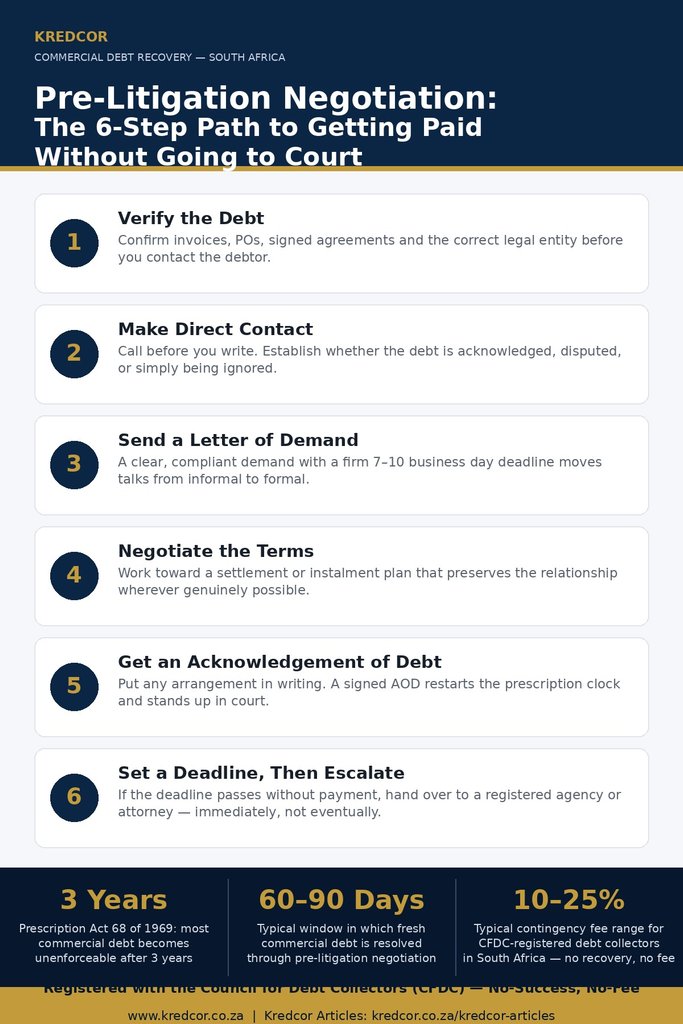
- The 6-Step Pre-Litigation Negotiation Process
- Common Debtor Excuses (and How to Counter Them)
- One Principle, Many Industries and Regions
- Troubleshooting: 5 Pre-Litigation Negotiation Problems, Solved
- The Debate: Should You Ever Skip Negotiation and Go Straight to Court?
- What to Do Next
- Quick-Action Checklist
- Frequently Asked Questions
1. What Is Pre-Litigation Negotiation?
Pre-litigation negotiation is every legitimate step a creditor takes to recover a commercial debt before issuing summons — direct communication, a formal letter of demand, and a negotiated settlement or payment plan, all conducted without ever opening a court file. It sits between a polite reminder email on one end and full litigation on the other, and it’s where the overwhelming majority of South African B2B debt actually gets recovered.
You’ll also see pre-litigation negotiation described as amicable debt recovery, soft collections, or early delinquency management — different names for the same underlying discipline: resolving arrears through structured communication rather than high-friction legal battles. Whatever you call it, the goal doesn’t change: get paid without turning a paying customer into a former client and a legal bill.
2. Why Pre-Litigation Negotiation Beats Rushing to Court
Litigation isn’t free, and it’s rarely fast. A claim under R200,000 sits in the District Magistrate’s Court, one between R200,000 and R400,000 moves to the Regional Magistrate’s Court, and anything above that — or any genuinely complex dispute — belongs in the High Court. Even an undefended claim, the best-case scenario, still takes weeks to reach default judgment, and a judgment on its own doesn’t put money in your account: you still need a writ of execution or a garnishee order to enforce it.
Our team’s experience across South African commercial accounts shows a consistent pattern: pre-litigation negotiation resolves fresh commercial debt — accounts under 90 days overdue — at a meaningfully higher rate than debt that’s already been fought over in court, largely because the debtor still has cash flow and the relationship hasn’t yet calcified into avoidance. Litigation remains the right tool when a debtor refuses all contact or has shown a pattern of bad faith. For everyone else, it’s the slow, expensive option you reach for only once negotiation has genuinely failed.
- Preserves the commercial relationship and future repeat business
- Costs nothing upfront when run through a no-win, no-fee agency
- Typically resolves in 60–90 days versus months for litigation
- Keeps the outcome — and the settlement terms — in both parties’ hands, not a court’s
3. The Legal Framework Behind Pre-Litigation Negotiation
Pre-litigation negotiation doesn’t happen in a legal vacuum, and knowing the framework changes how you write every letter and take every call.
Commercial debt collection in South Africa sits primarily under the Debt Collectors Act 114 of 1998, which created the Council for Debt Collectors (CFDC) — the statutory body that registers and disciplines anyone who collects debt for reward. Any negotiation you or your agency conducts has to stay inside the CFDC’s Code of Conduct: reasonable contact hours, no misrepresenting the legal consequences of non-payment, and no third-party pressure tactics aimed at embarrassing a debtor.
Two other laws shape the pre-litigation negotiation timeline directly. Under the Prescription Act 68 of 1969, most commercial debt becomes legally unenforceable three years after it falls due — exactly why a stalled negotiation should never be left to drift indefinitely. And because the National Credit Act 34 of 2005 protects consumers rather than registered companies or close corporations, B2B debt collection generally enjoys more contractual flexibility than consumer debt — with one exception worth flagging: if your debtor is a sole proprietor, NCA provisions, including a Section 129 notice requirement, may still apply before you can proceed to litigation.
“The Council for Debt Collectors exists to keep pre-litigation negotiation honest. Every tactic we use has to survive contact with the CFDC’s Code of Conduct — and that’s exactly what protects a creditor’s legal position if talks eventually fail.” — Kredcor Commercial Debt Recovery Team
4. The 6-Step Pre-Litigation Negotiation Process
Here’s the process our team runs on every commercial account before it ever reaches an attorney’s desk.
Step 1: Verify the Debt and Documentation
Before you contact anyone, confirm the invoice numbers, purchase orders, delivery notes, and the debtor’s correct registered legal name — pull it from CIPC if you’re unsure. I’ve personally seen negotiations stall for weeks simply because a letter was addressed to a trading name instead of the registered entity. Precision here isn’t paperwork for its own sake; it’s what makes every later step enforceable.
Step 2: Make Direct Contact First
Call before you write. A short, professional phone call tells you more in five minutes than a week of unanswered emails: is the debt acknowledged, genuinely disputed, or is the debtor simply avoiding the conversation? That single distinction shapes everything that follows — a disputed amount needs documentation and a written response deadline, while an ignored account needs escalation, not more patience.
Step 3: Send a Compliant Letter of Demand
If contact doesn’t produce a payment commitment within a few days, formalise the pressure with a letter of demand — a firm, referenced, deadline-driven notice that shifts the conversation from informal to legal. We’ve written a full step-by-step guide to this exact document: How to Write a Powerful Letter of Demand That Actually Gets Paid in South Africa. Get this letter wrong — vague amounts, no deadline, sent to the wrong contact — and you hand the debtor every excuse to keep stalling.
Step 4: Negotiate the Settlement or Payment Plan
Most pre-litigation negotiation succeeds or fails right here. Where a debtor genuinely can’t pay in full immediately but is negotiating in good faith, a structured instalment plan — commercial payment arrangements set out in writing, with specific dates and amounts — usually beats an all-or-nothing standoff. Our team’s experience is that debtors who help design the payment schedule are considerably more likely to honour it than those who simply have one imposed on them.
- The total amount, including any interest your terms allow
- Payment dates and amounts — not vague commitments like “soon”
- What happens immediately if a single instalment is missed
Step 5: Formalise It — Get an Acknowledgement of Debt
Never let a negotiated outcome live only in an email chain. A signed Acknowledgement of Debt (AOD) records the amount, the payment schedule, and the debtor’s admission that the money is owed — and it restarts the three-year prescription clock, which matters enormously if the account has already been outstanding for a while. We cover exactly what a strong AOD needs to include in What Is an Acknowledgement of Debt (AOD) and Why Does It Really Matter?
Step 6: Set a Real Deadline, Then Escalate
Pre-litigation negotiation only works if the debtor believes escalation is real. Set a firm final deadline, state exactly what happens if it passes — handover to a registered agency, credit bureau listing, or attorney referral for summons — and then follow through immediately if it does. If you reach this point, our guide on Issuing a Summons for Debt walks through what legal escalation actually involves.
5. Common Debtor Excuses During Pre-Litigation Negotiation (and How to Counter Them)
- “We never received the invoice.” Resend it with the original delivery or read receipt and timestamp — this typically ends the excuse immediately.
- “We’re waiting for our customer to pay us first.” Their downstream cash-flow problem doesn’t suspend your legal right to payment. Say so, in writing.
- “We dispute the amount.” Request the specific dispute, in writing, with supporting documents, by a fixed date. Genuine disputes produce detail fast; stalling tactics don’t.
- “We’ll pay next month, I promise.” Get it in writing as a dated commitment or AOD. Verbal promises with no signature rarely survive a second missed deadline.
- “The decision-maker isn’t available.” Escalate contact to a named director or financial signatory in writing — a quick CIPC company search makes this easy to establish.
6. One Principle, Many Industries and Regions
Whether your overdue account sits in Sandton, Cape Town, Durban, or with a debtor across the border in Namibia or Botswana, the core principle of pre-litigation negotiation doesn’t change: document everything, negotiate in good faith, and set deadlines you’re prepared to enforce. What does change is the detail — cross-border SADC debt involves different service and enforcement protocols, construction-sector negotiations tend to hinge on retention certificates and variation orders, and professional-services firms often need a softer opening tone because reputational sensitivity runs higher in smaller, tightly networked industries. A generic script underperforms; a negotiation approach adapted to the debtor’s sector consistently recovers more.
7. Troubleshooting: 5 Pre-Litigation Negotiation Problems, Solved
Negotiation has stalled for over 30 days with no progress. Set — and enforce — a hard final deadline this week rather than letting talks drift. Stalled negotiation almost always favours the debtor, not you.
The debtor keeps proposing new terms after you’ve already agreed. Insist any renegotiation happens in writing and references the original AOD. Don’t let a signed agreement get reopened informally.
You’re not sure the debtor can actually pay. Run a pre-legal solvency check or CIPC company search before investing more negotiation time in an account that may already be insolvent.
The account is approaching the three-year prescription mark. Get a signed Acknowledgement of Debt immediately — it’s the fastest way to interrupt prescription — or hand over for urgent legal action.
Internal staff have been negotiating for months with nothing to show for it. Hand the account to a specialist. The moment negotiation costs more in staff time than the debt is worth chasing internally, outsourced credit management stops being a luxury and starts being the cheaper option.
8. The Debate: Should You Ever Skip Negotiation and Go Straight to Court?
Some creditors — particularly those burned before by a debtor who negotiated only to stall — argue that skipping pre-litigation negotiation entirely and issuing summons immediately sends the strongest possible signal. It’s a fair position, worth engaging honestly rather than dismissing.
The case for going straight to legal action: it removes any illusion of further delay, creates an enforceable public record, and against a debtor with a known pattern of non-payment, a summons may be the only lever that actually produces movement.
The case against it: litigation is slower and more expensive than most creditors expect, and a judgment obtained six to twelve months later can deliver less real-world value than a settlement negotiated in the first sixty days — while permanently ending a commercial relationship that might otherwise have continued.
Based on the pattern we see across the South African commercial debt recovery industry, the more defensible default is to exhaust genuine pre-litigation negotiation first, unless the debtor has already shown clear bad faith. It costs nothing to attempt through a no-win, no-fee agency, and it resolves the majority of fresh commercial debt — which makes it the rational starting point even when it isn’t the most emotionally satisfying one.
9. What to Do Next
If pre-litigation negotiation is new to your business, don’t start with your oldest, most frustrating account. Start with everything sitting at 30 to 60 days overdue today — that’s where the highest-probability recoveries live. Pull the debtor age analysis, confirm the paperwork is complete for each account, and begin structured contact this week rather than next month.
And if you’re already mid-negotiation on an account and it stalls past your deadline, the natural next question is what legal escalation actually looks like. Our guide on Issuing a Summons for Debt is the logical next read.
10. ✅ Quick-Action Checklist
- Pull every account 30–60 days overdue and verify the documentation today.
- Make direct phone contact before sending anything in writing.
- Send a compliant, deadline-driven letter of demand if contact doesn’t produce payment.
- Get any agreed arrangement signed as a written Acknowledgement of Debt.
- Set a firm final deadline and hand over to a registered agency or attorney the moment it passes.
11. Frequently Asked Questions
What is the difference between pre-litigation negotiation and a letter of demand?
A letter of demand is one formal document used within pre-litigation negotiation. Pre-litigation negotiation is the entire process — contact, negotiation, documentation, and deadline-setting — that surrounds and follows it.
How long should pre-litigation negotiation take before I escalate to court?
Most genuine pre-litigation recoveries in South Africa conclude within 60 to 90 days. If a debtor is negotiating in good faith and making partial payments against a signed arrangement, some flexibility is reasonable. If there’s no documented progress after 90 days, escalate.
Is a signed Acknowledgement of Debt legally binding in South Africa?
Yes. A properly drafted AOD, signed by someone with authority to bind the debtor company, is a legally binding document that can be enforced in court — and it restarts the three-year prescription period on the debt.
Can I negotiate directly with a debtor, or do I need a registered debt collector?
You can negotiate directly, and many businesses do. A CFDC-registered debt collector or attorney becomes valuable once informal contact stalls, once tracing is required, or once you need the negotiation to carry credible legal weight — most registered agencies work on a no-success, no-fee basis, so there’s little downside in bringing one in earlier rather than later.
Pre-litigation negotiation is a skill, and like any skill, it improves with volume and with knowing exactly where the legal lines sit. If your internal team is already stretched, or a handful of accounts have moved past the point where another phone call will help, it may be time to bring in specialist support. For the complete picture of how professional debt collectors in South Africa operate — what they cost, how they’re regulated, and how to choose one — read our full guide.
This article is one of many practical, South Africa-specific guides Kredcor publishes for business owners, credit managers, and financial managers who’d rather solve a cash-flow problem than live with one. Explore the full library at Kredcor Articles for more actionable guidance on credit management, debt recovery, and protecting your business’s cash flow.