

7 Steps to a Rock-Solid Credit Control System for SA Businesses
Executive Summary: A credit control system is the set of policies, checks and follow-up habits a business uses to decide who gets credit, how much, and how it gets collected on time. For South African businesses, an effective credit control system rests on seven pillars: a written credit policy, upfront customer vetting through CIPC and commercial credit bureaus, clear payment terms and credit limits, a properly structured credit team, active accounts receivable monitoring, an automated follow-up cadence, and a systematic escalation path that ends, when needed, with professional debt collectors in South Africa. Recent research found 91% of South African SMEs are paid late, with businesses typically waiting 60 to 90 days for money they are owed. Companies that build these seven pillars into a repeatable system collect faster, write off less bad debt, and protect the client relationships that took years to build.
Kredcor Khuluma CC | Co. Reg. Nr.: 2009/140932/23 | CFDC Reg Nr.: 0016365/06 | 65 Saint Michael Ave, New Redruth, Alberton | 011 907 4406
If you run a South African SME, manage credit, or sit in the CFO’s chair, you already know the feeling: the sale is done, the invoice is out, and now you’re just… waiting. And waiting some more. Late payment has quietly become one of the biggest threats to South African business survival, and having a proper credit control system in place is what separates the businesses that grow from the ones that slowly bleed cash until they can’t. In this guide, we’ll walk you through exactly how to build one — the same framework our team leans on every day when we help clients protect their cash flow and know when it’s time to call in professional debt collectors. Stick around, because by the end you’ll have a checklist you can start using today.
What’s in This Guide
- What Is a Credit Control System?
- Why South African Businesses Can’t Afford to Skip This
- Step 1: Write a Credit Policy You’ll Actually Use
- Step 2: Vet Every New Customer Before You Extend Credit
- Step 3: Set Clear Payment Terms and Credit Limits
- Step 4: Structure Who Owns Credit Control
- Step 5: Monitor Accounts Receivable Like a Hawk
- Step 6: Automate Your Follow-Up Cadence
- Step 7: Build a Systematic Escalation Path
- In-House vs Outsourced: The Honest Debate
- 5 Troubleshooting Tips for a System That Isn’t Working
- The Local Reality: What Makes South Africa Different
- What to Do Next
- Quick-Action Checklist
- Frequently Asked Questions
What Is a Credit Control System?
A credit control system is the set of policies, checks and habits a business uses to manage the money it’s owed. In plain terms, it’s how you decide who gets credit, how much they get, what happens if they pay late, and how you collect if they don’t pay at all. A good system covers the whole journey — from vetting a new customer before you ever raise an invoice, right through to handing a stubborn non-payer over to debt collectors in South Africa as a last resort. It isn’t just an accounting function. It’s a cash flow survival tool, and every SME owner, credit manager and CFO in South Africa needs one that actually works, not just one that exists on paper.
Why South African Businesses Can’t Afford to Skip This
Here’s the blunt truth: late payment isn’t a rare, unlucky event anymore. It’s the default. Research based on Xero’s late-payment data found that 91% of South African SMEs had invoices paid late, with the average overdue invoice settled a full 18 days after terms (see the Business Day analysis for the full picture). On top of that, local SMEs are typically waiting 60 to 90 days from invoice date to actually see the money — not the 30 days most credit terms promise.
And it isn’t only small, unpredictable clients causing the problem. By late 2025, government departments alone were sitting on more than 95,000 invoices worth over R12 billion that were older than 30 days. If even government departments pay late, your credit control system can’t rely on hope. It needs process.
Days Sales Outstanding (DSO) — the average number of days it takes to collect a sale — is the number that tells you if your system is working. One 2026 industry benchmark puts the South African SME average DSO at 34 days, though this swings hard by sector; construction businesses often average well over 50 days. Whatever your number is, the goal of a credit control system is simple: keep your actual DSO as close to your stated terms as possible. For a deeper look at what this delay costs your business specifically, see our piece on the true cost of late payments for SA SMEs.
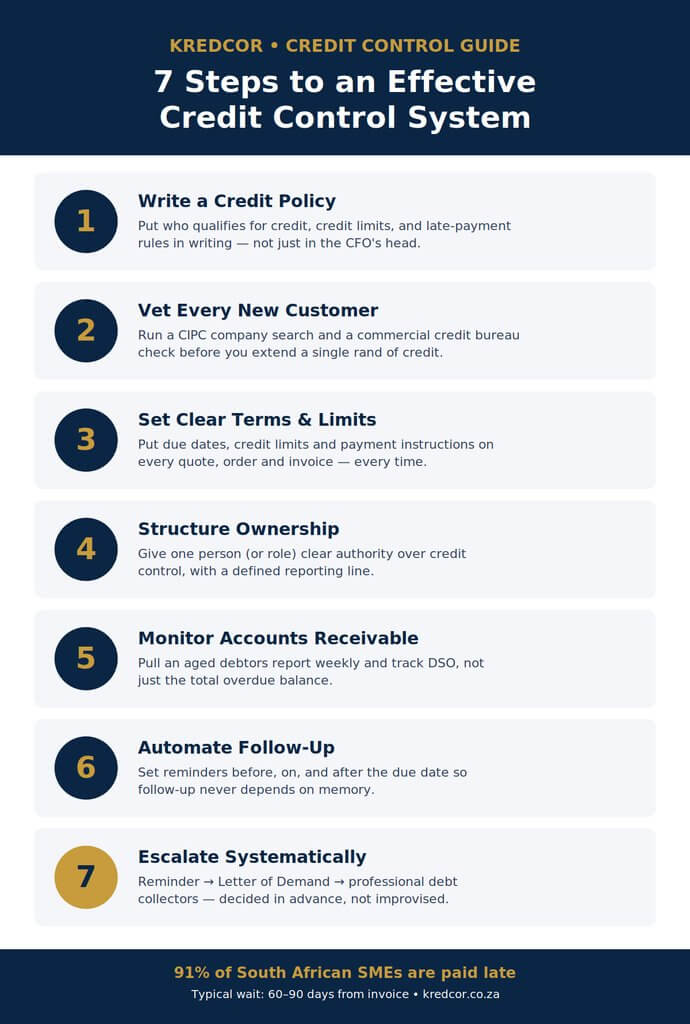
The 7 Steps to an Effective Credit Control System
Right, let’s get into it. Here’s the framework, broken into seven practical steps you can start applying this week.
Step 1: Write a Credit Policy You’ll Actually Use
Every credit control system starts with a written credit policy — not a vague idea in the CFO’s head, but an actual document that spells out who qualifies for credit, what the limits are, and what happens when someone doesn’t pay. Without this, your sales team will extend credit to anyone who asks, and your finance team will spend their days fighting fires instead of preventing them.
We’ve written a full breakdown of how to do this properly in our guide on building a credit policy that doesn’t scare away sales. The short version: your policy needs to balance protecting cash flow against not losing good customers to red tape. Keep it simple enough that your sales team can explain it in one sentence, and strict enough that it actually protects you.
Step 2: Vet Every New Customer Before You Extend Credit
This is the step most SMEs skip, and it’s the one that causes the most pain later. Before you extend a single rand of credit, do a proper check: a CIPC company search to confirm the entity is real, active, and who they say they are; a commercial credit bureau report (TransUnion or Experian, for example) to check payment history and any adverse listings; and, for bigger accounts, a director trace so you know who’s actually behind the business.
Our team’s experience is that five minutes of vetting upfront saves months of chasing later. It also gives you a legitimate, defensible reason to set a lower credit limit — or decline credit altogether — when a business information report raises red flags.
Step 3: Set Clear Payment Terms and Credit Limits
Vague terms create disputes. “Net 30” means nothing if it isn’t printed on your quote, your order confirmation, and your invoice, every single time. Set a specific credit limit per customer based on what your vetting turned up, and review it at least once a year — or immediately if a customer’s payment behaviour changes.
Keep terms as simple as possible: a due date, a clear penalty or interest clause for late payment (within what’s legally allowed), and clear instructions for how and where to pay. The fewer excuses a customer has to misunderstand your terms, the fewer disputes you’ll have to resolve down the line.
Step 4: Structure Who Owns Credit Control
Credit control fails when it’s “everyone’s job,” which usually means it’s no one’s job. Someone — whether that’s a dedicated credit controller, a shared finance resource, or, for smaller SMEs, the owner with a clear weekly slot in the diary — needs to own the process end to end.
We cover this in more depth in our guide on how to structure an internal credit department for growth. The short version: as your business grows, credit control needs a clear reporting line, defined authority (who can approve a credit limit increase, who can approve a write-off), and enough headroom that follow-up doesn’t quietly fall away the moment things get busy.
Step 5: Monitor Accounts Receivable Like a Hawk
You can’t manage what you don’t measure. Pull an aged debtors report weekly, not monthly — waiting a full month to notice a 45-day-old invoice means you’ve already lost three weeks of follow-up time. Watch for early warning signs: a reliable payer suddenly going quiet, a partial payment with no explanation, or a change in the person you usually deal with at a client.
Track your DSO over time, not just your total overdue balance. A rising DSO, even while sales are growing, is one of the clearest early signs that your credit control system is starting to slip.
Step 6: Automate Your Follow-Up Cadence
Manual follow-up is where good intentions go to die. Set up an automated cadence: a friendly reminder before the due date, a firm-but-polite nudge on the day it’s overdue, and escalating check-ins at 7, 14 and 30 days. This is amicable debt recovery, sometimes called soft collections — structured, professional communication rather than a last-minute scramble.
Automation doesn’t mean impersonal. It means the reminder always goes out on time, every time, without depending on someone remembering to send it between meetings.
Step 7: Build a Systematic Escalation Path
When soft collections don’t work, your system needs a clear next step, decided in advance rather than improvised in the moment. A typical escalation path looks like this: a final demand notice, then an attorney’s Letter of Demand (LoD), then, if the debtor still won’t engage, handover to a professional pre-legal debt collection specialist.
This is where a lot of businesses either wait too long, writing off debt that was still recoverable, or escalate too fast and damage a relationship over a genuine misunderstanding. A good credit control system builds in a decision point — usually somewhere between 60 and 90 days overdue — where you formally hand the file to debt collectors in South Africa who specialise in pre-legal, no-win-no-fee commercial recovery, rather than burning internal time and goodwill chasing an account that needs a firmer hand.
“Five minutes of vetting a new customer upfront routinely saves months of chasing later — it’s the cheapest insurance a credit control system has.” — Kredcor credit risk team
In-House vs Outsourced: The Honest Debate
There’s a genuine debate among credit managers about where the line should sit between handling collections in-house and outsourcing to a specialist agency. The case for keeping it in-house: you retain full control of the customer relationship, and for well-behaved accounts, a simple reminder from your own team usually gets the job done without any third-party involvement.
The case for outsourcing earlier: professional debt collectors bring skip tracing, credit bureau access, and negotiation experience your internal team likely doesn’t use day-to-day — and a specialist agency working on a no-win-no-fee, contingency basis costs you nothing if they don’t recover. Most experienced credit managers land somewhere in the middle: run early-stage, low-risk collections in-house, and hand over accounts that hit a set overdue threshold or show clear evasion. Neither approach is “wrong.” The right mix depends on your team’s capacity and your appetite for risk.
5 Troubleshooting Tips for a System That Isn’t Working
- Your DSO keeps climbing even though your policy hasn’t changed. Check whether your team is actually following the credit policy, or whether sales is quietly overriding it to close deals.
- The same customers are “always” late. Stop treating chronic late payers the same as everyone else — move them to shorter terms, prepayment, or a lower credit limit.
- Follow-up only happens when someone remembers. Automate reminders so the system doesn’t depend on any one person’s memory or workload.
- You can’t tell who owns an overdue account. Assign a single named owner to every debtor file, with a documented next action and date.
- Files sit for months before anyone escalates. Set a hard rule (e.g. 60 or 90 days overdue) that triggers automatic handover to a Letter of Demand or a debt collection agency, no exceptions without sign-off.
The Local Reality: What Makes South Africa Different
Whether you’re running a business in Sandton, Cape Town or a small town in the Karoo, the core principles of credit control stay the same. But South Africa adds its own texture: most B2B credit control sits outside the National Credit Act (which mainly governs consumer credit), so commercial debt recovery generally moves faster and with fewer formal notice requirements than a personal loan default would. That said, professional debt collectors still need to be registered with the Council for Debt Collectors (CFDC) under the Debt Collectors Act, and a reputable agency will always show you its registration number without you having to ask.
Load shedding, currency swings and interest rate hikes also hit South African businesses’ cash flow harder than in more stable economies, which makes a tight credit control system less of a “nice to have” and more of a survival requirement.
What to Do Next
Once your system is running, the next question most credit managers ask is: how do I know when to stop chasing internally and hand a file over? As a rule of thumb, if an account is 60+ days overdue, the debtor has gone quiet, or you’ve tried at least three follow-ups without a clear payment commitment, that’s your signal. At that point, a specialist agency can run a fresh skip trace, apply pressure your internal team can’t, and, because most operate on a no-win-no-fee basis, do it without adding to your costs if the debt isn’t recovered.
That handover point is exactly where most of our clients bring us in. If you’d rather focus on running your business than chasing invoices, working with experienced debt collectors in South Africa means you get a dedicated Credit Risk Manager, monthly reporting, and a strictly no-success-no-fee arrangement — so building this escalation step into your credit control system costs you nothing until it actually recovers money.
Building a credit control system is an ongoing process, not a once-off project, and the details matter as much as the framework. If you want to go deeper on any of the steps above, from writing a credit policy to structuring your credit team, you can browse more practical, South Africa-specific guides on our Kredcor Articles page.
Quick-Action Checklist
- Pull your aged debtors report today and flag anything over 30 days.
- Write down the credit limit and terms for your three biggest customers — if you can’t, that’s your first fix.
- Set a calendar reminder for a weekly (not monthly) accounts receivable review.
- Pick one chronically late payer and move them to stricter terms this week.
- Decide, in writing, your escalation threshold (e.g. 60 days) before you need it.
Frequently Asked Questions
What is the difference between credit control and credit management?
Credit control is the operational, day-to-day process of monitoring accounts and chasing payment. Credit management is the broader strategic function of setting policy, assessing risk, and deciding how much credit exposure the business is willing to carry. Most SMEs need both, even if one person handles both roles.
How much does it cost to use debt collectors in South Africa?
Reputable commercial debt collectors in South Africa typically work on a contingency, no-success-no-fee basis, charging a percentage of what’s actually recovered rather than upfront or monthly fees. Always confirm the fee structure and CFDC registration before handing over a file.
When should I hand a debtor over to a collection agency instead of handling it myself?
As a general guideline, once an account passes 60 to 90 days overdue, the debtor stops responding, or your internal follow-ups (calls, emails, a Letter of Demand) haven’t produced a payment commitment, it’s time to bring in a specialist rather than continuing to absorb the cash flow hit internally.
Does the National Credit Act apply to B2B debt collection in South Africa?
Generally, no — the National Credit Act mainly regulates consumer credit agreements. Most commercial, business-to-business debt sits outside its scope, though the specifics can depend on the size and structure of the debtor entity, so it’s worth checking borderline cases with an attorney.