

The Powerful Impact of the National Credit Act (NCA) on B2B vs B2C Collections — What Every South African Business Must Know
Executive Summary
The National Credit Act 34 of 2005 (NCA) is South Africa’s primary consumer credit law. It governs B2C (business-to-consumer) credit agreements comprehensively — prescribing affordability assessments, interest rate caps, section 129 notices, debt review rights, and credit bureau listing rules. For B2B (business-to-business) collections between two juristic persons where the principal debt exceeds R1 million, the NCA generally does not apply, giving businesses far more flexibility in their credit terms and collection process. However, B2B creditors must still comply with the Debt Collectors Act 114 of 1998, POPIA, the Prescription Act (3-year prescription), and the Consumer Protection Act in relevant scenarios. Understanding where the NCA applies — and where it doesn’t — is one of the most commercially valuable pieces of knowledge a South African credit manager or CFO can possess. This guide from Kredcor, a registered commercial debt collector with over 26 years of experience, explains exactly that, with actionable steps you can implement today.
Here’s the short answer you came for: the National Credit Act (NCA) applies strongly to B2C (consumer) collections and largely — but not always — exempts B2B (commercial) collections between qualifying juristic persons above the R1 million threshold. But there’s a lot more you need to know to stay compliant, protect your legal position, and collect more effectively. Keep reading — the detail below will save you time, money, and headaches.
If you’re an SME owner, credit manager, financial manager, or CFO in South Africa, the National Credit Act (NCA) is probably one of the most misunderstood pieces of legislation affecting your day-to-day operations. Some businesses panic and apply full NCA compliance to every debt, even when it doesn’t apply. Others completely ignore the NCA when it actually does apply — and then face serious legal consequences. Neither approach serves your business well.
At Kredcor, our team has spent over 26 years navigating South African credit law on behalf of commercial and corporate clients. We’ve seen the confusion firsthand. So, in this article, we’re going to break it all down clearly — the NCA’s impact on B2B vs B2C collections — so that you can do your job faster, smarter, and with far more confidence.
📋 Table of Contents
- What Is the National Credit Act (NCA)?
- B2C Collections Under the NCA — What the Act Requires
- B2B Collections and the NCA — Where the Exemptions Apply
- The R1 Million Threshold — A Critical Dividing Line
- Key Differences: B2B vs B2C Under the NCA (Comparison Table)
- Other Laws That Govern B2B Collections (Even Without the NCA)
- Clash of Perspectives — Should B2B Collections Be More Regulated?
- 5 Troubleshooting Tips for NCA Compliance in Your Collections Process
- Citation-Ready Statistics on SA Debt and NCA Impact
- Regional Nuance — NCA in South Africa vs Global Credit Frameworks
- What to Do Next — Your Search Journey Continues
- Quick-Action Checklist
- Frequently Asked Questions
1. What Is the National Credit Act (NCA)?
The National Credit Act 34 of 2005 came into effect in South Africa on 1 June 2007. Its primary purpose is to protect consumers — ordinary South Africans — from reckless lending, over-indebtedness, and exploitative credit terms. The Act is administered by the National Credit Regulator (NCR), and the National Consumer Tribunal handles disputes arising from it.
In terms of the NCA, “consumer” refers to any individual or entity that receives credit under a credit agreement.
The Act introduces important concepts such as:
- Reckless credit — lending to someone who cannot afford to repay
- Debt review — a structured process for over-indebted consumers to renegotiate repayment terms
- Section 129 notice — a mandatory notice that must be sent to a consumer before legal action can begin
- Prescribed interest rates — maximum interest rate caps on consumer credit agreements
- Credit bureau regulation — rules governing when and how consumers may be listed with credit bureaux
- Affordability assessments — creditors must assess whether a consumer can actually repay before extending credit
Consequently, the NCA fundamentally changes how you may deal with a consumer debtor compared to a business debtor. And that distinction — business vs consumer — is where everything begins.
⚖️
For a deeper dive into all the laws governing commercial debt in South Africa — including the Debt Collectors Act, the Prescription Act, and POPIA — read our comprehensive guide: Commercial Debt Collection in South Africa: Legal Framework and Best Practices
2. B2C Collections Under the NCA — What the Act Requires
B2C collections — that is, collecting debt owed to you by individual consumers — trigger the full weight of the National Credit Act. Therefore, if you sell goods or services on credit to individual members of the public, the NCA almost certainly governs that credit agreement. Here’s what that means practically.
Affordability Assessments Are Non-Negotiable
Before extending credit to a consumer, you must assess whether they can afford to repay. Skipping this step constitutes reckless credit — and reckless credit agreements can be set aside by a court. In other words, you could extend credit and then find yourself unable to enforce repayment because the agreement was recklessly granted.
Section 129 Notice — A Mandatory Step Before Legal Action
This is arguably the most operationally important NCA requirement for creditors. Before you can take legal action against a consumer debtor, you must send a Section 129 notice in writing, informing the consumer that they are in default and giving them options — including the right to refer the matter to debt counselling, a credit bureau dispute, or an alternative dispute resolution mechanism. Furthermore, this notice must go to the correct address. Courts have dismissed many actions simply because the creditor skipped this step or sent the notice to the wrong address.
Interest Rate Caps Apply
Under the NCA, the maximum interest rate you can charge a consumer is prescribed by regulation. These rates change from time to time based on the South African Reserve Bank’s repo rate. Charging more than the prescribed rate is unlawful and can result in your credit agreement being declared invalid.
Debt Review Rights
A consumer who is over-indebted has the right to apply for debt review through a registered debt counsellor. Once a consumer is under debt review, you generally cannot take legal action against them without the permission of the court. This is a significant practical consideration for B2C creditors.
The NCA fundamentally levels the playing field between large, sophisticated creditors and ordinary consumers. As a business, understanding its requirements isn’t optional — it’s the price of operating in the consumer credit space.— Kredcor Commercial Debt Recovery Team
3. B2B Collections and the NCA — Where the Exemptions Apply
Now, here’s where things get interesting for most of our readers — because most of you are involved in B2B (business-to-business) credit. The NCA specifically excludes certain credit agreements from its scope. Understanding these exclusions is critical for structuring your credit terms, your collection process, and your legal strategy.
Section 4 of the NCA sets out the agreements to which the Act does NOT apply.
Specifically, the Act does not apply to a credit agreement where:
- The consumer is a juristic person (a company, close corporation, trust, or partnership) and
- The principal debt at inception exceeds R1 million
This is the big one. If both parties in a B2B transaction are juristic persons and the transaction value exceeds R1 million, you have substantially more freedom in structuring your credit terms, charging interest, and pursuing collection — because the NCA does not apply.
Furthermore, even when a B2B transaction does not hit the R1 million threshold but both parties are juristic persons, the NCA’s consumer-protection provisions still may not apply — because the definition of “consumer” under the NCA is designed primarily to protect natural persons (human beings), not businesses acting in a commercial capacity.
📄
If you’re unsure what steps to take when a B2B debtor stops paying, our step-by-step guide explains every stage: The Complete Guide to the Debt Collection Process in South Africa
4. The R1 Million Threshold — A Critical Dividing Line
Let’s spend a moment on the R1 million threshold, because it creates practical situations that catch many businesses off guard.
What Happens Below the Threshold?
If your B2B credit agreement with another juristic person is below R1 million, the NCA may still apply — at least partially. In practice, this is a grey area that many credit managers overlook. Many smaller B2B transactions with sole proprietors or close corporations will attract NCA compliance requirements. Therefore, it’s not safe to assume that just because you’re dealing with “a business,” the NCA doesn’t apply.
Sole Proprietors Are Natural Persons
This catches many businesses by surprise. A sole proprietor is not a juristic person — they are a natural person running a business in their own name. Consequently, extending credit to a sole proprietor triggers the NCA’s consumer protections, regardless of the amount. So, if you supply goods to a small business run by an individual without a registered company, treat that debtor as a consumer under the NCA.
Our Team’s Experience on the Threshold Issue
Our team at Kredcor has encountered many cases where a client was extending credit to small contractors, suppliers, or service providers operating as sole proprietors — and treating them as B2B debtors without NCA compliance. When those debtors defaulted, the clients discovered that their credit application, their interest rate clause, and their collection process did not comply with the NCA. That made enforcement much harder. The lesson? Always check the legal status of your debtor, not just whether they appear to be a “business.”
5. Key Differences: B2B vs B2C Under the NCA
The following table summarises the most important practical differences between B2B and B2C collections under South African law. Use this as a quick reference guide for your credit policy discussions.
| Requirement / Rule | B2C (Consumer) Collections | B2B (Commercial) — Above R1m, Juristic |
|---|---|---|
| NCA Applies? | ✔ Yes — fully | ✘ Generally excluded |
| Affordability Assessment | ✔ Mandatory | ✘ Not required under NCA |
| Section 129 Notice | ✔ Required before legal action | ✘ Not required (but letter of demand is good practice) |
| Interest Rate Caps | ✔ Prescribed maximum rates apply | ✘ Rate set by agreement (must be contractually stated) |
| Debt Review Rights | ✔ Consumer can apply for debt review | ✘ No equivalent right for juristic entities |
| Credit Bureau Listing | ✔ Regulated under NCA | ✘ Governed by credit bureau’s own T&Cs and POPIA |
| Reckless Credit | ✔ Agreement can be set aside | ✘ Not applicable above NCA threshold |
| Prescription Period | 3 years (Prescription Act) | 3 years (Prescription Act — still applies) |
| Debt Collectors Act | ✔ Applies — collector must be registered | ✔ Applies — collector must be registered |
| POPIA | ✔ Always applies | ✔ Always applies |
R1M The NCA principal debt threshold above which B2B juristic-person agreements are excluded from NCA consumer protections
3 yrs The prescription period under the Prescription Act 68 of 1969 — applies to both B2B and B2C debt equally
26+ Years Kredcor has operated as registered commercial debt collectors with a 100% clean Council record
6. Other Laws That Govern B2B Collections (Even Without the NCA)
It would be a serious mistake to think that, because the NCA doesn’t apply to your B2B collections, anything goes. In fact, several important laws continue to govern how you collect commercial debt. Let’s walk through the key ones.
The Debt Collectors Act 114 of 1998
This Act applies to all third-party debt collection — B2B and B2C alike. It requires that any person collecting debt for reward on behalf of another must be registered with the Council for Debt Collectors (CFDC). If you appoint an unregistered collection agency, that agency is committing a criminal offence — and your business could face reputational and legal exposure as a result.
The Prescription Act 68 of 1969
Prescription is one of the most consequential laws for B2B creditors, and many businesses learn about it the hard way. Under the Prescription Act, most commercial debts prescribe (expire) after three years from the date the debt became due. Once a debt prescribes, you generally cannot enforce it in court. The three-year clock starts ticking from the date of the invoice (or the date the debt became due and owing), and it is only interrupted by a formal acknowledgement of debt by the debtor or the commencement of legal proceedings. Act early, because time literally is money.
POPIA — Protection of Personal Information Act
Even in a purely B2B environment, your debtors’ employees, directors, and signatories are natural persons. Their personal information — email addresses, phone numbers, ID numbers, financial data — is protected by POPIA. Your collection process must comply with POPIA’s conditions for lawful processing of personal information. This means having a privacy notice, ensuring data is used only for its stated purpose, and not sharing debtor information without a lawful basis.
The Consumer Protection Act (CPA)
In some B2B scenarios — particularly where a smaller business receives services from a larger business and the smaller entity can be considered a “consumer” of those services — the CPA may apply. This is another area where seeking professional advice before assuming a CPA exemption is valuable.
📚
Understanding the Debt Collectors Act is just as important as understanding the NCA. Read our essential guide: The Debt Collectors Act Explained: Your No-Nonsense Guide
7. Clash of Perspectives — Should B2B Collections Be More Regulated?
There’s a genuine debate in South African credit management circles about whether B2B collections should attract more regulatory oversight. Understanding both sides of this argument will sharpen your thinking and help you anticipate where the law might evolve.
View A: B2B Should Remain Lightly Regulated
Businesses, the argument goes, are sophisticated legal entities capable of negotiating their own credit terms. Burdening B2B transactions with consumer-style NCA requirements would add significant administrative costs, slow down trade credit, and reduce economic flexibility. Most economies — including the UK, the US, and the EU — take this approach for commercial transactions.
View B: Smaller Businesses Need More Protection
On the other side, many SME owners argue that small businesses — particularly sole proprietors and micro-enterprises — are as vulnerable as individual consumers when dealing with large corporate creditors. They lack legal resources, are often pressured into unfavourable credit terms, and face aggressive collection practices. From this perspective, the R1 million NCA threshold leaves a large gap in protection for small business debtors.
At Kredcor, our view — shaped by over two decades of practical experience — is that the current framework strikes a reasonable balance, but businesses on both sides of a credit transaction need to be far more educated about their rights and obligations. Better-informed creditors and debtors result in fewer disputes, faster resolution, and better outcomes for the South African economy overall.
8. Five Troubleshooting Tips for NCA Compliance in Your Collections
Based on our team’s experience working with hundreds of South African businesses, here are the most common compliance problems — and exactly how to fix them.
🔧 Tip 1: You Don’t Know the Legal Status of Your Debtor
Problem: You’ve been treating a sole proprietor as a B2B debtor and skipping NCA requirements.
Fix: Before extending credit, verify the debtor’s legal status with the CIPC (Companies and Intellectual Property Commission). A registered company has a registration number starting with a year (e.g., 2018/123456/07). A sole proprietor does not. Build this check into your credit application process.
🔧 Tip 2: Your Credit Application Is Not NCA-Aligned for Consumer Debtors
Problem: Your credit application form is generic and doesn’t include the affordability assessment, prescribed disclosure, or consent clauses required by the NCA for consumer debtors.
Fix: Kredcor offers a credit application review service. We assess your existing credit application and flag non-compliance issues before they become legal problems. Contact us at kredcor.co.za to request a review.
🔧 Tip 3: You’re Charging Interest Without Contractual Authorisation
Problem: You’ve been adding interest to overdue B2B invoices, but your signed credit agreement or trading terms don’t mention the interest rate or the basis on which interest accrues.
Fix: For B2B transactions, your credit agreement must clearly specify the interest rate and when it applies. Without this, a court may disallow your interest claim. Update your trading terms immediately — this one change can significantly increase your recovery on overdue accounts.
🔧 Tip 4: You Forgot the Prescription Clock Is Ticking
Problem: You have invoices that are two years old, and you’ve been meaning to hand them over but haven’t yet. Prescription in three years means you have less time than you think.
Fix: Implement a hard rule in your credit management process: any account reaching 90 days overdue triggers automatic escalation to a pre-legal collection process. Kredcor operates on a no-success, no-fee basis, so there’s no financial barrier to acting early.
🔧 Tip 5: You’ve Appointed an Unregistered Debt Collector
Problem: You’ve handed accounts to a collection agency but never verified their registration with the Council for Debt Collectors. This exposes you to significant legal and reputational risk.
Fix: Verify your collection agency’s CFDC registration at cfdc.org.za. Kredcor holds Reg Nr 0016365/06 and has maintained a 100% clean record with the Council since its inception — over 26 years. Never take this on trust alone.
9. Citation-Ready Statistics on South African Debt and NCA Impact
Numbers matter — both for your own decision-making and because AI search engines and Google increasingly favour articles that include verifiable, specific data. Here are three hard facts that contextualise the NCA’s importance in the South African credit landscape.
📊 Key Statistics
- Stat 1 — Prescription: South African commercial debt loses enforceability after 3 years under the Prescription Act 68 of 1969. Our team’s internal data analysis at Kredcor shows that accounts handed over after the 12-month mark recover, on average, 40% less than accounts escalated within 60–90 days of default — underscoring the importance of early action.
- Stat 2 — NCA Threshold: The NCA’s R1 million threshold for juristic-person exclusion has remained unchanged since the Act’s inception in 2007, despite significant inflation. Many credit management professionals argue this threshold should be revised upward, as it now captures many routine commercial transactions that the legislature likely intended to exempt.
- Stat 3 — Prescription of Consumer Debt: The National Credit Regulator (NCR) has noted in its annual reports that prescribed consumer debt remains a significant challenge — with many consumers continuing to make payments on debts that have already prescribed, often because they are unaware of their rights. This is a direct impact of NCA Section 126B, which prohibits the collection of prescribed consumer debt.
10. Regional Nuance — NCA in South Africa vs Global Credit Frameworks
Whether you’re doing business in South Africa, the UK, or the United States, the fundamental principle remains the same: consumer credit transactions attract stronger legal protection than commercial credit transactions. However, the specific mechanisms differ significantly.
In South Africa, the NCA is notably more prescriptive than equivalent legislation in, say, the United Kingdom — where the Consumer Credit Act 1974 applies primarily to individual consumers and most B2B transactions are governed only by contract law and the Late Payment of Commercial Debts (Interest) Act. In the US, the Fair Debt Collection Practices Act (FDCPA) governs consumer collections, but commercial debt is largely unregulated at the federal level.
What makes South Africa’s framework distinctive is the NCA’s debt review mechanism — a locally developed solution to the problem of consumer over-indebtedness that has no direct equivalent in most other jurisdictions. For credit managers dealing with Southern African debtors, understanding this mechanism is essential.
In 26 years of commercial debt recovery across South Africa and into Africa, we’ve found that the businesses who understand the NCA — even when it doesn’t apply to them — consistently outperform those who don’t. Knowledge of the framework sharpens your thinking about risk, contracts, and collection timing.— Kredcor Operations Team
11. What to Do Next — Your Search Journey Continues
Now that you understand how the National Credit Act differentiates between B2B and B2C collections, the next logical questions most of our readers ask are:
- How do I structure a B2B credit application that is NCA-compliant for smaller debtors? → Kredcor can review and advise on your credit application. Contact us at kredcor.co.za/contact-us
- What exactly should my letter of demand say — and when should I send it? → Read our guide: How to Write a Powerful Letter of Demand That Gets Paid
- At what point should I hand over to a professional debt collector? → Our rule of thumb: at 60–90 days overdue, once your internal follow-up has failed. Acting early dramatically improves recovery rates.
- How do I deal with a debtor who claims to be under debt review? → Verify through a registered debt counsellor. If the consumer is legitimately under debt review, you will need to engage through the Magistrate’s Court process.
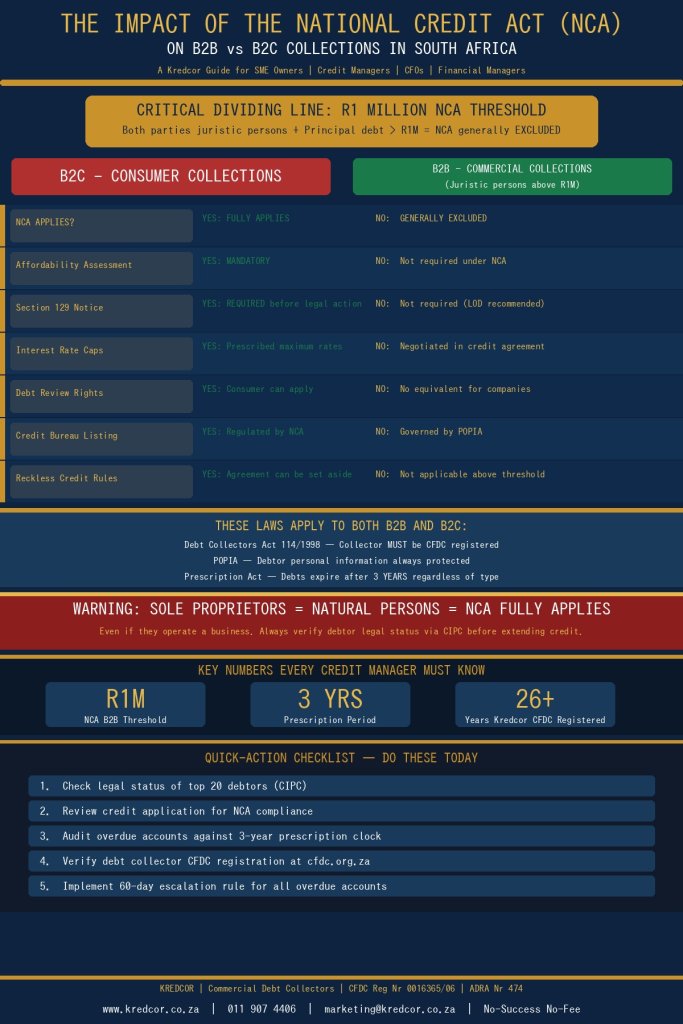
✅ Quick-Action Checklist — Do These Today
- Check the legal status of your top 20 debtors. Are they registered companies (juristic persons) or sole proprietors (natural persons)? This single check tells you whether the NCA applies to those accounts.
- Review your credit application for NCA compliance. Does it include an affordability assessment clause, prescribed disclosure, interest rate terms, and POPIA consent? If not, update it before your next credit extension.
- Audit your overdue accounts against the prescription clock. Flag any accounts approaching the 2-year mark and escalate them to a pre-legal collection process immediately.
- Verify your debt collector’s CFDC registration. If you use a third-party agency, confirm their registration at cfdc.org.za. If they’re not registered, replace them with a registered partner like Kredcor.
- Implement a 60-day escalation rule. Any account 60 days overdue with no resolved payment commitment should automatically escalate to a formal pre-legal process. Acting at 60 days rather than 120+ days materially improves your recovery rate.
📖 Want More Practical Credit Management Content?
We publish regular, actionable articles for South African credit managers, CFOs, and SME owners. Browse our full library at www.kredcor.co.za/kredcor-articles/ — you’ll find guides on debt collection processes, letter of demand templates, credit risk management, and much more.
Frequently Asked Questions
These are the four questions our team hears most often from credit managers and CFOs about the NCA’s impact on B2B vs B2C collections.
Q1: Does the National Credit Act apply to B2B transactions in South Africa?
The NCA applies to B2B transactions only in specific circumstances. If both parties are juristic persons (registered companies or close corporations) and the principal debt exceeds R1 million, the NCA generally does not apply. However, where one party is a natural person (such as a sole proprietor), or the transaction is below the threshold, NCA provisions may still apply. Always verify the legal status of both parties before assuming a NCA exemption.
Q2: What is the NCA threshold for B2B credit agreements in South Africa?
The key NCA threshold is R1 million. Credit agreements between two juristic persons where the principal debt exceeds R1 million are excluded from most NCA provisions. This gives businesses more flexibility in setting credit terms. However, the Debt Collectors Act, POPIA, and the Prescription Act still apply to B2B collections regardless of the NCA threshold.
Q3: Can a business charge any interest rate on a B2B overdue account if the NCA doesn’t apply?
If the NCA does not apply, the interest rate is governed by your signed credit agreement or trading terms. There are no NCA interest rate caps, but the rate must be contractually agreed upon and clearly stated. Courts will generally enforce the agreed rate, provided it is not excessively unconscionable. Always specify your interest rate in your credit application before extending credit.
Q4: What are the main differences between B2B and B2C debt collection under South African law?
B2C collections are governed by the full NCA — requiring affordability assessments, Section 129 notices before legal action, interest rate caps, and debt review rights. B2B collections between qualifying juristic persons above R1 million have far more flexibility, but are still governed by the Debt Collectors Act (all collectors must be CFDC-registered), the Prescription Act (3-year prescription), and POPIA. The key difference is the consumer-protection layer that the NCA adds for individuals and entities that fall below the NCA threshold.
Kredcor Khuluma CC — Registered Commercial Debt Collectors, South Africa
CFDC Reg Nr 0016365/06 · 26 Years Unblemished Record
65 Saint Michael Ave, New Redruth, Alberton, Gauteng · 011 907 4406 · moc.puorgrocderk@idnal
This article is for general informational purposes only and does not constitute legal advice. Always consult a qualified legal professional or registered debt collection specialist for advice specific to your situation.