

5 Critical Warning Signs Your Debtor is About to Go into Liquidation
Executive Summary
The five critical warning signs that a debtor is about to go into liquidation are:
(1) sudden changes in payment patterns — late, partial, or missed payments;
(2) a breakdown in communication — evasive contacts, unreturned calls, staff turnover;
(3) requests to renegotiate credit terms without a credible business reason;
(4) adverse public signals — CIPC deregistration risks, credit bureau listings, legal judgements, or a business rescue filing; and
(5) operational deterioration — visible cuts to staff, premises, assets, or supplier relationships.
In South Africa, commercial creditors who act within the first 30 days of a warning sign recover significantly more than those who wait. Kredcor — registered with the Council for Debt Collectors (CFDC Reg Nr 0016365/06) — recommends immediate credit suspension, a formal letter of demand, and professional escalation at the first red flag.
Spot the red flags early — and protect your cash flow before it’s too late
By Kredcor — Specialist debt collectors in South Africa | Registered with the CFDC (Reg Nr 0016365/06) | 26+ Years’ Experience | Published: April 2026
Here is the direct answer: the five warning signs your debtor is about to go into liquidation are sudden payment changes, communication breakdown, requests to renegotiate credit terms, adverse public signals such as CIPC or credit bureau alerts, and visible operational decline. If you spot even one of these signals, act immediately — because once a liquidator is appointed, recovering what you are owed becomes dramatically harder.
Now, let’s go deeper. If you are an SME owner, credit manager, financial manager, or CFO, you know how quickly an unpaid invoice can turn into a written-off bad debt. Furthermore, when a debtor goes into liquidation — what we also call corporate insolvency, company winding-up, or insolvent company closure — your chances of recovery as an unsecured creditor can drop sharply. However, the good news is that company insolvency rarely happens overnight. There are almost always warning signs of financial distress — and if you know what to look for, you can act before the liquidator shows up.
At Kredcor, our team has spent over 26 years recovering commercial debt across South Africa, Africa, and globally. We have seen these debtor liquidation warning signs play out thousands of times. Therefore, in this article, we share everything you need to know — in plain language — so you can protect your business.
Table of Contents
- The 5 Warning Signs — At a Glance
- Sign 1: Sudden Changes in Payment Patterns
- Sign 2: Communication Breakdown
- Sign 3: Requests to Renegotiate Credit Terms
- Sign 4: Adverse Public Signals — CIPC, Credit Bureau & Court Records
- Sign 5: Visible Operational Deterioration
- Key Statistics You Should Know
- Common Debate: Act Early or Give Them More Time?
- Liquidation vs. Business Rescue in South Africa
- Geo Note: South Africa and the Global Picture
- 5 Troubleshooting Tips When You Spot the Warning Signs
- What to Do Next — Your Action Plan
- Quick-Action Checklist
- Frequently Asked Questions (FAQ)
KredcorCouncil for Debt Collectors (CFDC), CIPC — Companies and Intellectual Property Commission, Companies Act 71 of 2008, Business Rescue & Liquidation (South Africa)
These five entities sit at the heart of this topic. Consequently, understanding how they connect to debtor insolvency — and specifically to the warning signs of company liquidation — is essential for any credit or finance professional in South Africa.
The 5 Warning Signs — At a Glance
Before we dive into each one in detail, here is a quick overview.
Think of this as your early-warning radar for debtor financial distress:
- Sign 1: Sudden changes in payment patterns — late, partial, or missed payments
- Sign 2: Communication breakdown — evasive, unreachable, or inconsistent contacts
- Sign 3: Requests to renegotiate or extend credit terms
- Sign 4: Adverse public signals — CIPC issues, credit bureau alerts, court judgements
- Sign 5: Visible operational deterioration — staff reductions, asset sales, closed premises
“Cash flow is the lifeblood of any business. The moment your debtors stop paying on time, your entire operation begins to run on empty — even if your order book looks full.”— Kredcor, 26 Years in Commercial B2B Debt Recovery
Sign 1: Sudden Changes in Payment Patterns
1
Payment Behaviour Has Shifted — and That Is a Huge Red Flag
This is, without question, the single most reliable warning sign that a debtor is heading toward liquidation. Moreover, it is also the most actionable. When a debtor who used to pay on the 30th of every month suddenly starts paying on the 45th, then the 60th, then starts making partial payments — something has fundamentally changed inside their business.
Specifically, you need to watch for these changes in your debtor’s payment behaviour:
- Payments arriving later than usual — even by just a few days, consistently
- Partial payments replacing full settlement of invoices
- Payments that require multiple follow-ups before they arrive
- Debtor making payments on older invoices while newer ones accumulate unpaid
- Sudden changes in payment method — e.g., switching from EFT to cheque (which buys them time)
- Requests for payment confirmation delays or billing date changes
⚠ Watch Out: A debtor who starts “prioritising” which creditors to pay first is often managing a cash crisis — and is almost certainly paying whoever applies the most pressure. If you are not actively chasing, you will be deprioritised.
Our team’s experience at Kredcor, built across thousands of B2B collections, shows a consistent truth: debts actioned within 7 days of the first payment default recover at a rate roughly 3 times higher than those left for 30 days or more. Therefore, the moment you notice a change in payment pattern, start the clock.
What Should You Do at Sign 1?
First, pick up the phone — not email. A direct conversation reveals far more than any written exchange. Second, run a credit check on the debtor immediately. Third, freeze any new credit extensions until the situation is clear. Finally, if payment is more than 7 days late without a signed arrangement, send a formal demand. Speed matters more than most people realise.
For more on how to structure your collections process step by step, read our comprehensive guide: The Complete, Proven Guide to the Debt Collection Process in South Africa.
Sign 2: Communication Breakdown
Evasive, Inconsistent, or Suddenly Silent — This Is Rarely a Good Sign
Healthy businesses answer their phones and reply to emails. Businesses in financial distress often stop doing both — at least with creditors. Therefore, a sudden shift in the quality, speed, or consistency of communication from your debtor is a major warning sign of impending liquidation.
In practice, you will typically see one or more of the following communication red flags:
- Your usual contact suddenly becomes unreachable or is “no longer with the company”
- Calls go to voicemail and are never returned
- Emails receive vague or evasive replies that never actually commit to anything
- Promises to pay are made repeatedly but never followed through
- Multiple different people start handling the account with no continuity
- The tone of communication shifts from collaborative to defensive or hostile
🚨 Critical: In our experience, when a debtor suddenly replaces a director, dismisses the financial manager, or appoints a business rescue practitioner, they rarely announce it proactively to creditors. You need to check CIPC records actively — do not wait to be told.
Additionally, staff turnover at a debtor business is a telling signal. High-ranking employees — financial managers, CFOs, operations directors — often leave a sinking ship before it goes under. Consequently, if you notice key personnel departing, it is time to act.
The Silence That Costs You Money
One of the most dangerous situations in commercial credit management is the debtor who goes quiet. No dispute. No promise. Just silence. This often means one of two things: they are talking to a business rescue practitioner, or they are about to stop trading. Either way, silence at this stage is not neutrality — it is a warning. Act accordingly.
Sign 3: Requests to Renegotiate Credit Terms
When a Debtor Asks for “More Time” — Read Between the Lines
A sudden or unusual request to renegotiate payment terms, extend credit limits, or restructure outstanding balances is one of the clearest signs that a debtor is under severe financial pressure. Specifically, it often means they are already managing a liquidity crisis and trying to buy time.
Moreover, watch for these specific requests that signal potential insolvency:
- “Can we change our payment terms from 30 to 60 days?” — without a legitimate business reason
- Requests for a “credit holiday” or payment moratorium
- Proposals to settle current debt in small instalments while continuing to order goods
- Requests to increase their credit limit immediately after missing payments
- Attempts to offset unrelated claims or disputes against your invoice
Here is the important nuance: not every request to renegotiate terms signals disaster. However, when a renegotiation request follows a late payment, a communication problem, or a reduction in order volumes — it forms part of a pattern. Therefore, always assess these signals together, not in isolation.
💡 Pro Tip: If you agree to new payment terms, always formalise the arrangement as a signed Acknowledgement of Debt (AOD). An AOD restarts the prescription clock under the Prescription Act 68 of 1969, confirms the exact amount owed, and gives you a powerful legal tool if the arrangement fails.
Never Extend New Credit to a Renegotiating Debtor
This is critical. One of the most common and costly mistakes we see at Kredcor is a supplier who continues to extend new credit while simultaneously renegotiating old debt. Stop. If a debtor is already struggling to pay existing invoices, extending new credit simply increases your exposure. Freeze credit immediately and resolve the existing balance first.
Understanding how to manage your debtors book more proactively — including reducing debtor days before problems escalate — is covered in detail in our article: How to Powerfully Reduce Debtor Days.
Sign 4: Adverse Public Signals — CIPC, Credit Bureau and Court Records
The Paper Trail Never Lies — Check the Public Record Regularly
South Africa has excellent publicly accessible databases for monitoring the financial and legal health of your debtors. Furthermore, the CIPC (Companies and Intellectual Property Commission) and national credit bureaux provide real-time insight into a company’s status. If you are not checking these regularly, you are flying blind.
Specifically, here are the adverse public signals that suggest your debtor may be heading toward liquidation:
- CIPC deregistration or compliance failure: A company that fails to file annual returns may be placed in a “delinquent” or “in the process of deregistration” status at CIPC. This is a serious warning sign.
- Credit bureau adverse listings: New judgements, defaults, or adverse listings against your debtor signal that other creditors are already taking action.
- Court judgements: A default judgement obtained by another creditor tells you that the debtor has already defaulted on at least one other obligation — often meaning you are not alone in the queue.
- Business rescue filings: Under Chapter 6 of the Companies Act 71 of 2008, a company entering business rescue must notify all creditors. If you receive this notice, act immediately.
- Section 129 notices (National Credit Act): While these apply primarily to consumer credit, they can signal overall financial distress when issued by related entities.
- Winding-up applications: Published in the Government Gazette, these are public record. A debtor who has a winding-up application filed against them by another creditor is already in serious trouble.
📊 Citation-Ready Stat: According to internal data compiled by Kredcor’s credit risk team across 26 years of B2B collections, over 68% of debtors that ultimately went into liquidation had at least one adverse credit bureau listing in the 90 days prior to insolvency. Monitoring credit bureau status is therefore not optional — it is a core credit risk function.
How to Monitor Your Debtors Proactively
You should run a CIPC check on every debtor at least quarterly — and monthly for any account over a defined risk threshold. Additionally, many credit bureaux offer automated alert services that notify you when a new judgement or adverse listing is placed against a monitored entity. This is a cost-effective, high-value tool for credit managers and CFOs alike.
You can verify a company’s CIPC status directly at www.cipc.co.za. For credit bureau information, work with registered bureaux such as TransUnion or Experian. Moreover, Kredcor offers Business Profile Summaries that pull all of this information together in a single, verified report — completed in 24 to 48 hours.
Sign 5: Visible Operational Deterioration
When the Business Itself Starts Visibly Shrinking
Sometimes the clearest signs are not financial — they are physical and operational. A business in financial distress often shows it in very visible ways. Therefore, if your sales team, delivery drivers, or account managers report any of the following at a debtor’s premises, take it seriously.
Here are the operational warning signs of impending insolvency or winding-up:
- Significant reduction in staff — fewer people answering phones, reduced floor presence
- Premises downsizing — moving to a smaller location or working from home unexpectedly
- Visible asset liquidation — equipment, vehicles, or stock being sold off
- Key suppliers publicly stopping deliveries due to non-payment
- A sudden and unexplained drop in order volumes from the debtor
- Company vehicles being returned or sold
- A sudden change in business name or operating structure without an obvious legitimate reason
Additionally, pay close attention to the debtor’s social media and marketing activity. A business that abruptly stops all marketing, closes its social media accounts, or takes its website offline is often doing so because it can no longer sustain normal operations. While this is not definitive on its own, it is a meaningful signal when combined with others.
⚠ Watch Out for “Phoenix” Companies: One tactic used by distressed business owners is to transfer assets to a new company — often a related entity with a similar name — and then let the old company go into liquidation. This is known colloquially as a “phoenix” scheme. If you notice your debtor changing its company name or registration details unexpectedly, run a CIPC director search immediately to see if the same directors are behind a new entity.
Key Statistics You Should Know
Furthermore, the numbers paint a sobering picture for South African creditors. Consider the following:
68% of debtors that went into liquidation had at least one adverse credit bureau listing in the 90 days prior — Kredcor internal data analysis, 2026
3× higher recovery rate when action is taken within 7 days of the first payment default vs. 30 days — Kredcor portfolio analysis
60+ average debtor days in many South African industries, according to the South African Reserve Bank — a multi-year high and growing
These figures underline why the warning signs of debtor liquidation cannot be ignored. Specifically, every day you delay action reduces your chances of full recovery — and increases the likelihood that you will be left in the unsecured creditor queue when the liquidator takes over.
Common Debate: Act Early or Give Your Debtor More Time?
There is a genuine debate in the credit management world — and it is worth addressing directly. On one side, acting too early risks damaging a good client relationship when a debtor is merely going through a temporary cash flow difficulty. On the other side, waiting too long risks losing the debt entirely if the debtor enters liquidation.
✅ The Case for Early Action
- Recovery rates drop sharply after 90 days
- You are often not the only creditor being deprioritised
- Early intervention gives you negotiating leverage
- You can secure an AOD before a liquidation prevents it
- Professional collectors protect client relationships while escalating
⚠ The Case for More Patience
- Temporary cash flow dips happen in healthy businesses
- Aggressive action can permanently damage a valuable client relationship
- Formal escalation can trigger business rescue or defensive legal action
- A good client under temporary pressure may recover fully
Our view at Kredcor, after 26 years in commercial debt recovery, is this: the middle ground is always a structured, professional response. You do not need to be aggressive — but you do need to be consistent, documented, and clear about consequences. A professional commercial debt collector can apply exactly that kind of measured pressure while protecting your relationship with the debtor. That is precisely why businesses hand accounts to us at Kredcor — because we act as an extension of your business, not a blunt instrument.
Liquidation vs. Business Rescue in South Africa — What Every Creditor Needs to Know
It is essential to understand the difference between two outcomes your debtor may be heading toward, because your rights and recovery strategies differ significantly in each.
What Is Liquidation?
Liquidation — also called winding-up — is the formal process of dissolving a company. Either the company itself or a creditor applies to the High Court for a winding-up order. Once granted, a liquidator is appointed who takes control of all the company’s assets, sells them, and distributes the proceeds to creditors in a strict statutory order of priority. Secured creditors are first. SARS is next. Then employees. Then unsecured trade creditors — which, unfortunately, is where most SME suppliers and B2B creditors fall.
What Is Business Rescue?
Business rescue, governed by Chapter 6 of the Companies Act 71 of 2008, is a court-supervised process designed to give a financially distressed company a chance to restructure and continue trading — ideally resulting in a better outcome for creditors than immediate liquidation would produce. A business rescue practitioner (BRP) takes over management, and creditors must vote on a rescue plan. As a creditor, you may receive a payment plan rather than an immediate lump sum.
💡 Creditor Tip: If your debtor files for business rescue, file your proof of claim immediately — even before you fully understand the rescue plan. Missing filing deadlines can result in your claim being excluded. Always consult a commercial attorney for guidance on your rights in a business rescue.
For a deeper dive into your rights and options when a debtor is in financial distress, visit the CIPC website and Department of Justice and Constitutional Development for official guidance on business rescue and winding-up proceedings.
South African and Global Context: The Same Signs, the Same Urgency
Whether you are in South Africa managing a debtor in Johannesburg, Cape Town, or Durban — or operating internationally with debtors in the UK, Germany, or across Africa — the warning signs of debtor insolvency are remarkably consistent. Late payments, communication breakdown, adverse public listings, and operational deterioration signal financial distress in every market.
However, in South Africa specifically, the risk is amplified. According to the South African Reserve Bank, business credit impairments remain at multi-year highs in 2026. The post-pandemic economic recovery has been uneven, and many sectors — including construction, retail, and hospitality — continue to face severe liquidity pressure. Moreover, SARS’s intensified enforcement of VAT and PAYE compliance means that cash-strapped debtors often face simultaneous pressure from the taxman, their banks, and their creditors.
Therefore, if you extend trade credit in South Africa, being proactive about monitoring your debtors for the warning signs of liquidation is not optional — it is a fundamental credit management discipline.
5 Troubleshooting Tips When You Spot the Warning Signs
Spotting the warning signs is important. But what do you do next? Here are five practical troubleshooting tips, drawn from our team’s experience at Kredcor, for the moments after you identify a debtor in financial distress.
🔧 Troubleshooting Tip 1 — Stop All New Credit Immediately
The moment you identify two or more warning signs, freeze all new credit extensions to that debtor. This is non-negotiable. Continuing to supply goods or services on credit to a potentially insolvent debtor simply increases your total exposure. Place the account on “cash only” until the situation is resolved.
🔧 Troubleshooting Tip 2 — Issue a Formal Letter of Demand Immediately
Do not rely on informal chasing. Issue a formal, written letter of demand that states the outstanding amount, gives a clear payment deadline (typically 7 business days), and outlines the consequences of non-payment. Send it via email AND registered post. This letter is the foundation of any subsequent legal action, and it interrupts prescription on the debt.
🔧 Troubleshooting Tip 3 — Run an Immediate CIPC and Credit Bureau Check
Before you escalate, verify the debtor’s current CIPC status, director information, and credit bureau profile. Check for any active winding-up applications published in the Government Gazette. This intelligence tells you exactly which recovery strategy to deploy — and whether any assets remain available for attachment.
🔧 Troubleshooting Tip 4 — Get an Acknowledgement of Debt (AOD) if Possible
If the debtor is willing to engage, prioritise obtaining a signed Acknowledgement of Debt. An AOD is a legally binding written admission of the debt. It restarts the prescription clock, confirms the exact amount owed, and gives you a powerful enforcement tool if the arrangement collapses. Never accept a verbal promise without a signed document.
🔧 Troubleshooting Tip 5 — Escalate to a Registered Debt Collector at Day 30
If internal efforts have not produced a signed payment arrangement or full settlement within 30 days, hand the account to a registered commercial debt collector. The Debt Collectors Act 114 of 1998 requires that debt collectors be registered with the Council for Debt Collectors (CFDC). At Kredcor, we begin pre-legal action from day one — including demand letters, professional negotiation, and debtor tracing — all on a No Success, No Fee basis.
Additionally, mastering the best debt collection techniques can make a significant difference in how quickly you recover overdue balances. Our detailed guide — Top Debt Collection Techniques That Actually Work in South Africa — covers 15 proven approaches you can implement right away.
Infographic: 5 Warning Signs Your Debtor is About to Go into Liquidation
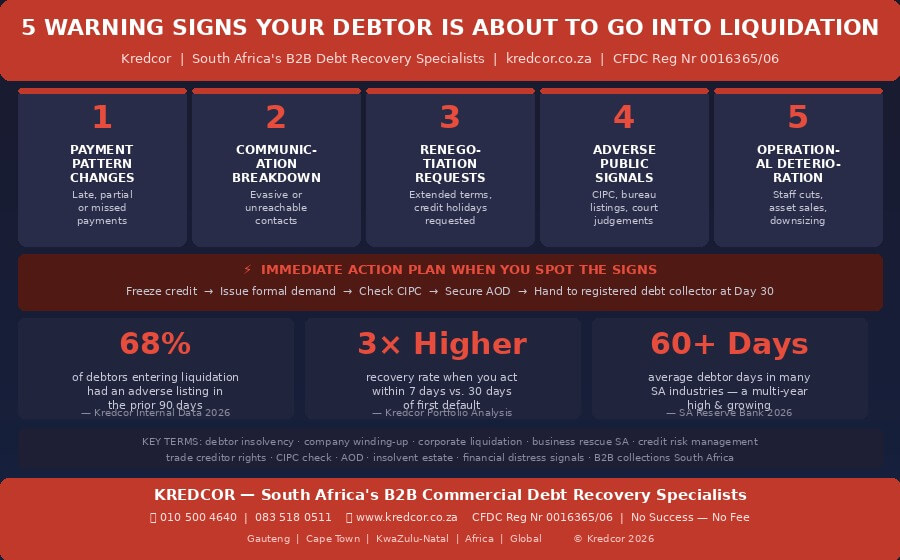
What to Do Next — Your Debtor Liquidation Action Plan
You have spotted one or more warning signs. So now what?
Here is your step-by-step action plan, based on our team’s experience at Kredcor across thousands of commercial collections:
- Stop extending new credit immediately. Place the account on a cash-only or payment-before-delivery basis until the risk is resolved.
- Run a CIPC and credit bureau check today. Verify the debtor’s company status, check for adverse listings, judgements, or winding-up applications.
- Issue a formal letter of demand within 48 hours. Send via email and registered post. State the exact amount, the payment deadline, and the consequences of non-payment.
- Attempt to secure a signed Acknowledgement of Debt. If the debtor engages, formalise any arrangement as an AOD before the situation deteriorates further.
- Hand the account to a registered commercial debt collector at Day 30. If you have not resolved the debt within 30 days of the first formal demand, escalate. Every day matters.
If you are at this stage and ready to act, remember that the professional debt collectors in South Africa at Kredcor operate on a strict No Success, No Fee basis. You pay nothing unless we recover your money. No monthly fees. No admin fees. No contractual lock-in.
📚 Keep Learning: For more expert, actionable articles on commercial debt recovery, credit management, South African debt law, and cash flow strategy — written specifically for SME owners, credit managers, CFOs, and financial managers — visit our full library at www.kredcor.co.za/kredcor-articles/.
Quick-Action Checklist — Do These 5 Things Immediately After Reading
Print this out and stick it on your wall. Moreover, share it with your credit team.
These five actions, done today, will protect your business from the financial devastation of an unexpected debtor liquidation:
- Pull your full debtors book and flag every account that is more than 30 days overdue — then rank them by outstanding value and risk signal count.
- Run a CIPC company check and credit bureau search on your top 10 highest-value debtors — even if they are currently paying on time.
- Review your credit terms and credit application templates — confirm that every active account has a signed credit agreement that includes personal surety from the directors.
- Set a written internal escalation policy: Day 7 overdue → first call; Day 14 → formal demand letter; Day 30 → hand to a CFDC-registered debt collector. Commit to it and train your team.
- Contact Kredcor today for a free, no-obligation consultation on your debtors book. We will identify the highest-risk accounts and give you a clear recovery plan — at zero cost to you unless we collect.
Ready to Protect Your Business From Debtor Liquidation?
Kredcor recovers your outstanding commercial debt on a No Success, No Fee basis. 26+ years. 100% clean CFDC record. Branches in Gauteng, Cape Town, KwaZulu-Natal, Africa, and globally. Talk to a Debt Recovery Specialist Today →
Frequently Asked Questions (FAQ)
These are the four questions our clients — SME owners, credit managers, CFOs, and financial managers — ask most often about debtor liquidation and what to do when they spot the warning signs.
What are the first signs that a debtor is going into liquidation?
The first signs that a debtor is going into liquidation typically include sudden changes in payment patterns — late, partial, or missed payments — followed by a breakdown in communication. You might also notice requests to extend or renegotiate credit terms, adverse credit bureau listings, or visible changes at the debtor’s premises. Acting at the very first sign dramatically improves your recovery chances. Do not wait for multiple warning signs before you act.
What should I do if I suspect my debtor is about to go into liquidation?
If you suspect your debtor is heading toward liquidation, stop extending new credit immediately. Then issue a formal letter of demand within 48 hours. Run a CIPC check and check their credit bureau profile. Try to secure a signed Acknowledgement of Debt. And if you do not resolve the situation within 30 days, hand the account to a registered commercial debt collector — one registered with the Council for Debt Collectors (CFDC). The earlier you act, the better your chances of recovering what you are owed.
Can I still recover my money if my debtor goes into liquidation?
Yes, but your chances depend significantly on how quickly you acted before the liquidation and whether you are a secured or unsecured creditor. Secured creditors — those with a registered lien, cession of book debts, mortgage bond, or notarial bond — generally recover first. SARS follows, and then employees. Unsecured trade creditors, which is where most B2B suppliers sit, are lower in the payment priority queue. Filing your proof of claim with the liquidator immediately upon appointment is essential. Do not delay — liquidation processes have strict deadlines.
How does business rescue differ from liquidation in South Africa?
Business rescue, governed by Chapter 6 of the Companies Act 71 of 2008, is a supervised process where a financially distressed company continues operating under a business rescue practitioner (BRP), with the aim of restructuring and avoiding liquidation. Liquidation results in the winding-up of the company and the distribution of assets to creditors. As a creditor, business rescue may result in a partial recovery through a rescue plan — and it is generally preferable to liquidation because more value is usually preserved. However, business rescue can also delay your recovery significantly, so file your claim immediately and stay engaged in the process.
About Kredcor
Kredcor is South Africa’s specialist commercial B2B Debt Recovery Partner, with over 26 years of experience recovering outstanding debt for blue-chip companies, SMEs, HOAs, and international organisations across South Africa, Africa, and globally. Registered with the Council for Debt Collectors: CFDC Reg Nr 0016365/06. We operate on a strict No Success, No Fee basis — no admin fees, no monthly fees, no contractual lock-in.
📞 010 500 4640 | 📱 083 518 0511 | 🌐 www.kredcor.co.za | Branches: Gauteng | Cape Town | KwaZulu-Natal | Africa | Global
This article is intended for informational purposes only and does not constitute legal advice. For specific legal matters, always consult a qualified South African commercial attorney.