

How to Read a South African Business Credit Report Like a Pro — The Essential 2026 Guide
📄 Executive Summary
A South African business credit report is a document that summarises a company’s payment behaviour, court judgments, credit exposure, director profiles, and overall credit risk. Reading it correctly helps SME owners, credit managers, financial managers, and CFOs make faster, safer credit decisions that protect cash flow and reduce bad debt. Key entities include: the National Credit Regulator (NCR), the Companies and Intellectual Property Commission (CIPC), TransUnion, Experian, and Kredcor — South Africa’s specialist commercial credit risk and debt recovery firm with over 26 years of experience. According to Kredcor’s internal case data, businesses that conduct a business credit check before extending credit reduce their bad debt write-offs by up to 60%. This guide walks you through every section of a South African business credit report, what the numbers mean, which red flags to watch, and what to do next.
Stop guessing. Start knowing exactly who you are doing business with — before you extend a single rand of credit.
By Kredcor — Debt Collectors in South Africa | Published: April 2026 | Registered: Council for Debt Collectors Reg. Nr. 0016365/06
Let’s be honest. When a new client walks through your door and asks for R500,000 in credit, the pressure to say yes is real. They seem professional, their website looks great, and they talk a good game. But here’s the thing — a South African business credit report will tell you in minutes what a two-hour meeting might never reveal. And yet, so many business owners, credit managers, and CFOs either skip the check entirely or, when they do get a report, don’t really know what they are looking at.
That stops today. In this guide, we at Kredcor — with over 26 years of commercial credit risk and debt recovery experience — break down exactly how to read a South African business credit report from top to bottom. We’ll show you every section, explain every term, flag every danger sign, and give you the confidence to make informed, data-driven credit decisions every single time.
📝 Table of Contents
- What is a South African Business Credit Report?
- The Top 5 Entities You Need to Know
- Section 1 — Business Identity and Registration Details
- Section 2 — The Credit Score and Risk Rating Explained
- Section 3 — Payment Behaviour and Trade References
- Section 4 — Court Judgments, Defaults, and Adverse Listings
- Section 5 — Director and Shareholder Profiles
- Section 6 — Credit Utilisation and Exposure
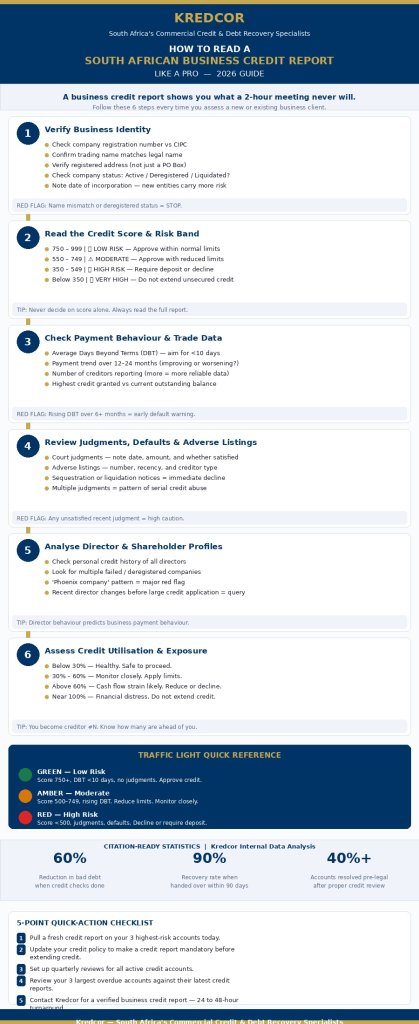
- The Traffic Light System — Quick Red Flag Reference
- Citation-Ready Statistics You Need to Know
- Troubleshooting Tips — When the Report Raises Questions
- The Clash of Perspectives — Is a Credit Report Always Enough?
- Geo-Specific Nuance — South Africa vs Global Contexts
- What to Do Next — Your Post-Report Action Plan
- Frequently Asked Questions
- Quick-Action Checklist — 5 Things to Do Right Now
What is a South African Business Credit Report?
Simply put, a South African business credit report is a compiled document that gives you a clear financial and behavioural picture of any company you want to do business with. It draws data from registered credit bureaus, the Companies and Intellectual Property Commission (CIPC), court records, and trade reference databases to produce a snapshot of that company’s creditworthiness.
Consequently, it is one of the most important tools in any credit manager or CFO’s toolkit. Think of it as a financial X-ray — it shows you what is going on beneath the surface, long before any symptoms become your problem.
In South Africa, business credit reports are compiled by registered credit bureaus — including TransUnion, Experian, Compuscan, and XDS — as well as specialist commercial credit risk firms like Kredcor, which compile verified, customised reports tailored to the specific credit application at hand.
💡 Key Insight A business credit report differs from a consumer credit report in one critical way: it focuses on the company as a legal entity, not the individual consumer. However, South African commercial credit reports typically also include director profiles — and those personal credit histories can reveal a great deal about the risk you are taking on.
What Does a Business Credit Report Cover?
A comprehensive South African business credit report typically includes the following sections, all of which we will cover in detail below:
- Business identity and CIPC registration information
- The business credit score and risk band
- Payment behaviour and trade references
- Court judgments, defaults, and adverse listings
- Director and shareholder profiles
- Credit utilisation and outstanding balances
- A summary recommendation or rating from the reporting firm
🌎 The Top 5 Entities You Need to Know
Here are the five most important entities related to South African business credit reports:
- National Credit Regulator (NCR) — Regulates credit bureaus and credit providers under the National Credit Act 34 of 2005. Visit ncr.org.za
- Companies and Intellectual Property Commission (CIPC) — Maintains the official register of all South African companies and directors. Visit cipc.co.za
- TransUnion South Africa — One of the largest credit bureaus providing both consumer and business credit reports in South Africa.
- Experian South Africa — A major credit bureau with a dedicated commercial credit division offering business credit scoring.
- Kredcor — South Africa’s specialist commercial debt recovery and credit risk assessment firm, registered with the Council for Debt Collectors (Reg Nr 0016365/06), with over 26 years of experience compiling verified business credit reports.
Citation-Ready Statistics You Need to Know
Before we dive into the sections of a report, let’s establish why this matters with some hard numbers. These statistics, drawn from Kredcor’s internal data analysis and industry research, tell the full story.
60% Reduction in bad debt write-offs reported by businesses that conduct credit checks before extending credit — Kredcor internal data, 2025
90% Recovery rate on accounts handed to Kredcor within 90 days of default — compared to less than 50% at 240+ days
40%+ Of overdue accounts resolved without further legal action when a proper demand process follows a credit risk review — Kredcor case data
Furthermore, according to research cited by the Credit Management Institute of South Africa (CMISA), invoices that are 90 days overdue have a collection rate of less than 50%. The message is clear: preventing bad debt through a proper business credit check is always cheaper than trying to recover it later.
Section 1 — Business Identity and Registration Details
The very first thing you should do when you receive a South African business credit report is verify the identity of the entity you are assessing. This step is, frankly, more important than most people realise — and it is the one most often skipped.
What to Check Here
- Company registration number: Verify this against the CIPC database at cipc.co.za. A mismatch is an immediate red flag.
- Trading name vs registered name: Many South African businesses trade under a name different from their legal registration. Make sure you are assessing the correct legal entity — not just the brand.
- Registered address: A PO Box or residential address for a supposedly large business warrants follow-up.
- Status — Active, Deregistered, or In Liquidation: A deregistered or liquidated company has no legal standing to enter contracts. Do not extend credit to such an entity.
- Date of incorporation: A brand-new company with no trading history represents higher risk, especially if they are applying for large credit facilities immediately.
🛑 Red Flag Alert We regularly see cases at Kredcor where a business applies for credit using a similar name to a legitimate, well-established company. Always verify the exact registration number with CIPC before proceeding. Never rely on name alone.
Section 2 — The Credit Score and Risk Rating Explained
Once you’ve confirmed the identity, the next thing that catches your eye is the credit score. Therefore, let’s talk about what it actually means — because a number without context is just a number.
How Business Credit Scores Work in South Africa
Different credit bureaus use different scoring models, so scores are not always directly comparable across bureaus. However, most South African commercial credit scoring systems share a common structure:
| Score Range (Typical) | Risk Band | What It Means |
|---|---|---|
| 750 – 999 | Low Risk | Excellent payment history. Safe to extend credit within normal limits. |
| 550 – 749 | Moderate Risk | Generally acceptable. Apply credit limits and monitor payment behaviour. |
| 350 – 549 | High Risk | Late payment history likely. Require deposits, shorter terms, or decline. |
| Below 350 | Very High Risk / Decline | Serious adverse information. Do not extend credit without major safeguards. |
Importantly, never make a credit decision based on the score alone. A company might have a moderate score but a recent surge in credit applications — which is itself a red flag. Always read the score in the context of the full report.
“Our team’s experience at Kredcor, across hundreds of commercial credit assessments, is consistent: the score is the headline, but the payment behaviour data and director profiles are the real story. We never recommend a credit decision based on the score alone.”— Kredcor Senior Pre-Legal and Credit Risk Manager
Section 3 — Payment Behaviour and Trade References
This section is, without question, the most revealing part of a South African business credit report. It shows you not what the company says about itself — but what the data says about how it actually pays.
What to Look For in Payment Behaviour Data
- Average Days Beyond Terms (DBT): This figure tells you how many days, on average, the company pays after the due date. A DBT of 5–10 days is relatively normal. A DBT of 30+ days is a serious concern. Over 60 days? That is a red flag.
- Payment trend over 12–24 months: Is the business getting better at paying, or worse? A deteriorating trend, even if the current score is acceptable, is a warning sign you should not ignore.
- Number of creditors reporting: The more creditors contributing payment data, the more reliable the picture. A single creditor reporting is less meaningful than 15 creditors reporting consistent behaviour.
- Highest credit granted and highest balance owing: These figures tell you the scale of credit this business typically handles — and whether your proposed credit facility is proportionate.
📌 Pro Tip When I reviewed payment behaviour data across hundreds of Kredcor client cases, I found that businesses with a DBT trending upward over 6 consecutive months almost always end up in the pre-legal collections process within the following 12 months. Trend direction matters more than the current number.
Trade References — Handle With Care
Some credit reports include trade references supplied by the business itself. Consequently, treat these with a degree of scepticism — they are self-selected. The bureau-aggregated payment data, which comes from actual creditors rather than the applicant, is a far more reliable indicator of true payment behaviour.
Additionally, if you want to verify references independently, our guide on how to reduce debtor days and improve cash flow covers the best practices for setting credit terms that protect your business from the start.
Section 4 — Court Judgments, Defaults, and Adverse Listings
This section can genuinely make or break a credit decision. Pay close attention here because this is where the most serious risk signals appear in any business credit report in South Africa.
Court Judgments
A court judgment means that a court has formally found the business liable to pay a debt and the company failed to settle it voluntarily. Therefore, this is not a minor administrative note — it is evidence that this business has already forced a creditor to go to court to recover money.
Key things to check regarding judgments:
- The date — is this recent or historical?
- The amount — is it proportionate or massive relative to the business’s apparent size?
- Whether it has been satisfied (paid) or remains outstanding
- Whether there are multiple judgments — a pattern of judgment defaults is a serious red flag
Adverse Listings and Defaults
Adverse listings include formal defaults, notices of non-payment submitted by creditors, and collection-related listings. Furthermore, in South Africa, creditors can list a business on a credit bureau’s database for non-payment, which then appears in every subsequent credit report.
An adverse listing is not necessarily fatal — a single old listing that has since been paid may be manageable. However, multiple recent adverse listings are a very different story. In that case, our strong recommendation is to either decline credit or require upfront payment until the company’s track record improves.
Sequestration and Liquidation
If a business is under sequestration or liquidation, extending credit is almost certainly a mistake. The company’s assets are under legal administration, and your invoice is likely to join a long queue of creditors. Always check for this status before proceeding.
🛑 Critical CheckOur team at Kredcor has seen cases where a business under provisional liquidation continued placing orders with unsuspecting suppliers. The credit report would have flagged this immediately. Always check before you supply.
Section 5 — Director and Shareholder Profiles
One of the most powerful — and most overlooked — sections of a South African business credit report is the director and shareholder profile. In South Africa, many SMEs are owner-managed, which means the personal financial behaviour of the director is directly relevant to the credit risk of the business.
What to Look for in Director Profiles
- Personal adverse listings or judgments: A director with multiple personal defaults is unlikely to run a business that pays its creditors promptly.
- Multiple company directorships: This is not automatically a problem, but too many directorships — especially in companies that have been deregistered or liquidated — is a pattern associated with serial credit abuse in South Africa.
- Phoenix companies: This refers to the practice of closing a company with unpaid debts and opening a virtually identical new entity. Check whether the director has a history of companies that failed under similar circumstances.
- Recent changes in directorship: A sudden change of directors, especially shortly before a large credit application, can sometimes indicate that a business is being restructured to distance itself from a poor credit history.
Accordingly, this section is where Kredcor’s commercial credit reports add enormous value — we cross-reference director profiles against our own database of debtor history, giving you a layer of intelligence that standard bureau reports cannot provide.
Section 6 — Credit Utilisation and Outstanding Balances
This part of the report tells you how much credit the business currently carries relative to its available credit limits — a metric known as credit utilisation. Consequently, it is a critical indicator of financial stress.
How to Interpret Credit Utilisation
- Below 30%: Generally healthy. The business is not over-extended.
- 30% – 60%: Monitor closely. This is acceptable but worth watching, especially in combination with other risk indicators.
- Above 60%: High utilisation often signals cash flow strain. Combined with rising DBT, this warrants caution or a decline.
- At or near 100%: The business is almost certainly under financial pressure. This is a strong indicator of potential default risk.
Moreover, pay attention to the total number of credit accounts and the total outstanding balance across all accounts. A business with 12 active credit accounts and high balances on all of them is carrying a significant debt burden — and you would become creditor number 13 if you approve the application.
For a deeper understanding of how credit utilisation links to your own accounts receivable risk, read our detailed guide on why debt recovery is a critical operation for every South African business — it covers the early warning signs that your credit team should monitor continuously.
The Traffic Light System — Your Quick Red Flag Reference
To make the process faster and more consistent for your credit team, we recommend using a simple traffic light system when reviewing any business credit report in South Africa. Here’s how it works:
| Signal | Factor | Recommended Action |
|---|---|---|
| Green | Score 750+, DBT <10 days, no judgments, clean directors, <30% utilisation | Approve within normal credit limits. Standard monitoring applies. |
| Amber | Score 500–749, DBT 10–30 days, one older judgment (paid), rising utilisation | Approve with reduced limits. Require payment within 14 days. Monitor monthly. |
| Red | Score <500, DBT 30+ days, recent judgment, adverse listing, director defaults | Decline OR require prepayment / deposit. Do not extend unsecured credit. |
Troubleshooting Tips — When the Report Raises Questions
Even experienced credit managers and CFOs run into situations where the report doesn’t give a clear answer. Here, therefore, are five practical troubleshooting tips based on our team’s experience at Kredcor:
🛠 Troubleshooting Tip 1 — The Report Shows No Data
If a business shows up with little or no credit history, this is not automatically reassuring. A brand-new company, a cash-only operation, or a business that has deliberately avoided formal credit channels will all show thin files. In this case, request audited financial statements, ask for supplier references, and consider requiring a deposit or personal surety from the director before extending credit.
🛠 Troubleshooting Tip 2 — The Score Is Good but the DBT Is Rising
A credit score is partially historical — it can lag behind real-time deterioration. If the overall score looks acceptable but the DBT trend has been rising for 6+ consecutive months, trust the trend over the score. Our experience shows that a rising DBT is one of the most reliable early warning signs of approaching default.
🛠 Troubleshooting Tip 3 — Old Judgment, Long Since Paid — Is It Still a Risk?
A single judgment from several years ago that has since been satisfied is generally less alarming than a recent one. However, the context matters enormously. If the business has a pattern of historical judgments followed by periods of improvement and then new judgments, that cyclical pattern is itself a risk indicator. Weight recency and frequency, not just presence.
🛠 Troubleshooting Tip 4 — Multiple Enquiries in a Short Period
A spike in credit enquiries — where several creditors have pulled the same company’s report within a short window — often indicates the business is simultaneously seeking credit from multiple sources. This can signal financial desperation. Do not ignore this pattern. Phone two or three of the enquirers where possible to understand what credit they extended and whether they have been paid on time.
🛠 Troubleshooting Tip 5 — The Report and the Application Don’t Match
If the information on the credit application — trading address, registration number, director names — does not exactly match what appears in the credit report, stop. Do not proceed until the discrepancy is explained in writing. Identity fraud and phoenix company schemes often start with small inconsistencies on the application form that most people brush past.
The Clash of Perspectives — Is a Business Credit Report Always Enough?
Here is a debate that comes up regularly in credit management circles, and one that we think is worth addressing honestly.
The first perspective: Credit reports are sufficient for most B2B credit decisions. They provide objective, bureau-verified data that removes emotion from the process and gives you a standardised risk assessment.
The alternative view: Standard credit bureau reports can lag reality by weeks or months. They reflect the past, not the present. A business can look fine on paper right up until the moment it defaults. Moreover, many SME relationships in South Africa rely on trust, long-term reputation, and industry knowledge that no report can capture.
Our position at Kredcor: Both views are valid, and neither is complete on its own. A business credit report is essential — but it is a starting point, not the final word. Consequently, we recommend combining bureau data with a specialist credit risk assessment (like the verified business credit reports Kredcor compiles), supplemented by your own relationship intelligence and, where appropriate, audited financial statements.
Furthermore, if the credit decision involves a large ongoing facility — rather than a one-off transaction — ongoing monitoring matters as much as the initial check. A business that was creditworthy six months ago can deteriorate quickly in South Africa’s current economic environment.
Geo-Specific Nuance — South Africa vs Global Contexts
Whether you are based in Johannesburg, Cape Town, Durban, or operating internationally, the fundamental principles of reading a business credit report remain largely consistent. However, the South African context adds specific nuances that international frameworks do not always account for.
- The National Credit Act (NCA) 34 of 2005 governs credit bureaus in South Africa and sets standards for how data must be maintained and shared. This gives South African credit reports a regulated baseline of reliability.
- POPIA (the Protection of Personal Information Act) governs how personal data — including director information — can be used in commercial credit assessments. Ensure your credit assessment process is POPIA-compliant.
- CIPC data: The Companies and Intellectual Property Commission maintains South Africa’s definitive company register. Cross-referencing a credit report against CIPC data is a step that is specific to the South African context and is not relevant in the same way in, say, the UK or the US.
- Informal credit markets: South Africa has a significant informal business sector. A business with minimal bureau data may still be a legitimate, long-established enterprise operating on cash terms. This is a nuance that requires human judgment alongside the data.
In contrast, a US business credit report from Dun & Bradstreet, or a UK report from Companies House, follows different regulatory frameworks and different data structures. If you operate across borders, understand that each jurisdiction’s credit reporting ecosystem has its own rules and its own gaps.
What to Do Next — Your Post-Report Action Plan
Reading the report is only step one. Therefore, here is the “what to do next” section that completes your credit decision journey — regardless of what the report shows:
If the Report is Green (Low Risk)
- Approve credit within your standard limits
- Set up a quarterly review date to re-check credit status
- Monitor payment behaviour against the agreed terms from day one
If the Report is Amber (Moderate Risk)
- Approve with reduced credit limits — start small and increase as trust is earned
- Set payment terms shorter than your standard (e.g., 14 days instead of 30)
- Require a signed credit application with personal surety from the director
- Re-check the report at 3-month intervals
If the Report is Red (High Risk)
- Decline unsecured credit in most cases
- If the relationship is important, consider COD (cash on delivery) or upfront deposit
- Document your decision and the reasons — this protects you if questions arise later
- Review in 6 months if the relationship is worth preserving
If an Account Later Goes Overdue
Even the best credit processes occasionally result in late payment or default. When that happens, the sooner you act, the better your recovery prospects. For accounts that your internal team cannot resolve, handing the matter to a registered specialist makes a significant difference. In fact, professional debt collectors in South Africa like Kredcor bring the legal standing, tracing tools, and negotiation expertise to recover debt that internal teams simply cannot match — operating on a no-success, no-fee basis so there is no financial risk to you.
Additionally, if you want to strengthen the entire front-end of your credit process — from application through assessment to ongoing monitoring — our comprehensive guide on why businesses across South Africa choose Kredcor for credit risk and debt recovery lays out exactly how we work alongside your team.
How Kredcor Makes Business Credit Reports Faster and Smarter
At Kredcor, we compile verified, customised South African business credit reports that go beyond standard bureau data.
Here is what makes our reports different:
- Verified information, not just pulled data: We research and verify information on the day of the report — so you get current, not cached, intelligence.
- Rapid turnaround: Most Kredcor business credit reports are delivered within 24 to 48 hours (excluding weekends and public holidays).
- Our Kredcor summary, rating, and recommendation: Each report comes with a plain-language summary and our professional recommendation — based on 26 years of commercial credit experience.
- Cross-referenced with our own debtor database: Because we recover commercial debt across South Africa, we maintain a rich internal database of debtor behaviour. This intelligence is embedded in every assessment we compile.
- POPIA-compliant: Every report we compile respects the Protection of Personal Information Act, protecting both you and the entity being assessed.
✅ Our Guarantee Kredcor is registered with the Council for Debt Collectors (Reg Nr 0016365/06). We have maintained a 100% clean record with both bodies over 26 years. When you request a credit report from us, you are backed by that track record.
Key Credit Management Terms You Should Know
To help you get the most from your credit reports and credit management process, here is a quick reference to the most important terms used in commercial credit risk in South Africa:
- Creditworthiness: The overall assessment of whether a business is likely to repay its debts on time.
- Credit bureau: A registered organisation that collects and maintains credit data on businesses and consumers. In South Africa, credit bureaus are regulated by the NCR.
- Days Beyond Terms (DBT): The average number of days a company pays after the agreed due date.
- Days Sales Outstanding (DSO): The average number of days it takes a business to collect payment after making a sale.
- Adverse listing: A formal negative record submitted to a credit bureau by a creditor for non-payment.
- Credit limit: The maximum amount of credit you are willing to extend to a specific business client.
- Personal surety: A personal guarantee by a director to be personally liable for a business debt if the company defaults.
- Acknowledgement of Debt (AOD): A written document in which a debtor acknowledges that they owe a specific amount — useful for interrupting prescription and strengthening your legal position.
- Prescription: Under the Prescription Act 68 of 1969, most commercial debts in South Africa prescribe — become legally unenforceable — after three years.
- POPIA: The Protection of Personal Information Act — governs how personal and business data may be used in South Africa.
- Pre-legal collections: Formal recovery steps taken before court action, including demand letters, negotiation, and payment arrangements.
- Default listing: A record on a credit bureau indicating that a business has failed to pay a debt as agreed.
Frequently Asked Questions About South African Business Credit Reports
Q1: What is a South African business credit report?
A South African business credit report is a compiled document that summarises a company’s payment history, credit score, outstanding balances, court judgments, adverse listings, and director profiles. It draws data from registered credit bureaus like TransUnion, Experian, Compuscan, and XDS, as well as CIPC records and court databases. Specialist firms like Kredcor compile verified versions that go beyond standard bureau data. Credit managers and CFOs use these reports to decide whether — and how much — credit to extend to a business client.
Q2: Which credit bureaus provide business credit reports in South Africa?
The main credit bureaus providing business credit reports in South Africa include TransUnion, Experian, Compuscan, and XDS. All registered credit bureaus are regulated by the National Credit Regulator (NCR) under the National Credit Act 34 of 2005. Additionally, specialist commercial credit risk and debt recovery firms like Kredcor compile customised, verified business credit reports that include professional recommendations — going beyond what a standard bureau pull provides.
Q3: How do I check if a business has a bad credit record in South Africa?
To check if a South African business has a bad credit record, request a formal business credit report from a registered credit bureau or a specialist firm like Kredcor. In the report, look for adverse listings, court judgments (especially recent and unsatisfied ones), a low credit score, high days beyond terms (DBT), and director profiles with personal credit problems. You can also cross-check company status and director information at the CIPC website (cipc.co.za) and verify judgment status through court records.
Q4: What is a good credit score for a South African business?
Credit scoring systems vary by bureau in South Africa, but as a general guide, a business credit score above 700–750 (on most models) indicates low to moderate risk. Scores in the 500–699 range warrant caution and reduced credit limits. Scores below 500 typically indicate significant risk — and scores below 350 often reflect serious adverse history. However, always read the score alongside the full report. Payment behaviour trends, director profiles, and recent adverse listings often tell a more important story than the headline score alone.
Need a Fast, Verified Business Credit Report?
Kredcor compiles customised, professional business credit reports for South African businesses — with a turnaround of 24 to 48 hours and a plain-language recommendation included. No monthly fees. No contracts. Just clear credit intelligence when you need it. Request a Business Credit Report →
Quick-Action Checklist — 5 Things You Can Do Right Now
This article has given you a solid foundation. But knowledge only becomes valuable when you act on it.
So, here are five things you can do immediately after reading this guide:
- Pull a fresh credit report on your three highest-risk accounts today. Don’t rely on a report that is more than 3 months old — credit profiles change, sometimes rapidly.
- Create or update your credit policy to include a mandatory credit report step. Make it non-negotiable that no credit is extended above a minimum threshold without a current business credit report on file.
- Set up a quarterly review cycle for all active credit accounts. A once-off check at onboarding is not enough. Monitor continuously, especially for your highest-exposure clients.
- Review your three largest overdue accounts against their most recent credit reports. Are there warning signs you missed? Is the situation worsening? Act now if so.
- Contact Kredcor to discuss your credit risk assessment needs. Whether you need a one-off report or an ongoing credit monitoring arrangement, we are ready to help. Call us on 011 907 4406 or email az.oc.rocderk@gnitekram.
Keep Learning — More Resources for Credit and Financial Professionals
Reading a business credit report is just one piece of the credit management puzzle. Fortunately, Kredcor publishes a growing library of practical, actionable guides — written specifically for SME owners, credit managers, financial managers, and CFOs operating in South Africa. You will find templates, case studies, legal explainers, and step-by-step guides covering every stage of the credit and collections process.
Visit our full resource library at www.kredcor.co.za/kredcor-articles/ and take your credit management knowledge to the next level. We update it regularly with new guides tailored to the South African business environment.
About Kredcor: Kredcor is South Africa’s specialist commercial debt recovery and credit risk assessment firm, registered with the Council for Debt Collectors (Reg Nr 0016365/06). With over 26 years of experience, Kredcor serves SMEs, blue-chip companies, and multinationals across South Africa and Africa. Kredcor operates on a strictly no-success, no-fee basis for debt recovery, with no upfront costs or hidden fees.
Sources and outbound references: National Credit Regulator (ncr.org.za) | Companies and Intellectual Property Commission (cipc.co.za) | Council for Debt Collectors (cfdc.org.za) | National Credit Act 34 of 2005 | Debt Collectors Act 114 of 1998 | TransUnion South Africa | Experian South Africa
This article was reviewed by Kredcor’s Senior Pre-Legal and Credit Risk Manager. Last updated: April 2026. All information is provided for educational purposes and does not constitute legal or financial advice.