

The Cost of Late Payments: How Overdue Invoices Impact South African SME Growth
Executive Summary
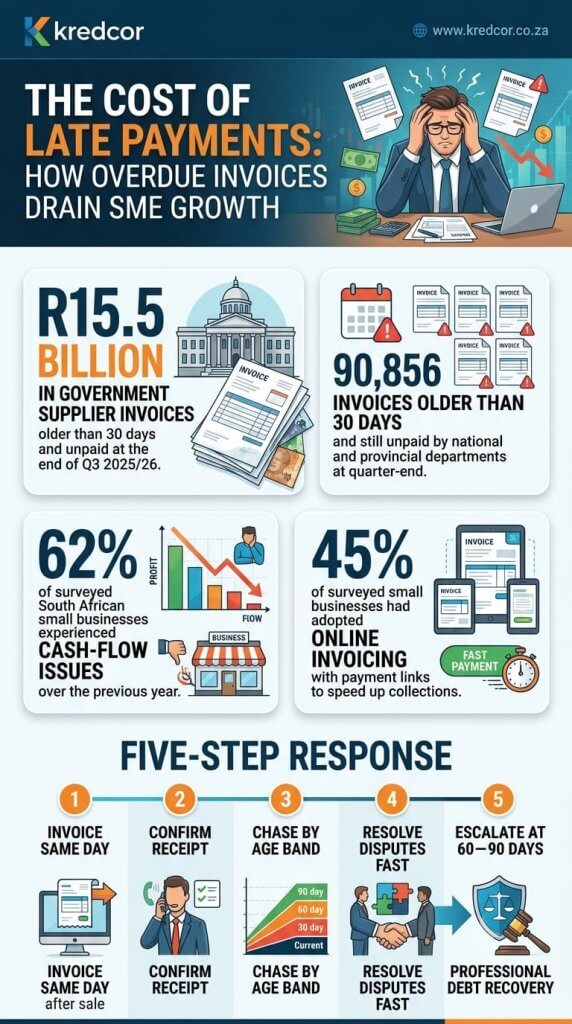
The cost of late payments is far bigger than the value of the overdue invoice. For South African SMEs, late payment can drain working capital, delay salaries, damage supplier relationships, increase borrowing costs, and quietly block growth plans. National Treasury’s 2025/26 supplier-payment reporting shows how serious the problem has become: by the end of Q3, national and provincial departments had R15.5 billion in invoices older than 30 days and still unpaid. For private-sector SMEs, the pattern is just as painful. When customers pay late, the business still has to fund wages, VAT, rent, stock, transport, finance charges, and new work. The practical answer is to manage overdue invoices early, measure debtor days weekly, resolve disputes fast, and escalate unpaid B2B accounts before they become bad debt.
Late payments rarely arrive wearing a villain’s hat. They usually arrive quietly.
One invoice becomes seven days overdue. Then fourteen. Then thirty. The customer says, “It’s with accounts.” Your sales team says, “Don’t push too hard, they’re a big client.” Your supplier wants payment on Friday. Payroll is next week. And suddenly, one unpaid invoice is no longer an admin issue. It is a cash-flow trapdoor.
This article explains the real cost of late payments for South African SMEs, how overdue invoices restrict growth, and what credit managers and CFOs can do before the debtors book starts chewing holes in the floorboards.
Table of Contents
- What Is the Cost of Late Payments?
- Why Late Payments Hurt SME Growth So Quickly
- The South African Context: Why This Problem Feels Worse Here
- The Hidden Costs Behind One Overdue Invoice
- Late Payments vs Bad Debt vs Slow Payers
- How to Calculate the Real Cost of Late Payments
- Practical Ways to Reduce Overdue Invoices
- Troubleshooting Tips
- Clash of Perspectives: Should You Be Patient or Escalate Fast?
- What to Do Next
- Quick-Action Checklist
- Frequently Asked Questions
- Article Schema Markup
- FAQ Schema Markup
- Infographic Brief
- Final Quality Pass Note
1. What Is the Cost of Late Payments?
The cost of late payments is the total financial, operational, and growth damage caused when customers pay after the agreed due date.
It includes the obvious cost, which is the cash you have not received. But that is only the surface. The deeper damage sits underneath: overdraft interest, staff time spent chasing payment, missed supplier discounts, delayed projects, postponed hiring, increased bad-debt risk, and management energy wasted on debtors instead of growth.
For an SME, cash flow is not a spreadsheet decoration. It is oxygen. A profitable business can still fail if money arrives too late to meet obligations.
That is why overdue invoices are so dangerous. They make your accounts look healthier than your bank account feels. Sales are recorded. Revenue looks good. But the money is still sitting in someone else’s bank account, doing push-ups while your business gets tired.
2. Why Late Payments Hurt SME Growth So Quickly
Late payments hurt SME growth because smaller businesses usually have less cash buffer, fewer funding options, and less negotiating power than large corporates.
A large company can often absorb a slow-paying customer.
An SME may not have that luxury. When R150,000, R500,000, or R1 million is overdue, the business may be forced to make hard choices:
| Growth Area Affected | What Late Payments Do | Practical Result |
|---|---|---|
| Hiring | Cash is tied up in debtors | Vacancies stay open longer |
| Stock and inventory | Suppliers still need payment | The business cannot accept bigger orders |
| Marketing | Cash is redirected to survival costs | Growth pipeline weakens |
| Equipment | Capex is delayed | Productivity remains stuck |
| Supplier relationships | The SME pays its own suppliers late | Credit terms may be reduced |
| Management focus | Leadership chases cash instead of strategy | Growth decisions become reactive |
This is the trap: a business can be busy, respected, and technically profitable, but still unable to grow because its working capital is trapped in overdue invoices.
That is the real cost of late payments. It does not only slow today’s cash flow. It steals tomorrow’s momentum.
3. The South African Context: Why This Problem Feels Worse Here
In South Africa, the cost of late payments is sharpened by high operating costs, funding constraints, infrastructure pressure, and long payment cultures in both public and private sectors.
National Treasury’s supplier-payment reports show the scale of the public-sector issue. In the Q3 2025/26 financial year report, national and provincial departments had R15.5 billion in invoices older than 30 days and still unpaid at quarter-end. The same report showed that provincial departments accounted for 98% of invoices older than 30 days and unpaid.
Xero’s 2026 State of South African Small Business research also points to a cash-flow pressure cooker. It found that 62% of surveyed small businesses experienced cash-flow issues over the previous year, while 45% had already adopted online invoicing with payment links to speed up collections and improve liquidity.
For South African SMEs, this means late payment is not a rare inconvenience. It is part of the commercial weather system. Some months are sunny. Some months bring invoice hailstones.
The good news is that late payment can be managed. But it needs structure, discipline, and early action.
4. The Hidden Costs Behind One Overdue Invoice
The hidden cost of late payments often exceeds the invoice value because the business must fund the delay from somewhere else.
Here are the most common hidden costs.
4.1 Borrowing Costs
When customers pay late, many SMEs bridge the gap with overdrafts, credit cards, short-term loans, invoice finance, or shareholder funds.
That creates a direct cost. Even if the invoice is eventually paid, the business may have absorbed interest charges for weeks or months.
4.2 Admin Time
Every follow-up email, phone call, statement resend, remittance request, dispute meeting, and “please confirm payment date” message costs time.
For a credit controller, this is normal work. But for an SME owner or finance manager, it becomes a thief wearing office shoes. Time spent chasing overdue invoices is time not spent pricing, planning, selling, hiring, or improving operations.
4.3 Supplier Strain
Late customer payments often cause late supplier payments.
That can damage trust. Suppliers may reduce credit limits, remove discounts, demand deposits, or shorten payment terms. Once supplier confidence drops, the business loses flexibility.
4.4 Growth Delays
Growth needs cash before it produces cash.
You may need to buy materials, pay staff, fund transport, or carry work-in-progress before the customer pays. If your money is trapped in overdue accounts, you may turn down profitable work simply because you cannot fund it.
4.5 Bad-Debt Risk
The older an invoice gets, the harder it usually becomes to recover.
A debtor who is 10 days late may simply have an admin delay. A debtor who is 120 days late may be disputing, avoiding, restructuring, or already under financial pressure. Delay reduces leverage.
For a practical recovery roadmap, read Kredcor’s guide to commercial debt collection in South Africa.
5. Late Payments vs Bad Debt vs Slow Payers
Late payments, bad debt, and slow payers are related, but they are not the same problem.
| Term | Meaning | Risk Level | Recommended Response |
| Late payment | Invoice paid after due date | Low to medium | Follow up immediately and document promises |
| Slow payer | Customer regularly pays late but eventually pays | Medium | Tighten terms, reduce limits, monitor weekly |
| Disputed invoice | Customer delays because of a service, pricing, or delivery issue | Medium to high | Resolve the dispute fast and reissue if needed |
| Bad debt | Debt unlikely to be recovered in full | High | Escalate to professional recovery or legal action |
| Strategic non-payer | Customer delays deliberately to fund their own cash flow | High | Stop supply, issue demand, escalate early |
This distinction matters because the wrong response can make things worse.
A genuine dispute needs resolution. A once-off admin delay needs a reminder. A repeat slow payer needs tighter credit control. A bad-faith debtor needs escalation.
Lumping all overdue invoices together is like treating every dashboard warning light as “probably fine.” Sometimes it is the petrol cap. Sometimes the engine is having a small financial tantrum.
6. How to Calculate the Real Cost of Late Payments
The simplest way to calculate the cost of late payments is to add the direct finance cost, the internal collection cost, and the opportunity cost of cash trapped in debtors.
Here is a practical formula:
Real cost of late payment = finance cost + admin cost + lost opportunity cost + write-off risk
Example
Assume an SME has a R500,000 invoice that is paid 60 days late.
| Cost Item | Example Calculation | Estimated Cost |
| Overdraft interest | R500,000 × annual interest rate × 60/365 | Depends on rate |
| Admin time | 8 hours × internal hourly cost | Direct staff cost |
| Lost supplier discount | Discount missed because cash was unavailable | Lost margin |
| Delayed stock purchase | New sales delayed by stock shortage | Lost revenue |
| Bad-debt risk increase | Higher probability of partial recovery | Risk provision |
Even when the customer eventually pays, the SME may already have lost money.
This is why credit managers track debtor days, also called Days Sales Outstanding or DSO. DSO shows how long it takes, on average, to collect payment after a sale. Kredcor has a useful guide on how to powerfully reduce debtor days if you want a deeper framework.
7. Practical Ways to Reduce Overdue Invoices
The best way to reduce the cost of late payments is to build a repeatable credit-control system that acts early and escalates predictably.
7.1 Invoice Immediately and Clearly
Send invoices the same day goods are delivered or services are completed.
Every invoice should include:
- Correct legal entity name
- Purchase order number, where required
- Clear description of goods or services
- VAT details, if applicable
- Due date
- Banking details
- Contact person for queries
- Payment terms
- Late-payment consequences, where contractually allowed
Many late payments begin as preventable invoice errors. A missing PO number can turn into 30 days of unnecessary waiting.
7.2 Confirm Receipt Before the Due Date
Do not wait until the invoice is overdue to discover the customer never loaded it.
For larger invoices, confirm receipt within 48 hours. Ask:
- Has the invoice been received?
- Is it approved for payment?
- Are there any disputes?
- What payment run will it be included in?
This one habit can prevent a small admin delay from becoming a cash-flow headache.
7.3 Segment Debtors by Risk
Not every customer deserves the same credit terms.
Segment customers into risk bands:
| Risk Band | Typical Customer Behaviour | Credit-Control Action |
| Low risk | Pays on time, communicates well | Standard terms |
| Medium risk | Occasionally late, usually resolves quickly | Earlier reminders, tighter limits |
| High risk | Regularly late, disputes often, vague promises | Reduced limit, stop-supply trigger |
| Critical risk | 60+ days overdue or broken promises | Formal demand and escalation |
This lets your finance team focus attention where cash is most exposed.
7.4 Use a Weekly Debtors Review
Monthly review is too slow.
A weekly review keeps overdue accounts visible while there is still time to act.
At minimum, review:
- Total debtors book
- Current, 30, 60, 90, and 120+ day balances
- Top 20 overdue accounts
- Promised payment dates
- Broken promises
- Disputed invoices
- Accounts needing escalation
This should be a standing finance rhythm, not a panic meeting.
7.5 Escalate Before the Account Gets Stale
Escalation does not mean becoming aggressive. It means becoming structured.
A practical escalation path looks like this:
| Age of Invoice | Recommended Action |
| 1–7 days overdue | Friendly reminder and receipt confirmation |
| 8–14 days overdue | Phone call and written payment commitment |
| 15–30 days overdue | Senior contact, statement, dispute check |
| 31–60 days overdue | Formal demand, stop-supply review |
| 60–90 days overdue | Hand over for professional commercial recovery |
| 90+ days overdue | Consider legal route, settlement, or write-off review |
For businesses unsure when to involve a recovery partner, Kredcor’s article on when to make use of a debt recovery agency is a helpful next step.
8. Troubleshooting Tips
Tip 1: If the Customer Says “The Invoice Is Not on Our System”
Send the invoice again immediately, but do not restart the payment clock without discussion.
Ask for written confirmation that it has now been loaded and approved. If the customer caused the delay, push for the earliest payment run.
Tip 2: If the Customer Raises a Dispute Late
Separate the disputed and undisputed amounts.
Ask them to pay the undisputed portion immediately while the query is resolved. This prevents one small dispute from freezing the whole invoice.
Tip 3: If the Customer Keeps Promising “Next Week”
Treat broken promises as risk signals.
After one broken promise, escalate to a senior contact. After two, move to formal written demand. A promise without a date, amount, and responsible person is not a payment plan. It is mist wearing a tie.
Tip 4: If Sales Keeps Blocking Credit Control
Agree a written stop-supply policy in advance.
Sales teams naturally want to protect relationships. Finance teams need to protect cash. A pre-approved policy removes emotional arm-wrestling when an important client becomes overdue.
Tip 5: If You Are Afraid to Escalate
Use professional language, not threats.
A firm, factual escalation often protects the relationship better than months of resentment. Good customers respect clear process. Bad customers exploit hesitation.
9. Clash of Perspectives: Should You Be Patient or Escalate Fast?
There is a fair debate here.
One view says you should be patient with good customers because relationships matter. Many late payments are caused by admin errors, temporary cash-flow pressure, or approval delays. If you escalate too quickly, you may damage a valuable long-term account.
The other view says late payment is unsecured finance. When customers delay payment, they are effectively borrowing from your business without permission. If you wait too long, you lose leverage and increase recovery risk.
The balanced answer is this: be human early, but structured always.
A good credit-control process does not start with threats. It starts with clarity. Confirm the invoice, identify disputes, ask for a payment date, and document everything. But once promises are broken or the invoice reaches 60 to 90 days overdue, you need to escalate.
Patience is a relationship tool. Silence is a cash-flow risk.
10. What to Do Next
The next logical step is to measure how much late payment is already costing your business.
Start with three numbers:
- Your current total debtors book
- The value sitting in 30, 60, 90, and 120+ day buckets
- Your average debtor days or DSO
Then identify the top 10 overdue accounts by value and risk. For each one, decide whether it needs a reminder, dispute resolution, payment plan, formal demand, stop-supply decision, or external recovery.
If overdue accounts are becoming a pattern, not an exception, speak to professional debt collectors in South Africa before the account gets too old.
You can also explore more practical credit-management guides at Kredcor Articles.
11. Quick-Action Checklist
Use this today:
- Pull your latest debtors ageing report and sort by value and age.
- Identify all accounts older than 30, 60, and 90 days.
- Confirm whether each overdue invoice is undisputed, disputed, or ignored.
- Phone the top 10 overdue debtors and document payment commitments.
- Set a weekly debtors review with clear escalation rules.
- Hand over serious 60–90 day overdue B2B accounts before recovery odds weaken.
12. Frequently Asked Questions
What is the cost of late payments for SMEs?
The cost of late payments includes lost cash flow, borrowing costs, admin time, supplier pressure, delayed growth, and increased bad-debt risk. The invoice value is only the starting point. The true cost is what the business cannot do while that money is trapped in debtors.
How do overdue invoices affect cash flow?
Overdue invoices affect cash flow by delaying the money a business needs to pay salaries, suppliers, rent, tax, stock, transport, and loan commitments. This can force the business to use overdrafts, delay growth plans, or pay its own suppliers late.
When should a business escalate an overdue invoice?
A business should usually escalate an overdue invoice when normal reminders have failed, payment promises are broken, the customer avoids communication, or the invoice reaches 60 to 90 days overdue. Earlier escalation may be needed for high-value invoices, repeat slow payers, or signs of financial distress.
How can South African SMEs reduce late payments?
South African SMEs can reduce late payments by invoicing immediately, confirming receipt, using clear payment terms, tracking debtor days weekly, resolving disputes quickly, enforcing stop-supply rules, and handing persistent overdue accounts to registered commercial debt collectors before the debt becomes stale.