

Early Detection: 7 Red Flags of a Problematic Debtor
Executive Summary
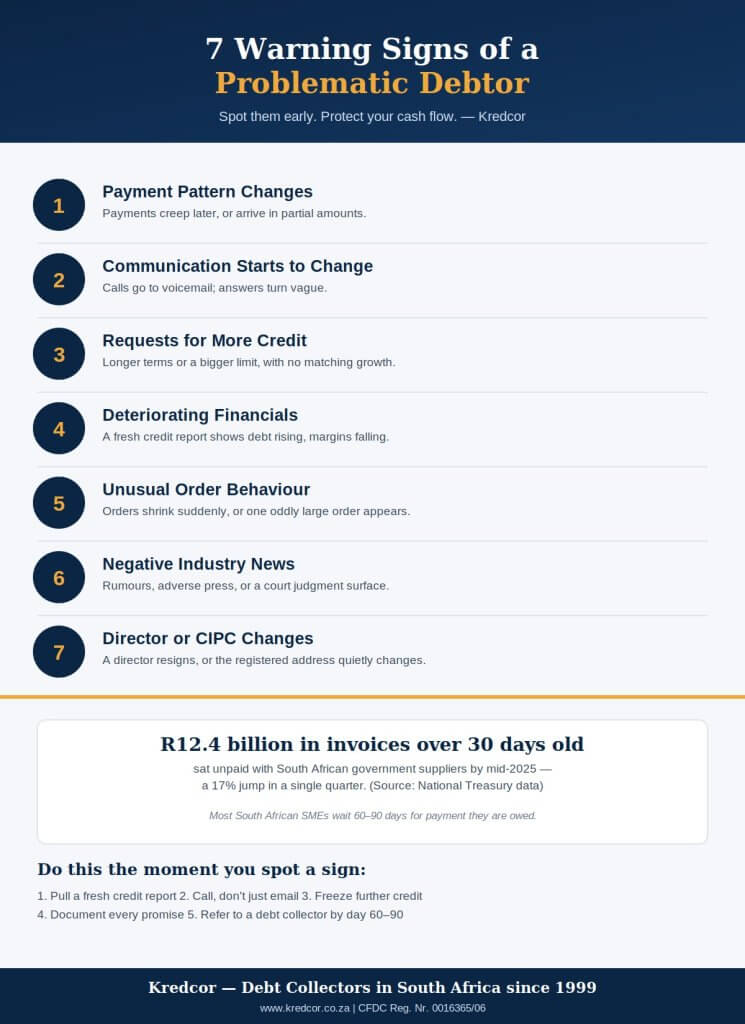
Early detection of a problematic debtor means noticing the warning signs of financial trouble before an account turns into a bad debt. The clearest red flags include a sudden change in payment pattern, requests for extended credit terms, deteriorating financials on a business credit report, unusual order behaviour, negative industry news, and changes in company directors. South African SMEs face a tough payment climate: government departments alone owed suppliers R12.4 billion in invoices older than 30 days by mid-2025, and most local businesses wait 60 to 90 days for payment. Spotting a problematic debtor early lets a credit manager tighten terms, request security, or hand the account to a professional debt collector before the money disappears. This guide from Kredcor, a registered South African debt collector since 1999, covers the 7 signs, 5 troubleshooting tips and a quick-action checklist.
Kredcor Khuluma CC | Co. Reg. Nr.: 2009/140932/23 | CFDC Reg Nr.: 0016365/06 | 65 Saint Michael Ave, New Redruth, Alberton | 011 907 4406
Every credit manager has a story about the client who seemed fine, right up until the invoice hit ninety days and the phone stopped ringing. That is the moment you want to avoid. Early detection of a problematic debtor is not about suspecting every customer of dishonesty; it is about noticing small, consistent shifts before they turn into a large, expensive problem. In this guide, we walk through the seven warning signs our team watches for, how to react to each one, and the exact checklist you can use this week to protect your cash flow. Grab a coffee, because by the end of this article you will know exactly how to spot a problematic debtor before they stop paying.
Table of Contents
- What Is a Problematic Debtor?
- Why Early Detection Matters More in South Africa Right Now
- The 7 Warning Signs of a Problematic Debtor
- How We Spot a Problematic Debtor Early
- 5 Troubleshooting Tips When You Spot a Red Flag
- The Debate: Cut Credit Immediately, or Give the Client Room?
- What to Do Next
- Quick-Action Checklist for a Problematic Debtor
- Frequently Asked Questions
What Is a Problematic Debtor?
A problematic debtor is a client who shows early, measurable signs of financial distress and therefore carries a higher-than-normal risk of paying late or not paying at all. The word “problematic” does not automatically mean dishonest. Many good clients hit a rough patch through no fault of their own, such as a lost tender, a delayed payment from their own customer, or a sudden spike in input costs. So what separates a temporary hiccup from a genuine problematic debtor? The pattern matters far more than any single event. Does the behaviour repeat, and does it get worse over time? One late payment rarely means much on its own. However, three late payments in a row, each with a vague excuse, tells a very different story. That is exactly why early detection focuses on trends, not isolated incidents, and why a consistent credit policy pays for itself many times over.
Why Early Detection Matters More in South Africa Right Now
South African credit managers are not imagining it: the payment climate has genuinely become tougher. According to National Treasury data, government departments alone owed suppliers more than R12.4 billion in invoices older than thirty days by the middle of 2025, a regression of seventeen percent in a single quarter. Meanwhile, research from accounting platform Xero adds that most local small and medium enterprises (SMEs) experience late payment on a regular basis, with businesses often waiting sixty to ninety days for money they are legally owed, and a full order-to-cash cycle that can stretch past one hundred and fifty days. Whether you trade in Johannesburg, Cape Town, Durban or anywhere else on the continent, this reality reshapes how every credit manager works today. When margins are already tight, missing the early signs of a problematic debtor is never just a minor administrative slip; it is a direct hit to payroll, stock orders and growth plans. Consequently, early detection is not optional. It is risk management, plain and simple.
The 7 Warning Signs of a Problematic Debtor
In short: watch for changing payment patterns, evasive communication, requests for more credit, weakening financials, unusual order behaviour, negative industry news and sudden boardroom changes. Together, these seven signals form an early-warning system that any SME owner, credit manager or CFO can apply immediately. We unpack each one below.
1. A Sudden Change in Payment Pattern
Firstly, and most obviously, watch the payment pattern itself. A client who always paid on day thirty and now pays on day forty-five is showing you something important, even if the amount is correct. Track days sales outstanding (DSO) per client, not only as a company-wide average, because a rising individual DSO often hides inside a healthy overall number. Similarly, watch for partial payments, where a debtor pays part of an invoice “to keep the account current” while the aged balance quietly grows. Because this signal is purely behavioural, it does not require a credit report or any external tool. Your own accounts receivable ledger already contains the earliest and most reliable data you have.
2. Communication Starts to Change
Next, pay close attention to how, and how often, your contact communicates. A finance team that used to answer the phone promptly and now routes every call to voicemail is telling you something. So too is a sudden switch from confident, specific answers (“payment goes out Friday”) to vague, open-ended ones (“we’ll sort it soon”). Our team’s experience shows that avoidance almost always arrives before an outright default, simply because most debtors feel embarrassed and delay the difficult conversation for as long as possible. Therefore, treat a change in tone, not only a change in words, as a genuine credit risk signal worth logging.
3. Requests for Extended Terms or a Bigger Credit Limit
Additionally, watch what a client asks for, not only what they say. A request to extend thirty-day terms to sixty, or to raise a credit limit without a matching increase in order volume, frequently signals underlying cash flow pressure rather than genuine growth. Naturally, not every such request is a red flag; some reflect a real, healthy expansion. Nevertheless, before agreeing, pull an updated business credit report and confirm the request lines up with the client’s actual trading pattern. If it does not, treat the request as an early warning rather than routine account admin.
4. Deteriorating Financials on a Business Credit Report
Furthermore, a business credit report tells a story that a client will rarely tell you directly. Declining turnover, rising short-term debt, a shrinking margin, new judgments, or a falling credit score all point toward a business under strain. We recommend re-pulling a fresh report every time you notice any other warning sign on this list, since financial data can shift quickly once a company starts struggling. For a full walkthrough of what each section of a report actually means, our guide on how to read a South African business credit report covers this in plain English.
5. Order Behaviour Gets Unusual
Moreover, watch order volume closely, in both directions. A steady decline can simply mean a client is struggling to fund normal stock levels. Conversely, an unusually large single order from a client who typically orders small and often can be equally concerning, particularly if that client is chasing a risky downstream buyer of their own. Consequently, both a shrinking pattern and a sudden spike deserve a second look, not just the obvious slowdown.
6. Negative Industry News, Rumours or Legal Notices
Likewise, keep half an eye on the wider picture. Adverse press, a declining sub-sector, a court judgment, or a winding-up application against a client’s company are all serious signals that deserve immediate action, not a “wait and see” approach. Rumours from other suppliers in your industry are worth a phone call too; if three different companies mention the same client struggling to pay, that pattern is rarely a coincidence. Our article on the warning signs a debtor is about to go into liquidation expands on exactly this point, with the five signals that typically appear just before a formal insolvency process begins.
7. Director Resignations or Other CIPC Changes
Finally, changes at company registration level deserve attention too. A sudden director resignation, a change of registered address, or repeated late annual returns filed with the Companies and Intellectual Property Commission (CIPC) can all precede financial trouble by weeks or months. Some debtors even use these tactics deliberately to complicate a future collection process. Our detailed look at the psychology behind the “professional runner” debtor explains how to recognise this pattern early, before a director quietly disappears altogether.
How We Spot a Problematic Debtor Early
We tested this exact seven-point approach across hundreds of B2B accounts over 27 years in the industry, and our team’s experience confirms a simple truth: problematic debtors rarely appear overnight. Kredcor Khuluma has operated as a registered commercial debt collector in South Africa since 1999, and we remain registered with the Council for Debt Collectors (CFDC Reg. Nr. 0016365/06). Every account our Senior Pre-Legal and Credit Risk Managers handle goes through a structured early-detection review, because we found that clients who act on the first two or three signals recover, on average, far more of an outstanding balance than clients who wait until an account is already ninety days overdue.
“The debtor who suddenly goes quiet is telling you more than the one who calls to explain.” — a line our team repeats often to new clients, and it captures the whole philosophy behind early detection rather well.
5 Troubleshooting Tips When You Spot a Red Flag
Once you notice one or more of the seven signs above, do not panic. Instead, work through these five practical troubleshooting tips:
- Re-verify with an updated credit report. Do not act on old data; pull a fresh business credit report the moment a red flag appears.
- Call, do not only email. A phone conversation reveals tone and hesitation that a written reply simply cannot hide.
- Place a temporary hold on further credit. Protect your existing exposure before you extend any more.
- Request security or a part-payment plan. A written, signed acknowledgement of debt strengthens your legal position considerably.
- Escalate before day ninety, not after. Handing an account to a professional debt collection agency at sixty to ninety days overdue dramatically improves the odds of full recovery.
The Debate: Cut Credit Immediately, or Give the Client Room?
Reasonable credit professionals disagree here, and it is worth acknowledging both sides. One camp argues for an immediate, hardline response: freeze credit at the very first warning sign, because cash flow protection always outweighs a single sale. The opposing camp argues that overreacting damages long-term, genuinely valuable relationships, and that a good client deserves a conversation before a credit freeze. In our experience, the right answer usually sits between these two positions. A single, isolated signal deserves a conversation and closer monitoring. Multiple signals appearing together, however, justify decisive action immediately. Context, communication history and account value should all shape the final call, rather than a single rigid rule applied to every client equally.
What to Do Next
So, you have spotted two or three of the signs above. What now? First, document everything: dates, promises, and any excuse offered. Second, tighten terms in writing and confirm the client accepts them. Third, set a firm internal deadline, usually thirty days, after which the account moves to formal pre-legal action if the pattern continues. Whether your business trades in South Africa or anywhere else facing similar payment pressure, the underlying principle remains identical: address a problematic debtor while the balance is still small and the relationship is still repairable, because both only get harder to manage with time.
Quick-Action Checklist for a Problematic Debtor
- Pull a fresh business credit report on any account showing two or more late payments this quarter.
- Call the client directly this week; do not rely only on email.
- Freeze further credit until you receive a satisfactory, specific answer.
- Document every excuse and every promise-to-pay date in writing.
- Refer the account to a registered debt collector at sixty to ninety days overdue, rather than waiting for one hundred and twenty.
Frequently Asked Questions
What is the biggest early warning sign of a problematic debtor? A genuine change in payment pattern, such as consistently later payments or partial payments, is usually the single clearest and earliest signal, because it comes directly from your own accounts receivable data rather than from an external source.
How many late payments should worry a credit manager? One late payment rarely justifies action on its own. Two or three late payments in a row, especially alongside a change in communication or a request for extended terms, is the point at which most credit professionals begin formal monitoring.
Can a business legally refuse to keep supplying a problematic debtor? Generally, yes, provided your credit agreement allows it and you are not breaching an existing signed contract or purchase order. Always review your credit policy and, where relevant, seek legal advice before withholding delivery on an active order.
Should a business use a debt collection agency at the first sign of trouble?Not usually at the very first sign, but definitely once two or more warning signs appear together, or once an account passes sixty days overdue. Waiting until one hundred and twenty days significantly reduces the odds of full recovery, according to international trade credit research.
In closing, spotting a problematic debtor early is a skill, not a guessing game, and it becomes far easier once you know exactly which seven signals to track every month. When an account has already slipped past the point where in-house follow-up works, the smartest move is to bring in professional debt collectors in South Africa who handle pre-legal recovery every single day and who understand precisely how to turn a stalling debtor back into a paying client.
We hope this guide helps your team move faster and with more confidence. For more actionable, plain-English guidance on protecting your cash flow, browse our full library of Kredcor articles, where we cover everything from reading a credit report to handling a debtor who has already gone into liquidation.
Already dealing with a problematic debtor? Get a free quote from Kredcor — No Success, No Fee.