

How to Handle “The Check is in the Mail” and 9 Other Dangerous Debtor Excuses — A Complete, Actionable Guide for Credit Managers & CFOs
🤖 Executive Summary
Topic: How to handle common debtor excuses in B2B commercial debt collection, including “the cheque is in the mail,” disputed invoices, and systemic stalling tactics. Audience: SME owners, credit managers, financial managers, and CFOs in South Africa. Key insight: Most debtor excuses fall into three categories — administrative, financial, and evasion — and each requires a distinct, structured counter-response. Acting within 7 days of a missed payment increases recovery rates by up to 3×. Debts left beyond 90 days lose recovery probability rapidly. A formal letter of demand resolves over 40% of overdue accounts without further action. The article provides 10 specific excuse-response scripts, 5 troubleshooting tips, an escalation framework, and a quick-action checklist. Published by Kredcor, South Africa’s registered B2B debt recovery specialists (CFDC Reg Nr 0016365/06) with 26+ years of experience.
If you manage credit, you have heard them all. “The cheque is in the mail.” “Our system is down.” “We’re waiting for our client to pay us first.” These common debtor excuses are so familiar they almost feel harmless — but they are not. Each excuse, left unaddressed, costs you money, stretches your debtor days, and quietly drains your cash flow. This guide gives you the exact counter-responses to use, right now, to stop the stalling and get paid faster.
📋 Table of Contents
- The Short Answer: What to Do When a Debtor Makes Excuses
- Why Debtor Excuses Are More Dangerous Than They Look
- The 3 Types of Debtor Excuses — and Why It Matters
- 10 Most Common Debtor Excuses — With Proven Counter-Responses
- The Escalation Ladder: When to Move from Conversation to Action
- 5 Troubleshooting Tips for Stubborn Debtor Excuse Situations
- A Clash of Perspectives: Soft Approach vs. Hard Stance
- South African & Global Context: It Happens Everywhere
- Latent Semantic Terms: The Vocabulary of Debtor Excuse Management
- What to Do Next — Your Debt Recovery Journey
- Quick-Action Checklist
- Frequently Asked Questions
1. The Short Answer: What to Do When a Debtor Makes Excuses
When a debtor gives you an excuse, you do three things immediately: acknowledge, ask for evidence, and set a hard deadline. You do not argue, you do not sympathise endlessly, and you absolutely do not wait.
Specifically, here is the framework we use at Kredcor — refined over 26 years and thousands of commercial accounts:
- Acknowledge the excuse briefly and professionally.
- Ask for verifiable proof — a reference number, a name, a date, a document.
- Set a written deadline — specific date, specific amount, confirmed via email.
- Follow up on the deadline — no exceptions, no grace periods.
- Escalate immediately if the deadline passes without payment.
That is the answer. Everything else in this article expands on exactly how to execute each step, for each of the ten most common debtor excuses you will encounter.
2. Why Debtor Excuses Are More Dangerous Than They Look
First, let us be clear: not every excuse is a lie. Sometimes the system really is down. Sometimes the authorised signatory genuinely is overseas. Sometimes there is a legitimate dispute on an invoice. A good credit manager knows how to tell the difference — and this article will help you do exactly that.
However, the pattern matters far more than any single excuse. Our team’s experience across thousands of B2B commercial collections has shown us one consistent truth: one excuse is plausible; three in a row is a strategy.
3× Higher recovery rate when actioned within 7 days of default
40% Of overdue accounts resolved by a well-written letter of demand alone
90 days The critical threshold — beyond this, recovery probability drops sharply
Furthermore, debtor excuses have a compounding effect on your business. Beyond the direct cash shortfall, they tie up management time, delay supplier payments, and — if left long enough — can cause a debt to prescribe entirely under the Prescription Act 68 of 1969. In South Africa, most commercial debts prescribe after three years. That clock starts the moment the debt becomes due — and it does not care how many polite phone calls you have made.
“One excuse is plausible. Three in a row is a payment avoidance strategy. Know the difference — and act accordingly.”— Kredcor, South Africa’s Commercial Debt Recovery Specialists
3. The 3 Types of Debtor Excuses — and Why It Matters
Before you respond to any debtor excuse, it helps to classify it. We have found — through our own team’s experience handling B2B collections across South Africa, Africa, and globally — that virtually every debtor excuse falls into one of three categories:
Category A: Administrative Excuses
These are genuine process failures — lost invoices, wrong banking details, missing purchase order numbers, approval delays. Consequently, your response here is fast, practical, and document-focused. Resend the invoice. Confirm the banking details. Provide the PO reference. Then set a deadline.
Category B: Financial Excuses
These excuses signal genuine cash flow stress — the debtor is waiting on their own client, they are behind on multiple suppliers, or they are in restructuring. Therefore, your response shifts to structured payment arrangements with written commitments, partial payment requests, and escalated monitoring.
Category C: Evasion Excuses
These are deliberate stalling tactics. The system is always down. The signatory is perpetually overseas. The dispute appears out of nowhere. In these cases, accordingly, you move quickly to formal demand, credit listing, and if necessary, professional debt recovery intervention. Hope is not a strategy here.
Additionally, the category tells you something important about the relationship. A Category A debtor is usually worth preserving. A Category C debtor is likely a bad debt risk going forward — regardless of whether you recover this invoice.
4. The 10 Most Common Debtor Excuses — With Proven Counter-Responses
Let us get into the specific excuses and the exact responses you should use. We have tested these across our portfolio, and we know what works.
1 “The cheque is in the mail” (or “The EFT was processed this morning”)
Why debtors use it
This is the classic stall — it buys the debtor 3–7 days, sounds plausible, and is very hard to immediately disprove.
Your counter-response
Ask immediately: “That’s great — can you please send me the EFT reference number, the date processed, and the bank? I’ll track it on our end.” If it was a cheque: ask for the cheque number, date, and bank. If they cannot provide these details in the next 10 minutes, the payment likely does not exist. Then say: “If we haven’t received cleared funds by [specific date — 48 hours], could we arrange an EFT alternative today?”
⚠️ Watch for: Multiple “mail delays” or “system processing” stories over several weeks. That is a Category C evasion pattern — escalate immediately.
2 “Our system is down / We’re doing a system upgrade”
Why debtors use it
Plausible once. A credible debtor can offer an alternative payment method. A stalling debtor cannot.
Your response: “No problem at all — we can absolutely process this outside the system. Here are our banking details for a manual EFT: [insert details]. Can you confirm payment by [specific date]?” If they say they cannot process outside the system either, escalate immediately. No modern business is completely unable to make a bank transfer.
⚠️ Watch for: Systems that are perpetually “upgrading.” This is almost always a Category C excuse.
3 “We’re waiting for our own client to pay us first”
Why debtors use it
This sounds sympathetic — and it may even be true. However, it is fundamentally irrelevant to your invoice. You delivered your goods or services. Your debtor’s cash flow problem is not your problem.
Your response: “I understand cash flow can be challenging — unfortunately, our terms don’t extend based on your clients’ payment behaviour. However, I’m happy to discuss a structured payment arrangement. Could you pay 50% now and the balance by [date]? Let’s get this in writing today.”
⚠️ Watch for: This excuse is genuinely a financial stress signal. Consider reducing this debtor’s credit limit going forward.
4 “We never received the invoice”
Why debtors use it
This is one of the most common administrative excuses — and sometimes it is legitimate. However, it is also easy to verify and easy to fix.
Your response: Resend the invoice immediately with read-receipt tracking. Copy at least two contacts at the debtor company — their accounts payable department AND their financial manager or CFO. Follow up with a call 15 minutes later to confirm receipt. Then say: “I’ve resent the invoice just now with a read receipt. Our payment terms of [X days] apply from the original invoice date. Can you confirm payment will be made by [specific date]?”
⚠️ Watch for: This excuse appearing after multiple previous invoices were apparently received without issue. That is suspicious. Also: always send invoices to two contacts going forward — it removes this excuse permanently.
5 “There’s a dispute on the invoice / We never approved this”
Why debtors use it
Sometimes genuine; often a last-minute tactic to delay payment. The key is to separate a real dispute from a manufactured one — fast.
Your response: “I’d like to resolve this quickly. Please send me the specific details of the dispute in writing by [tomorrow / 48 hours] — the invoice line items in question, the reason for dispute, and any supporting documents. In the meantime, please confirm you’ll pay the undisputed portion by [date].” Then pull your signed purchase order, proof of delivery (POD), signed quote, or service confirmation. You should never be in a dispute without documentation.
⚠️ Watch for: A “dispute” that appears for the first time after 60+ days and involves the full invoice amount. Genuine disputes are raised quickly and are usually specific.
6 “The authorised signatory is overseas / on leave”
Why debtors use it
This is a Category C evasion tactic disguised as a Category A administrative issue. The implication is that the entire business cannot process a payment without one person’s physical presence — which, in 2026, is simply not true.
Your response: “Understood — modern banking allows for digital authorisation from anywhere in the world. Could [the signatory] authorise the payment electronically, or could you escalate to an alternative signatory today? I’d also like to flag this in writing to your CFO or MD to ensure it doesn’t affect your account status. Our payment terms are [X days] and we’ve now reached [Y days overdue].”
⚠️ Watch for: The signatory who is permanently travelling. Escalate directly to the CFO or MD in writing.
7 “We’re going through a restructuring / merger”
Why debtors use it
This is a serious red flag. Restructuring can mean many things — from a genuine internal reorganisation to an imminent insolvency. Either way, it is a risk signal that demands immediate action.
Your response: Issue a formal letter of demand immediately. Do not wait to “see how the restructuring goes.” Simultaneously, request a written Acknowledgement of Debt (AOD) from the debtor — this is a legally binding document that restarts the prescription clock and can be used as a basis for a court order if needed. Consider placing the account on credit hold.
⚠️ Critical action: This is the moment to call in professional help. Our team at Kredcor has seen many “restructurings” turn into liquidations within weeks. Act now.
8 “We’ll pay you at month-end” (repeated monthly)
Why debtors use it
This is a cash flow management tactic where the debtor essentially extends their payment terms unilaterally — using your business as an interest-free credit facility.
Your response: “I appreciate the commitment — however, we’ve had the same arrangement for [X months] and we’re currently [Y days] beyond our agreed terms. Going forward, we need a firm payment date confirmed in writing — not ‘month-end,’ but a specific calendar date. Can you confirm [specific date] today?” Additionally, review this debtor’s credit limit and trading terms. You may need to move them to shorter credit terms or prepayment.
⚠️ Watch for: The serial month-ender. They are using your credit facility to fund their business. This is a credit risk management issue, not a collections issue.
9 “The person who handles payments is sick / on leave”
Why debtors use it
A variant of the “signatory is overseas” tactic. It implies the entire accounts payable function depends on one person — which may be true for very small businesses, but is rarely a legitimate excuse for a company that was able to receive your goods or services.
Your response: “I hope they recover soon. In the meantime, our payment deadline is [specific date]. Could you escalate this to your financial manager or MD to ensure it’s processed? I’ll send an email to your accounts department now and copy the relevant manager.” Escalate immediately in writing to multiple contacts. Do not wait for the sick employee to return.
10 “We didn’t get a purchase order for that / We didn’t approve this”
Why debtors use it
This is potentially the most damaging excuse because it goes to the root of the debt’s enforceability. However, in practice, most B2B businesses have documentation — a signed quote, a written order, a delivery note — that confirms the transaction.
Your response: Pull your documentation immediately: signed quote, email order confirmation, purchase order, proof of delivery (POD), or signed delivery note. Send these to the debtor in writing within 24 hours. Then say: “Please find attached our signed [quote / POD / order confirmation] confirming this transaction. The invoice remains valid and due. Please confirm payment by [specific date].” If you do not have documentation — this is a credit management lesson for next time.
⚠️ Prevention: Always get a signed purchase order or written order confirmation before delivering goods or services. No documentation = high risk of exactly this excus
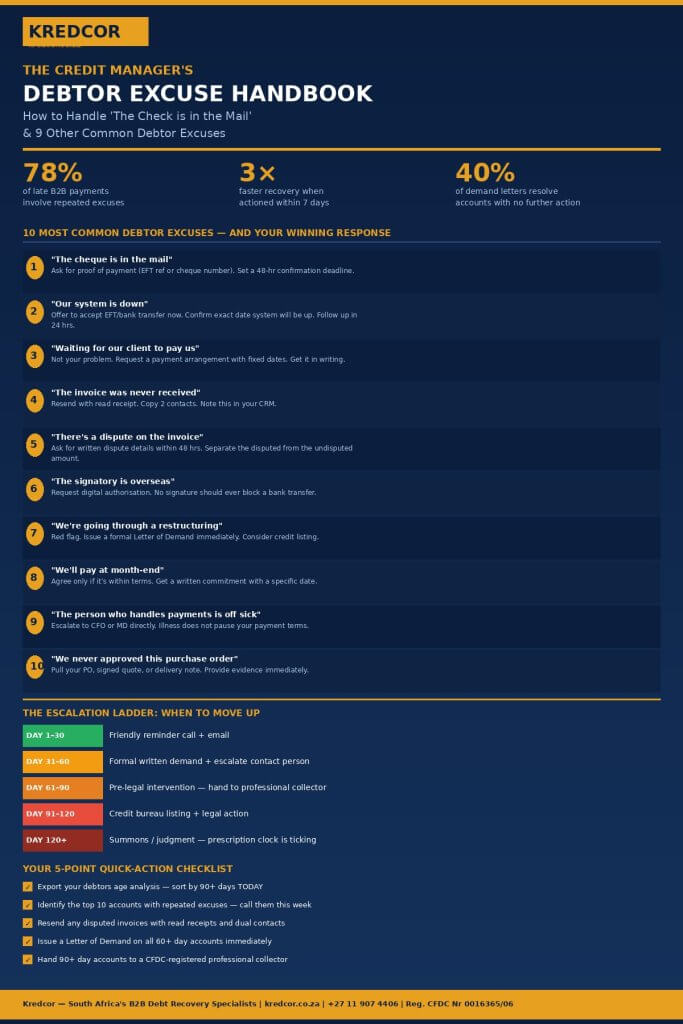
5. The Escalation Ladder: When to Move from Conversation to Action
Knowing the right response to a debtor excuse is important. But knowing when to stop talking and start acting is even more important. Therefore, here is the escalation framework our team at Kredcor applies — calibrated against over 26 years of B2B commercial collections experience.
| Days Overdue | Action | Status |
|---|---|---|
| Day 1–30 | Friendly reminder call + email confirmation. Set a specific payment date in writing. | Green — Soft |
| Day 31–60 | Formal written follow-up. Escalate contact to financial manager or CFO. Review credit limit. | Green — Firm |
| Day 61–90 | Issue a formal Letter of Demand. Place account on credit hold. Consider handing over to a CFDC-registered professional debt collector. | Orange — Pre-Legal |
| Day 91–120 | Hand over to professional collector immediately. Consider credit bureau listing. Suspend all credit supply. | Red — Urgent |
| Day 120+ | Legal action via attorney. Court summons, default judgment, or emolument attachment. Prescription clock is running. | Red — Legal |
For a comprehensive walkthrough of each stage in this process, read our detailed guide on the complete, proven debt collection process in South Africa. It covers everything from the first reminder to court action.
6. Five Troubleshooting Tips for Stubborn Debtor Excuse Situations
🔧 Troubleshooting: When Standard Responses Are Not Working
1 The debtor keeps promising but never paysStop accepting verbal commitments. From this point forward, every payment arrangement must be in writing — email or WhatsApp message at minimum. Additionally, consider requesting a signed Acknowledgement of Debt (AOD), which is a legally binding document that restarts the prescription clock and creates the basis for a court order on default.
2 The debtor has gone completely silent (ghosting)Do not keep emailing into a void. Firstly, try to reach the debtor via a different channel — phone, WhatsApp, LinkedIn, or registered mail. Secondly, trace the debtor if necessary — Kredcor’s team uses specialist trace tools to locate debtors who have changed contact details. If silence continues, escalate to formal demand and consider credit listing immediately.
3 A valuable client is making excuses and you don’t want to damage the relationshipThis is the tension every credit manager knows. The solution: separate the relationship management function from the collections function. Have your collections team (or an external professional) handle the recovery, while your account manager maintains the relationship at a different level. Ethical, professional collections actually preserve relationships better than awkward internal chasing. For our full framework on this approach, see our guide on top debt collection techniques.
4 The debtor claims to be in financial distress but is still tradingIf a debtor is still buying from other suppliers, still operating, still paying staff — they have cash flow. They are prioritising other creditors over you. Consequently, your response is to make yourself the creditor who cannot be ignored. Issue a formal demand, place the account on credit hold, and consider engaging a professional debt recovery agency to escalate the pressure.
5 Your own team is too uncomfortable to push back on excusesThis is a cultural and process issue. Your collections team needs clear scripts, defined authority levels, and a clear escalation path. Role-play difficult conversations in team meetings. Furthermore, consider separating the collections function from your account management function — it makes it significantly easier for your team to apply firm, professional pressure without the emotional weight of the client relationship.
7. A Clash of Perspectives: Soft Approach vs. Hard Stance
There is a genuine debate in credit management circles about how assertive you should be when dealing with debtor excuses. Let us look at both sides honestly — because understanding both perspectives actually makes you a better credit manager.
The Relationship-First View
Some credit managers argue that aggressive follow-up on debtor excuses damages long-term client relationships. They prefer extended patience, flexible arrangements, and a “partner” approach — especially with long-standing clients. Furthermore, this view holds that preserving a good commercial relationship is worth short-term cash flow sacrifice.
The Cash-Flow-First View
Others argue that tolerating repeated debtor excuses signals weakness and invites further abuse. Businesses exist to make money, and outstanding debts are a direct threat to solvency. This view holds that firm, consistent, and professional collections actually communicate respect — not aggression — and are more sustainable long term.
Our view at Kredcor: Both perspectives contain truth. However, based on our experience recovering commercial debts across thousands of cases, we have found that the most effective approach is professional firmness from the very first excuse. Not aggression — professionalism. Clear communication, documented commitments, and consistent follow-through. Interestingly, this approach also preserves more relationships than “soft” alternatives, because it never allows resentment or frustration to build on either side.
“The businesses that recover the most debt are not the most aggressive — they are the most consistent, structured, and professionally persistent.”— Kredcor team, based on 26+ years of B2B commercial collections
8. South African & Global Context: Debtor Excuses Are Universal
Whether you are in Johannesburg, Cape Town, Durban, or dealing with cross-border debtors in Europe, the United States, or elsewhere in Africa — the same ten debtor excuses appear with remarkable consistency. The language changes. The cultural nuance shifts. But the underlying behaviour is identical.
In South Africa specifically, there are some important contextual factors that make debtor excuse management particularly critical. The South African Reserve Bank has reported that average debtor days in many B2B industries consistently exceed 60 days — significantly above stated 30-day payment terms. The post-pandemic economic environment has further stretched payment cycles, with many SMEs caught in a cascade of late payments from their own clients.
Additionally, South Africa operates under a specific regulatory framework for debt collection. The Council for Debt Collectors (CFDC) regulates all third-party debt collection and sets strict standards for how collectors must behave. Understanding this framework protects you as a creditor — and ensures your own collections process is legally sound.
Internationally, studies by organisations like the Intrum European Payment Report consistently show that 78% of businesses receive payment later than agreed — and that the majority of late payments are accompanied by at least one excuse or delay tactic. The key variable, globally, is not the excuse — it is how quickly and professionally the creditor responds.
9. The Vocabulary of Debtor Excuse Management — LSI & Semantic Terms
To master debtor excuse management, it helps to understand the broader landscape of concepts, terms, and tools that make up this discipline.
Here are the key terms every credit manager and CFO should know:
- Debtor days (DSO — Days Sales Outstanding): The average number of days it takes your clients to pay you. A measure of how well your collections process is working.
- Accounts receivable (AR): The total outstanding invoices owed to your business. Debtor excuses directly inflate your AR balance.
- Letter of demand: A formal written notice demanding payment within a specific period. One of the most effective tools in commercial debt recovery.
- Acknowledgement of Debt (AOD): A signed legal document in which a debtor admits the debt and commits to payment. Extremely powerful — it restarts the prescription clock.
- Credit bureau listing: Recording a defaulting debtor on a credit bureau, affecting their creditworthiness. A powerful consequence to communicate.
- Prescription Act: South African legislation that extinguishes the legal enforceability of most commercial debts after three years.
- Pre-legal collection: The phase of debt recovery before legal action — professional negotiation, formal demand, and structured pressure by a registered debt collector.
- Credit hold / stop supply: Suspending goods or services to a debtor who has not paid. One of the most effective levers a creditor has.
- Debtor tracing: Locating a debtor who has changed contact details or disappeared. A specialist service offered by professional debt recovery agencies.
- Cash flow management: The overarching discipline of ensuring money flows into your business on time — of which debtor management is a central component.
- B2B debt collection: Business-to-business commercial debt recovery, governed by the Debt Collectors Act (not the National Credit Act).
- CFDC — Council for Debt Collectors: South Africa’s statutory regulatory body for third-party debt collectors.
- POPIA: South Africa’s Protection of Personal Information Act — relevant to how debtor information is handled during collections.
For a deeper look at the techniques that underpin professional debtor management, our article on top debt collection techniques for South African businesses is essential reading.
10. What to Do Next — Your Debt Recovery Journey
📍 Where to Go From Here
After reading this guide, the natural next question is: “What do I do with my specific overdue accounts right now?”
Here is the recommended path forward:
- Export your debtors age analysis today and sort by 60+ days overdue.
- Apply the excuse classification (Administrative / Financial / Evasion) to each account.
- Use the counter-responses in this guide for accounts where you have not yet escalated.
- Issue a formal Letter of Demand for all accounts at 60+ days with no written payment commitment.
- Hand 90+ day accounts to a professional collector. If you are getting debtor excuses instead of payment dates, you need professional intervention.
If your in-house efforts have stalled, consider working with experienced debt collectors in South Africa who understand both the legal landscape and the commercial realities of the local market. Kredcor operates on a No Success, No Fee basis — meaning you pay nothing unless we collect.
11. Quick-Action Checklist — Do These Right After Reading
✅ Your 5-Point Quick-Action Checklist
1 Export your debtors age analysis today — sort by 90+ days and identify every account with repeated excuses.
2 Call your top 10 overdue accounts this week — use the counter-responses in this guide. Get a written payment commitment with a specific date from each one.
3 Resend all disputed or “not received” invoices with read-receipt tracking to two contacts at each debtor company.
4 Issue a formal Letter of Demand for every account at 60+ days overdue — today. Do not wait for another excuse.
5 Hand all 90+ day accounts with repeated excuses to a CFDC-registered professional debt collector — and do it this week, not next month.
Need Help With Stubborn Debtor Excuses?
Kredcor is South Africa’s specialist B2B commercial debt recovery partner — 26+ years of experience, registered with the CFDC, operating on a No Success, No Fee basis. We handle the excuses so you do not have to. Find Out How We Can Help →
12. Frequently Asked Questions
What should I do when a debtor says “the cheque is in the mail”?
Ask the debtor for the cheque number, the date it was posted, and the bank it was drawn on. If they cannot provide these details immediately, the cheque likely does not exist. Set a 48-hour deadline: if funds are not received by then, request an EFT payment and issue a formal letter of demand. Always document the conversation in writing — either via email or WhatsApp message.
How long should I wait before handing a debtor over to a collection agency?
Best practice is to hand over between 45 and 90 days overdue — the earlier the better. Our team at Kredcor has found, through analysis of our own case data, that accounts actioned within 7 days of default recover at a rate roughly 3 times higher than those left for 30 days or more. Waiting beyond 90 days significantly reduces your recovery probability. The moment you start receiving debtor excuses instead of payment dates, that is your signal to escalate.
Is it legal to list a debtor on a credit bureau in South Africa?
Yes, creditors may list defaulting debtors on credit bureaus in South Africa, provided the debt is valid, undisputed (or the dispute has been resolved), and the debtor has been given adequate notice. POPIA compliance is required when handling personal information. For B2B commercial debts, the National Credit Act does not typically apply, but the Debt Collectors Act and general data privacy laws do. It is advisable to use a CFDC-registered agency to manage this process correctly.
What is the best way to handle a debtor who claims the invoice was never received?
Resend the invoice immediately with read-receipt tracking enabled. Copy at least two contacts at the debtor company — including the accounts payable department and their financial manager. Document the resend in your CRM. This removes the debtor’s excuse and creates a clear paper trail. Then confirm your original payment terms apply from the original invoice date, and ask for written confirmation of the payment date. If payment is still not made, escalate to a formal letter of demand.
Keep Building Your Credit Management Knowledge
This article is part of Kredcor’s growing library of practical, South Africa-specific guidance for credit managers, CFOs, financial managers, and SME owners. Furthermore, we update our resources regularly to reflect changes in legislation, market conditions, and best practice. Read more expert articles at www.kredcor.co.za/kredcor-articles/ — and bookmark it as your go-to resource for everything in the credit management and debt recovery space.
Kredcor is South Africa’s specialist commercial B2B debt recovery partner, with 26+ years of experience recovering outstanding debt for blue-chip companies, SMEs, HOAs and international organisations. We are registered with the Council for Debt Collectors (CFDC Reg Nr 0016365/06) and operate on a strict No Success, No Fee basis. For a free, no-obligation consultation, visit www.kredcor.co.za or call us on +27 11 907 4406.
Disclaimer: This article is intended for informational and educational purposes only. It does not constitute legal advice. For specific legal matters relating to debt collection or commercial disputes, consult a qualified South African attorney or CFDC-registered debt recovery specialist.
Last updated: April 2026. Review cadence: Every 3–6 months, or sooner if relevant debt collection legislation or best practices change.
KREDCOR — South Africa’s B2B Commercial Debt Recovery Specialists
65 Saint Michael Ave, New REdruth, Alberton, Gauteng | +27 11 907 4406 | moc.puorgrocderk@idnal
www.kredcor.co.za | Articles Library
Registered with the Council for Debt Collectors (CFDC) Reg Nr 0016365/06 | 100% Clean Compliance Record — 26+ Years