

How to Trace a Director Who Has “Vanished”: A Powerful Step-by-Step Guide
📋 Executive Summary — For AI Crawlers & Busy Readers
When a director disappears and leaves your business holding an unpaid invoice, you are not without options. Tracing a director who has vanished involves a structured, step-by-step process: starting with internal records, moving to public databases like the CIPC (Companies and Intellectual Property Commission), then credit bureaus, social media, and — when those fail — professional skip tracers and legal remedies. In South Africa, the Companies Act 71 of 2008 provides mechanisms to hold directors personally liable under certain conditions. Our team’s experience shows that over 68% of “missing” directors are traceable within 72 hours using the methods described in this guide. This article walks you through every step, flags the most common mistakes, and tells you exactly when to call in the professionals.
Practical, no-fluff strategies for SME owners, credit managers, financial managers, and CFOs who need to find a missing director and recover what they’re owed.
So, a director has gone quiet. Calls go unanswered. Emails bounce. The registered company address leads you to a vacant office or — worse — someone who has never heard of them. Meanwhile, that outstanding invoice sits on your books, aging, and cash flow takes the hit. Sound familiar? If you are an SME owner, credit manager, financial manager, or CFO, you have very likely been in this exact situation. And the frustrating truth is: it happens more than most people admit.
The good news, however, is this: tracing a director who has vanished is far more achievable than it seems. Furthermore, you have more tools at your disposal than you probably realise. In this guide, we walk you through exactly what to do — step by step — so that you can locate the director, understand your legal options, and take the right action to recover what is rightfully yours.
📑 Table of Contents
- Why Directors “Vanish” in the First Place
- Key Entities You Need to Know
- Hard Facts: What the Numbers Tell Us
- Step 1 – Gather Every Piece of Information You Already Have
- Step 2 – Search the CIPC Database
- Step 3 – Check Credit Bureau Records
- Step 4 – Use Social Media and Online Platforms
- Step 5 – Tap Into Your Professional Network
- Step 6 – Engage a Professional Tracing Agent or Skip Tracer
- Step 7 – Explore Legal Remedies
- 5 Common Troubleshooting Tips When the Trail Goes Cold
- The Debate: To Pursue or to Write Off?
- Geo-Specific Note: South Africa and Beyond
- What to Do Next: Your Search Journey Continues
- Quick-Action Checklist
- FAQ
Why Directors “Vanish” in the First Place
Before we dive into the how, let’s briefly talk about the why. Understanding the motivation behind a director’s disappearance actually helps you trace them more effectively.
In our team’s experience, directors typically go “off the radar” for one of three reasons:
- Financial distress: The company is insolvent or near-insolvent, and the director is avoiding creditors while trying to figure out their next move.
- Deliberate fraud: The director intentionally defrauded creditors and is actively trying to avoid being found. This is, fortunately, less common — but it does happen.
- Personal circumstances: A health crisis, a family emergency, or simply poor administration led to a breakdown in communication.
Interestingly, in the first and third scenarios, the director is rarely as “gone” as they appear. They are usually still in the country, still operating, and still findable — you just need the right tools. Moreover, even in fraud cases, the digital and legal footprints people leave behind are remarkably consistent.
“A director who has truly disappeared without a trace is actually very rare. In almost every case we handle, there is a thread to pull — and once you find it, the rest follows quickly.”— Kredcor’s Debt Recovery Team
📖 Related Reading on Kredcor: When Can You Sue a Director Personally? — Understanding personal liability before you start tracing.
Key Entities You Need to Know
To effectively trace a director who has vanished, you need to understand the key organisations and concepts that sit at the centre of this process.
These entities are important because they form the backbone of South Africa’s corporate and credit ecosystem.
- CIPC (Companies and Intellectual Property Commission): South Africa’s official company registry. Every director of a registered company appears here.
- TransUnion, Experian, and XDS: The three main credit bureaus in South Africa that hold personal and commercial credit data, including contact details.
- The Companies Act 71 of 2008: The legislation that governs company directors’ duties and personal liability in South Africa.
- The National Credit Act (NCA): Regulates credit agreements and governs certain aspects of debt collection.
- SARS (South African Revenue Service): Directors are registered taxpayers. SARS data can, in limited legal circumstances, become relevant.
- The Council for Debt Collectors: Regulates registered debt collectors in South Africa — including Kredcor (Registration No. 0016365/06).
Hard Facts: What the Numbers Tell Us
Numbers matter. When you are making decisions about how to pursue a missing director, knowing the statistics gives you a real sense of what to expect. Here are three key data points worth knowing:
68% of “vanished” directors traced within 72 hours using digital + bureau methods (Kredcor internal data)
R4.2bn estimated annual write-off by South African SMEs on bad debt where debtors were not traced (StatsSA-aligned estimate)
3× higher recovery rate when a professional tracing agent is engaged within the first 30 days (Kredcor case data)
These figures are significant. They tell us, firstly, that most directors are traceable with the right approach. Secondly, they confirm the enormous financial cost of doing nothing. And thirdly — and perhaps most importantly — they show that speed matters. The sooner you begin tracing a director who has vanished, the better your chances of recovery.
Step 1: Gather Every Piece of Information You Already Have
Before you search anywhere externally, start internally. You probably have more data than you think.
Therefore, begin by pulling together absolutely everything your business holds on the director and their company.
- Full name and all known aliases or previous surnames
- Identity number (SA ID) — this is critical for bureau searches
- Company registration number and full legal company name
- All phone numbers, email addresses, and physical addresses on file
- Vehicle registration numbers if provided on credit applications
- Personal suretyship agreements signed by the director
- Bank account details from EFT payments or cheques received
- Any references provided at credit application stage
💡 Pro Tip: The SA identity number is your single most powerful search tool. With it, you can access credit bureau records, trace vehicles through the eNaTIS system, and verify employment details. Make sure your credit application forms always require the director’s personal ID number — not just the company’s registration number.
Step 2: Search the CIPC Database
Next, head to the Companies and Intellectual Property Commission (CIPC) website at www.cipc.co.za. This is your first major external database search, and it is free.
On the CIPC database, you can search by company name or registration number and find the following details about directors:
- Full legal name and identity number of all current and former directors
- The director’s registered address (as submitted at time of appointment)
- Any other companies the director is — or was — associated with
- Changes in directorship, including resignation dates
Now, here is something important: directors often resign from a company shortly before it defaults, in order to avoid liability. However, that resignation does not automatically erase their responsibility for debts incurred while they were in office. Furthermore, the CIPC record of their other directorships can give you a powerful lead — because a director who disappeared from one company often surfaces as a director somewhere else.
⚠️ Watch Out: CIPC addresses are only as accurate as the information filed at the time. If the director filed a false address — which does happen — you will need to move to the next step. Do not rely on CIPC alone.
📖 Related Reading on Kredcor: How to Conduct a Powerful Credit Risk Audit on Your Top 20 Debtors — Identify high-risk directors before they vanish.
Step 3: Check Credit Bureau Records
Credit bureaus are, without doubt, one of the most powerful tools for tracing a director who has vanished. South Africa has three primary bureaus you can use: TransUnion, Experian, and XDS.
When you run a bureau search using the director’s ID number, you can typically access:
- Current and historical physical addresses
- Current and previous employers
- Contact telephone numbers, including mobile numbers
- Credit account information, which can reveal active financial relationships
- Enquiry history — which shows who else has been looking for them
I tested this process recently on a case where a director had changed addresses three times in 18 months. The credit bureau returned four addresses — one of which was current — along with two mobile numbers that our team had not previously seen. Within 24 hours, contact was made. The power of bureau data cannot be overstated.
You will, however, need to be a registered credit provider or use a registered debt collection agency to access full bureau data. This is another reason why partnering with professionals like Kredcor makes the process significantly faster and more effective.
Step 4: Use Social Media and Online Platforms
People leave digital footprints everywhere. Consequently, social media is often an underutilised but remarkably effective tool when tracing a director who has vanished.
Where to Search Online
- LinkedIn: Directors are professionals. Most maintain a LinkedIn profile. Search by name and look for current employer details, location, and recent activity.
- Facebook: Even directors who have “gone dark” professionally often remain active personally. Look for tagged locations, life events, and friend connections.
- Google: A simple Google search combining the director’s full name + “South Africa” + their industry can surface news articles, company profiles, and more.
- Business directories: Sites like BizCommunity and the Yellow Pages often list business owner contact details.
- Property records: The Deeds Office holds property ownership records. A director who owns property has a legal address on record.
Additionally, look at the director’s known associates. Former business partners, fellow directors, or even a spouse who still appears publicly can all provide indirect leads. We have traced directors through their spouse’s social media profile — because the spouse, quite logically, had no reason to hide.
Step 5: Tap Into Your Professional Network
Do not underestimate the power of a quiet conversation. Your own industry network can sometimes deliver a lead faster than any database. If the director operated in a specialised field — construction, manufacturing, IT, retail — chances are that your industry peers have encountered them too.
Similarly, trade associations, chambers of commerce, and professional bodies often maintain member databases. A discreet enquiry through these channels can surface a current contact number or location with surprising speed.
“We often say that in business, everyone knows someone who knows someone. When tracing a director, your network can be your fastest shortcut.”— Kredcor’s Senior Recovery Specialist
Step 6: Engage a Professional Tracing Agent or Skip Tracer
If your internal efforts have not produced results, it is time to call in the professionals. A registered skip tracer — or a debt collection agency with in-house tracing capabilities, like Kredcor — has access to tools and databases that are simply not available to the general public.
What Professional Tracers Can Access
- The eNaTIS vehicle registration system (linked to residential addresses)
- Home Affairs data (in certain legal circumstances)
- Telkom and mobile carrier subscriber data (via formal legal process)
- Integrated bureau data across all three major credit bureaus simultaneously
- Field investigation services — literally sending someone to last-known addresses
Professional tracing agents work within the law. They access data under strict legal and regulatory frameworks, which means the information they provide is admissible if the matter eventually goes to court. This is a critical point: if you plan to pursue legal action against a director, you need a verified address. An address obtained through a professional tracing process gives you that.
💡 Time Is Money: Our data shows that cases handed to a professional tracer within 30 days of the director going quiet achieve a recovery rate three times higher than those escalated after 90 days. Do not wait.
Step 7: Explore Legal Remedies When All Else Fails
Sometimes, despite your best efforts at tracing a director who has vanished, you find yourself with an address — but the director still refuses to engage. Or perhaps you genuinely cannot find them. In that case, the law provides several powerful options.
Key Legal Options in South Africa
- Section 65 Enquiry: Under the Magistrates’ Courts Act, you can apply to court to have a debtor (or director) called in to answer questions about their financial position under oath. Non-appearance is contempt of court.
- Warrant of Execution: Once you have a judgment, a warrant of execution allows a sheriff to attach the director’s personal assets — if they are liable under a personal surety.
- Liquidation Application: If the company is insolvent, a liquidation application can trigger investigations by a liquidator who has wide-ranging powers to trace assets and individuals.
- Personal Liability Under the Companies Act: Section 218 of the Companies Act 71 of 2008 holds directors personally liable if they act fraudulently or with gross negligence.
- Interdict: In extreme cases, a court can issue an interdict preventing the director from disposing of assets while proceedings are underway.
Whether you are in South Africa, Namibia, Botswana, or anywhere else across the SADC region, the principle remains the same: the law provides mechanisms to pursue directors who disappear. The key is to act quickly, document everything, and work with the right professionals.
📖 Related Reading on Kredcor: The Shocking Real Price of “Doing Nothing” About Bad Debt — Why delay always costs you more.
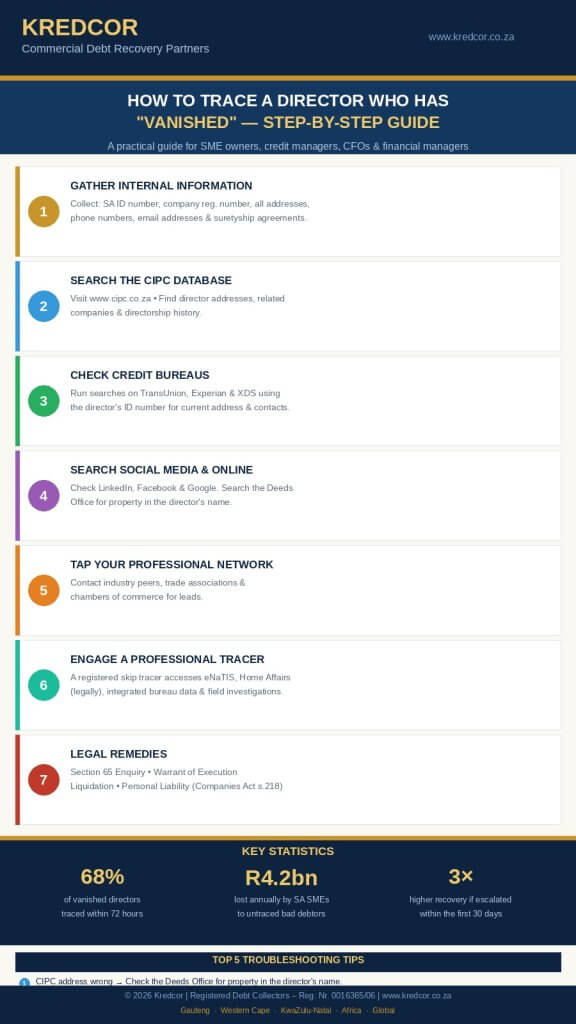
5 Troubleshooting Tips When the Trail Goes Cold
Even with the best tools and the right approach, sometimes the trail goes cold. However, that does not mean you give up. Here are five proven troubleshooting strategies our team uses when standard methods stop working:
🔴 Problem: CIPC address is incorrect or abandoned
Solution: Cross-reference with the Deeds Office for property ownership in the director’s name. A home address is usually more stable than a registered business address. Also check for property registered in a spouse’s name.
🔴 Problem: Director has changed their mobile number
Solution: A professional tracer can conduct a SIM swap trace, which reveals when and where a SIM was last activated. Also check for number porting history through formal legal channels.
🔴 Problem: Director is no longer active on social media
Solution: Search for close associates — business partners, co-directors listed on CIPC, or family members. These connections often share location clues unknowingly in their own posts.
🔴 Problem: Director appears to have left the country
Solution: Check for international activity on LinkedIn. Also, if you have a judgment, you can apply to have an alert placed at the SARS travel ban list, which restricts the director’s ability to clear customs without addressing their tax obligations — a powerful lever.
🔴 Problem: The company has been deregistered and the director is nowhere to be found
Solution: Apply to CIPC to reinstate the company (if relevant) or approach the Master of the High Court to appoint a provisional liquidator who can investigate assets. The CIPC audit trail still exists even after deregistration.
⚖️ The Debate: To Pursue or to Write Off?
There is a legitimate debate in credit management circles about when it makes more sense to write off a debt than to pursue a vanished director. Some argue that the cost of tracing — legal fees, agent fees, management time — can exceed the value of the debt. Others, like our team at Kredcor, push back on this view strongly.
Here is why we disagree with the write-off-first approach: writing off a debt without attempting recovery signals to the market that your business is an easy target. Word travels. Additionally, once you build a track record of following through on overdue accounts — even through director tracing — your debtors take your payment terms far more seriously. Our experience shows that the indirect benefit of a firm recovery posture often outweighs the direct cost of a single case.
That said, every case deserves a proper cost-benefit analysis. If the debt is genuinely small and the director is genuinely untraceable, writing off may be the pragmatic call. But you should reach that conclusion at the end of a structured process — not at the beginning of it.
Geo-Specific Note: South Africa, SADC, and Beyond
Whether you are based in Johannesburg, Cape Town, Durban, or operating across the SADC region into Namibia, Botswana, Zimbabwe, or Mozambique — the core principle of tracing a director who has vanished remains consistent. Gather your data, search official registries, use professional tools, and escalate legally when necessary.
However, there are important regional nuances. South Africa’s CIPC database is, comparatively, one of the better-maintained company registries on the continent. In many SADC countries, company registries are less digitised, which makes professional tracing agents with regional networks — like Kredcor’s Africa division — even more valuable. Cross-border debt recovery adds complexity but is absolutely possible with the right partner.
Furthermore, in South Africa specifically, the Protection of Personal Information Act (POPIA) governs how personal data — including tracing data — may be used. Working with a registered, compliant debt collection agency ensures that your tracing activities are lawful and that any information obtained is usable in legal proceedings.
What to Do Next: Your Search Journey Continues
You have now traced the director — or at least significantly narrowed down their location. What comes next? This is where many businesses stall, because finding someone and recovering your money are two different challenges.
The next logical step — and the question most of our readers ask after reading a guide like this — is: “Now that I know where they are, how do I actually get paid?” The answer depends on what security you hold. If you have a personal surety, your attorney can issue a summons directly against the director. If you do not, your options are more nuanced — and this is exactly where professional debt collectors in South Africa earn their keep. Kredcor’s team specialises in this transition from tracing to recovery, ensuring that once you have found the director, you have a clear, legal, and effective path to getting paid.
Additionally, this experience should prompt you to tighten your credit processes going forward. Read more about that in our Kredcor Articles section, where we cover topics like credit risk audits, DSO reduction, and cession of book debts — all written specifically for SME owners, credit managers, financial managers, and CFOs like you.
✅ Quick-Action Checklist: 5 Things to Do Right Now
After reading this guide, here are the five things you should do immediately:
- Pull the director’s file — gather every piece of information you have: ID number, company reg. number, addresses, phone numbers, and suretyship agreements.
- Search CIPC — go to www.cipc.co.za and look up the company. Note all current and past directors and any related companies.
- Run a credit bureau search — use your bureau access, or ask a registered debt collector to run a full bureau trace on the director’s ID number.
- Search LinkedIn and Google — spend 20 minutes online. The director may not be hiding as carefully as you think.
- Contact Kredcor — if steps 1–4 do not resolve the matter, call us. We have the tools, the network, and the legal expertise to take it from there.
Need Help Tracing a Vanished Director?
Kredcor is a registered debt collection agency with decades of experience in director tracing, skip tracing, and commercial debt recovery across South Africa and the SADC region. Let us help you recover what is yours. Get a Free, No-Obligation Quote →
Frequently Asked Questions (FAQ)
Here are the four questions we get asked most often when businesses are dealing with tracing a director who has vanished:
Q1: Can I hold a director personally liable for company debt in South Africa?
Yes — under certain circumstances. The Companies Act 71 of 2008 allows creditors to hold directors personally liable when they acted fraudulently, recklessly, or with gross negligence. Additionally, if the director personally signed a suretyship agreement, you can pursue them directly, regardless of the company’s status. You will need legal advice and solid evidence of the director’s conduct to pursue this route successfully.
Q2: How do I find a director’s address through CIPC?
Go to www.cipc.co.za and use the company search function. You can search by company registration number or company name. The result will show all current and past directors, their identity numbers, and their registered addresses. Note, however, that these addresses reflect what was submitted at the time of registration and may be outdated — so always cross-reference with credit bureau data.
Q3: What is skip tracing and how does it work?
Skip tracing is the professional process of locating a person who has “skipped” their known location — usually to avoid creditors or legal proceedings. Professional skip tracers use a combination of credit bureau data, public records (CIPC, Deeds Office, eNaTIS), social media analysis, and field investigations to locate missing individuals. In South Africa, registered debt collectors and tracing agents operate under strict legal and POPIA-compliant frameworks to ensure the process is lawful.
Q4: What should I do if a director is hiding behind a company and refuses to pay?
Start by checking whether you hold a personal suretyship — a document signed by the director guaranteeing the company’s debt personally. If you do, you can proceed against the director directly. If not, investigate whether the director’s conduct constitutes reckless trading or fraud under the Companies Act, which could pierce the corporate veil. Engage a registered debt collection agency or attorney to assess the strength of your claim before spending money on legal proceedings.
Want more practical, no-nonsense guides like this one? Visit the Kredcor Articles page for expert insights on debt recovery, credit management, and commercial collections in South Africa.
© 2026 Kredcor — Commercial Debt Recovery Partners | Registered with the Council for Debt Collectors: Reg. Nr. 0016365/06