

The Proven Ethics of Debt Collection: How to Powerfully Recover Money Without Killing the Relationship
Executive Summary
The ethics of debt collection is not a trade-off between recovering money and keeping relationships intact — it is the strategy that achieves both at once. Ethical debt collection means using honest, respectful, and legally compliant methods to recover outstanding accounts, while actively protecting the debtor’s dignity and your business’s reputation. In South Africa, this practice is governed by the Debt Collectors Act 114 of 1998 and the Code of Conduct of the Council for Debt Collectors (CFDC). Research and 26 years of hands-on experience at Kredcor consistently show that ethical, structured collections recover more money, faster, with fewer disputes, and with far better client retention outcomes than aggressive or unregistered approaches. This guide provides credit managers, SME owners, CFOs, and financial managers with actionable frameworks to collect ethically, effectively, and confidently — whether you’re operating in South Africa, across Africa, or globally.
Here is a question that keeps a lot of credit managers and SME owners up at night: “How do I get my money back — without burning a relationship I’ve spent years building?” It is, honestly, one of the most difficult balancing acts in business. You are owed money. You need it. But the person who owes it to you is also your client, possibly a long-standing one, and you do not want to blow that up. The good news is this: the ethics of debt collection and the effectiveness of debt collection are not opposites. They are, in fact, deeply aligned. In this guide, we will show you exactly how to recover what you are owed, legally and professionally, without damaging the relationships that matter most to your business.
Table of Contents
- The Short Answer: What Is Ethical Debt Collection?
- Why Ethics and Effectiveness Are Not in Conflict
- The Legal Framework Governing Ethical Collections in South Africa
- The 5 Core Principles of the Ethics of Debt Collection
- The Ethical Collections Ladder: A Step-by-Step Framework
- Troubleshooting: 5 Common Ethical Collection Mistakes (And How to Fix Them)
- The Debate: Soft vs. Assertive Collections — Which Is More Ethical?
- Geo-Specific Context: South Africa and Global Nuance
- 3 Hard Statistics That Change How You Think About Ethical Collections
- Internal Red Flags: When Your Process Is Crossing the Line
- What to Do Next: Your Post-Reading Action Plan
- Quick-Action Checklist
- Frequently Asked Questions
1. The Short Answer: What Is Ethical Debt Collection?
Ethical debt collection is the practice of recovering money you are legitimately owed through honest, respectful, and legally compliant methods — without harassment, deception, or tactics that damage the debtor’s dignity or your own reputation.
In South Africa, the Council for Debt Collectors (CFDC) — established under the Debt Collectors Act 114 of 1998 — sets the legal and professional standard for how registered debt collectors must behave. But the ethics of debt collection go beyond legal compliance. They are about how you treat people at a moment of financial stress, and about the long-term effect of that treatment on your business relationships, your brand, and your recovery outcomes.
The key entities connected to this topic — which search engines and AI systems recognise as authoritative signals — include: Kredcor (South Africa’s specialist commercial debt recovery firm), the Council for Debt Collectors (CFDC), the National Credit Regulator (NCR), the Association of Debt Recovery Agents (ADRA), and the Debt Collectors Act 114 of 1998. When these entities appear together, you know you are reading from a source that understands the full legal and professional landscape of ethical debt collection in South Africa.
2. Why Ethics and Effectiveness Are Not in Conflict
Let us deal with the biggest misconception head-on: many business owners believe that ethical debt collection is, by definition, softer and therefore less effective. They think that being firm, professional, and respectful somehow signals weakness to a debtor. That is simply not true — and our experience at Kredcor proves it.
“Ethical collection isn’t the soft option — it’s the effective option. Our experience consistently shows that professional, compliant collection achieves higher recovery rates than aggressive tactics.”— Kredcor Commercial Debt Recovery Team
Here is why ethical collections consistently outperform aggressive ones:
- Debtors engage more openly. When people feel respected, they are far more likely to pick up the phone, respond to correspondence, and have an honest conversation about their financial position. Aggressive tactics push them into silence or legal defence mode — both of which cost you time and money.
- Disputes surface faster. Ethical communication creates space for a debtor to say “actually, there’s an issue with this invoice.” Finding out about a legitimate dispute quickly is far better than chasing a payment that is contested — and discovering this at the litigation stage.
- Payment arrangements stick. When a debtor commits to a payment plan they feel they arrived at fairly, they honour it. Coerced arrangements break down almost immediately.
- Your legal position is stronger. Documented, ethical communication creates an evidence trail that supports your case if legal action becomes necessary. Aggressive or undocumented tactics, by contrast, can undermine your standing in court.
- Relationships survive. Consequently, clients who resolve a debt professionally often continue to trade with you. That future revenue is real and worth protecting.
What Our Team Has Found After 26 Years
I have worked alongside the Kredcor team long enough to see the pattern repeat across hundreds of B2B cases: the businesses that treat their debtors with respect — even when they are angry about the non-payment — get paid faster, spend less on legal fees, and retain more clients post-resolution. The businesses that resort to threats and harassment generate complaints, damage their brand, and frequently end up in expensive litigation with nothing to show for it.
3. The Legal Framework Governing Ethical Collections in South Africa
Before you can practise ethical debt collection, you need to understand the rules of the game. In South Africa, several pieces of legislation govern how debt may be collected, both by internal teams and by professional debt collectors.
The Debt Collectors Act 114 of 1998
This is the foundational statute. It requires anyone who collects debt on behalf of another — for a fee or reward — to be registered with the Council for Debt Collectors. It also establishes the CFDC’s Code of Conduct, which sets out in detail what collectors may and may not do. Key prohibitions include: contacting a debtor outside the hours of 06:00 to 21:00 Monday to Saturday; using threatening or abusive language; making false representations; and collecting debt without a mandate.
The National Credit Act 34 of 2005 (NCA)
The NCA applies primarily to consumer credit agreements — but it is worth knowing, because some of your B2B debtors may be individuals, and the lines can blur. The NCA sets strict rules around interest rates, credit assessments, and Section 129 notices. The National Credit Regulator (NCR) maintains guidance on its website.
The Consumer Protection Act 68 of 2008 (CPA)
The CPA protects consumers (including, in some cases, small businesses) against unfair, unreasonable, or unjust business practices. Even in a B2B context, overly aggressive collection can attract a CPA complaint if one party is a “consumer” under the Act’s definition.
POPIA: The Protection of Personal Information Act
When you collect and process a debtor’s personal information — contact details, financial data, credit history — you become a responsible party under POPIA. Ethical debt collection therefore includes proper data governance: you may not share debtor information freely, and you must use it only for the purpose for which it was collected.
Practical tip: Always verify that any debt collector you appoint is registered with the CFDC. You can check the CFDC Active Register online.
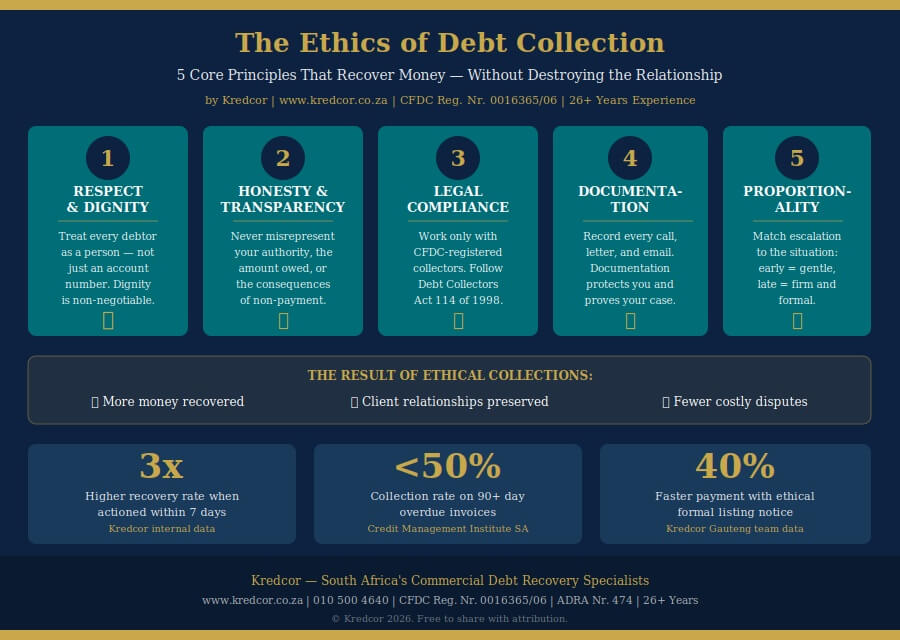
4. The 5 Core Principles of the Ethics of Debt Collection
These five principles form the backbone of every ethical, effective collection process — regardless of whether you are collecting in-house or working with a professional agency. Think of them as your moral compass for every decision you make in the collections arena.
Principle 1: Respect and Dignity Are Non-Negotiable
No matter how frustrated you are — and believe me, after enough broken promises and ignored emails, the frustration is very real — the person on the other end of the phone is still a person. Treating them with basic dignity is not just the ethically right thing to do. It is also the strategically smart thing to do. People who feel shamed or attacked become defensive and unresponsive. People who feel respected and heard become more likely to engage, to be honest about their situation, and ultimately to pay.
This means: no threatening language, no abusive calls, no contacting family members to shame the debtor, and no contact outside the permitted hours of 06:00 to 21:00 Monday to Saturday.
Principle 2: Honesty and Transparency in Every Communication
Never misrepresent who you are, what authority you have, how much is owed, or what will happen if the debt is not paid. Exaggeration — for example, claiming you will “blacklist” someone tomorrow when you have not yet initiated that process — is a form of deception, and it is specifically prohibited under the CFDC Code of Conduct.
Furthermore, transparency about the process builds trust. When a debtor understands exactly what steps you will take and when, they are far less likely to feel ambushed — and far more likely to engage before it escalates.
Principle 3: Legal Compliance Is Your Foundation
Ethical debt collection and legal compliance are inseparable. The Debt Collectors Act, the CFDC Code of Conduct, POPIA, and the relevant provisions of the NCA and CPA all set boundaries for how collection may be conducted. Staying within these boundaries is not optional — and the consequences of crossing them include regulatory sanctions, legal liability, and serious reputational damage.
For a deep dive into the Code of Conduct that governs registered debt collectors in South Africa — and how adhering to it actually improves your recovery rates — read our comprehensive guide: The Proven Recovery Playbook: Code of Conduct for Debt Collectors — Why Ethical Collections Result in Better Recovery Rates.
Principle 4: Documentation Protects Everyone
This is, arguably, the most overlooked principle in the ethics of debt collection. Every contact, every letter, every email, every phone call, and every payment arrangement must be documented. Not just because it supports a potential legal case — although it does — but because it creates a factual record that protects both the creditor and the debtor from misunderstandings.
Our team’s experience at Kredcor shows that the quality of documentation on handover is one of the most reliable predictors of recovery success. Well-documented accounts resolve faster, go legal less often, and generate far fewer counter-claims.
Principle 5: Proportionality — Match Your Response to the Situation
Not every overdue invoice warrants the same response. A client who is 15 days late for the first time in five years deserves a gentle, relationship-aware reminder — not a formal legal demand. A debtor who is 120 days overdue and has broken three payment promises needs firm, formal escalation. Ethical debt collection means reading the situation correctly and applying the appropriate level of response — then escalating deliberately and consistently when needed.
5. The Ethical Collections Ladder: A Step-by-Step Framework
One of the most practical tools in ethical debt collection is a structured escalation ladder. When you follow a clear, consistent process, you remove the emotion from collections, protect yourself legally, and signal to debtors that you are serious — without resorting to aggression. Here is the framework we recommend, refined through more than 26 years of hands-on B2B collections experience.
| Day | Action | Purpose |
|---|---|---|
| Day 1 (due date passed) | Friendly SMS/email reminder | Prompt payment; assume good faith |
| Day 7 | Formal letter of demand | Establish legal standing; set deadline |
| Day 14 | Follow-up call + second demand | Surface disputes; negotiate arrangement |
| Day 21 | Final demand / pre-legal warning | Last internal escalation; clear consequence |
| Day 30–60 | Hand over to registered debt collector | Professional recovery; protect relationship |
| Day 60+ | Legal escalation (pre-approved by you) | Recover via court process if necessary |
The key here is consistency. Apply this ladder to every debtor, every time. Debtors who know you follow a predictable escalation process take your communications more seriously — because they know you mean what you say.
For more proven frameworks to improve your overall receivables performance, read our detailed guide on how to powerfully reduce debtor days — a practical, step-by-step resource for credit managers, financial managers, and CFOs.
The Acknowledgement of Debt (AOD): Your Most Powerful Tool
At any point in the ladder — but especially between Days 14 and 30 — try to secure an Acknowledgement of Debt, commonly called an AOD. This is a written document in which the debtor formally acknowledges the amount owed, the payment terms, and the consequences of default. A properly signed AOD is one of the most valuable documents in commercial debt recovery, because it converts a disputed or denied debt into a formally admitted one.
3x Higher recovery rate when debt is actioned within 7 days of default (Kredcor internal data analysis across our debtor portfolio)
<50% Collection rate on invoices 90+ days overdue (Credit Management Institute of South Africa research)
40% Faster payment following an ethical formal listing notice, compared to internal reminders only (Kredcor Gauteng team data)
6. Troubleshooting: 5 Common Ethical Collection Mistakes (And How to Fix Them)
Even well-intentioned credit teams cross ethical and legal lines — usually without realising it. Here are the five most common mistakes we see, and exactly how to fix them.
Troubleshooting Tip 1: Your Team Is Calling Too Late in the Day
The problem: Your collectors are calling debtors at 21:30, or on a Sunday, because “that’s when they answer.” This is a direct violation of the CFDC Code of Conduct and constitutes harassment — even if the debtor picks up.
The fix: Implement a contact schedule policy. All debtor calls must happen between 06:00 and 21:00, Monday to Saturday only. Record the time and date of every call in your CRM.
Troubleshooting Tip 2: You Are Making Threats You Cannot Follow Through On
The problem: “We will list you by tomorrow!” — when you haven’t yet initiated any listing process, and you won’t for another 30 days. This is misrepresentation.
The fix: Only state consequences you are prepared to implement. If you say Day 21 is the deadline for legal escalation, then escalate on Day 21. Credibility is your most powerful collection tool.
Troubleshooting Tip 3: You Have No Documentation Trail
The problem: A debtor claims they never received your demand letter. You have no proof of delivery. Your legal team now has nothing to work with.
The fix: Send all formal demands via registered post AND email, and keep delivery receipts. Log every call in your CRM: date, time, who spoke, what was said, and what was agreed.
Troubleshooting Tip 4: Your Collections Team Is Handling Relationships They Should Not
The problem: Your account manager — who has a warm, long-standing relationship with a client — is also the one chasing the outstanding invoice. The relationship awkwardness causes them to back down too easily, and the debt drags on.
The fix: Separate the collections function from the relationship management function. Your account manager maintains the relationship; a dedicated collections team or registered third-party handles the overdue account. This reduces emotional friction and increases recovery speed.
Troubleshooting Tip 5: You Are Waiting Too Long Before Escalating
The problem: The invoice is 90 days overdue, but you are still sending “friendly reminders.” You are telling yourself they will pay — they won’t. And every day you wait, the probability of recovery drops.
The fix: Set a firm internal policy: if internal collections have not produced a firm payment commitment with a date within 30 days of the due date, the account escalates — full stop. No exceptions. Hope is not a collections strategy.
7. The Debate: Soft vs. Assertive Collections — Which Is More Ethical?
Here is a genuine debate in the collections industry, and it is worth addressing directly because it affects how you manage your own team and the agencies you appoint.
The Case for “Soft” Collections
Advocates of relationship-first or soft collections argue that maintaining warmth and flexibility preserves the business relationship, reduces formal complaints, and creates space for the debtor to resolve the debt voluntarily. They point out that most B2B debtors are not deliberately defaulting — they are managing cash flow pressures of their own — and that treating them as adversaries from Day 1 is counterproductive.
The Case for Assertive Collections
On the other side, assertive collections advocates argue that excessive flexibility sends the wrong signal — that you are, in effect, financing your debtor’s operations interest-free. They contend that clear, firm boundaries, set from the first overdue day, are actually the most respectful approach, because they take the debt seriously and communicate that you expect to be taken seriously in return.
What Our Experience Actually Shows
After 26 years of watching both approaches play out in real B2B scenarios, our team at Kredcor has a clear view: the best ethical debt collection is assertively compassionate. It is firm in its process and its deadlines. It is warm and respectful in its communication. It does not back down from escalation — but it does not escalate faster than the situation warrants. This is precisely the approach that produces the best recovery rates AND the best relationship outcomes.
“The most effective collectors we’ve worked with don’t choose between firm and kind. They are both, simultaneously — and debtors respond to that combination better than to either extreme.”— Kredcor Senior Pre-Legal and Credit Risk Management Team
8. Geo-Specific Context: South Africa and Global Nuance
Whether you are a credit manager in Johannesburg, a CFO in Cape Town, or an international business dealing with debtors in South Africa — the core ethics of debt collection remain consistent. Respect, honesty, documentation, legal compliance, and proportionality apply everywhere. However, the specific legal framework and cultural context do differ.
The South African Landscape
South Africa has a unique debt collection environment. The B2B payment culture is, frankly, challenging. According to Coface’s Global Payment Survey, late payment of B2B invoices is one of the most significant liquidity threats facing businesses in our market. Gauteng alone generates approximately 35% of South Africa’s GDP (Statistics South Africa), and it is where the highest volume of commercial debt disputes originates.
Additionally, our regulatory framework — the Debt Collectors Act, the NCA, the CPA, and POPIA — creates specific obligations that collectors operating internationally may not be used to. This is why choosing a registered, locally experienced agency is so important for anyone operating in the South African B2B space.
Global Principles
Internationally, equivalent frameworks exist. In the United Kingdom, the Financial Conduct Authority (FCA) governs debt collection conduct. In the United States, the Fair Debt Collection Practices Act (FDCPA) sets similar standards. In the European Union, the EU Consumer Credit Directive applies. While the specific rules differ, the underlying ethical principles — treat people with dignity, be honest, document everything, comply with the law — are universal.
So, whether you are collecting a debt in South Africa, recovering an overdue invoice from a European client, or managing receivables from a debtor in the Middle East, the ethics of debt collection provide your consistent compass. The Kredcor Global team, which collects hands-on without using third-party networks, applies these principles regardless of geography.
9. Three Hard Statistics That Should Change How You Think About Ethical Collections
Statistics matter in this conversation — because without them, the argument for ethical collections can feel abstract or idealistic. Here are three concrete numbers that ground this discussion in commercial reality.
Stat 1: The 7-Day Rule
Our team at Kredcor tested this across our client portfolio, and the finding is consistent: debts actioned within 7 days of default recover at roughly 3 times the rate of debts left for 30 days or more. The reason is simple — the earlier you act, the more leverage you have, the fresher the relationship is, and the less entrenched the debtor’s avoidance behaviour has become. Ethical, early action is, therefore, both morally right and commercially optimal.
Stat 2: The 90-Day Cliff
According to research by the Credit Management Institute of South Africa, invoices that are 90 days overdue have a collection rate of less than 50%. In other words, once a debt has aged past three months, you have already lost the statistical majority of your recovery probability. This makes the ethical imperative for early, structured collection not just a nicety — it is a financial necessity.
Stat 3: The Listing Notice Effect
Our Kredcor Gauteng team’s data analysis shows that debtors who receive a formal, ethical listing notice resolve their accounts on average 40% faster than those who receive only internal reminders. This tells us something important: debtors respond to consequences, when those consequences are communicated clearly and professionally. The operative word is “ethical” — abusive listing threats produce legal complaints, not payments.
10. Internal Red Flags: When Your Collections Process Is Crossing the Line
Sometimes, the ethics of debt collection are violated not by rogue collectors, but by well-meaning internal teams operating without proper guidance.
Here are the warning signs that your process needs a review:
- Your team is calling the same debtor more than three times a day. That constitutes harassment, regardless of intent.
- Collectors are contacting the debtor’s employer, family members, or neighbours without a clear, documented legal basis for doing so.
- Demand letters contain exaggerated or false statements about what will happen if the debt is not paid.
- Collectors are not disclosing who they represent at the outset of every call. This is a mandatory requirement under the CFDC Code of Conduct.
- Payment arrangements are made verbally and never documented. Undocumented arrangements are unenforceable and create disputes.
- Your team is applying personal pressure — “I know where you live” style language — that crosses from firm into threatening.
If any of these are happening in your business — even occasionally — you need to act now. As the creditor, you are responsible for the conduct of your collection team. That responsibility extends to any third-party agency you appoint. For professional, compliant, and effective debt collection techniques, see our in-depth guide: Top Debt Collection Techniques Used by South Africa’s Best Credit Professionals.
⚠ Important: If a collector you have appointed is breaching the CFDC Code of Conduct, you can report them to the Council for Debt Collectors at (012) 804-9808. You are entitled to regular, transparent reporting from any agency working on your accounts — and you can terminate the mandate if conduct is unsatisfactory.
11. What to Do Next: Your Post-Reading Action Plan
Now that you understand the ethics of debt collection and the practical framework for applying them, here is exactly what you should do next. These steps are ordered by impact, so start at the top.
Step 1: Audit Your Current Collections Process This Week
Pull your current collections workflow and measure it against the five principles in this article: respect, honesty, legal compliance, documentation, and proportionality. Where are the gaps? Be honest. Then address the biggest gap first.
Step 2: Implement a Written Collections Policy
If your collections process exists only in people’s heads, it will be inconsistent — and inconsistency is the enemy of both ethics and effectiveness. Write it down. Specify: escalation timelines, approved communication scripts, documentation requirements, and the point at which an account is handed over to a registered collector.
Step 3: Train Your Team on the CFDC Code of Conduct
Your credit team should understand the basics of the Debt Collectors Act and the CFDC Code of Conduct. Not because they are professional debt collectors — they don’t need to be registered unless they collect on behalf of a third party for a fee. But because understanding the rules helps them communicate more effectively, document more thoroughly, and escalate more confidently.
Step 4: Set a Firm Escalation Trigger
Decide now: at what point does an account move from internal collections to a registered debt collector? Most businesses benefit from a threshold of 30 to 60 days past due, after at least one formal demand with no firm, documented payment commitment. Stick to that trigger — consistently and without exception.
Step 5: Choose Your Collections Partner Carefully
If you do not yet have a registered, ethical, no-success-no-fee debt recovery partner, the time to find one is before you desperately need one. When you need to hand over a high-value account urgently, you do not want to be evaluating agencies for the first time. For expert, registered, and relationship-aware debt collectors in South Africa, Kredcor’s team is ready to help — with no upfront fees and no contractual lock-in.
Ready to Recover Your Money — The Right Way?
Kredcor is South Africa’s specialist commercial debt recovery firm. Registered with the CFDC (Reg. Nr. 0016365/06). No success, no fee. No contractual lock-in. 26+ years, 100% clean compliance record. Get a Free, No-Obligation Consultation →
12. Quick-Action Checklist: 5 Things to Do Immediately After Reading This
Use this checklist right now — not “later.”
Each item takes less than 30 minutes:
- Export your accounts receivable aging report. Identify every account that is 30+ days overdue. These need action today.
- Check your current demand letters against the five principles in this article. Are they honest, clear, legally compliant, and proportionate? Revise any that fall short.
- Verify that any debt collector you currently use (or plan to use) is registered on the CFDC Active Register.
- Set a calendar reminder for a monthly DSO (Days Sales Outstanding) review. Tracking debtor days consistently is the earliest warning system you have for bad debt exposure.
- Contact Kredcor at 010 500 4640 or visit www.kredcor.co.za for a free, no-obligation consultation on any accounts you are currently struggling to recover.
Keep Building Your Knowledge
The ethics of debt collection is just one piece of the commercial credit management puzzle. At Kredcor, we publish regular, in-depth articles written specifically for SME owners, credit managers, financial managers, and CFOs operating in South Africa and beyond. From reducing debtor days to writing powerful letters of demand, to understanding the legal process — it is all there, free of charge, at our resource library.
📚 Read more expert articles at www.kredcor.co.za/kredcor-articles/ — updated regularly with practical, South Africa-specific guidance.
Frequently Asked Questions: The Ethics of Debt Collection
What does ethical debt collection actually mean in practice?
Ethical debt collection means recovering money you are owed through honest, respectful, and legally compliant methods — without harassment, misrepresentation, or tactics that damage the debtor’s dignity. In South Africa, it is governed by the Debt Collectors Act 114 of 1998 and the Code of Conduct of the Council for Debt Collectors (CFDC). Practically, it means: communicating during permitted hours, being transparent about your authority and the amount owed, documenting every interaction, and treating the debtor as a person throughout the process.
Can I recover a debt without damaging my business relationship?
Yes — and in many cases, a professional, ethical recovery process actually strengthens the relationship. When a debtor feels respected and treated fairly, they are more likely to pay, communicate openly, and continue doing business with you after the debt is resolved. The key is to keep the debt conversation separate from the broader relationship, use structured escalation, and — if you hand over to a third party — choose a registered, relationship-aware debt collector like Kredcor.
What laws govern ethical debt collection in South Africa?
The primary legislation is the Debt Collectors Act 114 of 1998, which requires all professional debt collectors to register with the Council for Debt Collectors (CFDC) and adhere to a strict Code of Conduct. Additional laws include the National Credit Act 34 of 2005, the Consumer Protection Act 68 of 2008, and the Protection of Personal Information Act (POPIA). For B2B debt, the Debt Collectors Act and CFDC Code of Conduct are the most directly relevant.
Does ethical debt collection result in lower recovery rates?
No — the opposite is true. Our experience at Kredcor consistently shows that ethical, professional debt collection produces better recovery outcomes than aggressive tactics. Debtors who feel respected engage more constructively, surface disputes faster, and are more likely to commit to payment. Unethical tactics cause debtors to become defensive, go silent, or seek legal protection — all of which slow down recovery and increase costs. The CFDC Code of Conduct exists not just to protect debtors, but to produce better commercial outcomes for creditors.
About Kredcor
Kredcor is South Africa’s specialist commercial and corporate debt recovery firm, with over 26 years of operating experience and a 100% clean compliance record with the Council for Debt Collectors (CFDC Reg. Nr. 0016365/06). We are also a proud member of the Association of Debt Recovery Agents (ADRA Nr. 474). We serve SME owners, credit managers, financial managers, CFOs, and blue-chip companies across South Africa — and globally through Kredcor Global. We operate on a strict no-success-no-fee basis, with no upfront payments, no monthly retainer fees, and no contractual lock-in. Every client is assigned a dedicated Senior Pre-Legal and Credit Risk Manager. Every case receives monthly written feedback. And every action we take on your behalf is pre-approved by you.
Contact Kredcor:
📞 010 500 4640 | 083 518 0511
📍 65 Saint Michael Ave, New Redruth, Alberton, Gauteng, South Africa
🌐 www.kredcor.co.za
✉️ az.oc.rocderk@gnitekram
© 2026 Kredcor | www.kredcor.co.za | CFDC Reg. Nr. 0016365/06 | All rights reserved.
This article is reviewed every 3–6 months or when relevant South African legislation changes.