
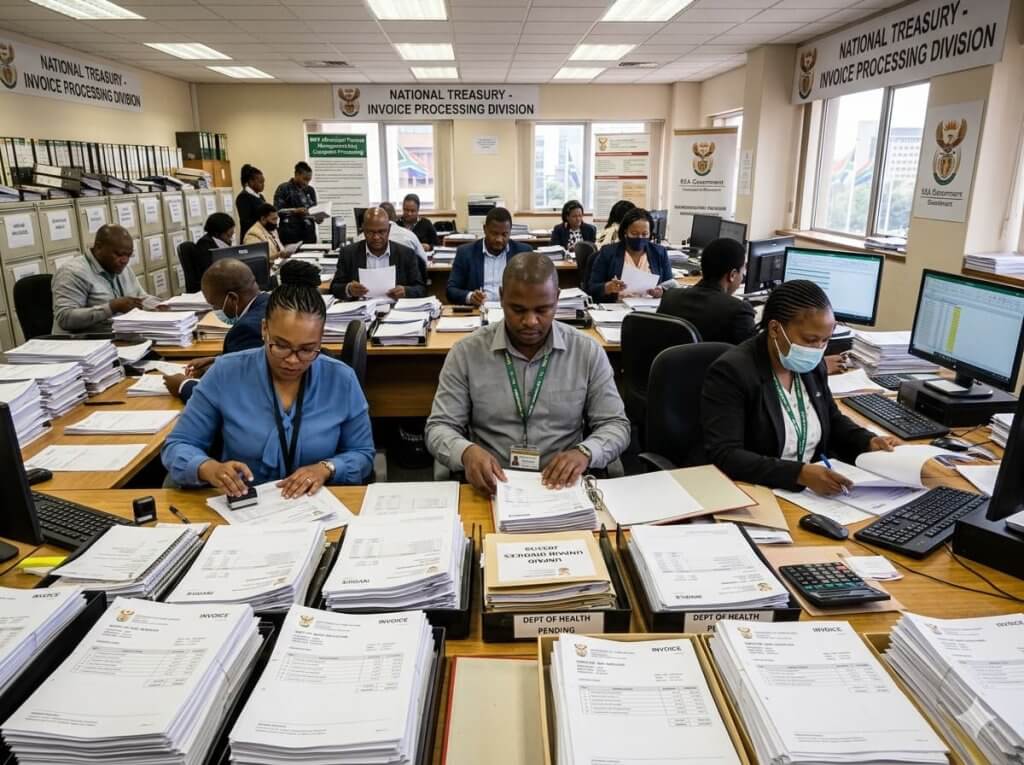
Collecting from Government Departments: Your Essential PFMA & Treasury Rules Guide (2026)
Struggling to get paid by a government department? Learn exactly how the PFMA and Treasury Regulation 8.2.3 work, and get 5 proven steps to collect what you’re owed.
📋 Executive Summary
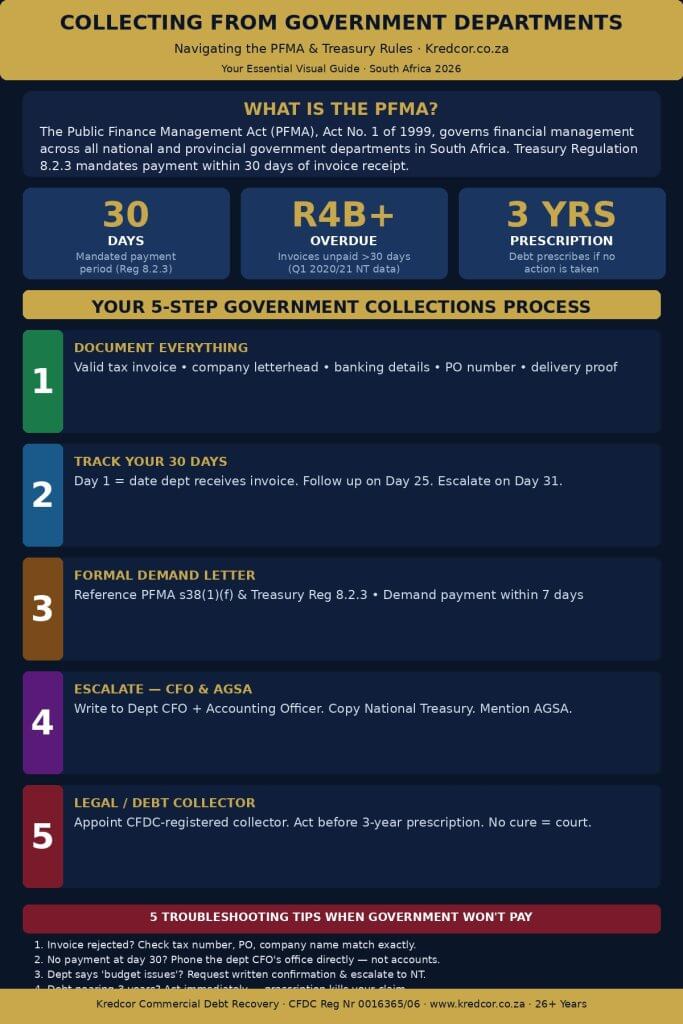
Collecting from government departments in South Africa is governed by the Public Finance Management Act (PFMA), Act No. 1 of 1999, and its Treasury Regulation 8.2.3, which legally require all national and provincial departments to pay valid invoices within 30 days of receipt. Section 38(1)(f) of the PFMA holds accounting officers personally liable for non-compliance, which constitutes financial misconduct. National Treasury data shows that in Q1 2020/21, over R4 billion in invoices remained unpaid beyond 30 days. Prescription under the Prescription Act 68 of 1969 extinguishes your claim after 3 years of inaction. This guide gives SME owners, credit managers, financial managers, and CFOs a clear, 5-step collections process, key compliance checklists, and troubleshooting tips — so they can recover government debt quickly, legally, and confidently. Kredcor (CFDC Reg Nr 0016365/06) has helped South African businesses navigate government collections for over 26 years.
So, your government department client has not paid. You have sent the invoice. You have followed up. You have been polite. And still — nothing. Sound familiar? If you supply goods or services to government, this situation happens far more often than it should. The good news, however, is that the law is firmly on your side. The Public Finance Management Act (PFMA) and National Treasury regulations set a clear, legally binding obligation for government departments to pay you. And when you know how to use those rules, collecting from government departments becomes a structured, actionable process — not a frustrating guessing game.
This guide walks you through everything you need to know. Furthermore, it gives you specific steps, real numbers, and practical tools to speed up recovery. Whether you are a small business owner, a credit manager, a financial manager, or a CFO, you will find this guide genuinely useful. Let’s get into it.
✅ Quick Answer: Under Section 38(1)(f) of the PFMA and Treasury Regulation 8.2.3, all South African government departments must pay valid invoices within 30 days from date of receipt. If they don’t, the accounting officer commits financial misconduct. You have the right to demand payment, escalate to National Treasury, and take legal action — before the 3-year prescription period expires.
📑 Table of Contents
- What Is the PFMA, and Why Does It Matter to You?
- Treasury Regulation 8.2.3 — The 30-Day Rule Explained
- 3 Hard Facts You Need to Know About Government Payments
- The 5 Key Entities Involved in Government Collections
- Your 5-Step Process for Collecting from Government Departments
- What Counts as a Valid Invoice Under the PFMA?
- The MFMA — What About Municipalities?
- Troubleshooting: 5 Tips When Government Won’t Pay
- The Debate: Should You Sue Government or Use a Debt Collector?
- South Africa vs. Global Context — A Regional Note
- What to Do Next — Your Action Plan
- Quick-Action Checklist
- Frequently Asked Questions (FAQ)
1. What Is the PFMA, and Why Does It Matter to You?
The Public Finance Management Act (PFMA), Act No. 1 of 1999, is South Africa’s primary law governing financial management in national and provincial government. In simple terms, it tells government departments how to handle money — including how and when they must pay their suppliers.
The PFMA was enacted to modernise public finance management and bring it in line with Section 216 of the Constitution, which requires transparency, accountability, and effective financial management in public institutions. Therefore, it is not just a bureaucratic rulebook. It is a powerful law with real teeth.
Who does the PFMA apply to?
The PFMA applies to national and provincial government departments, constitutional institutions, and public entities listed in its schedules. For suppliers and creditors, the most important sections are Sections 38 to 43, which place specific obligations on the accounting officer (typically the Director-General or Head of Department) of each institution.
Importantly, the PFMA does not directly apply to municipalities. Municipalities fall under the Municipal Finance Management Act (MFMA), Act No. 56 of 2003, which we cover in Section 7 below.
“The PFMA was drafted to ensure that all revenue, expenditure, assets, and liabilities of government are managed efficiently and effectively. For suppliers, this means your right to be paid on time is not just a courtesy — it is a constitutional imperative.”— Kredcor Commercial Debt Recovery, 26+ years of government collections experience
2. Treasury Regulation 8.2.3 — The 30-Day Rule Explained
Here is the rule that matters most when you are collecting from government departments. Treasury Regulation 8.2.3 states clearly:
“Unless determined otherwise in a contract or other agreement, all payments due to creditors must be settled within 30 days from receipt of an invoice or, in the case of civil claims, the date of settlement or court judgement.”— National Treasury, Treasury Regulation 8.2.3 under the PFMA
So, the 30-day clock starts on the day the department receives your invoice — not the day they capture it into their system, not the day they approve it, and not the end of the month. The day of receipt is day one.
What happens if they don’t pay within 30 days?
Non-payment beyond 30 days is not simply an administrative delay. Under Section 38(1)(f) of the PFMA, the accounting officer of a department has a personal legal obligation to settle all contractual obligations within the prescribed period. Failure to do so constitutes financial misconduct — a serious offence with personal consequences for the official responsible.
Furthermore, Cabinet re-affirmed this obligation in November 2010 and again in subsequent years, instructing all accounting officers to comply with the 30-day rule without exception. National Treasury even introduced a mandatory exception-reporting system: departments must report any invoice older than 30 days that remains unpaid to their relevant treasury by the 7th of each month. In practice, however, compliance remains inconsistent — which is exactly why this guide exists.
📌 Pro Tip: Always ask for written acknowledgement of receipt when you submit your invoice. An email reply, a signed delivery note, or even a WhatsApp confirmation can serve as proof of the date of receipt — and it locks in the 30-day clock.
3. Three Hard Facts You Need to Know About Government Payments
Before we get into your action plan, let’s look at the numbers. These facts are critical because they set the context — and they will motivate you to act faster.
R4B+ Unpaid Invoices
National Treasury data: Q1 2020/21 — invoices older than 30 days from both national & provincial departments totalled over R4 billion.
27 716 Overdue Invoices; Number of invoices older than 30 days unpaid by national & provincial departments as at end of June 2020 (National Treasury Q1 2020/21 Report).
3 YRS Prescription; Under the Prescription Act 68 of 1969, most commercial debts — including those owed by government — prescribe after 3 years of inaction.
Additionally, our team’s experience — across more than 26 years of commercial debt recovery in South Africa — confirms that many SMEs only act after the debt is 6, 12, or even 24 months old. By that stage, recovery becomes significantly harder. Consequently, early and structured action is always the winning strategy.
⚠️ Key Warning: The South African government is the largest single consumer of goods and services in the country. Government payment delays directly threaten job creation, service delivery, and SMME survival. Do not treat a government debt as “safe” just because the debtor is the state. Act systematically, just as you would with any other overdue debtor.
4. The 5 Key Entities in Government Collections
To collect effectively, you need to know who the key players are.
Here are the five most important entities you will deal with when collecting from government departments:
| Entity | Role | Why They Matter to You |
|---|---|---|
| National Treasury | Governs PFMA implementation; publishes 30-day payment compliance data | You can copy them on escalation letters; they monitor and report on non-compliant departments |
| Accounting Officer (AO) | Director-General or HoD; personally accountable for financial management | The AO is personally liable for financial misconduct — escalating to them carries real weight |
| Auditor-General South Africa (AGSA) | Independent audit body; reports on government financial management annually | Mentioning an AGSA report in your escalation letter gets serious attention |
| Chief Financial Officer (CFO) | Manages the dept’s finances; reports to the Accounting Officer | Your first escalation target after 30 days; they control the payments queue |
| Council for Debt Collectors (CFDC) | Regulatory body for SA debt collectors under the Debt Collectors Act 114 of 1998 | Any third-party collector you appoint must be CFDC-registered; verify at cfdc.org.za |
5. Your 5-Step Process for Collecting from Government Departments
This is the core of what we have learned after 26 years of collecting from government departments across South Africa. Follow these steps in order, and you will dramatically improve your recovery rate.
1 Submit a Fully Compliant Invoice
First and foremost, ensure your invoice is legally valid before the 30-day clock starts. A rejected invoice resets the clock — and government departments often use this as a delay tactic. Your invoice must include: a valid tax invoice header (SARS requirements), your exact registered company name and VAT number, the department’s correct official name and contact person, a valid purchase order (PO) number, a clear description of goods or services delivered, proof of delivery or service completion, and your correct banking details. Moreover, submit it to the correct address and obtain written acknowledgement of receipt. That acknowledgement locks in your Day 1.
2 Track Your 30-Day Clock Proactively
Do not wait until Day 31 to follow up. Instead, follow up at Day 15 with a polite status enquiry. Then follow up again at Day 25 with a more assertive call. Document every interaction — who you spoke to, what was said, and when. This paper trail is invaluable if you later need to escalate or take legal action. Consequently, keeping a simple spreadsheet for each government invoice is a very worthwhile investment of your time.
3 Send a Formal Letter of Demand
If payment has not arrived by Day 31, send a formal, written letter of demand. This letter must: reference the specific invoice number and amount; cite Section 38(1)(f) of the PFMA and Treasury Regulation 8.2.3; state that payment is now overdue and constitutes financial misconduct under the PFMA; demand full payment within 7 business days; and state clearly what consequences will follow if payment is not received. Send this letter by email with read-receipt, and by registered post. Keep copies of everything. A strong letter of demand dramatically increases your chance of payment without needing to escalate further. For more guidance, read our detailed guide: The Complete, Proven Guide to the Debt Collection Process in South Africa .
4 Escalate to the CFO and National Treasury
If your letter of demand produces no result, escalate immediately. Write directly to the department’s Chief Financial Officer (CFO) and Accounting Officer (Director-General or HoD). In your letter, copy the relevant provincial treasury (for provincial departments) or National Treasury (for national departments). Also mention that if the matter remains unresolved, you may bring it to the attention of the Auditor-General South Africa (AGSA). This escalation path is powerful because it triggers real personal accountability. Accounting officers take AGSA involvement very seriously, given that it affects their performance assessments and annual audit outcomes.
5 Appoint a Registered Debt Collector or Take Legal Action
If escalation still yields no result, it is time to appoint a professional. Always appoint a CFDC-registered commercial debt collector — it is a legal requirement under the Debt Collectors Act 114 of 1998. Alternatively, instruct an attorney to issue a summons. Either way, act well before the 3-year prescription period under the Prescription Act 68 of 1969 expires. I have personally seen businesses lose valid claims against government departments simply because they waited too long. Do not let that happen to you. Verify your collector’s registration at cfdc.org.za/active-register . For a comprehensive overview of the legal framework, see our guide: The Debt Collectors Act Explained: Your Essential No-Nonsense Guide .
6. What Counts as a Valid Invoice Under the PFMA?
One of the most common reasons government departments delay payment — and one of the most frustrating — is an “invalid” invoice. Therefore, getting your invoice right from the start is absolutely critical.
Your Invoice Compliance Checklist
- ✅ Correct legal name of the government department (as per the contract or purchase order)
- ✅ Valid SARS tax invoice format with “Tax Invoice” clearly stated
- ✅ Your registered company name matching your CIPC registration
- ✅ Your VAT registration number (if VAT-registered)
- ✅ A unique, sequential invoice number
- ✅ The purchase order (PO) number issued by the department
- ✅ A clear, detailed description of goods or services provided
- ✅ The date of supply or service completion
- ✅ Signed delivery note, job completion certificate, or official proof of delivery (POD)
- ✅ Your bank account details (matching your company name and CIPC registration)
- ✅ The invoice date and due date (30 days from receipt)
- ✅ Contact details for your accounts receivable team
🚨 Watch Out: Some government departments will reject an invoice if your company name on the invoice differs — even slightly — from your name on the CIPC register or the contract. For example, “Pty Ltd” vs “(Pty) Ltd” has caused rejections. Check this carefully before you submit.
The Role of a Valid Purchase Order (PO)
Under PFMA procurement rules, a government department may only commit expenditure once a budget has been appropriated and a purchase order has been issued. Section 38(2) of the PFMA specifically prohibits accounting officers from committing to contracts before budget appropriation. Therefore, if you supply goods or services without a valid PO, you may find it very difficult to enforce payment — even if the department received and used what you supplied. Always, always get a signed PO before you deliver.
7. The MFMA — What About Collecting from Municipalities?
Municipalities operate under a different law: the Municipal Finance Management Act (MFMA), Act No. 56 of 2003. The MFMA has its own set of financial management obligations for municipal accounting officers — and the same principle of timely payment applies.
However, collecting from municipalities is, in our experience, significantly more challenging than collecting from national or provincial departments. Municipalities often face severe cash-flow constraints, budget shortfalls, and high levels of irregular and unauthorised expenditure. Furthermore, Section 65 of the MFMA requires municipalities to pay their creditors within 30 days of invoice, but non-compliance is widespread.
Key differences between PFMA and MFMA collections
| Factor | PFMA (Departments) | MFMA (Municipalities) |
|---|---|---|
| Payment obligation | 30 days (Treasury Reg 8.2.3) | 30 days (s65 MFMA) |
| Governing body | National Treasury | National Treasury & CoGTA |
| Accounting officer | Director-General / HoD | Municipal Manager |
| Audit oversight | Auditor-General SA (AGSA) | Auditor-General SA (AGSA) |
| Escalation route | NT, AGSA | MEC for Finance, CoGTA, AGSA |
| Practical compliance | Inconsistent but improving | Often poor; many under administration |
For further insight into the full legal framework governing collections in South Africa, we recommend reading our comprehensive article: The Essential Guide to the Council for Debt Collectors — which covers who can legally collect, how the regulatory framework works, and how to protect your business when appointing a collection agency.
8. Troubleshooting: 5 Tips When Government Won’t Pay
Even when you follow every step correctly, government collections can hit roadblocks. Based on our team’s experience working with hundreds of South African businesses, here are the five most common problems — and exactly how to solve them.
- Tip 1: “Your invoice was rejected — incorrect format.” Do not argue — fix it immediately. Ask for the specific rejection reason in writing. Resubmit with a corrected invoice and a new cover letter, and request written acknowledgement of the new receipt date. Then restart your 30-day clock from the new confirmed receipt date.
- Tip 2: “We don’t have your banking details on the system.” This is a very common delay tactic. Request the department’s official supplier onboarding form and submit your banking details in writing, with a certified bank letter. Follow up daily until confirmed. Document every step.
- Tip 3: “We have a budget problem — payment will be delayed.” Budget constraints do not override the legal obligation to pay. Acknowledge their difficulty in writing, but make clear that your rights under the PFMA remain intact. Request a written payment schedule and copy the relevant treasury. If they cannot provide one, escalate immediately.
- Tip 4: “We cannot find the original invoice on our system.” This is why your submission tracking matters so much. Resend the invoice immediately with proof of your original submission date. Insist on written confirmation of the new receipt date. If this happens repeatedly, it constitutes a pattern of non-compliance — document it and include it in your escalation letter to the CFO and Accounting Officer.
- Tip 5: “The debt is nearing 3 years old and you still haven’t received anything.” Act now — today. The Prescription Act 68 of 1969 will extinguish your right to enforce the debt after three years of inaction. Appoint a CFDC-registered debt collector or instruct an attorney immediately. Even getting the debtor to acknowledge the debt in writing — an Acknowledgement of Debt (AOD) — interrupts prescription and protects your claim.
9. The Debate: Should You Sue Government or Use a Debt Collector?
There is a genuine debate among financial managers and legal advisors about the best approach when government departments refuse to pay. Here is both sides of the argument, so you can make the most informed decision for your business.
✅ Argument for Using a CFDC-Registered Debt Collector First
- Faster and less expensive than court action
- Pre-legal pressure often resolves the matter without litigation
- No-success, no-fee models mean zero upfront cost
- Specialists know government procurement processes and escalation routes
- Preserves the business relationship where possible
- A registered collector’s demand letter carries more legal weight than a creditor’s own letter
⚖️ Argument for Immediate Legal Action
- Government departments sometimes only respond to formal court process
- A court judgement creates a legal record that is harder to ignore
- In cases where prescription is imminent, legal action may be the only option
- Certain PFMA-related claims may benefit from specialised public law expertise
- Legal costs may be recoverable if awarded by the court
Our team’s view, based on practical experience? Use a professional debt collector first. In the vast majority of cases, structured pre-legal collection — with proper PFMA references — resolves government debts without the cost and delay of litigation. However, if the matter is complex, large, or approaching prescription, combine both approaches simultaneously.
10. South Africa vs. Global Context — A Regional Note
Whether you are based in Johannesburg, Cape Town, Durban, or Pretoria — or even if you are an international supplier dealing with South African government contracts from overseas — the principle of collecting from government departments remains the same: document everything, cite the law, escalate systematically, and act before prescription.
Globally, governments face similar payment compliance challenges. The UK, for example, has its Prompt Payment Code; the EU mandates 30-day payment terms for public authorities under its Late Payment Directive. In the US, the Prompt Payment Act requires federal agencies to pay within 30 days. South Africa’s PFMA framework is, therefore, aligned with international best practice — the challenge, as always, is consistent enforcement.
For South African suppliers specifically, the added complexity of provincial budget cycles, cash-flow management by National Treasury, and the fragmented nature of government procurement means that a structured, documented approach — as outlined in this guide — is not just helpful. It is absolutely essential.
11. What to Do Next — Your Action Plan
You have read the guide. Now, here is exactly what you should do next, based on your situation:
If you are setting up a new government contract
- Get a valid, signed purchase order before delivering a single rand’s worth of goods or services.
- Set up an invoice tracking system with automatic follow-up reminders at Day 15 and Day 25.
- Create an invoice template that is fully PFMA-compliant and pre-checked against the SARS requirements.
- Identify the department CFO and Accounting Officer’s contact details before you need them.
If you have an overdue government invoice right now
- Check: is it past 30 days? If yes, send a formal letter of demand today — referencing the PFMA.
- Check: is it past 60 days with no response? Escalate to the CFO and Accounting Officer immediately.
- Check: is it approaching 3 years old? Appoint a CFDC-registered collector or instruct an attorney without delay.
- Check: do you have a written acknowledgement of receipt for your invoice? If not, get one now — even retrospectively.
If you regularly supply to government
- Build a monthly debtors’ review process specifically for your government accounts.
- Train your credit control team on the PFMA, Treasury Regulation 8.2.3, and the MFMA.
- Consider invoice discounting or purchase order funding to bridge the gap between delivery and payment. Several South African financial institutions offer this specifically for government contractors.
- Appoint a dedicated partner — like Kredcor — to manage your government receivables professionally.
Speaking of professional partners: if your internal collection efforts have not produced results, the right next step is to appoint experienced, ethical debt collectors in South Africa who understand government procurement, the PFMA, and the full collection escalation process. At Kredcor, we have been doing exactly this for over 26 years — and we work on a strict No Success, No Fee basis.
Ready to Collect What Government Owes You?
Kredcor has 26+ years of experience collecting from government departments across South Africa. CFDC registered. No Success, No Fee. No contractual lock-in. Just results. Get a Free Assessment →
12. Quick-Action Checklist (Do These Today)
Here is your five-point action checklist. Do these five things today, and you will be in a far stronger position to collect from government departments.
- Audit your current government invoices. List every outstanding government invoice, the date it was received by the department, and its current age. Flag anything over 30 days immediately.
- Send a formal letter of demand for any invoice over 30 days. Reference Section 38(1)(f) of the PFMA and Treasury Regulation 8.2.3. Send by email with read-receipt and registered post. Keep copies.
- Identify the CFO and Accounting Officer of every department you are owed money by. You need these names and contact details ready for immediate escalation.
- Check whether any of your government debts are approaching the 3-year prescription date. If yes, appoint a CFDC-registered collector or attorney without delay. Verify collector registration at cfdc.org.za/active-register.
- Create an invoice receipt tracking system. For every future government invoice, get written acknowledgement of the date of receipt. Set automated follow-up reminders at Day 15, Day 25, and Day 31.
Related Topics & Semantic Context
To help you navigate the full landscape of government debt recovery in South Africa, here are related concepts worth understanding: public procurement compliance, invoice discounting for government contracts, acknowledgement of debt (AOD), supply chain management (SCM) regulations, financial misconduct under the PFMA, payment of creditors within 30 days, budget appropriation and cash management, Section 32 PFMA monthly reporting, government accounts receivable, overdue creditors report, intergovernmental fiscal transfers, National Treasury instruction notes, accounting officer liability, prescription of debt South Africa, and commercial debt recovery South Africa.
Authoritative Sources & External References
- National Treasury — PFMA Legislation & Regulations
- South African Government — PFMA Act No. 1 of 1999
- Council for Debt Collectors — Official Website
- Auditor-General South Africa (AGSA)
- Parliamentary Monitoring Group (PMG) — PFMA Compliance Hearings
📚 Want to learn more? Kredcor publishes practical, up-to-date guides specifically for South African SME owners, credit managers, and CFOs. We invite you to read more informative articles at www.kredcor.co.za/kredcor-articles/ — covering everything from letters of demand, the Prescription Act, POPIA compliance, and more.
Frequently Asked Questions (FAQ)
Here are the four most common questions we receive about collecting from government departments in South Africa — with clear, practical answers.
❓ How many days does a government department have to pay an invoice under the PFMA?
Under Treasury Regulation 8.2.3 of the Public Finance Management Act (PFMA), all national and provincial government departments must pay valid invoices within 30 days from the date of receipt. This is a legal obligation imposed on accounting officers under Section 38(1)(f) of the PFMA. Non-compliance constitutes financial misconduct with personal consequences for the accounting officer. Note: this refers to receipt of the invoice — not the end of the month or any other internal processing milestone.
❓ What can I do if a government department refuses to pay my invoice?
If payment is not received within 30 days, take these steps in order:
- Send a formal letter of demand citing the PFMA and Treasury Reg 8.2.3, and demand payment within 7 days.
- Escalate in writing to the department’s CFO and Accounting Officer.
- Copy National Treasury (for national departments) or the relevant provincial treasury.
- Consider referencing the Auditor-General South Africa (AGSA) in your escalation letter.
- If the above produces no result, appoint a CFDC-registered debt collector or instruct an attorney — before the 3-year prescription period expires.
❓ Does the PFMA apply to municipalities as well?
No. The PFMA applies specifically to national and provincial government departments and public entities. Municipalities fall under the Municipal Finance Management Act (MFMA), Act No. 56 of 2003. However, the MFMA similarly requires municipalities to pay creditors within 30 days (Section 65). The escalation route for municipal non-payment differs: approach the Municipal Manager, the MEC for Finance, and the relevant Department of Cooperative Governance and Traditional Affairs (CoGTA).
❓ When does a debt against a government department prescribe in South Africa?
Under the Prescription Act 68 of 1969, most commercial debts — including those owed by government departments — prescribe (expire legally) after three years. After this period, if no action has been taken and the debtor has not acknowledged the debt, you lose your legal right to enforce payment. Prescription is interrupted by: a formal written demand, a signed Acknowledgement of Debt (AOD), or the commencement of legal proceedings. Act well before the three years are up. Do not assume that because government owes you money, the debt is safe indefinitely — it is not.
In Conclusion
Collecting from government departments is not impossible — but it does require knowledge, patience, and a structured approach. The good news is that the PFMA, Treasury Regulation 8.2.3, and related laws give you strong legal leverage. Moreover, when you combine that legal leverage with a documented, proactive collection process, your chances of recovering what government owes you increase dramatically.
At Kredcor, we have helped South African businesses — from small SMEs to large blue-chip corporates — recover outstanding government debt for over 26 years. We know the system. We know the escalation paths. And we work on a strict No Success, No Fee basis, so you have nothing to lose by getting us involved.
If you found this guide useful, we warmly invite you to explore our full library of articles at Kredcor Articles — practical, plain-English guides on every aspect of commercial debt recovery in South Africa.
Published by Kredcor Commercial Debt Recovery | CFDC Reg Nr 0016365/06 | 26+ Years of Ethical, Effective Commercial Debt Collection | No Success, No Fee
Gauteng: +27 (0)11 907 4406 | moc.puorgrocderk@idnal | www.kredcor.co.za
Disclaimer: This article is for informational purposes only and does not constitute legal advice. For advice specific to your situation, consult a qualified legal professional or registered debt collection specialist.