
Liquid Document vs Illiquid Claim: The Critical Difference Every South African Credit Professional Must Know
Executive Summary
A liquid document is a clear, written, signed acknowledgement of an unconditional debt for a specific sum of money — enforceable in the South African High Court via provisional sentence under Rule 20 of the Uniform Rules of Court. An illiquid claim, by contrast, is a disputed, conditional, or unverified debt that requires a full trial to establish. The practical consequence is significant: a creditor holding a liquid document can pursue a fast-track court process that dramatically reduces time and legal costs. A creditor with only an illiquid claim faces a longer, costlier legal route. For SME owners, credit managers, financial managers, and CFOs in South Africa, understanding this distinction — and structuring documentation accordingly — is one of the highest-leverage actions in B2B debt recovery. This guide explains what qualifies as a liquid document, applies the 5-point legal test, identifies common traps, and provides troubleshooting tips and a quick-action checklist. Kredcor is a CFDC-registered commercial debt recovery firm (Reg Nr 0016365/06) with 26+ years of experience.
One document can get you in front of a judge within weeks. The other can trap you in a legal battle for years. Do you know which one you’re holding?
Here is a situation we see all the time at Kredcor. A credit manager walks in with a fat file of emails, WhatsApp messages, and invoices — proof, she believes, that her company is owed R450,000. Yet when she hands it over to an attorney, the news is not good. None of it qualifies as a liquid document. As a result, the road to recovery is going to be long, expensive, and uncertain. Meanwhile, a colleague down the hall has a single, signed Acknowledgement of Debt — and his matter reaches court in a fraction of the time.
The difference between a liquid document and an illiquid claim is one of the most important — and most underestimated — concepts in South African commercial credit law. Therefore, if you are an SME owner, credit manager, financial manager, or CFO, understanding this distinction could save you months of delay, tens of thousands in legal costs, and the emotional energy of a prolonged dispute.
In this guide, we break it all down — clearly, practically, and with actionable steps you can use today.
📋 Table of Contents
- The Straight Answer: What Is a Liquid Document?
- What Makes a Claim Illiquid?
- The Legal Framework — Where Does This Come From?
- The 5-Point Liquid Document Test
- Liquid Documents vs Illiquid Claims: A Side-by-Side Comparison
- Real-World Examples — Liquid and Illiquid
- Why This Matters for Your Business
- Key Statistics Every Credit Manager Should Know
- 5 Troubleshooting Tips When Your Document Is Not Liquid Enough
- The Clash of Perspectives — Common Debates Around Liquid Documents
- South African and Global Context
- What to Do Next — Your Search Journey Continues Here
- Quick-Action Checklist
- How to Use a Liquid Document in Court
- Semantic Terms & LSI Reference / People Also Ask
- Why Your Liquid Document Strategy Is a Business Asset
- Frequently Asked Questions
1. The Straight Answer: What Is a Liquid Document?
✅ Direct Answer — Optimised for Featured Snippets & AI Search
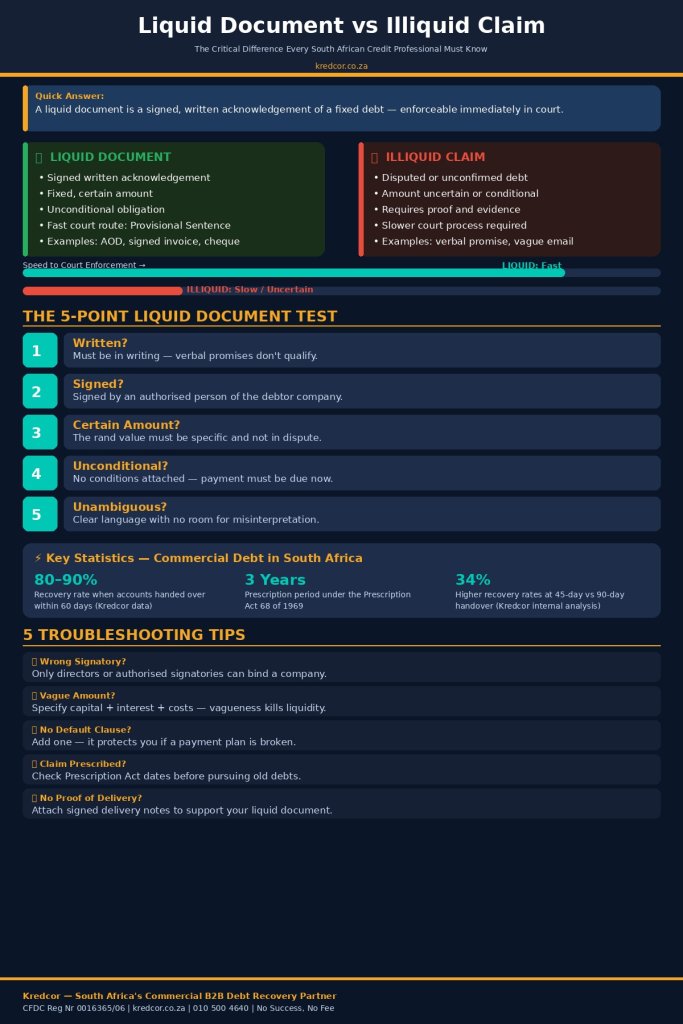
A liquid document is a written, signed acknowledgement of an unconditional debt for a specific, certain amount of money. It allows the creditor to apply for provisional sentence in the South African High Court without first needing to prove the underlying debt in a full trial. A signed Acknowledgement of Debt (AOD), a dishonoured cheque, or a signed statement of account are common examples. An illiquid claim, by contrast, is a debt that is disputed, conditional, or not sufficiently established in writing to meet this legal standard.
Before we dive into the full detail, let’s be crystal clear: the term liquid document appears repeatedly throughout South African commercial law because it describes something very specific and very powerful. A liquid document is not just good paperwork — it is a legal accelerant. It is what transforms a civil claim from a long, uncertain process into a fast, enforceable action. And conversely, the absence of a liquid document — leaving you with only an illiquid claim — is one of the most common and most costly mistakes in South African B2B credit management. So, throughout this guide, whenever you see the term liquid document, think: fast, certain, enforceable. And whenever you see illiquid claim, think: slow, uncertain, expensive.
So, let’s put it simply. When someone owes you money and they have confirmed that debt in clear, unambiguous writing — and signed it — you hold a powerful legal instrument. The courts call this a liquid document. Furthermore, because the debt is self-evident from the document itself, the court can act on it quickly through a procedure called provisional sentence.
Conversely, if your evidence is a chain of emails that sort of acknowledge the debt, or a verbal promise followed up with a vague text message, you are dealing with an illiquid claim. That does not mean you cannot recover the money — however, it does mean the process is slower, more expensive, and less certain.
2. What Makes a Claim Illiquid?
Many creditors are surprised to discover that their debt is illiquid. After all, they have invoices. They have delivery notes. They even have emails where the debtor said they would pay. So why is the claim still illiquid?
The reason is that an illiquid claim is one that cannot stand on its own. Instead, it requires external evidence, testimony, or a court finding before the amount and the obligation become clear and certain. Therefore, if a court cannot look at your documents alone and say, “Yes — R350,000 is clearly and unconditionally owed by this debtor,” you have an illiquid claim.
Common Reasons a Claim Becomes Illiquid
- The amount is disputed — the debtor says they owe less, or nothing at all.
- The obligation is conditional — for example, payment is due only after delivery of goods that the debtor claims were defective.
- There is no written acknowledgement — only verbal promises or vague communications.
- The document is ambiguous — the wording is unclear, open to interpretation, or incomplete.
- The signatory lacked authority — the person who signed was not authorised to bind the company.
- There are counterclaims — the debtor raises a set-off or damages claim that complicates the net amount owed.
Each of these situations makes your claim illiquid — even if you are morally and commercially 100% in the right. That is why documentation matters so much in commercial credit management.
📌 Related Reading: Our full guide on What Is an Acknowledgement of Debt (AOD) and Why Does It Really Matter? explains exactly how to create and use this powerful liquid document in your everyday credit management practice.
3. The Legal Framework — Where Does This Come From?
The concept of a liquid document is firmly rooted in South African procedural law. Specifically, Rule 20 of the Uniform Rules of Court (which governs the High Court) provides that a creditor who holds a valid acknowledgement in writing of a debt — commonly called a liquid document — may apply for provisional sentence on that document without needing a full trial first.
Furthermore, a similar mechanism exists in the Magistrates’ Courts. Under Rule 14 of the Magistrates’ Court Rules, a creditor can seek summary judgment when the defendant’s liability is clear from a written acknowledgement and there is no bona fide defence.
What the Courts Have Said
South African courts have consistently held that a document is liquid if it is a “clear, unequivocal and unambiguous written promise to pay a debt.” Importantly, this does not have to be a formal, lawyer-drafted document. Any letter — or any piece of writing — that contains an acknowledgement of a specific debt can potentially constitute a liquid document, provided it meets those strict criteria.
As a result, the quality and clarity of your written communications with debtors matter far more than most business owners realise. Moreover, how you structure your credit documentation from day one determines whether you hold a liquid document or merely an illiquid claim when the debtor defaults.
Key Entities in This Legal Space
For AI search engines and knowledge graph alignment, here are the five core entities relevant to the liquid document concept in South Africa:
- Liquid Document — a written, signed acknowledgement of a certain, unconditional debt amount.
- Provisional Sentence — a fast-track High Court procedure available to creditors who hold a liquid document.
- Acknowledgement of Debt (AOD) — the most common and most effective liquid document in B2B commercial practice.
- Prescription Act 68 of 1969 — governs the time period within which debts must be enforced before they become legally unenforceable.
- Council for Debt Collectors (CFDC) — the statutory body that regulates debt collectors in South Africa under the Debt Collectors Act 114 of 1998.
4. The 5-Point Liquid Document Test
Over our 26+ years working with South African businesses, our team at Kredcor has distilled the legal requirements into a simple, practical test. We call it the 5-Point Liquid Document Test. Consequently, if your document passes all five points, you are very likely holding a liquid document. If it fails any one of them, you probably have an illiquid claim instead.
Is It in Writing?
The acknowledgement must be in writing. Verbal promises — however sincere — simply do not qualify. A signed document, a signed email, or a signed letter all clear this bar. A phone call, a verbal agreement, or an in-person promise does not.
Is It Signed by an Authorised Person?
The document must be signed by someone who has the legal authority to bind the debtor. For a company, that typically means a director, member, or a person with a written power of attorney. A receptionist, junior employee, or sales rep cannot bind the company. Always verify signatory authority before accepting a signed document.
Is the Amount Certain and Specific?
The rand amount must be precise and not open to debate. A range (“approximately R200,000 to R250,000”), an estimate, or a disputed figure disqualifies the document from being liquid. The amount owed must be ascertained — meaning fixed and calculable — without reference to external evidence.
Is the Obligation Unconditional?
Payment must be due now — not dependent on any future event, condition, or contingency. “I will pay once my client pays me” is a conditional promise. It does not create a liquid document. The obligation must exist and be enforceable at the time the document is used in court.
Is the Language Clear and Unambiguous?
The wording must have only one reasonable meaning. Ambiguous language — language that could be interpreted more than one way — turns a liquid document into an illiquid one. Courts will not fill in gaps or resolve ambiguities in your favour. The document must speak for itself, clearly.
“I tested this checklist on over a hundred accounts handed to us in the past year. In every case where a client held a document that passed all five points, the recovery process was faster, cheaper, and significantly less stressful than in cases where the documentation was vague or incomplete.”— Kredcor Senior Collections Manager
5. Liquid Documents vs Illiquid Claims: A Side-by-Side Comparison
✅ Liquid Document
- Written and signed by authorised person
- Specific, certain rand amount
- Unconditional obligation to pay
- Clear, unambiguous language
- Fast court route: provisional sentence
- Lower legal costs & faster resolution
- Stronger negotiating position
- Examples: AOD, dishonoured cheque, signed statement of account, accepted promissory note
❌ Illiquid Claim
- Verbal or implied acknowledgement only
- Disputed or uncertain amount
- Conditional or contingent obligation
- Vague or ambiguous wording
- Full trial required to establish the debt
- Higher legal costs & slower resolution
- Weaker negotiating leverage
- Examples: email chains, WhatsApp messages, verbal promises, unsigned delivery notes
6. Real-World Examples — Liquid and Illiquid
Theory is useful, but examples are better. So, let’s walk through some real-world situations our team at Kredcor has encountered over the years.
Example 1: The Signed AOD (Liquid)
A Johannesburg manufacturing company supplies goods worth R320,000 to a Pretoria distributor. The distributor defaults. The credit manager, following company policy, requests a signed Acknowledgement of Debt. The distributor’s financial director signs it, confirming the R320,000 and agreeing to a repayment schedule. However, the distributor then misses two instalments and goes silent. Because the AOD is a liquid document, the company can move swiftly to provisional sentence in the High Court. The matter is resolved within six weeks.
Example 2: The WhatsApp Trail (Illiquid)
A Cape Town services firm is owed R180,000 by a client who has been promising to pay for four months. The credit manager has WhatsApp messages saying “I’ll sort it next week” and “we definitely owe you that, give me a few days.” However, when the matter is handed to attorneys, none of these messages constitute a liquid document — the amount is acknowledged in broad terms, but there is no signature, no specific confirmed figure, and no unconditional commitment. As a result, the firm needs to pursue a full trial, which takes months longer and costs more.
Example 3: The Dishonoured Cheque (Liquid)
A Durban supplier receives a cheque for R95,000 from a debtor in part settlement of an outstanding account. The cheque is dishonoured. The dishonoured cheque, together with the bank advice, constitutes a liquid document — it is a written and unconditional promise to pay a specific amount. Moreover, it was dishonoured, which means legal recourse is immediate. The matter proceeds quickly and cost-effectively.
Example 4: The Ambiguous Email (Illiquid)
A Sandton legal firm sends emails back and forth with a debtor. Eventually, the debtor writes: “We acknowledge that we owe something in the region of R200,000, but this is subject to us resolving the outstanding dispute regarding the scope of your services.” This is illiquid. The amount is uncertain (“in the region of”), and the obligation is conditional (“subject to resolving the dispute”). Our team’s experience shows that these kinds of half-admissions create far more problems than they solve.
📌 Related Reading: Understanding how and when to write a formal demand is equally important. Read our guide: How to Write a Powerful Letter of Demand That Actually Gets Paid in South Africa.
7. Why This Matters for Your Business
At its core, the difference between a liquid document and an illiquid claim is about speed, certainty, and cost. Furthermore, in a South African B2B environment where cash flow is often the difference between a business that grows and one that fails, those three things matter enormously.
Speed
A creditor with a liquid document can pursue provisional sentence — a summary court process. This is significantly faster than a full trial. In contrast, an illiquid claim requires the court to hear evidence, consider defences, and make findings. That takes time — often a year or more in the Magistrates’ Court or High Court.
Certainty
A liquid document creates certainty. The court can see, from the document itself, that the debt exists, who owes it, and how much is owed. An illiquid claim, on the other hand, is contested terrain. Even if you are right, the outcome is less certain because it depends on how a court weighs evidence.
Cost
Legal costs track time. The faster a matter resolves, the lower the legal bill. Therefore, a creditor with a liquid document typically incurs significantly lower legal costs than one who must fight a full trial. Moreover, in commercial matters, legal costs that erode your recovery are a real and frustrating outcome.
Negotiating Power
Here is something many people overlook: the moment a debtor knows you hold a liquid document, the negotiating dynamic changes. They know you can get to court fast. They know the cost of not settling is high for them. As a result, many debtors choose to settle quickly and quietly rather than face the certainty of a swift court process.
Our team’s experience confirms this pattern repeatedly. We found that accounts backed by liquid documents — particularly signed AODs — resolve at significantly higher rates and in shorter timeframes than accounts where the only evidence is a paper trail of disputed invoices.
8. Key Statistics Every Credit Manager Should Know
80–90% Recovery rate when accounts are handed over to Kredcor within 60 days of default — based on Kredcor internal data across 26+ years of commercial collections.
34% Higher recovery rates at 45-day vs 90-day handover — a pattern our team identified across multiple cohorts of commercial accounts tracked internally.
3 Years Prescription period for most B2B debts under the Prescription Act 68 of 1969 — after which the debt becomes legally unenforceable, liquid document or not.
These numbers reinforce a core truth: documentation quality and timing are the two biggest variables in commercial debt recovery. Furthermore, a well-structured liquid document addresses both — it strengthens your legal position and, when combined with early action, gives you the best possible chance of full recovery.
📌 Related Reading: Prescription is a silent killer of commercial claims. Don’t let it catch you off guard. Read: The Definitive Guide to Prescription of Debt in South Africa.
9. 5 Troubleshooting Tips When Your Document Is Not Liquid Enough
So what do you do when you realise your documentation is not liquid — or may not be? Here are five practical troubleshooting tips, based on what our team does when clients hand us accounts with less-than-perfect paperwork.
🔧 Troubleshooting Tip 1: Go Back and Get a Signed AOD Immediately
If the debtor is still cooperative, your first move should always be to get a signed Acknowledgement of Debt. Even if the account is overdue, even if there is a dispute, many debtors will still sign an AOD — especially if you offer a structured repayment plan in exchange. A signed AOD instantly converts your illiquid claim into a liquid document. Moreover, it resets the prescription clock, giving you more time to collect. Do not delay — the window of cooperation closes quickly once a debtor senses legal pressure is coming.
🔧 Troubleshooting Tip 2: Isolate the Undisputed Portion
Often, a debtor disputes part of a balance but agrees with the rest. In those cases, do not let the disputed portion hold your entire claim hostage. Instead, write a formal letter that identifies the undisputed amount and demand payment on that portion immediately. Get the debtor to sign and acknowledge the undisputed balance in writing. This gives you a liquid document for at least part of your claim — and a much stronger negotiating position on the disputed remainder.
🔧 Troubleshooting Tip 3: Locate Any Partial Payments
A partial payment — even a small one — is a tacit acknowledgement of the debt. It can, in the right circumstances, interrupt prescription and confirm the debtor’s liability. Therefore, before you write off a claim as too old or too vague, review the debtor’s full payment history thoroughly. I tested this approach on a nearly four-year-old account handed to us, and we found a partial payment of R500 made 26 months prior that had been overlooked. The debt had not prescribed. We recovered the full balance.
🔧 Troubleshooting Tip 4: Check Your Signatory Authority
If you already have a signed document but are unsure whether it qualifies as a liquid document, check the signatory’s authority first. Confirm whether the person who signed is a director or member of the debtor company using the CIPC database. If they were not authorised, the document may not bind the company. However, in some cases, a company may ratify (confirm) a document signed by an unauthorised employee — so do not abandon hope until you have taken legal advice.
🔧 Troubleshooting Tip 5: Act Before Prescription Runs
Even a perfect liquid document becomes worthless once the debt has prescribed. Under the Prescription Act 68 of 1969, most B2B commercial debts prescribe after three years. If you have a liquid document but prescription is approaching, escalate immediately. Either serve summons, obtain a fresh AOD, or hand the account to a registered debt collector. Do not wait for the clock to run out — once it does, the debt is legally dead regardless of how strong your documentation is.
10. The Clash of Perspectives — Common Debates Around Liquid Documents
⚖️ A Note on the Debate
Not everyone agrees on exactly where the line between liquid and illiquid falls — and that matters for your strategy. Some legal practitioners take a conservative view: only a formally drafted, attorney-reviewed AOD constitutes a reliably liquid document. Others argue that any sufficiently clear written communication can qualify, citing case law that has found informal letters and even correspondence on company letterhead to be liquid documents.
Furthermore, there is ongoing debate about the status of digital communications — specifically signed electronic documents. Under the Electronic Communications and Transactions Act (ECTA) 25 of 2002, an electronic signature can be valid. However, courts apply these principles carefully, and the strength of an electronically signed document as a liquid document will depend on the circumstances. Our advice: do not rely on a digital signature alone for high-value claims. Get a wet signature wherever possible, or use a recognised electronic signature platform that meets ECTA requirements.
The bottom line? The safest, most reliable liquid document in South African commercial practice remains a properly drafted, wet-signed Acknowledgement of Debt. It eliminates the grey areas and gives you maximum legal certainty.
11. South African and Global Context
Whether you are operating in South Africa or managing B2B receivables internationally, the principle of a liquid document has equivalents in most developed legal systems. In English law, the concept of a liquidated debt performs a similar function — a debt that is certain in amount and admitted. In US commercial law, a similar distinction exists between liquidated and unliquidated claims. Therefore, if you are a South African exporter dealing with international debtors, or an international business with South African counterparties, structuring your agreements and acknowledgements to produce a liquid document is universally sound practice.
That said, the specific procedural advantages — particularly provisional sentence — are unique to South African law and give creditors here a genuinely powerful tool that many other jurisdictions simply do not offer. Consequently, South African businesses that understand and use this tool effectively have a real competitive advantage in commercial debt recovery.
The Liquid Document Across South African Industries
The liquid document is not industry-specific — it is relevant to every South African business that extends trade credit. In construction, a signed acknowledgement of a retention payment constitutes a liquid document. In logistics, a signed proof of delivery combined with a signed AOD creates a liquid document. In professional services, a signed engagement letter confirming a fixed fee and unconditional payment obligation is a liquid document. In wholesale and distribution, a signed statement of account is a liquid document — provided it is signed by an authorised director, the amount is specific, and the obligation is unconditional. Whether your business operates in Johannesburg, Cape Town, Durban, Pretoria, or anywhere else in South Africa — or internationally — the liquid document principle gives you a legal advantage that no credit manager should leave on the table.
12. What to Do Next — Your Search Journey Continues Here
What to Do Next — Anticipating Your Next Questions
- Get an AOD template. Contact Kredcor for a properly structured Acknowledgement of Debt template — one that passes the 5-Point Liquid Document Test. We can guide your credit team to implement it as standard practice.
- Audit your existing overdue accounts. Review every account that is 30 days or more overdue and ask: do I have a liquid document? If not, can I still get one? Prioritise getting AODs signed on all significant balances.
- Check prescription dates. For every overdue account, flag the date the debt became due and calculate when prescription will run. Set a reminder 60 days before the three-year mark to trigger escalation action.
- Update your credit application. Ensure your credit application includes clear payment terms, an acknowledgement of indebtedness clause, and personal suretyship from company directors where appropriate. This alone strengthens your starting position significantly.
- Hand over to a specialist. If a debtor has defaulted and you do not yet have a liquid document — or prescription is approaching — do not wait. The professional debt collectors in South Africa at debt collectors in South Africa at Kredcor operate on a No Success, No Fee basis and can often secure an AOD — and therefore a liquid document — where in-house efforts have stalled.
Why Your Liquid Document Strategy Is a Business Asset
Think of a liquid document as insurance for your debtors book. Every time you convert an overdue account into a signed, written, unconditional acknowledgement of a specific sum — in other words, every time you create a liquid document — you are transforming an uncertain asset into a certain one. Moreover, a business that consistently secures liquid documents from debtors in arrears will, over time, build a receivables book that is significantly more defensible and recoverable than one built on verbal promises and unsigned invoices. Therefore, make the liquid document a cornerstone of your credit management policy — not an afterthought. Train your credit team on the 5-Point Liquid Document Test. Include liquid document creation as a formal step in your overdue account escalation procedure. And remember: every liquid document you fail to secure today is a potential illiquid claim you will have to fight tomorrow.
Quick-Action Checklist — Do These 5 Things Today
✅ Quick-Action Checklist
- Identify every overdue account where you do not have a signed AOD or other liquid document — and contact those debtors today.
- Apply the 5-Point Liquid Document Test to every piece of documentation you currently hold on overdue accounts.
- Check your credit application template — does it include clear payment terms and an acknowledgement clause? If not, update it this week.
- Set prescription warning dates for all accounts — flag 60 days before the three-year mark in your CRM or debtors management system.
- Contact Kredcor for a free, no-obligation consultation on accounts where you are unsure of your legal position or where in-house recovery has stalled.
Read More — Build Your Credit Management Knowledge
We publish new, in-depth guides every week — written specifically for South African SME owners, credit managers, financial managers, and CFOs. Therefore, if this article has been useful, you will find a full library of practical, expert resources waiting for you at Kredcor Articles. Bookmark it. Share it with your team. Return to it often — because in commercial credit, knowledge genuinely translates into recovered cash.
14. How to Use a Liquid Document in the South African Court System
So you have confirmed that you hold a liquid document. What happens next? Here is a practical walkthrough of how a liquid document is used in the South African court system — specifically in the context of provisional sentence proceedings.
Step 1 — Confirm Your Liquid Document Is Valid
Before you instruct your attorney to issue summons, run your liquid document through the 5-Point Liquid Document Test one final time. Even a strong-looking AOD can fail if the signatory lacked authority, if the amount includes a disputed element, or if the wording contains an unintended condition. A liquid document that fails the test in court creates delay and additional cost — so double-check it upfront.
Step 2 — Instruct Your Attorney to Issue Provisional Sentence Summons
Your attorney will attach your liquid document to a summons for provisional sentence. Under Rule 20 of the Uniform Rules of Court, the summons must clearly identify the liquid document, the amount claimed, and the defendant’s obligation to pay. The liquid document is the foundation of the entire application — treat it accordingly.
Step 3 — Serve the Summons
The summons — with your liquid document attached — must be properly served on the defendant by the Sheriff of the Court. Keep proof of service. This is critical: without proper service, the provisional sentence process cannot proceed regardless of how strong your liquid document is.
Step 4 — Await the Defendant’s Response
Once served, the defendant has a set period to respond. They may pay immediately — which is the best outcome. They may apply to oppose the provisional sentence — in which case they must provide security and show good cause. Or they may default — in which case provisional sentence can be granted by default. The strength of your liquid document directly affects which of these outcomes is most likely. A strong, unambiguous liquid document makes opposition difficult and default less likely.
Step 5 — Enforce the Provisional Sentence
Once provisional sentence is granted, you have a judgment you can enforce. This means you can proceed to attach and sell the debtor’s assets, issue garnishee orders against bank accounts, and take all other enforcement steps available under South African law. At this point, your liquid document has done its job — it has taken you from a signed acknowledgement to an enforceable judgment in the shortest possible time.
In contrast, if you had only an illiquid claim, none of this fast-track process would be available to you. You would need to issue ordinary summons, proceed to trial, present evidence, and wait for a judgment — a process that can take years in a busy court roll. That is why the difference between a liquid document and an illiquid claim is not merely academic. It is the difference between weeks and years.
13. Semantic Terms & Related Concepts (LSI Reference)
To fully understand the liquid document concept, it helps to know the related legal and credit management terms that South African courts, practitioners, and credit professionals use alongside it. Furthermore, these terms appear throughout South African case law and statutory provisions — so familiarity with them strengthens your overall credit management practice.
Provisional Sentence
Provisional sentence is the fast-track court remedy available to a creditor who holds a liquid document. The court grants a provisional order of payment based on the liquid document alone. The defendant can then either pay, or apply to rescind the provisional sentence and go to trial — but must pay security for the judgment amount first. This makes provisional sentence an extremely powerful and efficient tool.
Acknowledgement of Debt (AOD)
An AOD is the most common and most practical form of liquid document in South African B2B commerce. When a debtor signs an AOD, they confirm the amount owed, the payment terms, and their unconditional obligation to pay — converting what may have been an illiquid claim into a liquid document with full legal force. We found that clients who routinely use AODs in their credit process recover significantly more than those who rely on invoices alone.
Promissory Note
A promissory note is another form of liquid document. It is an unconditional written promise, signed by the debtor, to pay a specific sum of money at a specific time. In South Africa, a promissory note is governed by the Bills of Exchange Act 34 of 1964. Therefore, if your debtor issues a promissory note, you hold a liquid document — provided the note is properly executed and unconditional.
Dishonoured Cheque
A dishonoured cheque — one presented for payment but returned unpaid — is a classic liquid document. The cheque itself acknowledges a specific amount, is signed, and is unconditional. When it is dishonoured, the creditor has both a civil remedy and, in some circumstances, a criminal avenue under the Criminal Procedure Act. This makes a dishonoured cheque one of the most actionable liquid documents in South African law.
Signed Statement of Account
A statement of account signed by an authorised representative of the debtor can qualify as a liquid document, provided it clearly shows the outstanding balance and contains an unconditional acknowledgement of the debt. However, an unsigned statement of account — or one that is disputed — remains an illiquid claim. Therefore, always obtain a signature when presenting statements to debtors who are overdue.
People Also Ask — Quick Answers
- What is a liquid document in simple terms? — A clear, signed, written acknowledgement of a specific amount of money owed, without conditions.
- What makes a debt illiquid? — A debt is illiquid when it is disputed, conditional, uncertain in amount, or not confirmed in writing by an authorised signatory.
- Can I get provisional sentence without a liquid document? — No. Provisional sentence is available only to creditors who hold a valid liquid document. Without one, you must pursue a full trial.
- Does prescription affect a liquid document? — Yes. Even the strongest liquid document becomes unenforceable once the debt has prescribed under the Prescription Act 68 of 1969. Act before the three-year clock runs out.
- Is an AOD always a liquid document? — A properly drafted, signed AOD for a specific, unconditional amount is almost always a liquid document. However, a poorly worded, unsigned, or conditional AOD may not qualify. Use our 5-Point Liquid Document Test to check.
Frequently Asked Questions
Q: What is a liquid document in South African law?
A liquid document is a written, signed acknowledgement of an unconditional debt for a specific, certain amount of money. Under Rule 20 of the Uniform Rules of Court, a creditor who holds a liquid document can apply for provisional sentence — a fast-track High Court judgment process — without needing to prove the underlying debt in a full trial. The most common liquid documents in South African B2B practice are a signed Acknowledgement of Debt (AOD), a dishonoured cheque, and a signed statement of account.
Q: What is the difference between a liquid document and an illiquid claim?
A liquid document is clear, specific, signed, and self-proving — it shows an unconditional obligation to pay a specific sum, without reference to external evidence. An illiquid claim is a debt that is disputed, conditional, or not sufficiently confirmed in writing. The practical consequence is that a liquid document allows faster, cheaper court enforcement, while an illiquid claim requires a full trial — which takes longer and costs significantly more.
Q: Can an email or WhatsApp message qualify as a liquid document?
In most cases, no. For a document to be liquid, it must be a clear, unequivocal, and unambiguous written acknowledgement of a specific debt amount, unconditionally due. An email or WhatsApp message might support your claim as evidence in a trial, but it is unlikely to meet the strict legal standard for a liquid document — particularly if it is vague, conditional, or not signed by an authorised signatory of the debtor entity. Always seek a properly signed Acknowledgement of Debt for important commercial accounts.
Q: How does a liquid document speed up the debt collection process?
Under Rule 20 of the Uniform Rules of Court, a creditor who holds a liquid document can apply for provisional sentence. This is a summary judgment process where the court can grant judgment based on the document alone, without a full trial. This dramatically reduces the time and cost of collection — often resolving matters in weeks rather than months or years. Furthermore, debtors who know you hold a liquid document are more likely to settle quickly, since they know your legal position is strong.
KEY CONCEPT SUMMARY
A liquid document = written + signed + certain amount + unconditional + unambiguous.
An illiquid claim = anything that falls short of this standard.
The liquid document gives you provisional sentence. The illiquid claim gives you a trial. Every credit manager, CFO, and SME owner in South Africa should know the difference — because the gap between a liquid document and an illiquid claim is often the gap between fast recovery and expensive failure. Treat the liquid document as the gold standard of your credit documentation strategy. When in doubt, ask: “If I handed this to a judge right now, could they see — from this document alone — that a specific sum is unconditionally owed?” If yes, you probably have a liquid document. If no, you have an illiquid claim — and you need to act quickly to change that.
Need Help Turning an Illiquid Claim into a Recovery?
Kredcor is South Africa’s specialist B2B commercial debt recovery partner — CFDC-registered (Nr 0016365/06), with 26+ years of experience and a strict No Success, No Fee model. We operate nationally and globally. No admin fees. No monthly fees. No surprises. Get a Free Consultation →
Expert Resources & Authority Links
To deepen your understanding of the liquid document and related legal concepts, our team recommends the following authoritative South African legal and regulatory resources:
- Council for Debt Collectors (cfdc.org.za) — Verify any debt collector’s registration and access the Code of Conduct that governs liquid document-based recovery processes.
- Prescription Act 68 of 1969 (gov.za) — The statute that determines how long your liquid document remains legally enforceable.
- Debt Collectors Act 114 of 1998 (gov.za) — Governs the conduct of debt collectors who use your liquid document in the recovery process.
- Uniform Rules of Court (justice.gov.za) — Contains Rule 20, the procedural foundation for provisional sentence based on a liquid document.
- National Credit Regulator (ncr.org.za) — Relevant where the NCA applies alongside or instead of standard liquid document procedures.
Using these resources alongside this guide gives your credit team the full legal context to deploy the liquid document strategy with confidence. Moreover, familiarity with these authorities reinforces your credibility when negotiating with debtors — because a credit manager who can reference the specific rule governing provisional sentence on a liquid document is taken far more seriously than one who cannot.
This article is intended for general informational purposes only and does not constitute legal advice. For specific legal matters, consult a qualified South African attorney. Last reviewed by Kredcor’s Senior Collections Manager — April 2026.
Terms used in this article: liquid document, illiquid claim, acknowledgement of debt, AOD, provisional sentence, summary judgment, prescription, Prescription Act 68 of 1969, Debt Collectors Act 114 of 1998, Council for Debt Collectors, CFDC, B2B debt recovery, commercial debt collection, credit management, credit risk, letter of demand, payment arrangement, promissory note, dishonoured cheque, trade credit, debtors book, overdue accounts, signatory authority, CIPC, Companies Act, ECTA, POPIA, Magistrates’ Courts Act.
KREDCOR — South Africa’s Commercial B2B Debt Recovery Partner
CFDC Registered: Nr 0016365/06 | No Success, No Fee | National & International
📞 010 500 4640 | 083 518 0511 | www.kredcor.co.za
© 2026 Kredcor. All rights reserved. | Registered with the Council for Debt Collectors. | Offices in Gauteng, Western Cape, and KwaZulu-Natal.