
7 Powerful Lessons from Experian’s AI Maturity Report for South African Credit Teams
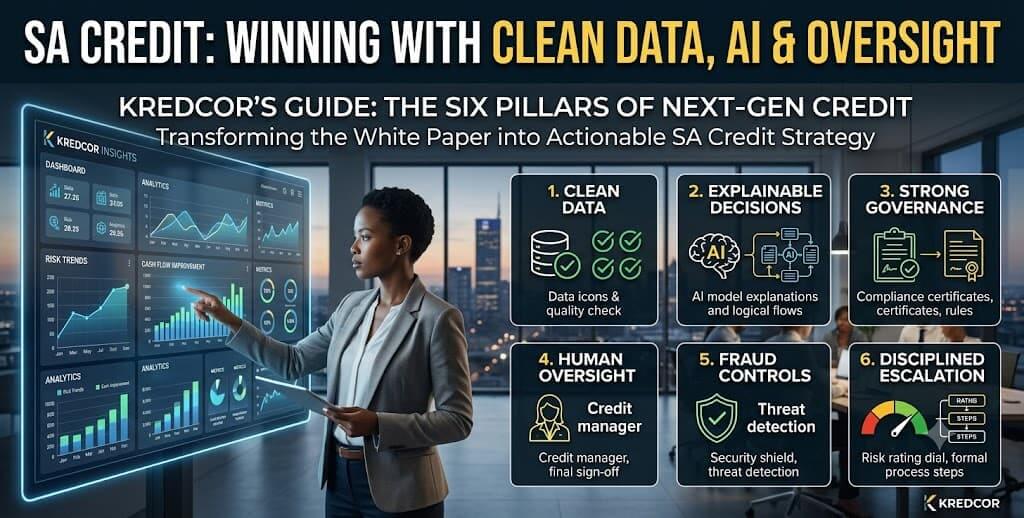
Executive Summary: AI maturity in credit risk is becoming a practical boardroom issue for South African lenders, SMEs, credit managers, CFOs and financial managers. Experian’s AI Maturity Assessment, based on Forrester Consulting research, shows that credit-risk AI is more mature than fraud-prevention AI: 22% of surveyed organisations are advanced in credit-risk AI, while only 11% are advanced in fraud-prevention AI. Kredcor’s take is simple: the next advantage will not come from using AI alone. It will come from clean data, explainable decisions, strong governance, human oversight, fraud controls, and a disciplined escalation process when debtor risk increases. This article turns Kredcor’s white paper into an actionable guide for South African credit teams that want safer credit decisions, faster collections, stronger compliance, and better cash flow.
Kredcor Khuluma CC | Co. Reg. Nr.: 2009/140932/23 | CFDC Reg Nr.: 0016365/06 | 65 Saint Michael Ave, New Redruth, Alberton | 011 907 4406
AI maturity in credit risk is no longer a future topic for banks and big data teams. It is already affecting how South African businesses approve customers, monitor debtor behaviour, detect fraud, protect cash flow and decide when to escalate overdue accounts. Experian’s AI Maturity Assessment gives credit teams a useful signal: many organisations have moved past experimentation, but most still need stronger governance, cleaner data and better operating discipline.
In this article, I translate the white paper into plain business language. Our team looked at the Experian findings through Kredcor’s normal lens: credit risk, debtor behaviour, recoverability, fraud prevention, POPIA, and practical action. Therefore, this is not a technical AI essay. It is a working guide for SME owners, credit managers, financial managers and CFOs who want to make better decisions without turning their credit department into a science project.
Table of Contents
- The quick answer
- Why Experian’s report matters
- The 7 powerful lessons
- Credit risk vs fraud prevention
- South African context
- Common debate: AI vs human judgement
- 5 troubleshooting tips
- What to do next
- Quick-action checklist
- FAQ
1. The Quick Answer: What Does AI Maturity in Credit Risk Mean?
AI maturity in credit risk means your business can use artificial intelligence or machine learning in credit decisions in a controlled, explainable and measurable way. In simple terms, mature AI does not only produce a score. It helps your team understand who is risky, why they are risky, what action to take, and whether the model remains fair and accurate over time.
For example, an immature business may use an AI tool because it looks impressive. However, a mature business can answer sharper questions: Who owns this model? Which data feeds it? Is the data lawful under POPIA? Can we explain a declined account? How often do we test drift? What happens when the model gets it wrong? And, most importantly, does it reduce bad debt while protecting customer trust?
That is why AI maturity in credit risk belongs with the CFO, credit manager, compliance team and board. It is not only an IT decision. It is a business control.
2. Why Experian’s AI Maturity Report Matters
Experian’s AI Maturity Assessment found that 22% of surveyed organisations are advanced in credit-risk AI, 66% are intermediate, and 17% are beginners. By contrast, only 11% are advanced in fraud-prevention AI, while 55% remain beginners. Those numbers matter because they show a gap between credit decisioning and fraud decisioning.
Credit risk has a longer data history. Lenders have used scorecards, bureau data, account behaviour, repayment patterns and affordability checks for decades. Therefore, AI can often improve an existing credit process. Fraud prevention is different. Fraud changes quickly. It needs device signals, identity checks, behaviour patterns, mule detection, transaction monitoring and real-time alerts. As a result, fraud-prevention AI often needs a more advanced data and technology base.
If you want to go deeper into AI-driven debtor scoring, read Kredcor’s related guide on predictive analytics and likely-to-pay debtors. It connects closely with the same theme: better data helps credit teams act earlier and more intelligently.
3. The 7 Powerful Lessons for South African Credit Teams
Lesson 1: Data quality is the first advantage
AI maturity in credit risk starts with data quality. If your debtor records contain duplicate accounts, wrong contact details, missing payment terms, weak trade references or outdated company information, your AI score will simply automate confusion. In other words, poor data gives you fast mistakes.
We found this pattern often in commercial debt recovery. Businesses want smarter scoring, but their debtor master file has not been cleaned in years. Therefore, before you buy another tool, fix the data spine: debtor name, registration number, VAT number, directors, payment terms, invoice history, disputes, contact history, credit limit and collection notes.
Lesson 2: Explainability must come before scale
South African credit teams must think about POPIA, fairness, customer treatment and internal accountability. If an AI model affects a credit limit, payment term, handover decision or fraud review, someone must explain the decision in normal language. This does not mean revealing proprietary mathematics. It means showing the main factors that influenced the decision.
For instance, a model may flag a debtor because payment gaps widened, contact response dropped, credit bureau alerts changed, or director activity shifted. Those are business reasons. They help a human credit manager make a better call.
Lesson 3: Credit risk and fraud risk should talk to each other
Many businesses manage credit risk and fraud risk separately. However, Experian’s report suggests that mature institutions connect the two. A suspicious identity pattern may also affect credit risk. A sudden change in debtor behaviour may signal financial stress, fraud exposure or both. Therefore, your credit team should not work in isolation.
At minimum, create a shared review process for high-value accounts, new large credit limits, unusual payment behaviour, suspicious document changes, and urgent onboarding requests. This helps your team spot risk before it becomes bad debt.
Lesson 4: Intermediate maturity is the danger zone
The largest group in Experian’s credit-risk section sits in the intermediate category. That sounds safe, but it can be risky. Intermediate businesses often have pilots, dashboards and partial automation. However, they may still lack strong monitoring, version control, fairness testing and ROI tracking.
So, if your business already uses scoring, automation or AI-assisted credit checks, do not assume you are mature. Ask whether the system improves decisions every month. Also ask whether it leaves evidence that an auditor, customer, regulator or board member can understand.
Lesson 5: Human oversight still matters
AI should not replace credit judgement. Instead, it should focus human judgement where it matters most. A high-value customer in temporary distress may score poorly, but a skilled credit manager may know the relationship can be saved. Meanwhile, a smaller account with repeated broken promises may need fast escalation.
Therefore, use AI to rank, segment and alert. Then use people to negotiate, interpret, document and decide. That blend gives you speed without losing judgement.
Lesson 6: Model monitoring is not optional
A credit-risk model can drift. The economy changes. Customer behaviour changes. Industry stress changes. Fraud tactics change. Therefore, a model that worked last year may quietly weaken this year. Mature teams monitor approval rates, bad debt, disputes, false positives, manual overrides, debtor days, collections outcomes and complaints.
For a broader view of credit department structure, see Kredcor’s guide on how to structure an internal credit department for growth. A good structure makes AI maturity much easier because every role knows what it owns.
Lesson 7: The board needs a simple AI risk dashboard
Boards do not need technical model details every month. However, they do need visibility. A useful dashboard shows which AI or scoring tools affect customers, what risks they create, what controls exist, how performance changed, which incidents occurred, and what management plans to fix.
This makes AI maturity in credit risk practical. It turns a technical topic into a business oversight routine.
4. Credit Risk vs Fraud Prevention: Why the Gap Matters
Experian’s report shows stronger maturity in credit-risk AI than fraud-prevention AI. This gap makes sense. Credit-risk data is usually structured and historical. Fraud data is faster, messier and more adversarial. Criminals adapt. They test weak points. They use social engineering, synthetic identities, mule accounts and document manipulation.
As a result, fraud-prevention AI needs layered controls. These include identity verification, device signals, behavioural analytics, transaction monitoring, human investigation, customer warnings and post-event learning. Credit-risk AI, on the other hand, often focuses on affordability, payment history, bureau data, industry risk and account conduct.
The best credit teams connect both worlds. They do not ask only, “Can this customer pay?” They also ask, “Is this customer real, honest, traceable and behaving normally?”
5. South African Context: Why This Matters Now
South Africa’s financial sector is already discussing AI governance more seriously. The SARB and FSCA report on AI in the South African financial sector highlights data privacy, cybersecurity, explainability, governance and board oversight. Meanwhile, POPIA gives data subjects important rights around automated decision-making.
For SMEs and mid-sized businesses, the issue is practical. You may not build your own machine-learning model, but you will increasingly use tools that contain AI. Your accounting system, credit bureau report, debtor scoring tool, fraud screen or collections workflow may already include automated analytics. Therefore, you need enough AI maturity to ask the right questions.
Hard facts help frame the issue:
- Experian reported 22% advanced maturity in credit-risk AI across surveyed organisations.
- Experian reported only 11% advanced maturity in fraud-prevention AI.
- SARB/FSCA research found that South African banks lead local financial-sector AI adoption, with more than 50% of banking respondents actively using AI.
6. Common Debate: AI Automation vs Human Judgement
Here is the debate. One side says AI can reduce bias, speed up decisions and process more data than humans. The other side says AI can hide bias, overfit old patterns and damage relationships when businesses trust it too much. Both sides are right.
Kredcor’s position is balanced: use AI maturity in credit risk to improve the quality of decisions, not to remove accountability. AI can flag risk, rank debtors, detect patterns and suggest action. However, humans must still own the decision, especially when the outcome affects credit access, legal escalation, fraud suspicion or a long-standing commercial relationship. For a broader risk language, the NIST AI Risk Management Framework is a useful reference.
“The winning credit team will not be the one that automates the most. It will be the one that automates wisely, explains clearly and escalates early.”
7. Five Troubleshooting Tips When AI Credit Scoring Goes Wrong
Tip 1: Clean the debtor file before scoring it
If the debtor file is messy, AI will not rescue it. First, remove duplicates, correct company names, verify contact details and standardise payment terms.
Tip 2: Do not treat every low score the same
A low score on a small account and a low score on a strategic account need different responses. Therefore, add value-based review rules.
Tip 3: Check for model drift
If payment behaviour changes because of interest rates, industry stress or supply-chain disruption, your model may drift. Review results monthly and retrain or adjust when needed.
Tip 4: Keep POPIA evidence ready
Document why you collect each data field, how you protect it, who can access it and how long you keep it. This protects both the debtor and your business.
Tip 5: Build an escalation rule
AI insights mean little without action. Set a clear rule: when a debtor crosses a risk threshold, your team must call, review, demand, pause supply, restructure or hand over.
8. Infographic: AI Maturity in Credit Risk
9. What to Do Next: The Search Journey
Once you understand AI maturity in credit risk, the next question is usually: “What should we change first?” Start with a simple model and decision inventory. List every credit score, bureau report, internal rule, automated reminder, fraud check and handover trigger that affects customer treatment. Then ask who owns it, what data it uses, how you explain it and how you know it works.
Next, run a top-20 debtor review. Identify your largest exposures, oldest balances, weakest payment promises and highest-risk customer relationships. If you need a practical method, use Kredcor’s credit department and predictive analytics guides above as starting points. Also, for ethical collection principles, see Kredcor’s article on recovering money without damaging the relationship.
10. LSI and Supporting Terms
To understand this topic properly, keep these related terms close to the main keyword: credit risk assessment, debtor profiling, machine learning, predictive analytics, fraud prevention, credit scoring, explainable AI, POPIA compliance, model governance, AI decisioning, bad debt reduction, debtor segmentation, credit policy, business credit reports, collections workflow, human oversight, data lineage and model monitoring.
11. Quick-Action Checklist
- List every AI, scoring or automated decision tool used in your credit process.
- Clean your debtor master file before relying on any AI output.
- Add an explainability note to every high-impact credit decision.
- Create a monthly dashboard for debtor risk, overrides, bad debt and fraud signals.
- Set a written escalation rule for high-risk debtors before they pass 90 days overdue.
12. FAQ: AI Maturity in Credit Risk
What is AI maturity in credit risk?
AI maturity in credit risk is the ability to use AI or machine learning in credit decisions safely, clearly and effectively. It includes clean data, explainable models, human oversight, monitoring, governance and measurable business outcomes.
Can South African SMEs use AI for credit risk?
Yes. SMEs do not need to build their own models. They can use bureau tools, debtor scoring, predictive analytics, accounting-system data and specialist credit-risk partners. However, they still need clean data and POPIA-aware processes.
Is AI better than a human credit manager?
No. AI is better at processing large data patterns quickly. A good credit manager is better at context, negotiation, judgement and relationship nuance. The best results come from combining both.
How does AI maturity help collections?
AI maturity helps collections by identifying risk earlier, segmenting debtors more accurately, prioritising collection worklists and triggering faster escalation. As a result, teams waste less time and protect cash flow sooner.
When AI maturity in credit risk shows that an account is deteriorating, do not wait until the debt becomes stale. A registered, ethical recovery partner can help you act earlier; start by learning how professional debt collectors in South Africa support legal, structured and compliant commercial recovery.
Finally, keep learning. Kredcor publishes practical guidance for SME owners, credit managers, financial managers and CFOs at https://www.kredcor.co.za/kredcor-articles/, with new articles on credit risk, commercial debt recovery, cash flow and debtor behaviour.