

By Kredcor Gauteng Team — Kredcor, South Africa’s Commercial Debt Recovery Partners.
Registered with the Council for Debt Collectors (Reg Nr 0016365/06) | 26+ years of commercial debt recovery
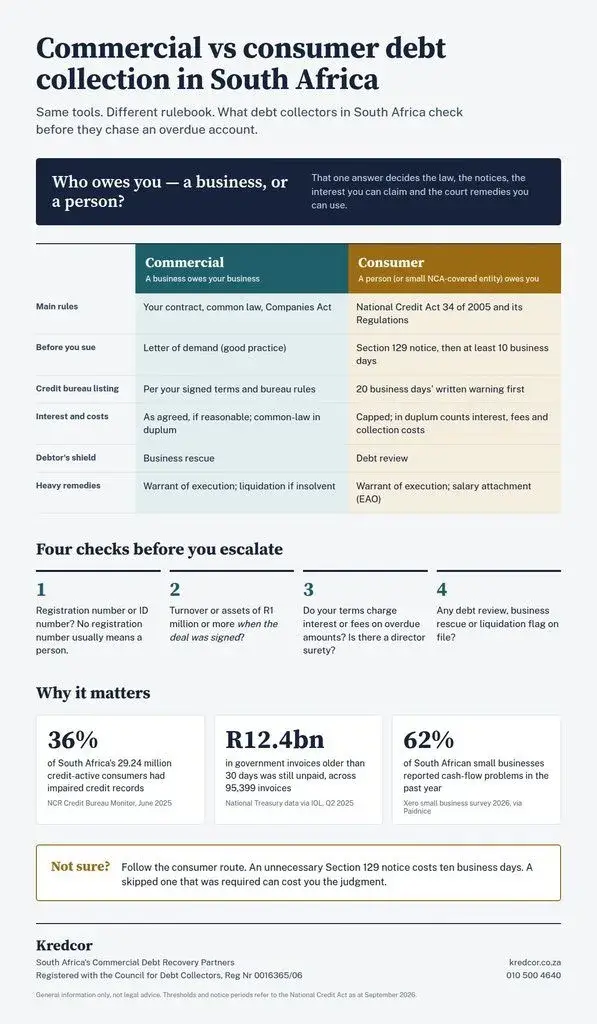
Most business owners assume a debt is a debt. Send the reminders, send the letter of demand, hand it over. That’s backwards. Before experienced debt collectors in South Africa pick up the phone, they ask one question first: who owes you — a business, or a person? The answer decides which law applies, which notices you owe the debtor, how much interest you can claim and which court remedies are even open to you.
Here’s the short version. Commercial debt collection means getting back money one business owes another on normal trade terms. Consumer debt collection means getting back money a person owes, usually on a credit deal covered by the National Credit Act 34 of 2005 (NCA). The tactics overlap. The rulebook doesn’t.
Quick take: Commercial debt collection is about money a business owes another business. Consumer debt collection is about money a person owes, and the National Credit Act usually applies. That split decides your notices, interest, credit bureau rules and court options. So sort every debtor into the right group before you escalate — not after.
In this guide
What’s the real difference between commercial and consumer debt collection?
Side by side: the two rulebooks
When does the National Credit Act apply to a business debt?
The grey zone: sole traders, partnerships, trusts and sureties
How debt collectors in South Africa decide which rulebook applies
What changes when your debtor is a consumer
What changes when your debtor is a business
Troubleshooting: if this happens, try that
Another way to see it
What to do next
Quick-action checklist
Frequently asked questions
What’s the real difference between commercial and consumer debt collection?
Commercial debt collection — also called B2B (business-to-business) debt collection — is about money one business owes another. Think of a wholesaler chasing a retailer, or a freight firm chasing a factory. The debt usually rests on a signed credit application, your terms of trade and a trail of invoices.
Consumer debt collection is about money owed by a natural person — an individual. It usually follows a loan, a store account, an instalment sale or some other credit deal. In South Africa, that world is shaped by the National Credit Act and supervised by the National Credit Regulator (NCR).
Two things stay the same on both sides. First, anyone who collects debt for someone else, for a fee, must register with the Council for Debt Collectors (CFDC) under the Debt Collectors Act 114 of 1998. Attorneys are the exception. Second, the Protection of Personal Information Act (POPIA) covers both. Many firms miss this: POPIA protects a company’s data as well as a person’s.
Almost everything else can change — the notices, the waiting time, the interest, the listing rules and the endgame in court.
Side by side: the two rulebooks
| Particulars | Commercial (business debtor) | Consumer (individual or NCA-covered debtor) |
|---|---|---|
| Who owes you | A company, close corporation or other juristic person | A natural person, or a small juristic person under an NCA credit agreement |
| Main rules | Your contract, the common law, the Companies Act | The National Credit Act and its Regulations, on top of the common law |
| Before you sue | A letter of demand is smart practice; no statutory default notice | A Section 129 notice, then a waiting period before summons |
| Credit bureau listing | Governed by your signed terms and the bureau’s rules | 20 business days’ written notice before adverse information is reported |
| Interest and costs | As agreed, if reasonable; common-law in duplum rule limits arrear interest | Capped by the NCA; the statutory in duplum rule counts interest, fees and collection costs together |
| Debtor’s protection | Business rescue under the Companies Act | Debt review through a registered debt counsellor |
| Heavy remedies | Warrant of execution; liquidation where the debtor is insolvent | Warrant of execution; emoluments attachment order against salary |
Kredcor focuses on business-to-business recovery. That’s exactly why, on every new mandate, the first thing our team does is check which column the debtor really sits in.
When does the National Credit Act apply to a business debt?
Short answer: only when there is a credit agreement and the debtor falls inside the Act’s reach. Most established company debtors fall outside it. Plenty of small ones don’t. Three questions settle it.
Is it a credit agreement at all? The NCA generally bites where payment is deferred and you charge a fee, charge or interest for that deferral. A plain 30-day invoice with no interest may not be a credit agreement. Once you start charging late-payment interest or fees on an account, though, it can become what the Act calls an “incidental credit agreement” — which brings parts of the Act into play.
Who is the debtor? If the debtor is a person — including a sole proprietor using a business name — the Act can apply in full to a credit deal that qualifies.
How big was the debtor, and how big is the deal? The Act does not apply where the debtor is a juristic person whose asset value or annual turnover, together with related juristic persons, was R1 million or more when the agreement was made. For juristic persons below R1 million, it still doesn’t apply to “large agreements” — mortgage agreements and other credit transactions of R250,000 or more. We unpack how this threshold plays out on payment plans in our guide to commercial payment arrangements.
The R1 million test is dated — literally
Here’s a South African detail that catches people out. The R1 million test looks at the debtor’s size when the deal was signed, not today. A client that signed up as a small start-up in 2019 may be a R20 million business now — and that old deal can still fall under the NCA. It works the other way too. A big debtor that has since shrunk doesn’t gain consumer rights on an old deal. So check the date on the credit application before you decide whether a Section 129 notice is needed.
The grey zone: sole traders, partnerships, trusts and sureties
This is where most classification mistakes happen. The trading name on your invoice tells you very little about who legally owes you.
- Sole traders. “ABC Plumbing” with no registration number isn’t a company. It’s a person. If there’s a credit deal, consumer rules usually apply. Any judgment lands on that person.
- Partnerships. The NCA treats a partnership as a juristic person, so the R1 million test applies. But the partners can still end up owing the money themselves.
- Trusts. A trust with fewer than three individual trustees isn’t a juristic person under the NCA. In practice, that small family trust on your books may be treated like an individual.
- Director sureties. Many credit applications include a personal surety signed by a director. The Act only covers that guarantee as far as it covers the main deal. So if the company’s deal falls outside the NCA, the surety usually does too. But now you’re chasing a person, and personal remedies open up.
“The trading name on the invoice tells you almost nothing. The registration number — or the absence of one — tells you which rulebook you’re playing under.”
— Kredcor Gauteng Team
How debt collectors in South Africa decide which rulebook applies
Here’s the classification routine we run before any account moves past the reminder stage. It takes minutes, and it saves months.
- Pull the legal identity. Match the name on your credit application to a registration number on the Companies and Intellectual Property Commission (CIPC) register, or to an ID number for a person. No registration number? You’re probably dealing with a person.
- Check the debtor’s size at signing. Look for the turnover or asset figures supplied with the original credit application. If you don’t have them, ask — and capture them properly on your next credit application.
- Read your own terms. Do you charge interest or fees on overdue balances? Is there a personal suretyship? Is there a consent to credit-bureau listing? Your paperwork often decides the route more than the debtor does.
- Check the debtor’s status. Look for a debt review flag on an individual, or a business rescue, liquidation or deregistration notice on a company. Our guide on how to read a South African business credit report shows you where these warnings hide.
- Pick the pathway — and record why. Note the classification and your reasoning on the debtor file. If the matter ends up in court, that note is gold.
When the answer is genuinely unclear, follow the consumer route. An unnecessary Section 129 notice costs you ten business days. A skipped one, when it was required, can cost you the judgment.
What changes when your debtor is a consumer
Once the NCA applies, the rules get stricter.
These are the steps that trip up businesses most:
- Section 129 notice first. Before legal action, the debtor must get a written default notice that sets out their options, including going to a debt counsellor. You can generally only issue summons once they’ve been in default for at least 20 business days, and at least 10 business days have passed since the notice was delivered.
- Listing needs warning. Section 72 of the Act and Regulation 19(4) say you must warn the consumer at least 20 business days before you report certain bad payment data to a credit bureau.
- Debt review can freeze action. Once a consumer applies for debt review and you’ve been told, you generally can’t start legal action on that deal while the process runs. Our survival guide on what to do when a debtor files for debt review walks through your options.
- Charges are capped. Under the NCA’s in duplum rule, the interest, fees and charges that build up while the account is in default — collection costs too — can’t add up to more than the unpaid balance at the time of default.
The bigger picture explains why these rules exist. According to the NCR’s Credit Bureau Monitor for June 2025, 10.54 million of South Africa’s 29.24 million credit-active consumers — 36.05% — had impaired credit records. The same report shows 22.46% of credit-active consumers were three or more months in arrears. In plain terms: when an individual owes your business, they very likely owe others too, and you’re competing for the same pay cheque.
What changes when your debtor is a business
With a company debtor outside the NCA, your contract does most of the heavy lifting. That’s good news, provided your paperwork is solid.
More freedom to contract. You can agree on interest on overdue accounts, a costs clause and an Acknowledgement of Debt (AOD) with consent to judgment. Keep interest reasonable. The common-law in duplum rule still stops arrear interest from growing past the capital owed. Our team’s experience is consistent here: the commercial debts that recover fastest are almost always the ones with a signed credit application, clear terms and an AOD on file.
No statutory default notice — but still send a demand. There’s no Section 129 requirement where the Act doesn’t apply. A properly worded letter of demand remains good practice, and your own terms may require one before you can claim collection costs.
Liquidation as a last resort. Under the old Companies Act, which still governs insolvent companies, a company that ignores a formal demand for more than R100 for three weeks is deemed unable to pay its debts. It’s a strong lever. But where a debt is truly disputed, courts won’t let you use liquidation as a shortcut to get paid.
Business rescue changes the game. Once a company enters business rescue under Chapter 6 of the Companies Act 71 of 2008, legal action against it is generally put on hold. You now talk to the business rescue practitioner, not the debtor’s finance team.
Why business debtors pay late
Why do business debtors pay late in the first place? Often because someone upstream is paying them late. At the end of June 2025, National Treasury data showed government departments sitting on 95,399 invoices older than 30 days, worth R12.4 billion. And 62% of South African small businesses reported cash-flow problems over the past year in Xero’s 2026 small-business survey, as tracked by Paidnice. Late payment runs down the supply chain like water downhill.
Troubleshooting: if this happens, try that
If the debtor’s name on your invoice has no registration number, treat the account as owed by a person until you learn otherwise. Get an ID number, check whether a credit agreement exists, and send a Section 129 notice if it does.
If a company debtor tells you it’s “in business rescue”, verify it on the CIPC register before you do anything else. If it’s confirmed, stop legal steps and submit your claim to the business rescue practitioner.
If a debt counsellor’s notice arrives for one of your sole-trader accounts, pause legal action on that deal. Then check whether the NCA really covers it. A debt owed by the debtor’s registered company isn’t part of their personal debt review.
If a debtor was small when they signed but large today, assess the NCA question on the original signing date. Then get a fresh credit application signed at current figures for any future trading.
If the company is liquidated but a director signed surety, don’t write the debt off yet. The company’s liquidation doesn’t free the surety on its own. Ask your attorney about proving your claim and chasing the surety at the same time.
Another way to see it
Some credit managers argue the classification exercise is overkill. Treat every debtor like a consumer — send a Section 129-style notice, give 20 business days’ warning before listing, keep interest modest — and you can never be caught out. That’s a fair point, and for a mixed debtor book it isn’t a bad fallback.
The cost is time. On a genuine B2B debt, every extra business day of waiting is a day a struggling company can pay other creditors first, move assets or file for business rescue. Our view: classify properly, and keep the consumer route for accounts where the answer is genuinely unclear.
What to do next
If your debtor book mixes companies, sole traders and people, your next question is probably: which of my overdue accounts are really consumer accounts? Pull your overdue list. Check each debtor for a registration or ID number. Flag the grey-zone ones first.
Then fix the source. Your credit application should capture the debtor’s legal identity, their size at signing, a personal surety where it makes sense, and consent to credit checks and listing. And for company accounts already past 60 to 90 days, stop chasing in-house. Hand them to a registered recovery specialist.
Quick-action checklist
- This week, add a “debtor type” field to every customer record: company, CC, trust, partnership, sole trader or person.
- Update your credit application. Capture a registration or ID number, the debtor’s size when they sign, and signed consent to credit bureau listing.
- Keep a Section 129 notice and a 20-business-day listing notice ready for accounts owed by people and sole traders.
- Run a CIPC search on your ten largest overdue company debtors to confirm they’re active and not in business rescue or deregistration.
- Ask your attorney to check any interest or late-fee clause you use with customers who are people, not companies.
Frequently asked questions
Does the National Credit Act apply to business-to-business debt?
Usually not, but it depends on the debtor and the deal. The Act doesn’t apply where the debtor is a juristic person with an asset value or annual turnover of R1 million or more at the time the agreement was made, and it excludes large agreements of R250,000 or more with smaller juristic persons. Sole proprietors are individuals, so the Act can apply to them in full.
Is a sole proprietor a business or a consumer for debt collection purposes?
In law, a sole trader is a person, even if they trade under a business name. If there’s a credit deal, consumer rules like the Section 129 notice and the 20-business-day listing notice usually apply. Any judgment is granted against that person.
Do I need to send a Section 129 notice before suing a company?
Only if the National Credit Act applies to that agreement. For most established company debtors above the R1 million threshold, no Section 129 notice is required, although a formal letter of demand is still good practice. If you’re unsure which side of the threshold a debtor sits on, send the notice or confirm the position with an attorney first.
Do debt collectors in South Africa follow different rules for businesses and individuals?
Partly. Every debt collector must register with the Council for Debt Collectors and follow the same Act and code of conduct, whoever owes the money. The National Credit Act then adds extra notices, caps and debtor rights when the debtor is a consumer.
The bottom line
Commercial and consumer debt collection use the same tools — calls, demands, payment plans and, in the end, court. They just run on different rulebooks. Getting the debtor type right on day one costs far less than defending a judgment later. If you’d rather hand that work to specialists, experienced debt collectors in South Africa who focus on commercial recovery can classify, notify and recover on your behalf — on a no-success, no-fee basis.
For more plain-English guidance on credit control, cash flow and South African debt law, browse the full library of Kredcor Articles.
Need help classifying or recovering an overdue account?
Kredcor — registered with the CFDC (Reg Nr 0016365/06). No success, no fee.
📞 010 500 4640 | 083 518 0511 | 🌐 www.kredcor.co.za/contact
Sources: National Credit Act 34 of 2005 (sections 4, 72, 103, 129 and 130) and National Credit Regulations (regulation 19); Debt Collectors Act 114 of 1998; Companies Act 71 of 2008 (Chapter 6); National Credit Regulator, Credit Bureau Monitor, Second Quarter, June 2025; National Treasury late-payment data as reported by IOL Business Report (March 2026); Xero State of South African Small Business 2026, via Paidnice.
Disclaimer: This article is for general information only and does not constitute legal or financial advice. Always consult a qualified attorney or registered debt collector for guidance specific to your business.