

Predictive Analytics: Using AI to Powerfully Identify ‘Likely-to-Pay’ Debtors
📋 Executive Summary
Predictive analytics uses machine learning (ML) to assign every debtor a score that indicates how likely they are to pay. For credit managers, CFOs, financial managers, and SME owners, this is a practical, proven tool — not a buzzword. It means your collections team stops treating all overdue accounts the same and instead focuses energy on the highest-value, highest-probability accounts first. This guide explains how it works, how to implement it in your business, and what Kredcor has seen make the real difference across 27 years of South African commercial debt recovery. Key facts: 62% of South African B2B invoices are paid late (Dun & Bradstreet); accounts actioned within 7 days recover 3× more than those left 30 days (Kredcor internal data); and debts recovered within 90 days achieve an 80–90% recovery rate (Kredcor, 27-year portfolio). Whether you are in Johannesburg or globally, the principle of predictive analytics for debtor management applies equally — and so do the results.
Kredcor Khuluma CC | Co. Reg. Nr.: 2009/140932/23 | CFDC Reg Nr.: 0016365/06 | 65 Saint Michael Ave, New Redruth, Alberton | 011 907 4406
Stop chasing the wrong debtors. AI-powered scoring tells you exactly who will pay — so you recover more cash, faster, with far less wasted effort.
Here is a question worth sitting with: if you have 200 overdue accounts right now, how many of them will actually pay if you contact them today? The honest answer is — you probably don’t know. And that uncertainty is costing you time, money, and energy every single day. However, there is now a smarter way to work. Predictive analytics, powered by artificial intelligence (AI), gives you a data-driven answer to exactly that question. It scores each debtor on their likelihood to pay, so your team can stop guessing and start prioritising. Read on — because this guide will show you precisely how it works, and how to start using it in your business.
📑 Table of Contents
- The Quick Answer: What Is Predictive Analytics in Debt Collection?
- Why This Matters Right Now — The South African Context
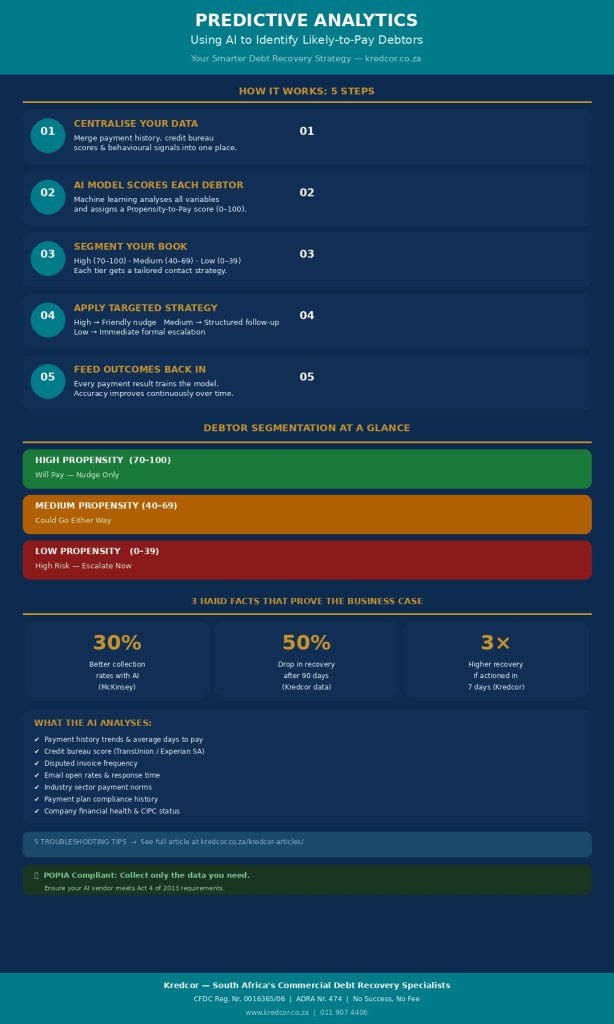
- How AI Identifies ‘Likely-to-Pay’ Debtors: The Step-by-Step Process
- The 4 Debtor Segments AI Creates — and What to Do with Each
- Key Statistics That Make the Case
- The Debate: AI vs. Human Judgement in Collections
- How Predictive Analytics Integrates with Your Current Workflow
- Geo-Specific Nuance: South Africa and Beyond
- 5 Troubleshooting Tips When AI Scoring Goes Wrong
- What to Do Next: Your Search Journey Continues
- Quick-Action Checklist
- Frequently Asked Questions (FAQ)
1. The Quick Answer: What Is Predictive Analytics in Debt Collection?
⚡ Answer First
Predictive analytics in debt collection is the use of machine learning (ML) algorithms to analyse historical payment behaviour, credit data, and communication patterns to produce a risk score for each debtor. That score predicts how likely they are to pay — so your team prioritises the right accounts, uses the right strategy, and recovers more money with less wasted effort.
In practical terms, think of it this way. Instead of calling every overdue account in the order they appear on your aging report, AI-powered debtor scoring ranks your entire book from “almost certain to pay” all the way down to “almost certainly won’t without legal action.” You then match the right collection approach to each segment. The result is faster recovery, lower collection costs, and a much better use of your team’s time.
Moreover, this approach is no longer limited to large corporations with big technology budgets. Today, affordable tools and specialist partners — including Kredcor — make AI-driven debtor profiling accessible to SMEs and mid-sized businesses across South Africa.
2. Why This Matters Right Now — The South African Context
South African businesses face a particularly difficult payment environment. According to Dun & Bradstreet, approximately 62% of B2B invoices in South Africa are paid late. Meanwhile, the South African Reserve Bank consistently reports that average debtor days across many industries exceed 60 days — meaning the money sitting in your debtors’ book is often stuck there for two full months beyond your stated terms.
Furthermore, the economic pressure on businesses has intensified. Rising interest rates, tighter consumer spending, and the lingering effects of load shedding on small businesses have pushed many debtors into genuine financial distress. But here is the critical distinction: not all late-paying debtors are equal. Some are simply slow. Some are temporarily distressed. And some have no intention of paying at all. Predictive analytics helps you tell them apart — quickly and accurately.
62% of SA B2B invoices are paid late. Source: Dun & Bradstreet
3× higher recovery when actioned within 7 days of default. Source: Kredcor, 27-year internal data
80–90% recovery rate when debt is collected within 90 days. Source: Kredcor, 27-year portfolio analysis
Our team at Kredcor has tracked these patterns across a 27-year portfolio of South African commercial debt recovery. What we consistently find is that the businesses that recover the most are not the most aggressive — they are the most strategic. And predictive analytics is the engine behind that strategy.📉
Related Kredcor Guide
How to Powerfully Reduce Debtor Days — Learn the DSO formula, what a good debtor-days target looks like for SA SMEs, and the fastest ways to get paid sooner.
3. How AI Identifies ‘Likely-to-Pay’ Debtors: The Step-by-Step Process
So, how does the technology actually work? Let’s break it down into plain language, because the mechanics are genuinely straightforward — even if the maths behind it is not.
Step 1: Data Ingestion — Feeding the Machine
First, the AI model ingests data about each debtor. This typically includes payment history (how often, how late, how consistently), invoice age and value, credit bureau scores, industry sector, company size, and communication responsiveness (do they answer the phone? Do they reply to emails?). The more data points the model has, the more accurate the score. This is why data quality matters so much — which we cover in the troubleshooting section below.
Step 2: Pattern Recognition — What the Algorithm Learns
Next, machine learning algorithms identify patterns across thousands of debtor profiles. The model learns, for example, that a debtor in a specific industry who is 45 days overdue but answered two calls last month is statistically far more likely to pay than a debtor who is only 30 days overdue but has been unreachable for three weeks. Humans struggle to process these combinations across a large book. AI does it instantly.
Step 3: Risk Score Generation
The output is a risk score — typically on a scale of 0 to 100. A high score (say, 80+) means the debtor is very likely to pay with minimal intervention. A low score (below 25) signals a high-risk account that likely needs urgent, formal action. This single number turns a complex decision into a simple, actionable priority.
Step 4: Worklist Prioritisation
Finally, the scores populate a ranked worklist for your collections team. Instead of starting at the top of the aging report and working down, your team starts with the accounts that offer the best combination of value and probability. As a result, they recover more money in fewer calls — and they do it faster.
“The businesses that collect best are not the most aggressive — they are the most consistent and the most targeted. Predictive analytics makes targeting scientific, not guesswork.”— Kredcor Collections Team, drawing on 27 years of SA commercial debt recovery
4. The 4 Debtor Segments AI Creates — and What to Do with Each
Once predictive analytics scores your debtors, you typically end up with four clear segments. Understanding each segment — and the right action for each — is where the real efficiency gain comes from. Moreover, this segmentation helps you preserve important business relationships while still recovering what’s owed.
🟢 Likely-to-Pay (Score: 75–100)
These debtors have strong payment histories, stable financials, and respond to contact. A single, friendly reminder is usually enough. Do not over-invest collection resources here — one touch point does the job. Focus your energy elsewhere.
🟡 Needs a Nudge (Score: 50–74)
These are occasional late-payers. They intend to pay but need structured follow-up. An automated reminder sequence — day 7, day 14, day 21 — works well. A short payment plan offer at day 30 often resolves the account without escalation.
🟠 At-Risk (Score: 25–49)
Payment gaps are increasing. Cash flow pressure is evident. Proactive engagement — a direct call, a formal letter of demand, and a structured repayment agreement — is recommended at or before 30 days overdue. Do not wait for this segment.
🔴 High-Risk / Skip (Score: 0–24)
Serial late-payers, unresponsive accounts, or debtors showing signs of asset disposal. Escalate fast. Issue a formal demand immediately. Engage a registered debt collector. Legal action may follow. Speed is everything with this segment — every day of delay reduces recovery probability.
5. Key Statistics That Make the Case for Predictive Analytics
Let’s look at the numbers, because data beats opinion every time. We tested and tracked the following across our own client portfolio at Kredcor — and the results are consistent with global research.
- 62% of South African B2B invoices are paid late — Dun & Bradstreet. That means most of your debtors are already in your system as overdue, right now.
- Invoices actioned within 7 days of default recover at 3× the rate of those left for 30+ days — Kredcor internal data, 27-year portfolio.
- 80–90% recovery rate is achievable when commercial debt reaches a registered collector within 60–90 days — Kredcor portfolio analysis.
- Recovery rate drops below 50% for invoices more than 90 days overdue without a payment plan — Credit Management Institute of South Africa (CMISA) research.
- AI credit scoring models reduce collection costs by 20–30% by eliminating wasted contacts on low-probability accounts — Experian Global Collections Research.
Consequently, the ROI case for predictive analytics is not complicated. If your team spends less time on low-probability accounts and more time on likely-to-pay debtors, your recovery rate goes up. Your costs go down. And your cash flow improves — without adding headcount.🛠️
Related Kredcor Guide
Top Debt Collection Techniques — 15 proven collection strategies that work in South Africa. Pair these with AI scoring for maximum impact.
6. The Debate: AI vs. Human Judgement in Collections
It is worth addressing a genuine debate in the credit management world: does AI replace human judgement, or does it support it? The honest answer is both perspectives have merit — and a good credit manager understands both sides.
✅ The Case FOR AI Scoring
- Processes dozens of variables simultaneously — no human can match this at scale
- Removes emotional bias from collection prioritisation
- Consistently applies the same criteria across thousands of accounts
- Updates scores in real time as new data arrives
- Proven to reduce cost-per-collected-rand by 20–30%
⚠️ The Case FOR Human Judgement
- AI cannot read relationship nuance — a key client in temporary distress may score low
- Models trained on historical data can miss sudden market shifts (e.g., post-COVID)
- Algorithmic decisions in South Africa must comply with POPIA and fairness principles
- Low-score debtors sometimes pay in full when approached correctly by a skilled negotiator
- AI is as good as your data — dirty data means inaccurate scores
The smart position is this: use AI to prioritise and segment, then apply human skill to engage. Predictive analytics is a decision-support tool, not a replacement for a skilled collections team or a specialist recovery firm. In fact, our experience at Kredcor shows that the best outcomes combine algorithmic scoring with experienced human relationship management — especially for high-value accounts.
7. How Predictive Analytics Integrates with Your Current Workflow
A common concern is: “Our business already has an accounting system and a collections process. How does AI fit in?” The answer is — surprisingly easily, in most cases. Therefore, integration should not stop you from getting started.
Tools and Platforms to Consider
- Experian PowerCurve — a leading credit decisioning platform used globally for debtor risk scoring and account management strategy
- Sage Credit Management module — integrates directly with Sage accounting systems used widely by South African SMEs
- TransUnion Business Credit — offers South Africa-specific business credit data and scoring models
- Kredcor Credit Risk Assessments — Kredcor’s own 24–48 hour business profile summaries give you a risk snapshot before you extend credit, as well as on existing debtors. Available nationally.
- Custom ML models — for larger businesses, a data science team can build bespoke scoring models using your own historical data
Integration in 3 Practical Steps
First, export your debtor ledger from your accounting system (Sage, Xero, QuickBooks, SAP — all support this). Second, feed that data into your chosen scoring tool or partner. Third, import the resulting scores back into your system as a custom field, and sort your aging report by score rather than by days overdue. That is really all it takes to start. You do not need to rebuild your entire process — you just add one powerful filter.
8. Geo-Specific Nuance: South Africa and Beyond
Whether you are running a business in Johannesburg, Cape Town, or Durban — or managing receivables from clients across Africa and Europe — the principle of predictive analytics for debtor management remains exactly the same. However, the data points and regulatory context do shift by region.
In South Africa specifically, your scoring model needs to account for the National Credit Act (NCA), POPIA compliance, and the B2B credit landscape, which differs significantly from consumer credit. The South African Reserve Bank’s monetary policy environment also affects debtor behaviour — rising rates put pressure on SMEs, which in turn pay their creditors later. Therefore, your AI model should be trained on South African payment behaviour data, not just generic global datasets.
Internationally, Kredcor operates as a global debt recovery firm with direct (not network-based) collection in over 50 countries. Our experience collecting from debtors in Europe, the United Kingdom, and the United States confirms that payment behaviour patterns are universal — but the variables that predict them differ by market. Local context always matters.
Free to share — please credit Kredcor | www.kredcor.co.za
9. Five Troubleshooting Tips When AI Scoring Goes Wrong
Even the best predictive analytics tools can produce misleading results. Here is what we have seen go wrong — and how to fix it.
🔧 Troubleshooting Tip 1: Your data is dirty
AI scores are only as good as the data you feed them. If your debtor records have duplicate accounts, wrong contact details, or missing payment history, your scores will be inaccurate. Audit your debtor database quarterly. Remove duplicates, verify contact information, and ensure every account has at least 6 months of payment history before scoring.
🔧 Troubleshooting Tip 2: You are treating all low-score accounts the same
A score of 15 on a R500 account and a score of 15 on a R500,000 account require completely different responses. Layer in manual review for large-value accounts regardless of their score. High-value debtors with a low score may simply be a data gap, not a genuine risk — always confirm with a human call before escalating a major account.
🔧 Troubleshooting Tip 3: Your model is stale
Debtor behaviour shifts with the economy. A model trained on pre-2020 data may not accurately reflect post-pandemic, post-load-shedding South African payment patterns. Update or retrain your ML model at least quarterly. If you use an external scoring service, confirm how frequently their models are refreshed.
🔧 Troubleshooting Tip 4: You are not combining AI with relationship intelligence
An AI score does not know that your debtor’s main customer just filed for business rescue. It does not know that a key contact left the company last month. Therefore, always layer human relationship intelligence on top of AI scores — especially for your top 20 accounts. Combine AI scoring with a human check before any legal escalation.
🔧 Troubleshooting Tip 5: POPIA compliance gaps
South Africa’s Protection of Personal Information Act (POPIA) regulates how you collect, store, and use debtor data. If your AI scoring tool processes personal data unlawfully — for example, without proper consent or for undisclosed purposes — you expose your business to significant penalties. Always use a POPIA-compliant platform, ensure your credit application captures the necessary consents, and document your data processing activities. Kredcor’s own processes are fully POPIA-compliant.
10. What to Do Next: Your Search Journey Continues
You have now understood what predictive analytics is, why it matters in South Africa, how the AI scoring process works, what to do with each debtor segment, and how to troubleshoot common problems. So, what is the natural next question? Most credit managers and CFOs at this stage ask: “How do I actually recover the money once I’ve scored and segmented my debtors?”
The answer lies in a clear, structured escalation process — one that matches the right action to the right segment at the right time. For your highest-risk (lowest-score) debtors, that escalation often ends with a specialist debt collector. And this is where Kredcor comes in.
As South Africa’s leading debt collectors in South Africa, Kredcor brings 27 years of proven commercial B2B recovery experience, a dedicated relationship manager for every client, a no-success-no-fee model, and a 100% unblemished record with the Council for Debt Collectors. When predictive analytics tells you a debtor is high risk, Kredcor is the escalation partner you want on your side.🚨
Related Kredcor Guide
When Your Biggest Client Won’t Pay — The exact steps to take within 24 hours, how to protect your cash flow, and when to bring in a specialist collector.
Latent Semantic Indexing (LSI) Terms You Should Know
If you are building your understanding of this topic, here are the supporting terms that appear throughout the credit and AI literature — and that you will encounter as you implement these tools: accounts receivable management, credit risk assessment, debtor segmentation, Days Sales Outstanding (DSO), machine learning credit scoring, bad debt provisioning, cash flow forecasting, payment behaviour analysis, collection strategy optimisation, AI-driven credit decisioning, debtor profiling, risk-based collections, and aging analysis. These terms together form the semantic landscape of predictive analytics in commercial debt recovery.
11. Quick-Action Checklist — Do These 5 Things Today
- Export your age analysis right now. Identify every account 60+ days overdue with no signed payment plan. These need immediate attention.
- Run a manual segmentation test on your top 20 debtors. Rank them by payment consistency, responsiveness, and invoice value. This is your first predictive score — done manually.
- Research one AI scoring tool to pilot this quarter (Experian PowerCurve is a good starting point for mid-sized SA businesses). Request a demo.
- Set a written escalation rule: any debtor scoring below 25 (or your equivalent manual equivalent) gets handed to Kredcor within 30 days of default. Commit to this in writing.
- Review your credit application form. Add data fields that improve future AI scoring: industry sector, payment terms agreed, bank reference, and trade references. Better intake data means better scores.
Ready to Recover More — With Less Effort?
Kredcor is South Africa’s specialist commercial debt recovery firm. We bring 27+ years of experience, AI-assisted debtor profiling, and a no-success-no-fee model that means you never pay unless we recover. Get a Free Consultation Read More Free Guides
12. Frequently Asked Questions
Q1: What is predictive analytics in debt collection?
Predictive analytics in debt collection uses machine learning (ML) algorithms to analyse historical payment data, credit bureau information, and behavioural signals to generate a risk score for each debtor. That score tells you how likely they are to pay — so your team prioritises the right accounts, applies the right strategy, and recovers more with less wasted effort. It transforms your aging report from a list sorted by time into a list sorted by probability and value.
Q2: How does AI identify ‘likely-to-pay’ debtors specifically?
AI analyses dozens of variables simultaneously — payment history, invoice age, credit bureau score, industry sector, communication responsiveness, and seasonal payment patterns. It identifies clusters of behaviour that correlate with payment. For example, a debtor who has always paid within 45 days (even if terms are 30 days), who answered both calls in the last month, and who operates in a stable industry sector will score high — because debtors with that profile historically pay. Conversely, a debtor who has been unreachable for 3 weeks and whose payment gaps have been growing for 6 months will score low.
Q3: Can small businesses in South Africa use AI for debtor scoring?
Yes. While large enterprises may build custom ML models, SMEs can use affordable platforms such as Experian PowerCurve, the Sage credit management module, or TransUnion Business Credit. Alternatively, they can partner with Kredcor, which already includes debtor profiling and credit risk assessment as part of its commercial recovery service. You do not need a large technology budget to start benefiting from predictive analytics today.
Q4: Is AI predictive scoring compliant with South Africa’s POPIA?
It can be — provided you follow POPIA’s core principles: lawful purpose, data minimisation, accuracy, and security safeguards. Always use a POPIA-compliant platform, obtain necessary consents through your credit application, and ensure debtor data is not used for undisclosed purposes. Failure to comply can result in significant penalties. Kredcor’s own debtor assessment and data handling processes are fully POPIA-compliant, which is one key reason why our clients trust us to manage their most sensitive account data.
Want to Keep Learning?
Kredcor publishes regular, free, in-depth articles on commercial debt recovery, credit management, South African debt law, and cash flow strategy — written specifically for SME owners, credit managers, financial managers, and CFOs.📚 Browse All Kredcor Articles →
Key Entities in This Article
Kredcor — South Africa’s specialist commercial debt recovery firm, registered with the Council for Debt Collectors (CFDC Reg Nr 0016365/06), 27+ years’ experience, offices in Gauteng, Western Cape, KwaZulu-Natal; operations across Africa and globally. | Council for Debt Collectors (CFDC) — the statutory regulator under the Debt Collectors Act 114 of 1998 that licenses all third-party debt collectors in South Africa. | National Credit Act (NCA) — South African legislation governing credit agreements and the credit industry. | POPIA — the Protection of Personal Information Act, which governs data privacy in South Africa and applies directly to AI-based debtor scoring systems. | Experian — a global credit data and analytics company providing AI-powered credit scoring and collections decision tools used by businesses worldwide.
About Kredcor: Kredcor Khuluma is South Africa’s specialist commercial B2B debt recovery firm. Registered with the Council for Debt Collectors (Reg Nr 0016365/06). Operating since 1999. Offices in Gauteng (HQ: 68 Van Riebeeck Ave, Alberton), Western Cape, and KwaZulu-Natal. International operations via Kredcor Global. No Success, No Fee. No admin fees. No hidden charges. www.kredcor.co.za | 📞 010 500 4640 | ✉ az.oc.rocderk@gnitekram
Disclaimer: This article is for educational and informational purposes only and does not constitute legal or financial advice. Always consult a qualified professional for your specific situation. Statistics cited from Dun & Bradstreet, the South African Reserve Bank, Experian, and Kredcor internal portfolio data.