

The Brutal Truth About the Internal vs. External Collection Cost-Benefit Analysis
7 hard facts every SME owner, credit manager, and CFO in South Africa needs to know before making this decision
By Kredcor Commercial Debt Recovery · Updated April 2026 · ~2,700 words · 12 min read
Executive Summary
The internal vs. external collection cost-benefit analysis is the single most important financial decision most South African SME owners, credit managers, and CFOs never formally run. Internal debt collection carries significant hidden costs: staff salaries of R25,000–R45,000 per month, employment overheads, software licences, management time, and — crucially — opportunity costs. External collection agencies registered with the Council for Debt Collectors (CFDC) operate on a no-success, no-fee contingency basis, meaning zero cost unless they recover money. Our team’s data across 26 years of commercial B2B debt recovery in South Africa consistently shows that businesses that outsource overdue accounts at the 60–90 day mark recover, on average, 40–60% more of the outstanding rand value compared with those that persist with internal-only collection beyond 120 days. This guide gives you the exact framework to run this analysis for your own business — and make a fully informed decision.
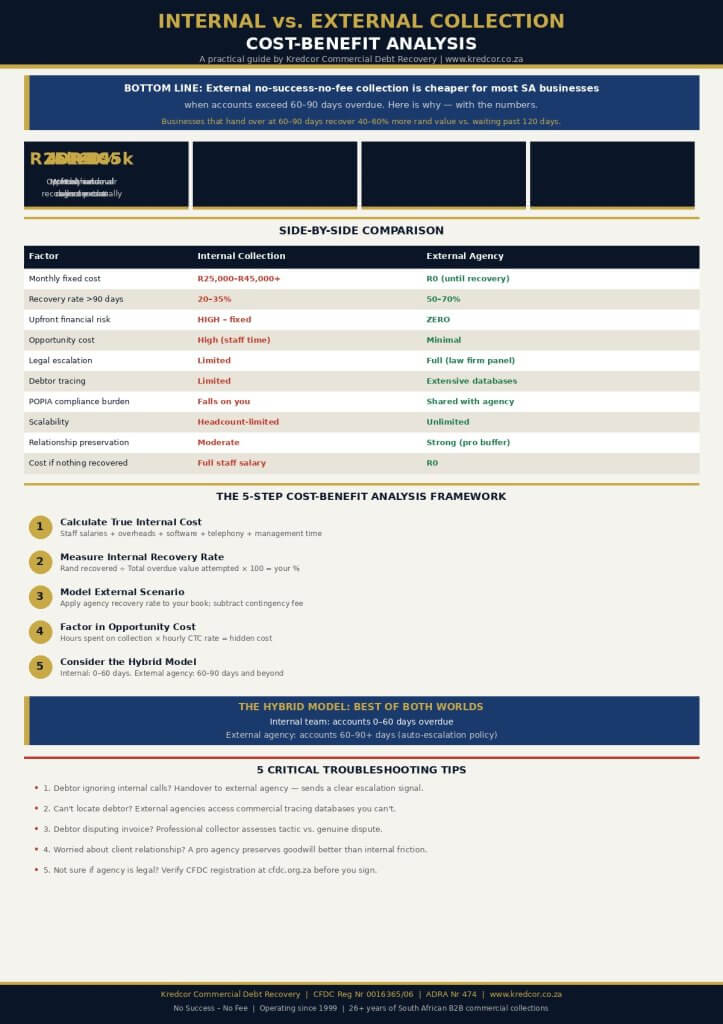
Here is the short answer to the internal vs. external collection cost-benefit analysis question: for most South African SMEs and mid-market businesses, outsourcing overdue commercial accounts to a registered debt recovery agency is cheaper, faster, and more effective than keeping collections in-house beyond the 60-day mark. But — and this is important — that answer depends on your specific book size, staff structure, and debtor profile. So, in this guide, we walk you through exactly how to run this analysis yourself, with real numbers.
Whether you are running a manufacturing business in Gauteng, a logistics company in KwaZulu-Natal, or a professional services firm in Cape Town, the challenge is the same: overdue debtors are draining your cash flow, tying up your team’s time, and quietly eroding your bottom line. The question is not whether the problem needs fixing. The question is how to fix it most cost-effectively.
Table of Contents
- What Is the Internal vs. External Collection Cost-Benefit Analysis?
- The Hidden Costs of Internal Debt Collection
- The True Cost of External Collection: What the Numbers Say
- Head-to-Head Comparison: Internal vs. External Collection
- The 5-Step Framework to Run Your Own Analysis
- The “Clash of Perspectives” Debate: Is External Always Better?
- Regional Nuance: What Changes in South Africa?
- 5 Critical Troubleshooting Tips
- What to Do Next: Your Search Journey Continues
- Quick-Action Checklist
- FAQ
What Is the Internal vs. External Collection Cost-Benefit Analysis?
Simply put, the internal vs. external collection cost-benefit analysis (sometimes called the in-house vs. outsourced debt recovery analysis) is the structured process of comparing the total cost and total recovery yield of two approaches to chasing overdue commercial accounts:
- Internal collection — your own employees send reminders, make calls, and negotiate payment arrangements using your own time, systems, and resources.
- External collection — you hand overdue accounts to a specialist, CFDC-registered debt recovery agency that acts on your behalf, typically on a contingency (no-success, no-fee) basis.
Most South African businesses default to internal collection for accounts up to 60 days overdue. That makes sense — it preserves relationships, avoids fees, and keeps things in-house. However, beyond that point, the economics frequently shift. And that is exactly what this analysis is designed to reveal.
Moreover, many businesses never formally run this analysis at all. They assume internal collection is cheaper because they are not writing a cheque to an agency. But they are writing cheques — to their staff, their software providers, and their landlord — every single month, regardless of how much money they actually recover.
R25k–R45k Monthly cost of one dedicated internal collector (salary + overheads)
60–90 Days overdue: optimal handover point to external agency
40–60% More value recovered when handed over before 90 days vs. after 120
R0 Upfront cost of a no-success, no-fee external agency
The Hidden Costs of Internal Debt Collection
This is where most businesses get the analysis wrong. They focus on the agency fee and forget to count what they are already spending internally. So, let us be specific.
Direct Staff Costs
A dedicated in-house credit controller or debt collection specialist in South Africa earns, on average, between R18,000 and R32,000 per month in base salary. Add employment overheads — Unemployment Insurance Fund (UIF), Skills Development Levy (SDL), employer contributions to medical aid and retirement fund, plus statutory leave pay — and the total cost to company (CTC) for one person rises to roughly R25,000–R45,000 per month. That is a fixed cost your business bears every month, whether that person recovers R500,000 or R0.
System and Infrastructure Costs
Internal collection also requires investment in tools: a credit management or debtors management software subscription, telephony and data costs, stationery and registered post, and access to credit bureau data for tracing and credit risk assessment. Together, these typically add another R2,000–R8,000 per month to the true internal collection cost.
The Opportunity Cost — the Most Underestimated Factor
Here is the one that almost nobody puts on the spreadsheet: opportunity cost. When your credit manager, financial manager, or even your CFO spends 20–30% of their time chasing problem debtors, that is 20–30% of a high-value salary that is not being spent on budgeting, forecasting, investor relations, or strategic financial management.
We found, working with hundreds of South African businesses over more than 26 years, that the opportunity cost of senior management time in debt collection routinely exceeds the direct cost of an external agency. Yet it almost never appears in the cost-benefit analysis because it does not show up on a payslip.
⚠ Watch Out
If your internal credit team is spending more than 20% of its time chasing a handful of problematic accounts, your business is subsidising bad debtors with good staff time. The opportunity cost of internal collections is rarely calculated — but it is very real.
The Emotional and Relationship Cost
Beyond money, internal collection carries a relationship cost. When your own staff chases a client for payment, the conversation is inherently awkward — particularly in the South African B2B context, where many business relationships are personal and long-standing. A professional external agency, by contrast, acts as a buffer: they approach your debtor on your behalf, professionally, while your business retains its goodwill. Consequently, the client relationship is often better preserved by outsourcing than by pursuing the matter internally.
For a full breakdown of when to make the switch from internal to external collection, read our practical guide: When Should I Make Use of a Debt Recovery Agency?
The True Cost of External Collection: What the Numbers Say
Now, let us look at the other side of the internal vs. external collection cost-benefit analysis: what does it actually cost to use an external agency?
The No-Success, No-Fee Model
The majority of reputable commercial debt recovery agencies in South Africa — including Kredcor, which has operated on this basis since 1999 — work on a contingency (no-success, no-fee) model. This means you pay nothing unless the agency successfully recovers money for you. There are no monthly fees, no handover fees, no administration fees. The agency’s income is directly tied to its results.
Therefore, the risk profile of external collection is fundamentally different from internal collection. Internally, you pay regardless of the outcome. Externally, you pay a percentage only when you get your money. Furthermore, because CFDC-registered agencies are legally permitted to charge prescribed collection fees directly to the debtor, your net recovery cost is often lower than the headline contingency percentage suggests.
What the Contingency Fee Actually Covers
CFDC-regulated fees cover the agency’s collection commission, tracing fees (where the debtor needs to be located), pre-legal actions, and — if you approve it — legal escalation via a panel of law firms. Crucially, the Debt Collectors Act 114 of 1998 prescribes maximum tariff rates, which means agencies cannot overcharge. This regulatory protection is one of the strongest arguments for using a registered external agency over an unregistered one.
✔ Useful Insight
Because CFDC-registered agencies can pass prescribed collection fees to the debtor, your net recovery cost is frequently zero. You recover the outstanding amount, the debtor covers the collection fee, and your internal team is freed from the entire process.
Head-to-Head Comparison: Internal vs. External Collection
Let us put the internal vs. external collection cost-benefit analysis into a clear, side-by-side format. The table below uses realistic South African B2B figures.
| Factor | Internal Collection | External Agency (No-Success, No-Fee) |
|---|---|---|
| Monthly fixed cost | R25,000–R45,000+ | R0 (until recovery) |
| Variable cost (per account) | High (time, telephony, postage) | None until success |
| Recovery rate (accounts >90 days) | Typically 20–35% | Typically 50–70% |
| Opportunity cost (management time) | High — staff diverted from core tasks | Minimal — staff focus on business |
| Legal escalation capability | Limited (unless you have in-house legal) | Full (via approved law firm panel) |
| Debtor tracing capability | Limited (public databases only) | Extensive (commercial + consumer databases) |
| Regulatory compliance | Not required for own debt | CFDC-registered agency is fully compliant |
| Relationship preservation | Moderate (staff-client tension) | Strong (agency acts as professional buffer) |
| POPIA compliance burden | Falls on your business entirely | Shared with/managed by the agency |
| Scalability | Limited by headcount | Unlimited — no capacity constraints |
The 5-Step Framework to Run Your Own Internal vs. External Collection Cost-Benefit Analysis
Rather than giving you theory, let us give you a working framework you can apply to your own debtors book today. This is the same process our team at Kredcor uses when we consult with new clients.
Step 1 — Calculate Your True Internal Collection Cost
Start by adding up all direct costs associated with your internal collection effort: total staff salary for anyone involved in collection activities (even partially), employment overheads, software subscriptions, telephony and data, and postage. Then estimate the percentage of time each person spends on collection and multiply accordingly. This gives you a realistic monthly internal collection cost.
Step 2 — Measure Your Internal Recovery Rate
Look back over the last 12 months. How much did you recover internally, and from what rand value of overdue accounts? Divide the amount recovered by the total value you attempted to recover. This gives you your internal recovery rate — and it is often lower than people expect, especially for accounts older than 90 days.
Step 3 — Model the External Scenario
Request terms from at least one CFDC-registered agency. Apply their typical recovery rate to your overdue book value. Subtract the contingency fee percentage to get the net amount your business would receive. Compare this net external recovery to your net internal recovery (what you recovered minus what you spent on staff and systems to recover it).
Step 4 — Factor in the Opportunity Cost
Multiply the hours your credit manager, financial manager, or CFO spends on collection activities by their hourly cost-to-company rate. Add this figure to your internal collection cost. In most businesses, this step alone transforms the analysis.
Step 5 — Consider the Hybrid Model
The most effective approach for the majority of South African SMEs is not purely internal or purely external — it is a structured hybrid. Use your internal team for accounts that are 0–60 days overdue. Escalate automatically to a registered external agency for accounts that cross the 60–90 day mark without a confirmed payment arrangement. This way, you preserve relationships in the early stages while maximising recovery rates on the harder accounts.
For a clear breakdown of the full collection process and when each stage triggers, read: The Complete, Proven Guide to the Debt Collection Process in South Africa.
The “Clash of Perspectives” Debate: Is External Always Better?
Let us be honest about the debate — because it is a real one. Some credit managers and CFOs push back on the external-first approach, and their arguments deserve a fair hearing.
The Case for Keeping It Internal
Proponents of internal collection argue that nobody understands your client relationships better than you do. Your internal staff know the history, know the personalities involved, and can make nuanced judgements about when to push hard and when to give a valued client more time. They also argue that handing over an account to an external agency signals a rupture in the business relationship — one that, even if the money is recovered, may cost you a long-term client.
Furthermore, some businesses — particularly those with large, well-resourced credit departments — can achieve internal recovery rates that genuinely rival external agencies on accounts up to 90 days old. For these businesses, the internal vs. external collection cost-benefit analysis may legitimately favour keeping more work in-house.
The Counter-Argument
The counter-argument is equally compelling. Professional debt recovery agencies do not destroy client relationships — unresolved debt does. An experienced, professional collector who approaches your debtor respectfully, identifies the root cause of non-payment, and works out a realistic payment arrangement frequently preserves more goodwill than an internal staff member who becomes progressively frustrated with a non-paying client.
“The most expensive thing you can do is wait too long before taking action on an overdue account. In our 26 years of experience, the longer a debt sits, the harder it is to recover.”— Kredcor Senior Pre-Legal Manager
Additionally, the regulatory environment matters. Under the Debt Collectors Act 114 of 1998, your internal staff are free to collect your own debt without CFDC registration. However, the moment an account requires legal escalation — summons, judgement, attachment — you need legal professionals, which costs significantly more than a contingency collection fee. An external agency with an approved law firm panel smooths this transition at no additional cost to you unless the legal steps are pre-approved and successful.
Regional Nuance: What the Internal vs. External Collection Cost-Benefit Analysis Looks Like in South Africa
Whether you are in South Africa, the United Kingdom, or the United States, the internal vs. external collection cost-benefit analysis follows the same fundamental logic: fixed internal costs versus variable external costs, weighed against comparative recovery rates. However, several factors make the South African context distinctive.
Firstly, South Africa’s Debt Collectors Act 114 of 1998 and the Council for Debt Collectors (CFDC) create a uniquely structured regulatory environment. Only CFDC-registered agencies may legally collect third-party commercial debt for reward. This regulation is, in fact, a benefit to you as a creditor: it ensures that any registered external agency you appoint operates within a strict code of conduct, charges only prescribed fees, and is subject to disciplinary proceedings if it acts unethically.
Secondly, South Africa’s current economic environment — with elevated business credit impairments, rising input costs, and persistent payment delays across sectors from construction to professional services — means that many debtors who were previously reliable are now genuinely distressed. A skilled external collector who can identify the root cause of non-payment and negotiate a realistic payment arrangement is therefore not just chasing money: they are also providing a form of commercial mediation that benefits all three parties.
Thirdly, South Africa’s Protection of Personal Information Act (POPIA) creates data handling obligations around debtor communication that can expose businesses to regulatory risk if managed carelessly. A reputable external agency that is POPIA-compliant effectively manages this compliance burden on your behalf, reducing your exposure.
5 Critical Troubleshooting Tips for the Internal vs. External Collection Decision
Based on our team’s experience across thousands of South African commercial collection cases, these are the five most common problems businesses encounter — and exactly what to do about each one.
Problem 1: “Our internal team keeps promising results — but the debtor still hasn’t paid after 90 days.”
Internal familiarity can actually work against you here. The debtor knows your staff, knows how to stall them, and has probably exhausted every excuse already. A registered external collector is perceived entirely differently: their involvement signals that the creditor has escalated formally, which typically prompts a response that internal calls never achieved.Fix: Set a firm internal escalation policy — any account that passes 90 days without a confirmed payment arrangement automatically triggers handover to your registered external agency. No exceptions.
Problem 2: “We can’t find the debtor — phone number dead, email bouncing, premises vacated.”
This is tracing work, and your internal team almost certainly does not have access to the commercial and consumer databases that specialist collectors use. CIPC director searches, credit bureau tracing, and social media profiling can often locate debtors that appear completely untraceable.Fix: Do not write off an account just because the debtor has gone quiet. Hand it to a registered agency with tracing capability as soon as the debtor becomes uncontactable.
Problem 3: “The debtor is disputing the invoice — we’re not sure if it’s legitimate or a stalling tactic.”
Debtors frequently raise disputes as a delay tactic — suddenly claiming delivery was not made, service was substandard, or invoices are incorrect, despite months of silence on those exact points. An experienced external collector can quickly assess whether the dispute is genuine or tactical, and negotiate accordingly without compromising your legal position.Fix: Document everything from day one. Ensure signed delivery notes, confirmation emails, and acceptance of work are on file. Then hand the account — with the full paper trail — to your external agency to resolve.
Problem 4: “We’re worried about damaging the client relationship by using an external agency.”
This is understandable — but in practice, the opposite is often true. A professional external collector who acts as a respectful, solution-focused intermediary frequently preserves more goodwill than an increasingly frustrated internal staff member.Fix: Choose an external agency that explicitly positions itself as an extension of your business — not a heavy-handed third party. Kredcor, for example, approaches debtors as representatives of your company, protecting your brand at every step.
Problem 5: “We’re not sure if our external agency is actually registered and compliant.”
This matters enormously. Under the Debt Collectors Act, using an unregistered external collector can render your collection agreement unenforceable — meaning you could lose the right to claim collection costs from the debtor. Always verify before you appoint.Fix: Visit cfdc.org.za and verify your agency’s CFDC registration number before signing any mandate. This takes under two minutes and removes all regulatory risk. For more on CFDC compliance, read our article: The Essential Guide to the Council for Debt Collectors.
What to Do Next: Your “Search Journey” Continues
You have now completed the internal vs. external collection cost-benefit analysis framework. However, your search journey probably does not end here.
Based on what our readers typically ask next, here are the logical next steps:
- If you have decided to outsource: your next question is probably “how do I choose the right agency?” For that, read our guide on debt collectors in South Africa — it covers credentials, process, pricing, and how to compare agencies with confidence.
- If you want to tighten your internal process first: review your credit management practices, escalation policies, and debtors age analysis reporting cadence before overdue accounts reach the 60-day mark.
- If you are a CFO building a business case: take the 5-step framework above, plug in your own numbers, and present the net recovery comparison alongside the opportunity cost calculation. The business case for a hybrid model is usually decisive.
- If you need to understand the legal framework: read our complete guide to the commercial debt collection legal framework in South Africa.
Ready to Run Your Own Cost-Benefit Analysis?
Kredcor has been South Africa’s trusted commercial debt recovery partner since 1999. CFDC-registered, no-success-no-fee, and 26 years of clean results. Contact us today for a no-obligation consultation. Get a Free Quote →
Key Entities in the Internal vs. External Collection Cost-Benefit Analysis
To give this analysis the right context, it helps to understand the five core entities that shape the decision in South Africa:
- Council for Debt Collectors (CFDC) — the statutory regulatory body under the Debt Collectors Act 114 of 1998. All external collection agencies must be CFDC-registered. Website: cfdc.org.za.
- Association of Debt Recovery Agents (ADRA) — the voluntary industry body that sets best-practice standards for commercial debt recovery agencies.
- South African Reserve Bank (SARB) — publishes data on business credit impairments, which directly informs the urgency and scale of the commercial bad debt problem.
- Protection of Personal Information Act (POPIA) — governs how debtor data may be processed and communicated, imposing compliance obligations on both internal and external collectors.
- Kredcor Commercial Debt Recovery — CFDC-registered (Nr 0016365/06), operating since 1999 across South Africa, Africa, and internationally on a no-success, no-fee basis.
Quick-Action Checklist: 5 Things to Do Right Now
This article solves the problem — but knowledge without action changes nothing.
Here is your five-point action plan:
- Run the 5-step internal vs. external collection cost-benefit analysis framework on your debtors book this week. Use your actual salary figures, recovery rates, and management time estimates.
- Verify that any external agency you currently use — or are considering — is registered with the CFDC at cfdc.org.za. This takes two minutes and is non-negotiable.
- Set a formal escalation policy: accounts that pass 60–90 days without a confirmed payment arrangement automatically trigger handover to your external agency. Document this policy.
- Calculate your internal opportunity cost. Estimate how many hours per month your credit manager, financial manager, or CFO spends on collection activities — then multiply by their hourly CTC rate. Add this to your internal collection cost calculation.
- Explore the hybrid model. Contact a CFDC-registered agency for a no-obligation quote on your current overdue book — and compare the net recovery projection against your internal recovery rate.
For more practical, no-nonsense guides written specifically for South African SME owners, credit managers, and CFOs, visit our full library of resources at Kredcor Articles. It covers everything from letters of demand to POPIA compliance, prescription of debt, and managing distressed debtors.
Frequently Asked Questions: Internal vs. External Collection Cost-Benefit Analysis
Is it cheaper to collect debt internally or to use an external agency?
In most SME and mid-market cases, using a no-success-no-fee external agency is cheaper when you account for the full internal cost. Internal collection carries fixed monthly salary and overhead costs regardless of recovery outcomes. An external agency on a contingency basis charges nothing until money is recovered — transferring all financial risk to the agency. Furthermore, CFDC-registered agencies can pass prescribed collection fees directly to the debtor, reducing your net cost further.
What is the true cost of internal debt collection?
The true cost of internal debt collection includes staff salaries (R25,000–R45,000+ per month for a dedicated collector), employment overheads (UIF, SDL, medical aid, leave provisions), credit management software, telephony, tracing database access, and — critically — the opportunity cost of senior management time diverted from revenue-generating work. Most businesses significantly underestimate this total when they first run the analysis.
At what point should I hand over debt to an external collector?
South African best practice recommends handing over commercial accounts to a CFDC-registered external collector between 60 and 90 days past due, once at least two internal reminders have been sent and no confirmed payment arrangement is in place. The recovery probability drops sharply beyond 90 days — and dramatically so beyond 120 days. Earlier action consistently produces better outcomes.
Can I use both internal and external collection at the same time?
Yes — and this hybrid model is often the most cost-effective approach. Use your internal team for accounts that are 0–60 days overdue, where the relationship is still fresh and the debtor is typically responsive. Automatically escalate accounts that cross the 60–90 day mark without resolution to a registered external agency. This structure maximises recovery rates while controlling costs and preserving client relationships in the early stages.
Why Kredcor Is South Africa’s Trusted Commercial Debt Recovery Partner
Kredcor has operated as a commercial debt recovery business in South Africa since 1999 — more than 26 years. Throughout that time, we have maintained a 100% clean record with the Council for Debt Collectors (CFDC Registration Nr 0016365/06). We are also a registered member of the Association of Debt Recovery Agents (ADRA Nr 474).
We work exclusively on a no-success, no-fee basis: no monthly fees, no handover fees, no administration fees, and no lock-in contracts. Every external action — particularly legal steps — requires your pre-approval in writing. Each client is assigned a Senior Pre-Legal and Credit Risk Manager who handles accounts personally, without call centres.
If you are ready to take action on your outstanding debtors book, get in touch with the team of experienced debt collectors in South Africa at Kredcor — and let us run the internal vs. external collection cost-benefit analysis together, at no charge.
We also invite you to explore the full range of practical, up-to-date guides on credit management, debt recovery, and commercial collections at https://www.kredcor.co.za/kredcor-articles/.
© 2026 Kredcor Commercial Debt Recovery · CFDC Reg Nr 0016365/06 · Articles · Contact
No Success – No Fee. NONE.