

Medical Aid Shortfalls & Rejected Claims: When South African Practices Need Debt Collectors
A practical playbook for recovering the money medical schemes and patients owe your practice — before it becomes a write-off.
Yes — medical aid shortfalls and rejected claims are recoverable, and writing them off is usually the wrong first move. A structured process — correcting and resubmitting the claim inside the scheme’s own deadline, following up in writing, escalating through the scheme’s dispute channel, and, when that stalls, handing the account to registered debt collectors in South Africa — recovers the large majority of legitimately owed shortfalls. For most practices the real obstacle isn’t legal. It’s timing. A rejected claim isn’t a dead end; it’s a 60-day window, and once that window closes, the money is far harder to get back.
📋 At a Glance: A medical aid shortfall is the gap between what a scheme pays and what a patient still owes. A rejected claim is the scheme’s outright refusal to pay, almost always for a fixable administrative reason. South African schemes must pay or formally dispute a claim within 30 days, then give the practice 60 days to correct and resubmit it. Miss that window, or exhaust internal follow-up, and it’s time to escalate.
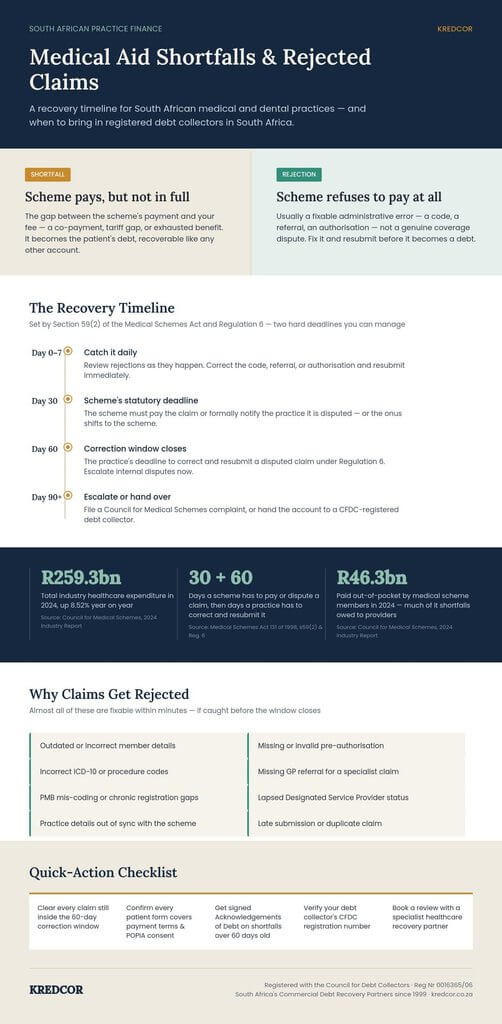
Table of Contents
- Shortfall vs Rejection: Two Different Problems
- The Legal Clock: What the Medical Schemes Act Requires
- Why Claims Actually Get Rejected
- Your Recovery Timeline, Step by Step
- Escalating to the Council for Medical Schemes
- When to Call In Debt Collectors in South Africa
- Five Troubleshooting Tips for Stuck Claims
- Another Way to See It: Is Every Shortfall Worth Chasing?
- What to Do Next
- Quick-Action Checklist
- FAQ
1. Shortfall vs Rejection: Two Different Problems
Practices often lump every unpaid medical aid account into one mental bucket: “the scheme didn’t pay.” In reality, two very different problems hide inside that bucket, and each needs its own recovery path.
A shortfall happens when the scheme processes the claim and pays something, but less than the practice charged. The difference — a co-payment, a gap between the scheme tariff and your fee, or a benefit that ran out mid-treatment — becomes the patient’s debt, not the scheme’s. A rejection is different: the scheme refuses to pay the claim at all, usually because of an administrative or coding problem rather than a genuine dispute about whether the treatment was covered.
That distinction matters because it decides who you’re chasing. A rejection needs fixing and resubmitting to the scheme before it becomes anyone’s “debt” in the traditional sense. A shortfall, once confirmed and undisputed, behaves like an ordinary patient account: reminders, a formal letter of demand, and, if needed, professional debt collection.
Either way, the regulatory landscape is the same. The Council for Medical Schemes (CMS) regulates the schemes themselves; the Board of Healthcare Funders (BHF) represents the administrators and funders across the industry; the Medical Schemes Act 131 of 1998 sets the legal timelines both sides must follow; the Council for Debt Collectors (CFDC) regulates anyone you eventually hand a patient account to; and the Protection of Personal Information Act (POPIA) governs how patient and claims data moves between all of them. Working out where your account sits — shortfall or rejection — is the first step in choosing which of these five to work through. For the wider picture of healthcare debt recovery beyond shortfalls specifically, see Kredcor’s guide to debt recovery for the medical and healthcare industry.
2. The Legal Clock: What the Medical Schemes Act Requires
This is where most practices lose recoverable money — not because the law is against them, but because nobody in the practice is watching the clock.
Section 59(2) of the Medical Schemes Act 131 of 1998 requires a scheme to pay a valid claim — or tell the practice it’s disputing it — within 30 days of receiving it. Regulation 6 then gives the practice 60 days from that notice to correct and resubmit. If a scheme fails to notify the practice within the initial 30 days, the onus shifts: the scheme, not the practice, must then prove the claim was genuinely wrong.
That 30-plus-60-day structure is the single most useful fact in this entire process. It converts a vague sense that “the medical aid didn’t pay” into two hard deadlines you can actually manage and diarise.
The same legislation cuts both ways, and it’s worth knowing that. A June 2026 High Court ruling upheld medical schemes’ power, under Section 59(3), to claw back payments made in error — litigation brought by the South African Society of Physiotherapy after years of disputed recoupments. The court found the recovery power inseparable from “the broader legislative scheme” it sits within. In other words: the same Act that gives your practice 90 days to fix a rejected claim also gives the scheme a real, if procedurally constrained, right to reclaim an overpayment later. Documentation protects you in both directions.
3. Why Claims Actually Get Rejected
The good news is that most rejections trace back to a short, predictable list of causes — not genuine coverage disputes.
Fix these at the front desk and a large share of your rejected-claims problem disappears before it starts:
- Outdated or incorrect member details — a lapsed membership, wrong dependant code, or a member who wasn’t active on the date of service.
- Missing or invalid pre-authorisation for a procedure that required it.
- Incorrect or outdated ICD-10 and procedure codes, or a missing modifier.
- A missing GP referral where the scheme’s network option requires one for a specialist visit.
- Prescribed Minimum Benefit (PMB) mis-coding — schemes must fund PMB conditions in full, but only if the ICD-10 code and chronic registration are exact.
- Designated Service Provider (DSP) or network status that has lapsed without the practice noticing.
- Practice or provider details that are out of sync between the BHF’s registry and an individual scheme’s own records.
- Late submission, past the scheme’s own claims window, or a duplicate of a claim already paid.
Almost all of these are correctable within minutes if caught early. The real cost isn’t the error itself — it’s discovering it weeks later, once the correction window is closing and the patient or the file has gone cold.
4. Your Recovery Timeline, Step by Step
Treat a rejected or short-paid claim the same way you’d treat any other overdue account: with early delinquency management, not a once-a-month sweep through the claims report.
Day 0–30: Catch It and Fix It
Day 0–7: Review rejection reports daily, not at month-end. Correct the fault — a code, a referral, an authorisation — and resubmit immediately. This single habit, more than any other on this page, keeps the practice inside the scheme’s 30-day and 60-day windows.
Day 7–30: If a resubmitted claim stalls, follow up in writing and keep a dated record of every call and email — you may need it if the dispute escalates. For a confirmed shortfall now sitting with the patient, this is the point for a friendly reminder, then a formal statement.
Day 30–90: Escalate and Formalise
Day 30–60: This is pre-litigation negotiation territory. Use the scheme’s internal disputes or clinical committee process before going to the regulator. For a patient shortfall that isn’t responding to statements, this is when a proper letter of demand goes out, and — if you don’t already have one — a signed Acknowledgement of Debt (AOD) becomes the next ask.
Day 60–90: If the scheme’s own process hasn’t resolved a rejection, escalate to the Council for Medical Schemes (see the next section). If the patient portion of a shortfall involves a payment arrangement or instalment plan, note that this can bring the account within the National Credit Act, meaning a Section 129 notice is required before any legal step. This is also, realistically, the point to consider handing the account to a specialist.
Get your foundation right before any of this becomes necessary: verify medical aid membership and benefit status at every visit, not just the first one, and make sure your patient registration form is signed and includes consent to share billing data with a registered debt collector if the account goes unpaid. For the fuller ethical and legal picture of collecting the patient side of these accounts, see Kredcor’s guide to the ethics of collecting outstanding patient fees.
5. Escalating to the Council for Medical Schemes
Before you involve the regulator, use the scheme’s own internal disputes process — most schemes require this first, and it’s usually the fastest route to a result. Submit a written dispute with the claim number, the rejection reason, and your supporting documentation (referral, authorisation, coding).
If that doesn’t resolve things, or the scheme misses its own timeframes, you can lodge a formal complaint with the Council for Medical Schemes, the statutory regulator established under the Medical Schemes Act. The CMS describes its own mission as being “to promote vibrant and affordable healthcare cover for all” — which, not incidentally, includes making sure providers get paid what schemes actually owe them. According to the CMS’s 2024 Industry Report, total healthcare expenditure across the industry rose 8.52% to R259.3 billion in 2024, with out-of-pocket payments by members climbing to R46.3 billion — a scale that makes an unresolved dispute process worth pursuing formally rather than quietly writing off. A CMS complaint also carries real weight precisely because so few practices ever file one; most write the shortfall off instead.
6. When to Call In Debt Collectors in South Africa
Not every stuck account needs a debt collector. Most rejected claims are fixed by resubmission, and most shortfalls are settled by a firm, well-documented reminder to the patient. But some accounts genuinely need outsourced credit management, and recognising the signs early protects both your cash flow and the patient relationship.
Consider handing the account over when:
- The patient portion of a shortfall is more than 60 days overdue and two reminders have gone unanswered.
- A patient has broken a payment arrangement, or made verbal promises with nothing signed.
- The scheme dispute has gone through the CMS process and the practice still can’t get traction.
- The patient has moved or become uncontactable — tracing is a specialist skill, not a front-desk task.
- The account is material enough that the cost of professional recovery is clearly worth it.
What a Compliant Partner Looks Like
Whoever you use must be registered with the Council for Debt Collectors — verify the registration number yourself rather than taking it on trust. Kredcor, for example, has held CFDC registration (Reg Nr 0016365/06) since 1999. Confirm they’re POPIA-compliant too: sharing a patient’s name, contact details, and amount owed with a third party for debt recovery is lawful, but only within a proper data-sharing agreement. Kredcor’s guide to POPIA and debt collection covers exactly what a compliant collector can and can’t do with that data.
In our experience recovering commercial and professional-service debt over 26 years, the same pattern holds in healthcare: accounts pursued inside the scheme’s original correction window recover at dramatically higher rates than the same claims picked up three or four months later. A good partner also lists confirmed, undisputed non-payers with the major credit bureaux — the default listing that gives a stalled patient account real incentive to settle — and does it on a No-Success, No-Fee basis, since that’s the only structure that keeps your interests and the collector’s genuinely aligned. Shrinking the time these accounts sit open is, in the end, just DSO (Days Sales Outstanding) reduction applied to healthcare billing.
7. Five Troubleshooting Tips for Stuck Claims
If the scheme insists it already paid, but the patient denies receiving anything — request the Explanation of Benefits (EOB) directly from the scheme. Many schemes pay members rather than providers by default; if the patient received the money, the debt still sits with them.
If the same claim keeps bouncing for the same coding reason — stop resubmitting blind. Pull the exact ICD-10 and procedure code combination the scheme expects, confirm it against the current tariff guide, and only then resend. A third identical rejection just wastes another submission cycle.
If the 60-day correction window has already passed — don’t assume the claim is dead. Lodge a written dispute anyway, citing Regulation 6 and the scheme’s own notification failure if it missed the 30-day deadline; the onus may already have shifted to the scheme.
If a corporate wellness or occupational-health client’s claim was accepted but payment still hasn’t arrived — treat it as a commercial debt, not a patient shortfall. It needs a credit application on file, formal terms, and, if it drags on, the same commercial payment arrangement and overdue invoice resolution process you’d use with any slow-paying corporate account.
If the patient portion is the only piece still unpaid once the scheme has settled its share — don’t let it get lost as “small change.” A string of R500 and R1,000 shortfalls left uncollected adds up to a material loss over a year; put every confirmed shortfall through the same reminder-to-demand sequence you’d use for a full account.
8. Another Way to See It: Is Every Shortfall Worth Chasing?
Not everyone in practice management agrees that every rand is worth the admin time. Some argue that a R200 co-payment shortfall costs more in staff hours to chase than it will ever recover, and that energy is better spent preventing the next one — through upfront collection and membership verification — than pursuing the last one.
That’s a fair point at the level of a single account. It stops being fair at the level of a debtor book. A practice that individually writes off every “small” shortfall is, collectively, writing off a meaningful share of its revenue every year — leakage that only shows up once someone finally adds up twelve months of ignored R500 balances. The realistic position sits between the two: batch and systematise the small stuff — an automated reminder sequence, a periodic handover of everything over 60 days — so it gets pursued without consuming a staff member’s whole afternoon, and reserve individual attention for the accounts that are large enough, or old enough, to justify it.
9. What to Do Next
If you don’t yet review rejections daily, start there — it’s the single highest-leverage change available to most practices. If your debtor book has confirmed shortfalls sitting past 60 days with no signed acknowledgement of debt, get one before you do anything else. And if you’re already past that point on a meaningful number of accounts, the next call worth making is to a CFDC-registered debt recovery partner, not another letter.
10. Quick-Action Checklist
- Pull your claims rejection report today and clear anything still inside the 60-day correction window.
- Check that every new patient signs a registration form covering payment terms, POPIA consent, and the right to hand unpaid accounts to a registered debt collector.
- List every medical aid shortfall over 60 days old and get a signed Acknowledgement of Debt on the largest ones.
- Verify the CFDC registration number of any collector or agency you currently use, or are considering.
- Book a no-obligation review of your outstanding accounts with a specialist healthcare debt recovery partner.
11. FAQ
Can a medical practice actually recover a medical aid shortfall from the patient?
Yes. Once a scheme has processed a claim and paid its portion, any remaining shortfall — a co-payment, tariff gap, or exhausted benefit — is a legitimate patient debt like any other. It can be pursued through the normal reminder, statement, and letter-of-demand sequence, and, if unpaid, handed to a registered debt collector.
How long does a medical scheme have to pay or reject a claim in South Africa?
Under Section 59(2) of the Medical Schemes Act 131 of 1998, a scheme must pay a valid claim, or notify the practice that it’s disputing it, within 30 days of receiving it. If it disputes the claim, Regulation 6 gives the practice a further 60 days to correct and resubmit.
What happens if a medical scheme misses its own 30-day deadline?
If a scheme fails to notify the practice within 30 days that a claim is erroneous or unacceptable, the onus shifts: the scheme then has to prove the claim was actually wrong, rather than the practice having to prove it was right. Keep dated records of every submission so you can rely on this if it comes up.
When should a practice bring in a debt collector rather than keep chasing internally?
Once a shortfall is more than 60 days overdue, the patient has broken a payment arrangement, or the account needs tracing skills the front desk doesn’t have, it’s usually time to hand it to a registered, CFDC-listed debt collector who understands healthcare billing and POPIA compliance.
Most of what’s in this guide is about buying yourself time: catching a rejection before the correction window closes, getting a shortfall acknowledged in writing before the patient forgets it, and knowing exactly which regulator or process to use before an account goes cold. But time runs out on some accounts regardless of how well you run your practice. When it does, partnering with experienced, registered debt collectors in South Africa who understand medical billing, POPIA, and the Medical Schemes Act — and who work on a No-Success, No-Fee basis — turns a write-off back into recovered revenue.
For more on the legal and ethical side of healthcare debt recovery, see Kredcor’s guides to debt recovery for the medical and healthcare industry and the ethics of collecting outstanding patient fees, or browse the full library at Kredcor Articles for everything else South African credit managers, practice managers, and CFOs need to protect their cash flow.
Published by Kredcor — South Africa’s Commercial Debt Recovery Partners.
Registered with the Council for Debt Collectors (CFDC), Reg Nr 0016365/06. Operating nationwide since 1999.
Disclaimer: This article is for general informational purposes only and does not constitute legal, medical-billing, or financial advice. Always consult a qualified attorney, medical billing specialist, or registered debt collector for guidance specific to your practice.