
By Kredcor Africa Team — Kredcor, South Africa’s Commercial Debt Recovery Partners.
Registered with the Council for Debt Collectors (Reg Nr 0016365/06) | 26+ years of commercial debt recovery
The invoice to your distributor in Lusaka went out in March. It’s now spring, their finance manager has stopped replying, and your attorney says a South African summons won’t get you far.
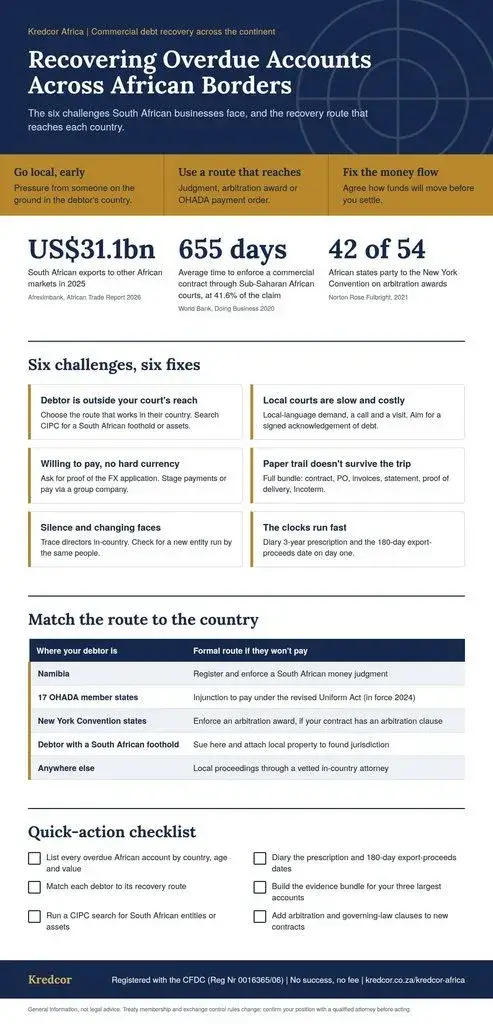
Here’s the direct answer. Recovering overdue accounts across African borders works when you match the recovery route to the debtor’s country instead of copying your domestic playbook. That means three moves. Put pressure on the debtor early, through someone on the ground. Use the enforcement tool that actually reaches that country. And settle how the money will physically move before you agree to anything.
This guide is for SME owners, credit managers, financial managers and CFOs who already have an African account on the overdue list. Still setting up terms for new African buyers? Start with our guide to cross-border debt collection in Africa, which covers vetting, contract clauses and credit insurance. This article picks up where that one ends: once the money is late.
At a glance: Recovering overdue accounts across African borders comes down to three moves. Get pressure on the ground in the debtor’s country early. Use the enforcement route that actually reaches that country — a court judgment, an arbitration award or an OHADA payment order. And fix how the money will move before you settle. Speed matters most.
In this guide:
- Why is an African receivable harder to recover than a local one?
- The six challenges, and what solves each one
- Which recovery route reaches your debtor’s country?
- The South African rules that still apply to you
- How we run a cross-border recovery at Kredcor Africa
- Another way to see it
- Troubleshooting: if this happens, try that
- Frequently asked questions
- What to do next
- Quick-action checklist
Why is an African receivable harder to recover than a local one?
Three things change the moment your debtor sits across a border: legal reach, time and money movement. Each one breaks a different part of your domestic collection process, so each needs its own fix.
Legal reach. A South African court order doesn’t automatically work in another country. Our Enforcement of Foreign Civil Judgments Act 32 of 1988 has only ever been applied to Namibia. In most other African countries, a foreign judgment has to be recognised by the local court in a separate application before anyone will enforce it.
Time and cost. Local courts can be slow. In the World Bank’s last Doing Business survey, enforcing a commercial contract through the courts took 655 days on average in Sub-Saharan Africa. It cost 41.6% of the claim value. The series has since ended and the data dates from 2019. But it’s still the best like-for-like benchmark we have, and it matches what we see on the ground.
Money movement. Even a willing debtor may struggle to pay you in rand or US dollars. Afreximbank’s 2026 African Trade Report puts the continent’s trade finance gap at about US$74 billion. It also points to scarce foreign exchange and fewer correspondent banking links between banks.
None of this is a reason to stop trading into Africa. South African firms exported US$31.1 billion worth of goods to other African markets in 2025. South Africa also accounted for 19.2% of all intra-African trade, according to the same Afreximbank report as reported by Nairametrics. The opportunity is real. It just needs a collection process built for it.
“Your South African judgment travels on a visitor’s visa. The local court still decides whether it gets to work.”— Kredcor Africa Team
The six challenges, and what solves each one
Every stuck African account we handle comes down to one or more of these six problems. Diagnose which ones you’re facing before you choose your next step.
The debtor is outside your court’s reach
What it looks like: your attorney confirms you’d win in a South African court, but the debtor has no assets here and ignores the summons.
What solves it: pick the enforcement route that works in the debtor’s country — the route table below shows the main options. Then look hard for a South African foothold. Foreign companies that conduct business here must register with the Companies and Intellectual Property Commission (CIPC) as external companies. Many African buyers also have local subsidiaries, stock in South African warehouses, or South African customers who owe them money.
Where a foreign debtor has property here, your attorney may be able to attach it to found jurisdiction. It’s a common-law remedy that brings the debtor within reach of a South African court.
Local courts are slow and costly
What it looks like: a local attorney quotes a timeline in years and a fee that eats a big slice of the claim.
What solves it: treat litigation as the credible threat, not the plan. Soft collections in the debtor’s own country settle far more African accounts than court papers do. Send a letter of demand from a local agent or attorney, in the local language. Follow it with a call and a visit. The goal of that pre-litigation negotiation is a signed acknowledgement of debt (AOD) and a realistic commercial payment arrangement.
The debtor wants to pay but can’t get hard currency
What it looks like: “We’ve applied to the bank for dollars. We’re waiting for allocation.” Sometimes that’s true. Sometimes it’s a stall.
What solves it: ask for proof. A genuine debtor can show you the bank’s foreign-exchange application or queue confirmation. Then build the settlement around that reality. Use smaller instalments timed to allocations, or payment from a group company in another country. A regional channel such as the Pan-African Payment and Settlement System (PAPSS) may also work, where both banks take part.
If you hold trade credit insurance, check whether currency-transfer delays count as a covered political risk. Our guide to export credit insurance explains how those policies work.
The paper trail doesn’t survive the trip
What it looks like: after months of silence, the debtor suddenly disputes quality, quantity or delivery.
What solves it: a complete bundle before you escalate. That means the signed credit application or contract, purchase order, invoices, statement and proof of delivery — a bill of lading, waybill or signed delivery note. Note the Incoterm too, because it shows when risk passed to the buyer. For French- or Portuguese-speaking debtors, translate the key documents early. We walk through the full list in how to prepare a bundle of evidence for your debt collector.
Silence, distance and changing faces
What it looks like: emails bounce, the director you dealt with has left, and a new company is trading from the same address.
What solves it: debtor skip tracing and director tracing in-country. A local partner can search the company registry, visit the premises and check whether the same directors now run a new entity. Use WhatsApp as well as email. It’s a standard business channel across much of the continent, and read receipts tell you whether anyone is listening.
The clocks run faster than you think
What it looks like: the account is two years old and nobody has checked the deadlines.
What solves it: diary two clocks on the first day the account goes overdue. The first is prescription. Under South Africa’s Prescription Act 68 of 1969, most ordinary commercial debts prescribe after three years. The debtor’s country may apply a different limit. The second is exchange control, covered in the South African rules section below.
One detail catches people out: a letter of demand on its own does not interrupt prescription in South Africa. A written acknowledgement of debt, or service of summons, does.
Which recovery route reaches your debtor’s country?
This is the decision that saves the most time and money. Before you spend a cent on legal fees, match the debtor’s country to the tool that works there. Where a debtor fits more than one row, use the fastest route available.
| Where your debtor is | What usually works first | The formal route if they still won’t pay |
|---|---|---|
| Namibia | A direct demand from South Africa, followed by a local agent | A South African money judgment can be registered and enforced under Namibia’s reciprocal enforcement law, which designates South Africa. |
| The 17 OHADA member states (mostly French-speaking West and Central Africa, such as Cameroon, Côte d’Ivoire, Senegal and the DRC) | A French-language demand from an in-country agent | An injunction to pay under OHADA’s Uniform Act on simplified recovery procedures, revised and in force since 16 February 2024. It’s a quick, low-cost court order for debts that are certain, liquid and due. |
| New York Convention states (42 of Africa’s 54 as at 2021, including Kenya, Nigeria, Ghana, Zambia, Zimbabwe, Botswana and Mozambique) | In-country pre-legal pressure and negotiation | An arbitration award, if your contract has an arbitration clause. Member courts may refuse enforcement only on very limited grounds. Without a clause, sue locally or ask the local court to recognise your South African judgment. |
| A debtor with a South African foothold | A CIPC search and an asset check here | Sue in South Africa, and attach local property to found jurisdiction where the debtor is foreign. |
| Anywhere else | A local agent plus a vetted local attorney | Local proceedings, using your South African paperwork as evidence. |
Two caveats. Arbitration only helps if your contract already contains an arbitration clause, so add one to every new African contract. South Africa’s International Arbitration Act 15 of 2017 gives you a modern framework. The Arbitration Foundation of Southern Africa (AFSA) is a common choice of institution.
Second, treaty lists change. Have a local attorney confirm the position in your debtor’s country before you commit to a route.
The South African rules that still apply to you
Your debtor may be in Kinshasa, but your business is in Gauteng or the Western Cape, and South African rules follow you. Four matter most.
Exchange control. The South African Reserve Bank’s Financial Surveillance Department runs exchange control through your bank. Its rules generally expect export proceeds to arrive within 180 days of shipment. A long-overdue African invoice can put you on your bank’s radar. Keep a record of every recovery step and speak to your bank’s exchange control desk early. Exports to Namibia, Lesotho and Eswatini are different: those countries share the Common Monetary Area (CMA) with South Africa, so the usual export-proceeds rules work differently.
The National Credit Act. A Section 129 notice rarely comes into it. Company debtors with assets or turnover of R1 million or more when they signed fall outside the National Credit Act (NCA). That covers most African trade customers. A properly worded letter of demand is still best practice.
Prescription. Three years for most commercial debts under South African law, interrupted by an acknowledgement of debt or service of summons — not by a demand letter.
Who collects for you. Anyone who collects debts for a fee in South Africa must be registered with the Council for Debt Collectors (CFDC) under the Debt Collectors Act 114 of 1998. That applies to the South African firm running your cross-border file, wherever its partners are. Ask for the registration number. Ours is 0016365/06.
How we run a cross-border recovery at Kredcor Africa
Kredcor has recovered commercial debts across the continent for more than 26 years. We’re the officially appointed recovery agents for thirteen European-based companies operating across Africa. We work through vetted in-country partners in more than 20 African countries. Here’s the sequence our team follows on a typical file.
| Stage | Typical timing | What happens |
|---|---|---|
| Triage | First 48 hours | We confirm the debtor’s legal identity, map the country route, check both clocks and review your bundle. |
| Local demand | Week 1 | Our in-country partner delivers a letter of demand in the debtor’s language, then follows up by phone, WhatsApp or a visit. |
| Negotiation | Weeks 2–6 | We find the real reason for non-payment — a dispute, cash flow or currency — and push for a signed AOD and a payment plan. |
| Escalation decision | Weeks 6–8 | We compare the claim value with likely legal costs and tell you honestly whether formal action makes sense. |
| Formal route | Month 2 onwards | Where it’s justified, a panel attorney in the debtor’s country takes the matter forward on the route that fits. |
| Report and repatriate | Throughout | You get regular updates, and we track every payment until it lands in your account or our audited trust account. |
Most of our cross-border work is pre-legal, and it runs on a no-success, no-fee basis. You pay commission only when we recover.
“Most African debtors who go quiet aren’t refusing to pay. They’re waiting to see whether you’re serious.”— Kredcor Africa Team
Another way to see it
Some credit managers argue that small African debts aren’t worth chasing. Write them off, claim the bad-debt deduction, tighten terms for the next order and move on. For a genuinely small balance with no realistic route, that can be the right call.
Our view: make it a calculated decision, not a default. A pre-legal attempt on a no-success, no-fee basis costs you nothing upfront, and buyers in the same market talk to each other. The supplier who never follows up quietly becomes the one everyone pays last.
Troubleshooting: if this happens, try that
If the debtor says the money has “already been sent”, ask for the SWIFT payment confirmation (the MT103) with its reference number. Your bank can trace a real payment quickly. A debtor who can’t produce one hasn’t paid.
If the debtor offers to pay in local currency, don’t refuse outright. Ask how and when it can be converted, and who carries the exchange risk. Could a group company elsewhere pay in US dollars or rand instead? Get the agreed exchange-rate mechanism in writing.
If your contact has vanished and a new company trades at the same address, trace the directors in the local registry. Do it before you write anything off. A new entity run by the same people is a lead, not a dead end.
If the account is close to three years old, get a signed acknowledgement of debt now, or instruct your attorney to issue and serve summons. Don’t rely on another demand letter to stop the clock.
If the debtor raises a quality dispute after months of silence, answer with your bundle. Show the signed delivery note, the date the goods were accepted, and any message where the debtor admitted the balance. Late disputes with no paper behind them rarely hold up.
If your bank asks why export proceeds are overdue, show your recovery file — the demand, the replies, the negotiation record and your partner’s reports. A documented recovery effort is exactly what you want to be able to produce.
Recovering overdue accounts across African borders: frequently asked questions
Can I sue an African debtor in a South African court?
Often yes, especially if your contract chooses South African law and courts. The harder part is enforcement. Outside Namibia, a court in the debtor’s country usually has to recognise the judgment before it can be enforced there. It works best when the debtor has assets, or money owed to it, in South Africa.
Is an arbitration award easier to enforce in Africa than a court judgment?
Usually, yes. At least 42 African states have signed up to the New York Convention. Under it, courts may refuse to enforce a foreign arbitration award only on narrow grounds. The catch is that you need an arbitration clause in your contract before the dispute starts.
How long do I have before a cross-border debt prescribes?
Under South African law, most commercial debts prescribe after three years, and the debtor’s country may apply its own limitation period. A signed acknowledgement of debt or service of summons interrupts prescription in South Africa; a letter of demand on its own does not. Diary the deadline on day one.
What does it cost to recover an overdue account in another African country?
Pre-legal recovery through a specialist can cost nothing upfront. Kredcor works on a no-success, no-fee basis and charges commission only on money recovered. Formal legal action in the debtor’s country carries attorney and court costs. That’s why we weigh the claim against the likely cost before we recommend it.
What if my debtor wants to pay but can’t access US dollars?
Ask for proof of the foreign-exchange application. Then build a settlement around it: staged payments timed to allocations, payment by a group company elsewhere, or a regional payment channel where available. Check with your credit insurer whether currency-transfer delays are covered.
What to do next
If you’re reading this with a live African account in mind, your next question is probably: is this one still recoverable? Answer it in three steps. Check the account’s age against both clocks. Find the debtor’s row in the route table. Then gather your bundle.
If the account is past 60 days and your own reminders have gone unanswered, stop chasing it from your desk. A letter of demand from someone inside the debtor’s country changes the conversation faster than another email from Johannesburg. Our Kredcor Africa team will assess the account for you.
Quick-action checklist
- Today, list every overdue African account with its country, age and value.
- Diary the prescription date and the 180-day export-proceeds date for each one.
- Match each debtor to its route: Namibian judgment, OHADA injunction to pay, arbitration award, South African foothold, or local proceedings.
- Build the bundle for your three largest accounts: contract, purchase order, invoices, statement and proof of delivery.
- Run a CIPC search on each debtor for a South African external company, subsidiary or assets.
- Add an arbitration clause and a governing-law clause to every new African contract.
Recovering overdue accounts across African borders is slower and messier than chasing a debtor in Durban, but it isn’t guesswork. Pick the right route, move early, and settle the money-movement question before you sign anything. Rather hand the work to specialists? The debt collectors in South Africa page at Kredcor recover commercial debts across the continent on a no-success, no-fee basis.
For more practical guidance on credit control, cash flow and South African debt law, browse the full library of Kredcor articles.
Got an African account that’s gone quiet?
Kredcor — registered with the CFDC (Reg Nr 0016365/06). No success, no fee.
010 500 4640 | 083 518 0511 | www.kredcor.co.za/contact
Sources:
- Afreximbank, African Trade Report 2026: Leveraging Geopolitics for Trade and Industrialisation in Global Africa (June 2026), as reported by Engineering News and Nairametrics.
- World Bank, Doing Business 2020, Sub-Saharan Africa regional profile (Enforcing Contracts; data collected May 2019).
- OHADA, Uniform Act Organising Simplified Recovery Procedures and Enforcement Measures (revised 17 October 2023; in force 16 February 2024).
- Norton Rose Fulbright, “Enforcement of awards across Africa – 42 of Africa’s 54 states have now acceded to the New York Convention” (March 2021).
- Cliffe Dekker Hofmeyr, Dispute Resolution Alert (7 February 2023), on the Enforcement of Foreign Civil Judgments Act.
- Addleshaw Goddard, Doing Business in Africa: Namibia (enforcement of foreign judgments).
- Enforcement of Foreign Civil Judgments Act 32 of 1988; Prescription Act 68 of 1969; Debt Collectors Act 114 of 1998; National Credit Act 34 of 2005; Companies Act 71 of 2008; International Arbitration Act 15 of 2017.
Disclaimer: This article is general information, not legal or financial advice. Cross-border rules differ by country and change over time, so confirm your position with a qualified attorney or a registered debt collector before acting.