
By Kredcor Senior Pre-Legal & Credit Risk Team — Kredcor, South Africa’s Commercial Debt Recovery Partners.
Registered with the Council for Debt Collectors (Reg Nr 0016365/06) | 26+ years of commercial debt recovery | 30 September 2026
Picture a steel fabricator in Germiston. On Tuesday it delivers R1.4 million of structural steel to a main contractor. By Friday, that steel is bolted into a building the fabricator does not own, on land it has no claim to, for a developer it has never met. Sixty days later the invoice is still open, and the contractor says it is “waiting on the next certificate”.
Managing unpaid invoices in the South African construction and manufacturing sectors comes down to one principle. Secure your position before the goods or labour leave your control, then escalate on fixed dates rather than on promises. The two sectors share one payment chain: employer, main contractor, subcontractor, manufacturer. A late payment at the top reaches the factory floor within weeks. The suppliers who get paid treat that chain as a risk they manage, not an excuse they accept.
In 50 words
To manage unpaid invoices in construction and manufacturing, secure your paperwork and security before you supply, invoice against signed proof of delivery or certified work, and escalate on a fixed timetable: reminder, letter of demand, acknowledgement of debt, adjudication or handover. In South Africa, no law forces prompt private-sector payment — so your contract must.
In this article
Why managing unpaid invoices in construction and manufacturing is different
What does South African law actually give you?
Before the first delivery: five protections that cost almost nothing
The escalation timetable, day by day
Pay-when-paid, quality disputes and business rescue
A fair objection: “If I push, I lose the next contract”
Troubleshooting: if this happens, try that
What to do next
Frequently asked questions
Quick-action checklist
Keeping the chain from breaking
Why managing unpaid invoices in construction and manufacturing is different
Most business-to-business (B2B) debt is a two-party problem: you supplied, they did not pay. Construction and manufacturing debt is usually a four- or five-party problem. The money you are owed often depends on a certificate from a principal agent or quantity surveyor. You may never have spoken to them, and their client is not your customer.
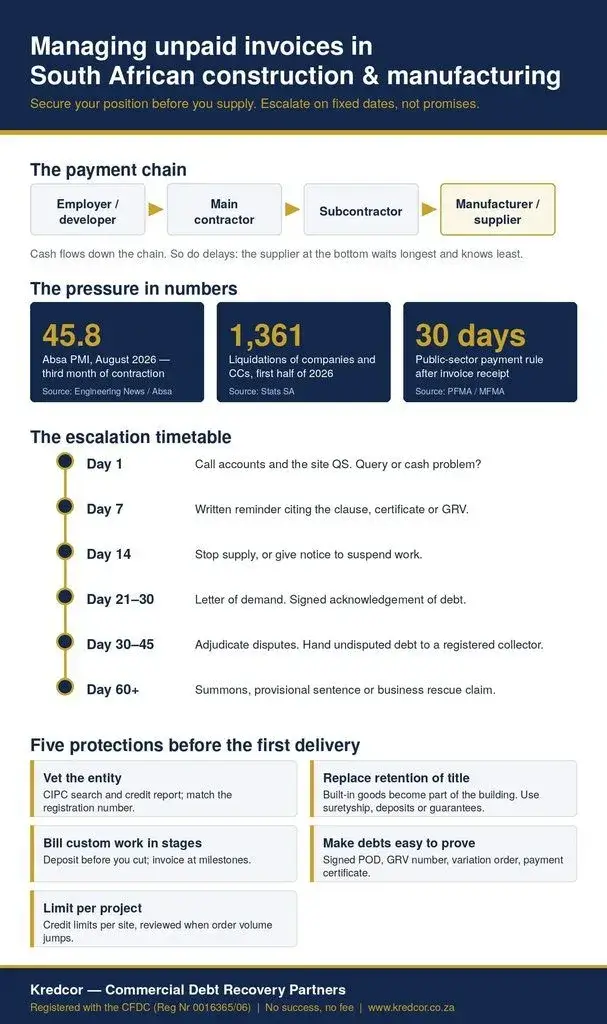
Employer / developer› Main contractor› Subcontractor› Manufacturer / supplier
That structure creates three risks you will not find in most other sectors:
- Your security disappears into someone else’s property. Once bricks, steel, glass or precast units are built into a structure, South African law generally treats them as part of the land. Your retention-of-title clause cannot follow them there.
- Your invoice is not payable until someone else agrees it is. Progress payments usually wait for a certificate. If the certificate is late or reduced, your invoice sits in limbo — and the contractor treats that limbo as a legitimate reason to wait.
- Delay flows downhill. Each party protects its own cash by paying the next party later. The manufacturer at the bottom carries the longest wait and has the least information.
In September 2026, Michelle Kerr of MDA Attorneys described contractors as the “unwitting financier of the construction project”. One step further down the chain, the same is true of the manufacturers who supply them.
The numbers behind the pressure
The operating climate is not helping. The Absa Purchasing Managers’ Index (PMI) fell to 45.8 in August 2026, according to Engineering News’ report on the Absa PMI. That is the third straight month below 50, the line between growth and contraction. New orders sank to just 40.3. When orders fall, manufacturers are tempted to protect volume by stretching credit terms to weaker buyers.
Business failure remains a live risk. Statistics South Africa (Stats SA) recorded 1,361 liquidations in the first half of 2026, broadly flat on the same period in 2025. July’s count of 239 was 23.2% lower year on year. Even so, credit insurer Coface still names construction among the sectors most exposed to insolvency globally, as FAnews reported. A falling national count is welcome. It does not mean your particular debtor is safe.
Our team’s experience on construction-linked accounts is consistent: the supplier that loses money is rarely the one with the worst debtor. It is usually the one with the weakest paperwork. For the retention-money side of the story, see our guide to commercial debt in construction.
What does South African law actually give you?
Less than most suppliers assume. South Africa has no statute that forces private-sector clients to pay construction invoices promptly. Draft prompt-payment and adjudication rules were proposed under the Construction Industry Development Board (CIDB) Act 38 of 2000 about a decade ago. They were later withdrawn over concerns about their constitutional validity. As a result, there is still no system of mandatory statutory adjudication here. In practice, your contract is your prompt-payment law.
The rules that do exist
Here is what the law does give you, and where each piece helps:
- Contractual adjudication. The standard forms used locally — the JBCC (Joint Building Contracts Committee) agreements, NEC, FIDIC and the GCC — almost all contain adjudication clauses. The Supreme Court of Appeal has confirmed that an adjudicator’s decision must be honoured while the final dispute runs its course.
- Public-sector payment rules. Government bodies must pay within 30 days of receiving an invoice. The rule sits in the Treasury Regulations under the Public Finance Management Act (PFMA) and in section 65 of the Municipal Finance Management Act (MFMA). Reality often differs, but the rule gives you a formal basis to escalate.
- The Prescription Act 68 of 1969. Ordinary commercial debts prescribe after three years. A written acknowledgement of debt or the service of a summons interrupts that clock. A letter of demand on its own does not.
- Interest. You may charge the rate your terms specify. If your terms are silent, the Prescribed Rate of Interest Act applies once the debtor is formally in default.
- The National Credit Act (NCA). It rarely applies to trade credit between established companies, because it excludes juristic persons with an asset value or turnover of R1 million or more. A Section 129 default notice — the consumer-credit step the National Credit Regulator (NCR) polices — is therefore seldom required. The exception is the small subcontractor trading in their own name, so check before you skip it.
Before the first delivery: five protections that cost almost nothing
Most recoveries are won or lost before the invoice exists. These five steps take an afternoon to put in place, and they change what you can do on day 60.
Vet the legal entity, not the trading name
Before you open an account, run a Companies and Intellectual Property Commission (CIPC) company search. Add a commercial credit bureau report from TransUnion or Experian, for example. Match the registration number on the credit application to the name on the order. In construction, special-purpose project companies and joint ventures are common, and a strong group name can sit on top of an empty shell.
Replace retention of title where it will not work
Retention of title protects stock that stays identifiable: pallets in a yard, coils in a warehouse. It does not protect cement in a slab or steel in a frame. For site-bound products, ask for something that survives installation — a director’s suretyship, a deposit, a payment guarantee, or a direct-payment undertaking from the employer. If the contractor refuses all of them, price the risk or shorten the terms.
Bill custom work in stages
Made-to-order items such as fabricated steel, precast units, custom joinery and tooling have little resale value if the buyer walks away. Take a deposit before you cut, and invoice at agreed milestones rather than on final delivery.
Make every debt easy to prove
A signed proof of delivery (POD) turns “we dispute it” into a paper argument you can win. So do a goods received voucher (GRV) number, a signed variation order and a payment certificate. A certified amount can often be enforced far faster than an open account. Our explainer on the difference between a liquid document and an illiquid claim shows why that matters once a matter reaches court.
Set credit limits per project, not per customer
A contractor that wins a large tender can triple its orders overnight — exactly when its own cash is thinnest. Tie limits to each site. Review them whenever a debtor’s order volume jumps. Then set an early-warning trigger, so early delinquency management starts on day one, not day 60.
“In this sector, the question isn’t whether your customer is honest. It’s whether the money above them will arrive on time — and what you hold if it doesn’t.”— Kredcor Senior Pre-Legal & Credit Risk Team
The escalation timetable, day by day
Pre-litigation negotiation works best when both sides know the next step and its date. The timetable below suits typical 30-day terms, with separate tracks for construction-side suppliers and for manufacturers. Adjust the days to your own terms — but keep them fixed, and keep them written down.
| When | Contractor or subcontractor | Manufacturer or materials supplier | What it achieves |
|---|---|---|---|
| 5 days before due | Confirm the work is on the next certificate and note the valuation date | Confirm the order and GRV are captured on the buyer’s system | Removes “we never received it” |
| Day 1 overdue | Call the contractor’s accounts team and the site quantity surveyor | Call accounts payable and ask for a specific payment date | Shows whether it is a query or a cash problem |
| Day 7 | Written reminder citing the contract clause and certificate | Written reminder with a statement and a stop-supply warning | Soft collection with a paper trail |
| Day 14 | Notice of intention to suspend work, where the contract allows it | Stop supply on new orders; send a final notice before action | Creates a real consequence |
| Day 21–30 | Letter of demand; offer an acknowledgement of debt (AOD) with an instalment plan | Letter of demand; AOD offer; default listing warning | Converts a promise into a signed, enforceable one |
| Day 30–45 | Refer disputed amounts to adjudication; hand undisputed amounts to a registered collector | Hand over to a registered collector on a contingency basis | Puts specialists on it before the debt goes stale |
| Day 60+ | Summons or provisional sentence on certified amounts; lodge claims in business rescue | Summons; statutory demand where the debtor appears insolvent | Legal enforcement |
Two rules that make the timetable work
First, do not skip a step because the customer is large; large debtors are the ones whose failure hurts most. Second, never keep supplying on open terms while an account sits past day 30. Every extra delivery increases the amount you may never see.
Pay-when-paid, quality disputes and business rescue
When the contractor says, “We haven’t been paid yet”
Pay-when-paid clauses are common in South African subcontracts, and no statute prohibits them. Whether one binds you depends on its exact words. Some clauses only delay payment until a reasonable time after the contractor is paid. Others make payment conditional on the employer paying at all. The difference is huge.
Manufacturers should check a more basic point: you are usually not a party to the subcontract. If you sold on your own terms and conditions, the contractor’s cash-flow problem with its client is not a defence to your invoice. Say so politely, in writing, and early.
When the debt turns into a quality dispute
Disputes over quantities, defects and short deliveries are the most common delay tactic in both sectors. Separate the disputed portion from the rest, and demand the undisputed amount at once. On a construction contract, refer the disputed part to adjudication rather than letting it drift. In manufacturing, your terms should require written quality claims within a fixed number of days after delivery. A complaint raised for the first time on day 75 deserves healthy scepticism.
When the debtor enters business rescue or liquidation
Business rescue under Chapter 6 of the Companies Act 71 of 2008 places a general moratorium on legal action against the company. Submit your claim to the business rescue practitioner promptly and attend the creditors’ meetings. The moratorium protects the company rather than its directors, so a signed suretyship can generally still be pursued.
Now suppose the debtor is insolvent but not in business rescue. If it ignores a formal demand for more than R100 for three weeks, the law presumes it cannot pay its debts. That is a powerful lever. It is never one to pull on a genuinely disputed debt.
Contractors who are still on site have one more tool: a lien over the property they have improved, which may allow them to keep possession until paid. The lien is lost once possession is given up, so take legal advice before you hand over a site on an unpaid account.
A fair objection: “If I push, I lose the next contract”
Many suppliers in these sectors depend on a handful of contractors, and the fear is real. Escalate once, and the next order may go to a competitor. A contractor that is merely slow, not insolvent, may well remember who embarrassed it.
Our view is that the choice is not between silence and aggression. A fixed, predictable timetable applied to every customer is not personal, and serious contractors tend to respect suppliers who run tight credit. The supplier who waits quietly is not protecting the relationship. It is simply volunteering to be paid last.
Troubleshooting: if this happens, try that
- If the quantity surveyor keeps delaying the certificate, ask in writing for the valuation date and the reasons for any reduction. Most standard forms fix a certification period, and a missed period can itself be referred to adjudication.
- If the buyer says your invoice “is not on the system”, resend it with the purchase order number, GRV number and signed POD attached. Then ask for written confirmation of the capture date — it becomes your new due-date anchor.
- If the debtor pays newer invoices but skips the oldest, treat the old invoice as a hidden dispute. Ask what the problem is, fix or reject it in writing, and request a signed AOD for the balance.
- If a director stops answering and the company goes quiet, run a fresh CIPC search and look for a new company with the same directors and a similar name. Director tracing and skip tracing work best when started within weeks, not months.
- If the debtor offers post-dated payments or a verbal plan, accept only a signed AOD with an acceleration clause. It interrupts prescription and gives you a document you can enforce the moment one instalment fails.
- If you are a subcontractor and the employer upstream has stalled, give the notice your subcontract requires before suspending work, and record all standing time. Walking off site without the correct notice can make you the party in breach.
What to do next
Your next question is probably where to start. Sort your debtors’ book by project and by position in the chain, not just by age. An invoice owed by a contractor whose own client is a struggling developer is riskier than an older invoice owed by a well-funded one.
Then look forward. Before your next big order or tender season, update your credit application with suretyship and listing consent, and add a quality-claims deadline to your terms. Tracking days sales outstanding (DSO) per project, not just per customer, will show you which sites are quietly financing someone else. For credit tactics suited to high-volume, low-margin trade, read our guide to manufacturing and wholesale debt.
Frequently asked questions
Can I take my materials back from a construction site if the contractor does not pay?
Usually not once they have been built in. Materials incorporated into a building generally become part of the property, so a retention-of-title clause no longer protects them. Loose materials that are still on site and identifiable may be recoverable if your terms reserve ownership, but act quickly and take legal advice first.
Are pay-when-paid clauses legal in South Africa?
Yes. Unlike the United Kingdom or Australia, South Africa has no statute that prohibits them. Their effect depends on the exact wording. They also bind only the parties who agreed to them, so a supplier selling on its own terms is usually not affected.
How long do I have to claim an unpaid construction or manufacturing invoice?
Most commercial debts prescribe three years after they fall due under the Prescription Act 68 of 1969. A written acknowledgement of debt, a part-payment that acknowledges the debt, or the service of a summons interrupts prescription. A letter of demand on its own does not.
Does the National Credit Act apply to debts between construction and manufacturing companies?
Rarely. The Act does not apply where the debtor is a juristic person with an asset value or annual turnover of R1 million or more at the time of the agreement. Small subcontractors trading in their own names can be an exception, so check the debtor’s legal status before you decide which notices to send.
When should I hand an unpaid invoice to a debt collector?
Once your internal steps have failed and the account is 30 to 45 days overdue, or immediately if you see signs of insolvency. Use a collector registered with the Council for Debt Collectors (CFDC), and ask whether it works on a no-success, no-fee basis.
Quick-action checklist
- Run a CIPC company search and a commercial credit report on your five largest construction-sector debtors this week.
- Flag every open invoice for products that get built into a structure, and decide what security replaces retention of title.
- Add a director’s suretyship, consent to credit bureau listing and a quality-claims deadline to your credit application and terms.
- Write your escalation timetable down with fixed dates, and apply it to every customer — large ones included.
- Get a signed acknowledgement of debt on any account where a payment plan was agreed verbally.
- Diarise the three-year prescription date for every invoice older than 18 months.
Keeping the chain from breaking
Construction and manufacturing will keep running on credit; the chain is too long for anything else. What you control is how exposed you are when one link weakens. If an account has already stalled, experienced debt collectors in South Africa can take over the pre-legal work. Choose a firm that understands certificates, adjudication and site-bound supply, and that works on a no-success, no-fee basis. You keep the customer relationship; the specialists do the chasing.
For more practical guidance on credit control, cash flow and South African debt law, browse the full library of Kredcor articles.
Need help with a stalled construction or manufacturing account?
Kredcor — registered with the CFDC (Reg Nr 0016365/06). No success, no fee.
Call 010 500 4640 or 083 518 0511, or visit www.kredcor.co.za/contact.
About the author: The Kredcor Senior Pre-Legal & Credit Risk Team handles pre-legal commercial recovery for Kredcor Khuluma CC, a B2B debt recovery firm registered with the Council for Debt Collectors (Reg Nr 0016365/06) and operating for more than 26 years across South Africa.
Sources: Prescription Act 68 of 1969; Companies Act 71 of 2008 (Chapter 6) and Companies Act 61 of 1973 (section 345, as preserved for insolvent companies); National Credit Act 34 of 2005 (sections 4 and 129); Public Finance Management Act Treasury Regulations and Municipal Finance Management Act (section 65); Construction Industry Development Board Act 38 of 2000; Statistics South Africa, Economic wrap-up for July 2026; Engineering News on the Absa PMI, 1 September 2026; FAnews on July 2026 liquidations and Coface commentary; Infrastructure News, 9 September 2026 (Michelle Kerr, MDA Attorneys); Cliffe Dekker Hofmeyr on prompt payment regulations; Mayet & Associates on construction adjudication, February 2026.
Disclaimer: This article is general information, not legal or financial advice. Contract wording decides most construction payment questions, so consult a qualified attorney or a registered debt collector about your specific matter.