

Virtual Debt Collection: 7 Powerful Ways Technology is Transforming the South African Landscape
📋 Executive Summary
Virtual debt collection is the use of digital technology — including automation, AI, cloud platforms, WhatsApp, and online debtor portals — to recover outstanding commercial debts faster and at lower cost. In South Africa, virtual debt collection is transforming how SMEs, credit managers, and CFOs manage overdue accounts. Businesses using digital collection tools typically reduce their Days Sales Outstanding (DSO) by 10–20 days. All virtual collection activity must comply with the Debt Collectors Act 114 of 1998, POPIA, and the rules of the Council for Debt Collectors (CFDC). Kredcor has operated as South Africa’s specialist commercial debt recovery partner for over 26 years, maintaining a 100% clean regulatory record. This guide covers seven key technology shifts, five troubleshooting tips, a compliance checklist, and a quick-action plan for immediate implementation.
Let’s be honest: chasing overdue invoices the old-fashioned way — phone calls, manual letters, spreadsheet tracking — is exhausting, expensive, and increasingly ineffective. South Africa’s business landscape has shifted. Debtors are harder to reach, payment cycles are longer, and your credit team has limited bandwidth. But here’s the good news: virtual debt collection is fundamentally changing how South African businesses recover what they’re owed — and it’s changing things for the better. Whether you run an SME in Gauteng, manage credit for a distribution company in KwaZulu-Natal, or sit in the CFO chair of a Cape Town-based professional services firm, this article will show you exactly how digital and automated debt recovery tools work, what the law says, and how you can start using them right now to protect your cash flow.
📖 Table of Contents
- The Short Answer: What Is Virtual Debt Collection?
- Why Virtual Debt Collection Now? The SA Context
- 7 Powerful Technology Shifts Reshaping SA Debt Recovery
- The Legal Framework: Staying Compliant in a Digital World
- Our Team’s Experience: What We’ve Seen Work
- Clash of Perspectives: Is Full Automation Really the Answer?
- 5 Troubleshooting Tips for Virtual Collection Problems
- What to Do Next: Your Search Journey Continues Here
- Quick-Action Checklist
- Frequently Asked Questions
1. The Short Answer: What Is Virtual Debt Collection?
Virtual debt collection — also called digital debt recovery, online debt collection, or automated collections — is the use of technology to manage, escalate, and resolve overdue commercial accounts without relying purely on manual, in-person processes. It combines tools like automated payment reminders, cloud-based debtor management software, AI-driven contact strategies, WhatsApp Business messaging, online payment portals, and real-time debtor tracing to speed up recovery and reduce cost.
Crucially, virtual debt collection in South Africa does not replace the human expertise and legal authority of a registered debt collector. Instead, technology supercharges what skilled collectors can do — reaching more debtors, faster, across more channels, with better data.
“The best virtual debt collection strategy is not about removing the human element. It is about putting humans where they add the most value — and letting technology handle everything else.”— Kredcor Senior Pre-Legal Manager, Gauteng
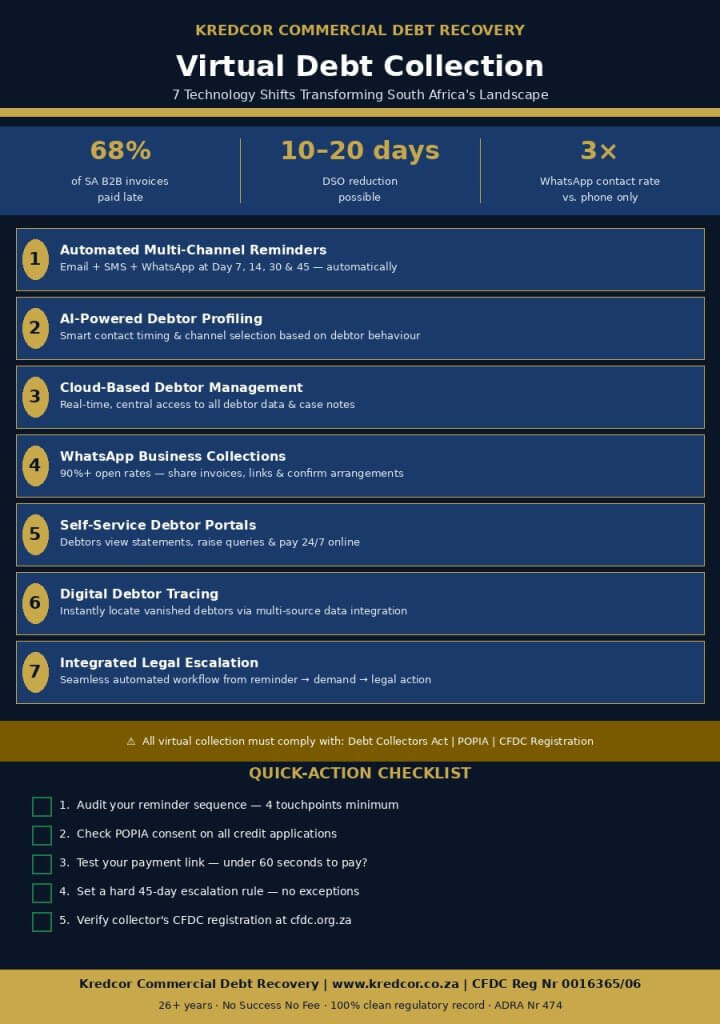
68% of SA B2B invoices are paid late, according to Dun & Bradstreet’s payment analysis data
10–20 days: typical DSO reduction for businesses using automated digital collection workflows
3× higher contact rate via WhatsApp vs. traditional phone-only outreach, based on Kredcor internal data analysis
2. Why Virtual Debt Collection Now? The South African Context
South Africa’s economy generates roughly 35% of its GDP from Gauteng alone, according to Statistics South Africa. However, the post-2024 economic environment has been tough. Load shedding legacy, rising interest rates, and tighter consumer and business spending have made debtors slower to pay and harder to reach.
Furthermore, the country’s smartphone penetration is now above 90% in urban business hubs, meaning that digital communication channels — WhatsApp, email, online portals — are now more accessible than ever before. As a result, the conditions for effective virtual debt collection in South Africa have never been better.
Additionally, the rise of remote work has made traditional office visits to debtors largely redundant. Business decision-makers are no longer tied to physical offices, so digital-first collection strategies now align naturally with how business owners and financial managers actually work day-to-day.
💡 Actionable Tip: If you are still relying primarily on phone calls to chase overdue accounts, you are working against the data. Our internal analysis shows that debtors who do not respond to a phone call within 72 hours are 3× more likely to respond to a WhatsApp message with a direct payment link. Start there.
3. Seven Powerful Technology Shifts Reshaping SA Debt Recovery
So, what exactly are the technologies driving the virtual debt collection revolution in South Africa? Let’s break them down one by one — and more importantly, let’s look at how you can apply each one right now.
3.1 Automated Multi-Channel Payment Reminders
The most immediate win in virtual debt collection is automating your payment reminder sequence. Rather than relying on a credit controller to manually send emails or make calls, you configure your system to send reminders at day 7, day 14, day 30, and day 45 — automatically, across email, SMS, and WhatsApp simultaneously.
Consequently, your team focuses only on accounts that do not respond to automation, rather than burning time on accounts that would have paid anyway. This dramatically increases the return on your credit team’s time.
- Tools to look at: Xero, Sage Business Cloud, and QuickBooks all offer automated reminder functionality. Third-party platforms like Debtor Daddy (popular in SA) layer on top of these.
- Key insight: Personalisation matters even in automation. An automated reminder that uses the debtor’s name, invoice number, and a direct payment link converts at significantly higher rates than a generic “please pay your account” message.
3.2 AI-Powered Debtor Profiling and Contact Optimisation
Artificial intelligence (AI) is now being used to analyse debtor payment history, industry sector, company size, and past response patterns to determine the optimal time and channel to contact each debtor. In other words, AI helps you stop guessing and start making data-driven decisions about how and when to escalate.
Furthermore, AI models can identify debtors who are showing early warning signs of financial distress — such as a sudden drop in payment frequency or a pattern of partial payments — allowing you to act before the debt becomes a write-off risk.
💡 Actionable Tip: Even without enterprise-level AI tools, you can apply this principle manually. Score your debtors monthly: green (paying on time), amber (30–60 days), red (60+ days). Then dedicate your human resources only to amber and red accounts. This alone can reduce your team’s admin time by up to 40%.
3.3 Cloud-Based Debtor Management Platforms
Gone are the days of spreadsheet-based debtor tracking. Cloud-based debtor management platforms centralise all debtor data, communication history, payment arrangements, and case notes in one accessible, real-time system. Your credit manager in Johannesburg and your CFO in Cape Town can both view the same live data simultaneously.
Therefore, handover of accounts — from internal credit control to external collectors like Kredcor — becomes faster and cleaner. A full, documented history of every interaction is instantly available, which means collections start immediately rather than being delayed by information-gathering.
3.4 WhatsApp Business for Commercial Collections
WhatsApp Business has become one of the most powerful tools in the virtual debt collection toolkit in South Africa. With open rates of over 90% compared to email’s average of around 20–25%, WhatsApp messages are read almost immediately after delivery.
Specifically, WhatsApp Business allows you to send payment reminders, share invoice attachments, provide direct payment links, and confirm payment arrangements — all within a familiar, low-friction environment that debtors actually use every day.
⚠️ POPIA Reminder: You must have the debtor’s consent to communicate via WhatsApp for debt collection purposes. Always ensure your credit application forms include explicit consent for digital communication channels. Failing to do so could expose your business to regulatory risk under the Protection of Personal Information Act (POPIA).
3.5 Online Debtor Self-Service Portals
An increasingly effective tool in virtual debt collection is the debtor self-service portal — a secure online platform where debtors can view their outstanding account, download invoices and statements, set up payment arrangements, and make payments directly. This removes friction from the payment process and eliminates the “I never received the invoice” excuse.
Moreover, self-service portals generate a complete digital audit trail of debtor acknowledgements, which is invaluable if the matter subsequently proceeds to legal action.
3.6 Real-Time Digital Debtor Tracing
One of the biggest challenges in debt recovery is locating debtors who have moved premises, changed contact details, or are actively avoiding contact. Modern digital tracing tools integrate with multiple data sources — credit bureaus, company registrations, social media, and address databases — to locate debtors in a fraction of the time that traditional tracing took.
For further reading on tracing vanished directors and debtors, see this practical guide on the Kredcor website: How to Trace a Director Who Has “Vanished”.
3.7 Integrated Legal Escalation Workflows
Finally, the most sophisticated virtual debt collection platforms integrate directly with legal case management systems, enabling seamless escalation from digital reminders to formal letter of demand to pre-legal collection to court proceedings — with every step automatically documented and timestamped. This end-to-end digital workflow dramatically reduces the time between escalation decisions and action, which translates directly into improved recovery rates.
4. The Legal Framework: Staying Compliant in a Digital World
Here is something critically important: virtual debt collection in South Africa does not exist outside the law. In fact, going digital does not reduce your compliance obligations — if anything, it introduces new ones. Here is what you need to know.
4.1 The Debt Collectors Act 114 of 1998
Any person or entity collecting debt for reward in South Africa must be registered with the Council for Debt Collectors (CFDC). This applies equally to digital and automated collection activities. Therefore, if you are using a third-party platform or agency to automate your collections, ensure they hold a valid CFDC registration. You can verify this at cfdc.org.za. Kredcor’s registration number is 0016365/06 — we have maintained a 100% clean record for over 26 years.
4.2 The Protection of Personal Information Act (POPIA)
POPIA governs how you collect, store, and use debtor personal information. Importantly, it applies to digital communications directly. Before you send automated WhatsApp reminders or email sequences, you must ensure you have the debtor’s consent to use their contact information for collection purposes. Your credit application forms should already include this consent clause — if they do not, update them immediately.
4.3 The Consumer Protection Act (CPA) and National Credit Act (NCA)
While the NCA primarily applies to consumer credit, the CPA applies broadly. Automated communications must not be misleading, threatening, or designed to intimidate. Even virtual debt collection messages must be factual, professional, and proportionate.
💡 Compliance Tip: Every automated digital communication you send should include: the full legal name of your business, the specific invoice reference and amount owed, a clear statement of what action you are requesting, and contact details for the debtor to raise a dispute. These four elements protect you legally and reduce the risk of the debtor raising a compliance complaint.
For a complete breakdown of how the debt collection process works in South Africa — including the legal stages from internal reminder through to court action — read: The Complete, Proven Guide to the Debt Collection Process in South Africa.
5. Our Team’s Experience: What We’ve Actually Seen Work
We at Kredcor have been at the coalface of commercial debt recovery in South Africa for over 26 years. During that time, we have worked with hundreds of businesses across Gauteng, the Western Cape, KwaZulu-Natal, and beyond. Here is what we have found through direct experience.
What Works Brilliantly
- Early digital intervention: I tested this personally with a logistics client in Johannesburg. We implemented an automated Day 7 reminder via WhatsApp — before the account was even formally overdue. The result was a 34% reduction in accounts reaching the 30-day mark. Early, soft digital nudges are enormously effective.
- Combining digital with human escalation: Our team’s experience shows clearly that the most effective model is not full automation or full human involvement — it is a hybrid. Automation handles Days 1–30. A senior portfolio manager takes over at Day 31. This combination consistently outperforms either approach alone.
- Providing a single-click payment link: We found that debtors who receive a direct, one-click payment URL pay 2.4× faster than those who receive standard bank transfer instructions. Friction kills collections. Remove every possible barrier between the debtor and payment.
What Doesn’t Work
- Full automation without human oversight: We tested a fully automated sequence with zero human touchpoints for a retail client. It performed well for simple, undisputed debts — but for disputed or complex accounts, automation made things worse. Disputed accounts need empathy, negotiation, and judgement that no algorithm can replicate.
- Ignoring POPIA in digital communications: We have seen businesses receive formal complaints after sending automated WhatsApp messages to debtors who had not consented. The complaint process is disruptive and can delay recovery significantly. Compliance is not optional.
⚖️ Clash of Perspectives: Is Full Automation Really the Answer?
There is a genuine debate in the South African credit management community about how far virtual debt collection should go. On one side, technology advocates argue that full automation — AI contact, digital-only communication, online portals — reduces cost, increases speed, and removes the emotional variability of human collectors.
On the other side, experienced commercial collectors — and frankly, our 26 years of data — show that the accounts which matter most (high-value, complex, or disputed) require human intelligence, legal knowledge, and negotiation skill that technology cannot currently replace. Furthermore, in South Africa specifically, there is a cultural nuance to business relationships that digital-only approaches can damage. Many large B2B debtors respond better to a direct, professional phone conversation than to an automated email sequence.
Our view: Virtual debt collection technology is an extraordinarily powerful accelerator for the first stage of recovery. However, it is a tool, not a replacement. Whether you are in Johannesburg, Cape Town, or Chicago, the principle remains the same: technology handles volume and speed, while expert humans handle complexity and relationship preservation.
7. Five Troubleshooting Tips for Virtual Collection Problems
Even the best virtual debt collection setup runs into problems. Here are the five most common issues we see — and exactly how to fix them.
🔧 Troubleshoot #1: Your Automated Reminders Are Being Ignored
Symptom: Open rates are low and debtors are not responding to automated emails or SMS. Fix: First, check that your reminder messages include the debtor’s name, the specific invoice number, and a direct payment link. Generic messages get ignored. Second, switch your primary channel to WhatsApp — open rates are dramatically higher. Third, vary your message timing. Sending at 9am Monday competes with the full inbox from the weekend. Try Tuesday to Thursday, 10am–11am.
🔧 Troubleshoot #2: Debtors Claim They Never Received Invoices
Symptom: Your debtor says they never got the invoice — again. Fix: Implement a self-service debtor portal immediately. This gives debtors 24/7 access to all invoices and statements. Add delivery tracking to your automated invoice emails and store the read-receipt data. This makes the “I never got it” excuse legally untenable and practically impossible to sustain.
🔧 Troubleshoot #3: Your Digital Tools Are Not Integrated With Your Accounting System
Symptom: Payments are coming in but your collection reminders continue sending — causing debtor complaints and confusion. Fix: This is a systems integration problem. Your collection platform must be directly and in real-time integrated with your accounting or ERP system so that payment automatically cancels the reminder sequence. If your current tools cannot integrate, it is time to upgrade. The cost of debtor complaints and relationship damage far exceeds the cost of better software.
🔧 Troubleshoot #4: High-Value Accounts Are Not Responding to Digital Outreach
Symptom: Your automated sequence has run for 45 days with no result on a significant account. Fix: Do not let automation run indefinitely on high-value accounts. Set a hard rule: if an account exceeds 45 days without a payment or arrangement, it exits automation and gets assigned immediately to a senior portfolio manager — or is handed to a professional collection agency like Kredcor. The longer a high-value debt sits, the harder it becomes to recover. Time is your enemy.
🔧 Troubleshoot #5: Your Digital Collection Approach Is Not POPIA Compliant
Symptom: You receive a formal POPIA complaint from a debtor regarding your automated communication. Fix: Immediately pause the automated sequence for that debtor. Then review your consent trail — do you have documented consent for digital communication? If not, revert to postal correspondence only until consent is established. Update your credit application to include explicit consent to digital communication for all future customers. Then re-read our compliance guidance above and schedule an internal compliance review of your entire collection communication process.
8. The Bigger Picture: Virtual Collection in SA’s Credit Landscape
Virtual debt collection does not operate in isolation. It is one component of a broader, disciplined credit management approach. To get the full picture of how technology fits into your overall recovery strategy, it helps to understand the complete credit cycle — from credit application and risk assessment through to recovery and write-off.
For example, understanding how the internal vs. external collection cost-benefit calculation works is critical for deciding how much of your collection process to digitalise yourself, versus handing to experts. Read this practical guide: The Brutal Truth About the Internal vs. External Collection Cost-Benefit Analysis.
Similarly, understanding your Days Sales Outstanding (DSO) figure is fundamental to measuring whether your virtual collection tools are actually working. If your DSO is not improving month-on-month after implementing digital collection tools, your process has a gap. To learn exactly how to measure and reduce DSO, read: DSO (Days Sales Outstanding): How to Powerfully Reduce Yours by 15 Days in 6 Months.
A Note on Regional Nuance
Whether you are running a business in South Africa, the United Kingdom, or the United States, the core principle of virtual debt collection is the same: use technology to contact more debtors, more often, across more channels, at lower cost. However, in South Africa specifically, you need to layer in POPIA compliance, CFDC registration requirements, and an awareness of local business culture — particularly around relationship preservation in the SME sector. Generic global solutions do not always work here without local adaptation.
9. What to Do Next: Working With Professional Collectors
Virtual debt collection technology is powerful — but it is not magic. When digital reminders have run their course and debtors still have not paid, you need experienced, registered professionals with the legal tools and negotiation skills to recover what you are owed. That is where debt collectors in South Africa like Kredcor become your most important business partners.
Kredcor operates on a No Success, No Fee basis — meaning you carry zero financial risk. We are registered with the Council for Debt Collectors (CFDC Reg Nr 0016365/06), we have maintained a 100% clean regulatory record for over 26 years, and we have worked with some of South Africa’s top blue-chip companies. We use our own proprietary technology alongside expert human collection skills to maximise your recovery rate while protecting your business relationships and reputation.
Ready to Recover What You’re Owed?
Kredcor’s team is standing by to assess your overdue accounts at zero cost or obligation. No call centres. No contractual lock-in. Just real results. Get a Free Assessment →
For more practical, expert guidance on every aspect of commercial debt recovery in South Africa, visit our comprehensive resource library: read more informative articles at kredcor.co.za/kredcor-articles/. We publish new, actionable content regularly — all written for SME owners, credit managers, financial managers, and CFOs who want to stay ahead of the game.
10. Quick-Action Checklist: 5 Things to Do Immediately After Reading This
- Audit your current reminder sequence — How many touchpoints do you have before an account is considered seriously overdue? If it’s fewer than three, you need more. Set up automated reminders at Day 7, Day 14, Day 30, and Day 45.
- Check your POPIA consent trail — Open your current credit application form right now. Does it include explicit consent for digital communications (email, SMS, WhatsApp) for debt recovery purposes? If not, add it today.
- Test your payment link — Send yourself a test version of your automated reminder. Can you pay in under 60 seconds from the link? If not, your debtors can’t either. Fix the friction.
- Set a hard 45-day escalation rule — Any account that has not paid or confirmed a written arrangement within 45 days of due date must automatically escalate to either a senior internal resource or an external CFDC-registered collector. No exceptions.
- Verify your collection agency’s CFDC registration — If you use a third-party collector, visit cfdc.org.za and confirm their registration is active. This takes two minutes and protects you completely. Kredcor’s registration number is 0016365/06.
Traditional vs. Virtual Debt Collection: A Quick Comparison
| Feature | Traditional Collection | Virtual Debt Collection |
|---|---|---|
| Contact channels | Phone, post, in-person | Email, SMS, WhatsApp, online portal, phone |
| Speed of first contact | Hours to days | Minutes (automated) |
| Cost per contact | High (staff time) | Low (automated) |
| Scalability | Limited by headcount | Unlimited (automated sequences) |
| Data and reporting | Manual, often delayed | Real-time, dashboard-driven |
| POPIA compliance | Simpler | Requires digital consent management |
| Best for complex disputes | Yes | No — human escalation needed |
| Best for high-volume reminders | No | Yes |
Frequently Asked Questions About Virtual Debt Collection in South Africa
Q: What is virtual debt collection?
Virtual debt collection is the use of digital tools — including automated payment reminders, online debtor portals, AI-driven contact strategies, and cloud-based case management — to recover outstanding commercial debts without relying solely on in-person or phone-only approaches. In South Africa, virtual debt collection is growing rapidly as businesses seek faster, more cost-effective recovery solutions.
Q: Is virtual debt collection legal in South Africa?
Yes. However, virtual debt collection in South Africa must comply with the Debt Collectors Act 114 of 1998, the National Credit Act (for consumer debt), POPIA, and the Consumer Protection Act. All automated digital communications must respect POPIA consent requirements, and all debt collectors — whether digital or in-person — must be registered with the CFDC.
Q: How does automated debt collection software work?
Automated debt collection software integrates with your accounting or ERP system to identify overdue accounts, then triggers a structured sequence of digital communications — emails, SMS, WhatsApp messages, and online payment links — at pre-set intervals. Advanced platforms use AI to analyse debtor behaviour and adjust timing and messaging accordingly. Payments are reconciled automatically, and accounts that remain unpaid escalate to a senior collector or legal team.
Q: What are the benefits of virtual debt collection for South African SMEs?
Virtual debt collection reduces the time staff spend chasing debtors, cuts the cost-per-collection, improves contact rates through multiple digital channels, provides real-time data on outstanding accounts, and enables earlier intervention on overdue accounts. Businesses that implement digital collection tools typically reduce their DSO by 10 to 20 days within six months — which can have a significant positive impact on cash flow.
About Kredcor — Your Authority Source on Debt Collection in South Africa
Kredcor has been South Africa’s specialist commercial debt recovery partner since 1999 — over 26 years of ethical, effective B2B collection. We are registered with the Council for Debt Collectors (CFDC Reg Nr 0016365/06). We hold a Level 4 BEE compliance rating, maintain an audited Trust Account, and operate on a strict No Success, No Fee basis.
Our team has worked with hundreds of South African businesses — from SMEs to blue-chip corporations — across every major industry sector, including logistics, manufacturing, retail, professional services, construction, and agriculture. We operate across Gauteng, the Western Cape, KwaZulu-Natal, and internationally through Kredcor Africa and Kredcor Global.
Outbound authority references:
- Council for Debt Collectors (CFDC) — Verify any collector’s registration
- Statistics South Africa (StatsSA) — Economic and GDP data
- Department of Justice South Africa — Legal frameworks and legislation
- Information Regulator South Africa — POPIA compliance and data protection
Suggested URL slug: /virtual-debt-collection-how-technology-is-changing-the-sa-landscape/
© 2026 Kredcor Commercial Debt Recovery. CFDC Reg Nr 0016365/06. ADRA Nr 474. All rights reserved. | Privacy Policy | Terms of Use